Home Blog Page 90

Why the Australian Open Plays Differently From the US Open

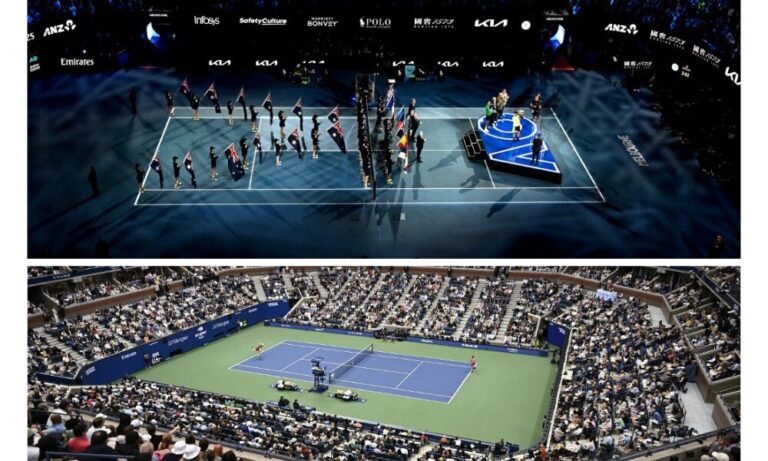
Both the Australian Open and the US Open are played on hard courts, so you’d be forgiven for thinking they play pretty much the same. They don’t. From the surface under players’ feet to the air temperature, the balls, the crowd, and the scheduling, the two tournaments offer very different experiences — on and off the court.

The Same Surface, But Not Really

The most common misconception about these two Grand Slams is that because both are played on hard courts, they must play the same way. In reality, the surfaces at Melbourne Park and Flushing Meadows are quite different products that behave very differently in play.

The Australian Open is played on GreenSet (which replaced Plexicushion when the AO switched suppliers in 2020), classified by the ITF as a Category 4 (Medium Fast) surface. The US Open uses Laykold (introduced in 2020, replacing the long-running DecoTurf that had been the New York surface since 1978), tuned each year for the tournament to a specific Court Pace Rating.

The ITF Court Pace Classification rates surfaces on a 1-to-5 scale — 1 (Slow), 2 (Medium Slow), 3 (Medium), 4 (Medium Fast), 5 (Fast) — but the rating only gives a broad bracket. Within those brackets, tournaments can dial in specific Court Pace Rating numbers year-to-year, and both the Australian Open and US Open adjust their surface formulations between editions. The popular conventional wisdom that the AO plays faster than the US Open has held over most of the past decade, although the US Open has been incrementally speeding up its surface in recent years.

In practical terms, the ball travels faster and stays lower at the Australian Open, while the US Open surface tends to generate slightly more bounce and gives heavy topspin players marginally more time to work with. Serve-and-volley players and big hitters tend to enjoy Melbourne, while grinders who rely on high-bouncing topspin can sometimes exploit the New York surface more effectively. It’s part of why certain players consistently perform better at one tournament than the other, even though both are nominally “hard court” events.

Heat vs. Humidity

Both tournaments have a weather problem, but they’re completely different problems.

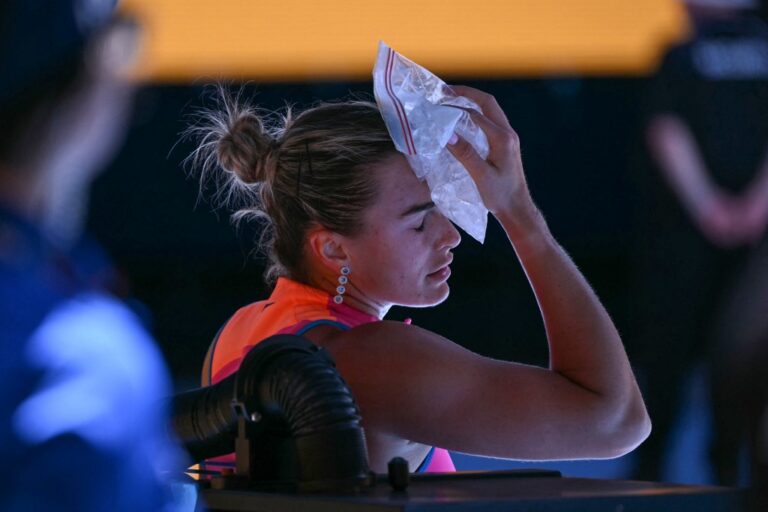
The Australian Open contends with extreme dry heat. January in Melbourne can push temperatures above 40°C (104°F), and the tournament operates a formal Extreme Heat Policy — a 1-to-5 Heat Stress Scale — that can suspend play on outside courts when conditions become dangerous.

The heat affects not only how players feel physically, but also how the ball behaves: hot air causes the gas inside the ball to expand, making it bounce higher and travel faster.

The US Open, held in late August and early September, deals with a different beast: humidity. New York’s late-summer air is thick and oppressive, and while temperatures rarely match Melbourne’s extremes, the humidity makes matches feel brutally exhausting in a different way.

The US Open also has its own heat rule — a 10-minute break between the second and third sets in women’s matches and between the third and fourth sets in men’s matches — but it operates without anything as systematic or technologically advanced as the AO’s Heat Stress Scale.

And as temperatures drop during New York’s evening sessions, the ball behaves differently too: cooler air causes the gas inside the ball to contract, producing a lower, flatter bounce than the same ball on the same court would produce in the afternoon heat.

The Ball Itself

Both tournaments use Wilson balls, but the specific ball types used at each event are calibrated differently to suit the surface and conditions. Ball choice has a meaningful effect on pace and spin, and players who’ve competed at both tournaments have noted how differently each ball plays — even when they look almost identical in the hand.

The Australian Open has long had issues with balls “fluffing up” over the course of a match in the Melbourne heat, which further slows the ball and can change the feel of a match as it progresses.

Scheduling and Night Sessions

Both tournaments run day and night sessions, but they have distinct characters.

The US Open night session is one of tennis’s most iconic settings. Matches under the lights of Arthur Ashe Stadium — the biggest tennis stadium in the world, with over 23,700 seats — attract some of the loudest, most energetic crowds in the sport. Night sessions in New York often stretch deep into the night, and the atmosphere is electric in a way that’s unique to New York City.

The Australian Open has wrestled with its own scheduling issues around night sessions. The combination of evening matches that run late and the Melbourne time zone — which puts it in prime daytime viewing slots across Asia and Europe — has sometimes resulted in matches finishing in the early hours of the morning.

A notorious 2023 match between Andy Murray and Thanasi Kokkinakis ended at 4:05am local time. From 2024, the AO restructured its scheduling to reduce this problem, cutting the number of day-session matches on the main courts to avoid pushing night matches so late. For a deeper read on how the AO night session works and its evolving scheduling debate, see Australian Open Night Sessions Explained.

Venue Size and Crowd Culture

The venues are strikingly different in scale and atmosphere. Arthur Ashe Stadium, the US Open’s main court, holds over 23,700 spectators — making it the largest tennis stadium in the world.

Rod Laver Arena at Melbourne Park holds around 15,000. The energy at Arthur Ashe is notoriously intense and vocal; the New York crowd is famous for its noise, opinionated reactions, and willingness to get involved in the match.

Melbourne crowds tend to be more relaxed — in keeping with Australia’s reputation for laid-back sporting culture — but that doesn’t mean they’re quiet. The Australian Open has consistently broken Grand Slam attendance records in recent years, drawing over 1.2 million visitors across the 2025 tournament.

The grounds-pass culture at Melbourne Park means large, festive crowds fill the precinct all day, creating an atmosphere that’s more festival-like than the stadium-centric experience of Flushing Meadows. Three retractable roofs at Melbourne Park (vs. one at the US Open’s Arthur Ashe Stadium) also give the AO more flexibility to manage weather and lighting conditions across multiple courts simultaneously.

Position in the Season

The timing of each tournament shapes how it plays out in ways that go beyond the calendar.

The Australian Open is the first Grand Slam of the year, held in January. Players arrive after an off-season break, which means some are in peak physical condition while others are still finding their rhythm.

For players who’ve spent the off-season training hard, the Australian Open can be the tournament where they make a big statement. For those still getting match-sharp, early exits are common.

The US Open is the final Grand Slam of the year, held in late August and early September. By this point, players have been on tour for months.

Fatigue, injuries, and accumulated wear can be factors — but so can peak form, as the hard court swing preceding the US Open (including major events in Cincinnati and Montreal) gives players extensive match practice.

The title also carries a season-closing significance that the Australian Open, as the opener, simply cannot replicate.

Prize Money

Both tournaments offer some of the largest prize pools in sport, with equal pay for men and women in singles. The US Open set a record in 2024 with a $75 million total prize pool, the largest in tennis history at the time.

The Australian Open’s 2026 prize pool stands at A$111.5 million — equivalent to roughly US$75 million — reflecting the tournament’s rapid growth in financial stature over the past decade. The 2026 figure represents more than a tripling of the prize money offered just ten years earlier, and was the first time the AO crossed the nine-figure threshold in Australian dollars.

Frequently Asked Questions

Is the Australian Open or US Open faster? The Australian Open’s GreenSet surface is generally rated faster than the US Open’s Laykold — historically classified by the ITF as Medium Fast (Category 4) compared to the US Open’s Medium Slow (Category 2). However, both tournaments tune their surfaces each year, and the US Open has been incrementally speeding up its court in recent editions, so the gap can vary tournament to tournament.

What surface does the Australian Open use? GreenSet, a cushioned acrylic hard court applied by GreenSet Worldwide since 2020. It replaced Plexicushion Prestige (used 2008–2019), which itself replaced Rebound Ace (used 1988–2007).

What surface does the US Open use? Laykold Cushion Plus, a cushioned acrylic hard court applied by Advanced Polymer Technology since 2020. It replaced DecoTurf, which had been the US Open surface from 1978 onward.

Do both tournaments use the same balls? Both use Wilson tennis balls, but the specific ball models are calibrated differently to suit each tournament’s surface, climate, and conditions. Players regularly comment on how differently the two balls play, even when they look identical.

Which tournament has the bigger stadium? The US Open’s Arthur Ashe Stadium is the largest tennis stadium in the world, with over 23,700 seats. The Australian Open’s Rod Laver Arena holds around 15,000 — but Melbourne Park as a whole accommodates more than 40,000 spectators across its 35 outdoor courts and three roofed arenas.

Which Slam has more attendees? The Australian Open consistently leads on total attendance, drawing over 1.2 million visitors in 2025 — the highest of any Grand Slam. The US Open also draws large crowds, but Melbourne Park’s grounds-pass culture and larger precinct footprint allow it to host more fans across the tournament fortnight.

Why does the heat affect each tournament differently? Melbourne’s January summer is characterised by extreme dry heat, sometimes exceeding 40°C (104°F) in radiant sun. New York’s late summer features humidity rather than peak temperatures — usually milder in absolute terms but oppressive in feel, with thick air that affects player stamina. The two climates produce different tactical and medical responses on court.

Is the Australian Open or US Open older? The US Open is significantly older. It was first played as the US National Championships in 1881, more than two decades before the first Australian Championships in 1905. The US Open also has older history in its current form, dating to 1968 (Open Era) at Flushing Meadows. The Australian Open didn’t move to its modern home at Melbourne Park until 1988.

The Bottom Line

Calling the Australian Open and US Open “the same kind of tournament” because both are played on hard courts is a bit like saying two restaurants serve the same food because both have kitchens.

The surface speed, the weather, the ball behaviour, the crowds, the scheduling, and the position in the season all combine to make each tournament a genuinely distinct test. Players know it, and so do the tacticians who prepare them.

The hard court Slams may share a surface category, but they demand very different things from the people who want to win them.
How the Australian Open Heat Rules Work

Every January, Melbourne’s scorching summer heat turns the Australian Open into a battle not just between opponents, but against the elements. Here’s everything you need to know about how tournament officials protect players when temperatures soar.

Why the Heat Rules Exist

The Australian Open is held in Melbourne every January, right in the heart of the Southern Hemisphere summer. While Melbourne is generally cooler than cities further north, extreme heat events are a regular feature of the tournament.

The heat policy was first formally invoked during the 1997 quarterfinals, and over the decades that followed, officials continued refining the rules in response to dangerous conditions on court.

The most significant turning point came in 2014, when four consecutive days of temperatures between 41.5°C and 43.9°C (107–111°F) caused a record nine first-round retirements.

Players suffered from heat-related illness, and ball kids and spectators were also affected. That controversy accelerated a complete overhaul of the policy, leading to the modern system in use today.

The Heat Stress Scale: A 1-to-5 System

In 2019, the Australian Open introduced the AO Heat Stress Scale (AO HSS), replacing earlier temperature-threshold systems with a more comprehensive and scientifically grounded approach. Rather than relying on air temperature alone, the scale combines four climate factors that together determine how much stress the human body is under:

  • Air temperature (measured in the shade)
  • Radiant heat (the intensity of direct sunlight)
  • Relative humidity
  • Wind speed

These factors are continuously monitored across Melbourne Park throughout the tournament day. The resulting score — ranging from 1 to 5 — determines what action tournament officials must take.

What Each Level Means

Level 1 — Temperate conditions Play proceeds normally with no special interventions required.

Level 2 — Moderate heat stress Standard monitoring continues. Players are advised to stay well hydrated before and during their matches.

Level 3 — Elevated heat stress Players are encouraged to increase hydration and use active cooling strategies such as ice towels, cooling vests, and fans during changeovers.

Level 4 — High heat stress The Tournament Referee gains discretion to offer extended breaks between sets — 10 minutes for men’s and women’s singles, and 15 minutes for wheelchair singles. These breaks allow players to recover, cool down, and rehydrate under supervision.

Level 5 — Extreme heat stress (play suspended) When the scale reaches 5, the Tournament Referee suspends the start of new matches on outside courts. For matches already underway, play is paused at the next natural break point before being stopped. The retractable roofs on Rod Laver Arena, Margaret Court Arena, and John Cain Arena are closed to provide climate-controlled conditions.

Who Makes the Call?

The Tournament Referee holds ultimate authority over invoking the Extreme Heat Policy. They consult real-time Heat Stress Scale data measured across multiple points within the Melbourne Park precinct and assess whether conditions warrant intervention.

Importantly, the scale is not just about the air temperature reading — a day that feels “just hot” to spectators can still register a dangerous level on the scale if humidity is high or radiant heat from the sun is intense.

Tennis Australia’s Chief Medical Officer plays a key advisory role, providing guidance based on the latest sports medicine research into heat tolerance, sweat rates, and core body temperature management.

Does the Heat Policy Apply to All Players Equally?

Not entirely. The system accounts for physiological differences between player groups. Wheelchair athletes, for example, have limited ability to regulate body temperature compared to able-bodied players, so their thresholds for intervention are adjusted accordingly. Junior players are also given different considerations, given that younger athletes may be more vulnerable to heat-related illness.

A Brief History of the Rules

The heat policy has been revised multiple times as organisers responded to real-world events and advances in sports science:

  • 1997: Heat rule first invoked at the tournament (quarterfinal round).
  • 1998: Formal policy introduced; play halted if air temperature reached 40°C (104°F).
  • 2003: Threshold lowered to 35°C (95°F), with the Wet-Bulb Globe Temperature (WBGT) introduced as an additional measure.
  • 2014: Deadly heat across four days exposed weaknesses in the policy; nine players retired in round one alone.
  • 2015: WBGT threshold raised to 32.5°C to allow more play in dry heat; critics argued the change prioritised broadcast scheduling over player safety.
  • 2019: The current AO Heat Stress Scale introduced, combining air temperature, radiant heat, humidity, and wind speed into a unified 1–5 rating system.

The ATP’s New 2026 Heat Rule

Effective from the 2026 season, the ATP Board approved a structured heat rule for men’s tour-level singles matches, finally bringing the men’s tour into line with the WTA — which has had a heat rule in place since 1992. The new rule applies to ATP best-of-three singles matches and is based on the Wet-Bulb Globe Temperature index.

The rule introduces two specific thresholds. When the WBGT reaches 30.1°C or higher during either of the first two sets, a 10-minute cooling break may be requested by either player after the second set, applying to both players. During the break, players may use cooling measures, change clothing, shower, hydrate, and receive coaching under the supervision of ATP medical staff.

When the WBGT exceeds 32.2°C, play is suspended entirely until conditions improve.

The new rule came in response to a series of brutal matches at the 2025 Shanghai Masters, where humidity exceeded 80 percent for consecutive days. Defending champion Jannik Sinner stopped a match due to severe leg cramps, Novak Djokovic was visibly ill on court during a victory, and several players retired or required medical intervention. The ATP Board moved within weeks of the tournament to formalise a tour-wide policy.

Importantly, the new ATP rule does not apply to the four Grand Slams, which retain their own independently developed heat policies. The Australian Open continues to use its 1-to-5 Heat Stress Scale, the US Open and Roland Garros use their own WBGT-style guidance, and Wimbledon — where heat is rarely the dominant climate issue — has lighter provisions in place.

The Role of the Retractable Roofs

One of the Australian Open’s greatest assets in managing extreme heat is the retractable roofs on its three main stadiums: Rod Laver Arena, Margaret Court Arena, and John Cain Arena — making Melbourne Park the only Grand Slam venue with three retractable roofs. When the heat policy is triggered, the roofs can be closed and the arenas air-conditioned, creating substantially cooler conditions for players and spectators alike.

Courts without roofs — the outer and show courts where many early-round matches are played — have no such protection. When the Heat Stress Scale hits Level 5, no new matches are started on those courts, and any match in progress is halted at the next available break point.

How the Heat Rules Affect Match Play

Beyond the formal scale thresholds, hot weather affects how the Australian Open plays in ways that ripple through every match. Hot air expands the gas inside tennis balls, making them fly faster and bounce higher than the same ball would on a cool evening. The GreenSet surface absorbs and radiates heat across the court itself, which can affect player footwork and recovery between points.

Night sessions at Rod Laver Arena, when the roof can be closed and the air conditioning engaged, often play in conditions completely different from the day-session matches earlier — and those differences show up clearly in match statistics across multiple AO tournaments.

Frequently Asked Questions

What is the AO Heat Stress Scale? It’s a 1-to-5 rating system the Australian Open uses to measure heat stress on court. The scale combines four factors — air temperature, radiant heat from the sun, humidity, and wind speed — into a single number. Each level triggers specific actions, from standard monitoring at Level 1 to suspended play at Level 5.

At what temperature does play get suspended at the Australian Open? There is no single temperature threshold. Play on outside courts is suspended when the AO Heat Stress Scale reaches Level 5 — the determination is based on the combined climate metrics, not just air temperature. On a humid day, the scale can reach Level 5 even when the air temperature is below extreme.

Who decides if play continues during extreme heat? The Tournament Referee, working with Tennis Australia’s Chief Medical Officer and using real-time data from the Heat Stress Scale measured across multiple points in Melbourne Park.

What is the 2026 ATP heat rule and how does it differ from the Australian Open’s? The ATP’s 2026 heat rule applies to ATP tour-level events and uses Wet-Bulb Globe Temperature to trigger cooling breaks (at 30.1°C) and match suspension (at 32.2°C) in best-of-three singles. The Australian Open is a Grand Slam, governed by its own AO Heat Stress Scale, and is not bound by the ATP’s policy. The two systems coexist independently.

Has the heat rule actually saved players? Records of injury reduction are hard to attribute to any single policy change, but the post-2014 overhaul did eliminate the worst single-day retirement counts the tournament had recorded. Tennis Australia continues to revise the policy in response to real conditions and player feedback.

Do the heat rules apply to all players the same way? No. Wheelchair athletes have lower thresholds for intervention because their ability to regulate body temperature is reduced. Junior players also receive adjusted considerations. Able-bodied professional players follow the standard 1-to-5 scale.

Can players use the heat rules tactically? The rule structure is designed to make tactical use difficult. Cooling breaks at Level 4 apply to both players in a match, are time-limited, and are supervised. Some critics have argued that the scale itself can be invoked strategically when conditions are borderline, but the Tournament Referee retains final discretion.

The Bottom Line

The Australian Open’s Extreme Heat Policy is among the most sophisticated in professional sport, combining real-time environmental monitoring with medically informed thresholds. It has evolved significantly over the decades, driven by hard lessons learned during some of the tournament’s most gruelling days — and the ATP’s 2026 catch-up policy reflects the broader recognition that heat management is no longer optional in modern tennis.

While the policy cannot eliminate the challenge of playing tennis in a Melbourne summer, it ensures that when conditions become truly dangerous, player health comes first.

Djokovic believes Alcaraz has everything needed to keep rolling

0

Novak Djokovic watched Carlos Alcaraz stretch his perfect 2026 season to 13 straight wins on Saturday and delivered a clear message: the 22-year-old Spaniard has the game, the adaptability and the fitness to make that run last a long time.

Alcaraz needed just 66 minutes to dismiss Grigor Dimitrov 6-2, 6-3 in the second round of the BNP Paribas Open. The victory followed titles at the Australian Open and the ATP Qatar Open and pushed the world number one’s unbeaten record this year to 13-0.

Before the tournament started, Alcaraz admitted that reaching a dozen consecutive wins had already opened his eyes to how tough Djokovic’s famous 41-match streak from the start of 2011 really was.

Djokovic, who opened his own campaign here with a gritty three-set comeback against Kamil Majchrzak, had no hesitation when asked if Alcaraz could keep winning.

“He can do it,” Djokovic said. “He has everything that you need to have in terms of the game, in terms of the adaptability to different surfaces, and level of fitness and recovery that he has shown and matured over the years.”

The Serbian added a simple condition. “He needs to keep his body healthy. If he keeps his body healthy, I mean, he’s so good that he can win any tournament he plays in.”

Djokovic knows exactly what riding a long winning streak feels like. In 2011 he began the year by winning his first 41 matches, a run that included three Grand Slam titles and set a benchmark that still stands. Speaking after his second-round win, he recalled the growing confidence that came with every victory.

“It’s demanding,” he said. “But at the same time, when you are winning so much and you’re riding that wave, you don’t want to let go. You want to surf on that wave as long as you can, because the level of confidence is really high.”

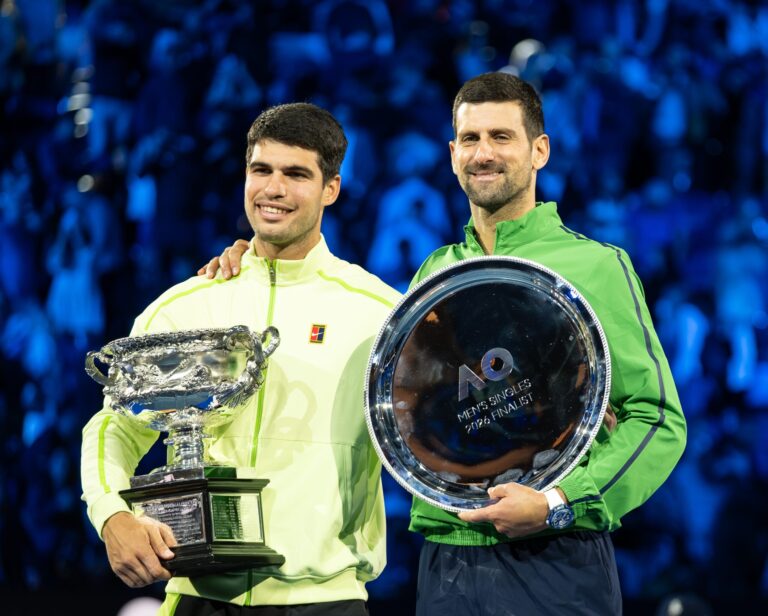
Alcaraz already owns one significant victory over Djokovic this season. He beat the 24-time Grand Slam champion in the Australian Open final to claim his fourth major title and become the youngest man in history to complete a career Grand Slam.

That result left their head-to-head record tied at 5-5 and set up the possibility of another meeting here in the semi-finals. Djokovic made it clear he respects what the Spaniard is doing.

“I wish him more victories,” he said. “I think he’s great for our sport, and what he’s been doing is remarkable.”

Alcaraz’s current form has drawn attention across the tour. After the Australian Open he collected the Doha title without dropping a set, then arrived in California carrying the kind of momentum that forces every opponent to raise their level.

Saturday’s match against Dimitrov offered another example of that control. The Bulgarian managed only five games and never threatened to break serve.

Djokovic’s own path through the early rounds has been less straightforward. He dropped the first set against Majchrzak before steadying himself to win 4-6, 6-1, 6-2. The 38-year-old has not played a competitive match since the Australian Open and admitted the rust showed early. Still, reaching the third round keeps him on course for a potential clash with Alcaraz later in the week.

The two players have split their last ten meetings, with Alcaraz winning the most recent four, including the 2025 Wimbledon final and this year’s Melbourne decider. Djokovic, a five-time Indian Wells champion, knows the desert courts well and will need his best tennis if the draw aligns for a semi-final showdown.

For now, the focus remains on Alcaraz’s streak. The young Spaniard has spoken openly about the mental challenge of chasing long winning runs, yet his results show no sign of slowing down. Djokovic, who has seen every kind of peak and dip across two decades at the top, believes the only real limit is staying injury-free.

The Serbian’s praise carries extra weight because he set the standard himself. His 41-match streak in 2011 remains the record for the Open Era start to a season. Alcaraz sits at 13 and would need to win the entire Indian Wells and Miami double to get close, but the tools are there, as Djokovic pointed out.

“He’s been doing some historic things in our sport for such a young age,” Djokovic added in his assessment.

Saturday’s results left both players through to the third round, with Alcaraz continuing to look untouchable and Djokovic grinding out the kind of tough win that has defined his career.

Whether the streak reaches further will depend on health, focus and the opponents who line up against the world number one. For the moment, one of the greatest players the game has seen says the sky is the limit.

Madrid Open 2026 Tennis Preview — Draw Seeds and Players to Watch

0

The Mutua Madrid Open runs April 22 to May 3, 2026 at the Caja Mágica in Madrid, a combined ATP Masters 1000 and WTA 1000 event on outdoor clay courts that anchors the early European clay swing.

The basics

Location: Madrid, Spain
Venue: Caja Mágica
Surface: Outdoor clay
Level: ATP Masters 1000; WTA 1000
Dates: April 22–May 3, 2026

Top seeds

Official seedings are finalized closer to the start. For now, list projected contenders and update once the official seed list posts.

Projected ATP top line: Carlos Alcaraz, Jannik Sinner, Novak Djokovic, Alexander Zverev, Daniil Medvedev

Projected WTA top line: Aryna Sabalenka, Iga Swiatek, Coco Gauff, Elena Rybakina, Jessica Pegula

Five storylines to watch

1) The clay swing’s first major stress test

Madrid is where clay season stops being theory and becomes a points-heavy reality. One strong week here can reshape seeding heading into Rome and Roland Garros.

2) Clay tennis with a different feel

Madrid is clay, but it often plays differently from slower European clay weeks. Players who serve well and strike cleanly can carry that advantage deeper than they might at heavier, slower venues.

3) The transition problem

Some players arrive with hard-court habits and need time to adjust: movement patterns, rally tolerance, and the way points reset on clay. Early rounds often expose who adapted fastest.

4) WTA depth on clay

Clay demands patience, but the women’s field has enough pace that matches can still turn quickly. Return games and second-serve pressure are often the real battleground.

5) The entry pipeline and draw chaos

Late withdrawals, wild cards, qualifiers and lucky losers can matter, especially in a 1000-level week with a packed calendar.

How Wild Cards Work in Tennis | How Tennis Qualifying Works | What Is a Lucky Loser in Tennis

Draw notes

The live draw details will be updated once the bracket is released around April 19.

Potential quarterfinal collisions

The matchup to circle before the draw even drops is Alcaraz vs. Sinner. Alcaraz arrives in Madrid defending a massive points haul from last year’s clay swing, having won Monte-Carlo, Rome, and Roland Garros.

Sinner, by contrast, missed nearly all of last year’s clay season and has virtually nothing to defend until Rome — meaning every match he wins in Madrid is pure gain.

If they land in opposite halves, a final is the most likely meeting point, but a quarterfinal or semifinal collision in the same half is the scenario that scrambles the whole narrative. Zverev and Medvedev meeting in the quarters is another credible heavy-half scenario, as both are capable of winning on clay without being natural clay specialists.

Floaters who can upset seeds early

Casper Ruud — the 2025 defending champion — arrives with points to protect and the surface confidence to go deep again, but that also makes him a dangerous floater if he lands outside the top seeds’ projected paths.

Lorenzo Musetti is another name worth tracking after his run to the 2025 semifinals; he’s now a genuine top-10 clay threat. Jack Draper showed last year that his game translates to Madrid-pace clay, reaching the final before losing to Ruud.

Wild cards and qualifiers to watch

Update once the entry list is confirmed. Madrid’s wild card spots historically go to Spanish players and high-profile returnees. Given the home crowd factor, any Spanish recipient — particularly a young clay-courter — will have built-in support and should be noted.

The section of the draw that looks “open”

Identify this once the bracket is published. In a draw this size, the quarter where the highest seeds face the most awkward early-round matchups tends to produce the real upsets. On the WTA side, unseeded Moyuka Uchijima reached the quarterfinals last year as a reminder that the bottom half of big draws can open up fast.

On the ATP side, lucky loser Gabriel Diallo reached the quarterfinals before falling to Musetti — a signal that the “open” quarter can emerge quickly once a seed or two falls early.

Conditions and how the court plays

Madrid is outdoor clay at a major venue. Treat this as a style tournament: movement and point construction matter, but players who can serve effectively and take control early often gain extra value here compared with slower clay weeks.

Players most likely to win

Carlos Alcaraz

Arrives in Madrid as the clear favorite and the man everyone else has to beat. He enters the clay swing with a 13-0 record in 2026, having already won the Australian Open and the Qatar Open, and he is the defending Madrid champion.

His clay athleticism — the ability to construct points, change direction mid-rally, and end matches with a range of offensive options — makes him uniquely dangerous on this surface at this venue.

Jannik Sinner

Enters the clay swing with a significant opportunity. He missed nearly all of last year’s clay season while serving a suspension, which means he has virtually no points to defend from Monte-Carlo through Rome.

Every match he wins in Madrid is pure gain. His baseline control and improving first-strike patterns on clay make him a genuine title threat, and a deep run here could quickly close the gap at the top of the rankings.

Novak Djokovic

Is coming off a remarkable Australian Open campaign, eliminating two-time defending champion Sinner in the semifinals — saving 16 break points — before falling to Alcaraz in the final. That run confirmed he still has the return discipline and high-leverage clutch tennis to compete at the highest level. On clay, his experience and tactical intelligence give him a ceiling that few players can match.

Alexander Zverev

Enters Madrid having demonstrated his ability to push Alcaraz to the limit. Their Australian Open semifinal lasted 5 hours and 27 minutes, the longest in the tournament’s history. His serve platform and backhand stability hold up on clay, and if he can find consistent rhythm from the baseline, he’s a serious threat to reach the final.

Daniil Medvedev

Remains a credible contender in any Masters 1000 week when his movement and patience click early. He has fewer natural advantages on clay than the others in this group, but his ability to neutralize pace and grind out tight sets makes him dangerous in a long draw.

Aryna Sabalenka

Is the defending Madrid champion and arrives with serious points to protect. Her power game is well-suited to Madrid’s conditions, where a big serve and clean, decisive striking can end sets quickly before opponents settle.

Iga Swiatek’s

Clay-court patterns translate most directly to this surface. She won her sixth Grand Slam at Wimbledon in 2025 and finished the year ranked No. 2, and her return pressure and heavy baseline patterns make her a consistent threat from the first round in any WTA clay event.

Elena Rybakina

Enters the clay swing as a Grand Slam champion, having won the 2026 Australian Open by defeating Sabalenka in the final. Her serve and clean ball-striking are particularly effective when Madrid’s conditions reward first-strike tennis, and she showed at the Australian Open that she can grind through a full field when her game is locked in.

Coco Gauff

Has steadily built her clay credentials into a genuine major-level threat. A strong clay swing in 2025 culminated in the Roland Garros title, and her combination of athletic defense and improving point construction gives her a clear pathway through any draw.

Jessica Pegula

Is playing some of the best tennis of her career heading into the clay season. She won the Dubai title in 2026, defeating four top-20 players, and her early-contact game and consistency make her a real threat to grind through awkward matchups in a 96-player draw.

One sleeper pick

Francisco Cerúndolo is a strong sleeper candidate in Madrid because his clay-court patterns translate immediately: heavy forehand pressure, comfort in longer exchanges, and the ability to win points without needing low-percentage shots.

If the draw gives him a manageable early path, he’s the type of player who can turn a couple of tight wins into a genuine run, especially against seeds who are still calibrating movement and patience on clay.

What it means for rankings

As an ATP Masters 1000 and WTA 1000, Madrid offers major points and influences seeding for Roland Garros. A deep run can swing a player’s clay-season narrative in a single week.

Related reading

Tennis Rankings Explained | Masters 1000 Guide | WTA 1000 Guide | How Tennis Seeding Works | How Wild Cards Work in Tennis | How Tennis Qualifying Works | What Is a Lucky Loser in Tennis

Indian Wells Becomes a Proving Ground for Tennis’s Next Wave

0


Indian Wells has a long habit of revealing the future before the rest of the tour fully catches up, and this year the California desert is doing it again.

A tournament usually framed around the biggest names in the sport has also become a stage for younger players pushing hard against the established order. Over the past several days, that pattern has shown up in different forms:

João Fonseca pushing Jannik Sinner to the edge, Alexandra Eala turning a breakthrough week into the biggest run of her young career, and qualifier Talia Gibson knocking out seventh seed Jasmine Paolini to reach the quarterfinals.

Fonseca’s performance may have been the clearest reminder of how quickly the next tier is arriving. Sinner still advanced, but the Italian had to survive a high-pressure duel that stretched across two tight tiebreak sets after dropping the opener to the 19-year-old Brazilian.

The scoreline alone showed the stress of the test, but the larger takeaway was that Fonseca did not look overawed by one of the sport’s most reliable elite players. He looked like someone already comfortable trading blows on a major stage.

On the women’s side, Eala has turned opportunity into momentum. The Filipina was already one of the more intriguing young players in the draw, and her route into the second week gained even more attention after Coco Gauff retired hurt from their match.

Eala’s run has not happened in isolation. It fits a broader theme of younger players taking advantage when openings appear, then showing enough composure to keep moving once the spotlight gets brighter.

Gibson’s week may be the most surprising of the group. The Australian qualifier beat Paolini 7-5, 2-6, 6-1 and became the first qualifier in 11 years to reach the Indian Wells quarterfinals, a result that underlined how dangerous this event can be for seeded players who arrive with expectations but without margin.

Indian Wells has always rewarded players who settle into conditions early, and qualifiers often carry that edge into the main draw. Gibson did exactly that.

What makes these results notable is not just the age of the players involved but the kind of tournament where they are happening. Indian Wells is a Masters 1000 and WTA 1000 event, one of the most important stops outside the Grand Slams.

Breakthroughs here tend to mean more because they are happening in a draw loaded with top-10 players, under conditions that demand patience, stamina and tactical discipline over several days.

This year there is also a second layer to the story: the conditions themselves. Indian Wells has traditionally been known as a slower hard-court event, though some recent discussion around court speed has suggested changes in how the surface is playing.

Even so, the tournament still tends to reward players who can absorb pace, extend rallies and hold their nerve in pressure moments, which helps explain why fearless younger players can make real noise here.

The biggest names are still standing. Sinner is through. Aryna Sabalenka is through. Alexander Zverev is through. But the story underneath the headline results is becoming harder to ignore. Indian Wells is once again doing what it does best: showing which young players are no longer just prospects, but problems.

Coco Gauff retires with left arm injury against Alexandra Eala at Indian Wells

0

Alexandra Eala advanced to the fourth round at the BNP Paribas Open when Coco Gauff retired in the third round on Sunday night. The score stood at 6-2, 2-0 in favor of the 31st-seeded Eala after 54 minutes when Gauff stopped play because of pain in her left arm.

Gauff, the No. 4 seed and a two-time Grand Slam champion, started the match with an early break. But the discomfort hit quickly. She felt the issue during the second game of the first set.

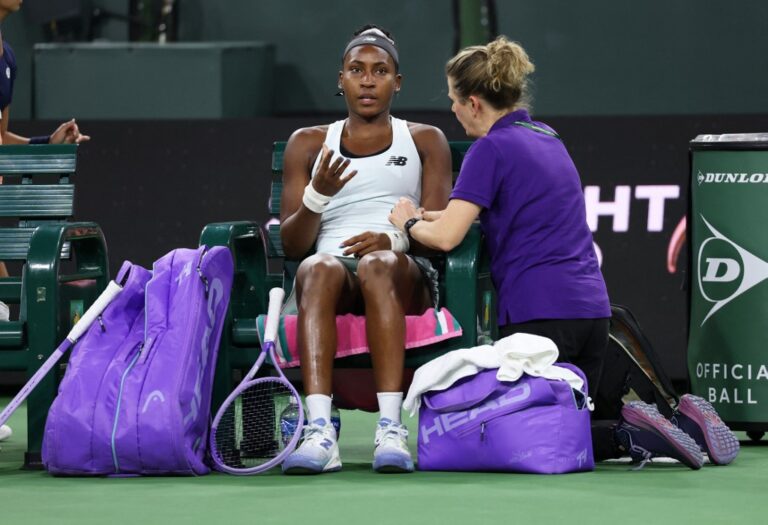
It grew worse as the match went on, even on shots that did not involve her left arm. Gauff called for the trainer late in the opening set, received heavy taping on her left forearm during the changeover, and tried to continue. Eala broke back to take the set 6-2. In the second set, Eala broke again at 2-0, and that was when Gauff shook hands at the net and ended the match.

Afterward, Gauff described the sensation in detail. “It felt like a firework was going off inside of my arm, and then my whole arm felt like it was on fire,” she said. “We’re going to figure out what it is tomorrow, but based off the feeling, being told that it’s probably something nerve-related. Never had anything like this before, never felt anything, a sensation like this before.”

She added that the pain got progressively worse and that she did not want to risk anything further. “I felt really bad to pull out, you never want to pull out, but more so for her because she was playing great tennis, and I don’t want to take anything away from the way that she was playing.”

This marked only the second retirement of Gauff’s WTA career. The first came in the first round of the 2022 Cincinnati Open when she rolled her ankle.

At the net, Gauff told Eala she was sorry. “I’m sorry, I hate to do this,” she said. Eala responded with support. Gauff later revealed the Filipino told her she hoped she felt better. “I think she’s going to have a great tournament,” Gauff added.

Eala, playing in her first main-draw appearance at Indian Wells, handled the moment with class. In her on-court interview, she first marked International Women’s Day. “I want to say thank you to all the incredible women who have paved the way and who have advocated for themselves and for other women,” she said.

“Among them is Coco, so thank you Coco for being an amazing competitor and an amazing role model. And I really hope that everything is well and you will recover soon.” She also admitted the win felt bittersweet. “I really didn’t want to win this way, but this is still a really big moment for me to be able to play on Stadium 1 at Indian Wells against such a great competitor. I’m really grateful to be here and I’m super happy.”

The result evens the head-to-head between the two at 1-1. Less than a month ago in Dubai, Gauff had beaten Eala 6-0, 6-2 on her way to the semifinals. Eala now becomes the first player from the Philippines to reach the round of 16 at Indian Wells. She will face Linda Noskova next in what will be their first career meeting.

Gauff posted a short update on social media shortly after the match. “Hey everyone thanks for the sweet messages. I felt a weird pain in my left arm in the second game of the match, I tried to continue but it was getting more intense.

As most of you know I rarely have to end matches with a retirement but because it was an unfamiliar pain I decided it was best to not continue. Never felt anything like this before, going to get an MRI tomorrow to see what’s up but I’ll be okay. Good luck to Alex the rest of the way, always a pleasure sharing the court with you! I’m sorry it had to end this way IW :(( see you next year.”

The 21-year-old American had arrived in Indian Wells as the top-seeded U.S. player and one of the favorites. She had shown strong form earlier in the season and came into the tournament with high expectations on the hard courts she knows well.

Eala, 20, has made steady progress this year. Her run here includes notable wins already, and the crowd on Stadium 1 gave her strong support throughout the match against Gauff.

The retirement brings an early end to Gauff’s Indian Wells campaign, but she plans further checks to understand the issue fully. Reports indicate she remains hopeful of returning later in March for the Miami Open, the second leg of the Sunshine Double. For now, the focus stays on diagnosis and recovery.

Eala’s breakthrough continues a strong week for the young Filipina. She has drawn large crowds and shown she can compete at the highest level. Reaching the round of 16 here marks a career milestone and sets up an intriguing matchup against Noskova.

Tennis fans at Indian Wells and watching worldwide saw strong sportsmanship from both players. Gauff chose caution with an unfamiliar injury, and Eala responded with grace and respect. The result sends Eala into the second week while Gauff steps away to address her arm.

The BNP Paribas Open continues this week with the fourth round underway. Eala will look to build on her momentum, while the tennis world waits for updates on Gauff’s condition after her MRI.

Miami Open 2026 Tennis Preview — Contenders Favorites and Sleeper Picks

0

The Miami Open returns to Hard Rock Stadium in Miami Gardens, Florida in March 2026, bringing a combined ATP Masters 1000 and WTA 1000 field to outdoor hard courts.

The basics

Location: Miami Gardens, Florida Venue: Hard Rock Stadium Surface: Outdoor hard Level: ATP Masters 1000; WTA 1000 Dates: March 15–29, 2026 (event); March 17–29, 2026 (WTA main-draw window) Draw size: Singles 96, Doubles 32

Top seeds

Official seedings are finalized closer to the start of the tournament. For now, here are the projected top seeds based on the likely field.

On the ATP side, the projected top line includes Novak Djokovic, Jannik Sinner, Carlos Alcaraz, Alexander Zverev and Taylor Fritz.

On the WTA side, the projected top line includes Aryna Sabalenka, Iga Swiatek, Coco Gauff, Elena Rybakina and Jessica Pegula.

Five storylines to watch

1) The Sunshine Double pressure

Miami is the second half of the Indian Wells–Miami swing. Players who go deep at Indian Wells arrive in Florida with form, but also fatigue and less practice time.

2) A 96-player draw means early danger matches

With a 96-player singles draw, seeded players typically receive byes, but the first match can still be a trap: qualifiers have rhythm, and unseeded main-draw players can be top-30 quality.

3) Hard-court margins and serve patterns

On outdoor hard courts, short stretches decide sets: one loose service game, one strong return game, one tiebreak. Miami often rewards players who serve cleanly and take the first forehand.

4) WTA depth and matchups that bite early

The women’s field is deep enough that a “second-week” player can be forced into a tight match on Day 3. The byes help, but they don’t protect against awkward styles.

5) Late changes that reshape the draw

As the calendar compresses, withdrawals happen. Miami is a tournament where wild cards, qualifiers, alternates, and lucky losers can matter.

How Wild Cards Work in Tennis | How Tennis Qualifying Works | What Is a Lucky Loser in Tennis

Draw notes

The live draw details will be updated once the bracket is released.

Potential quarterfinal collisions

The ATP top half carries real volatility. Djokovic arrives as the defending finalist — he reached the 2025 final before falling to Jakub Menšík in straight sets, a match in which Menšík went 7-0 in tiebreaks throughout the tournament. That result means Djokovic is back defending finalist points, and any early exit would be a significant rankings blow.

If Sinner and Alcaraz land in the same half, an earlier-than-expected collision is possible given how deep this field runs. On the WTA side, a Sabalenka-Gauff quarterfinal is the most anticipated potential matchup — Gauff has a strong recent record against Sabalenka, and a home crowd in Florida only amplifies the stakes.

Floaters who can upset seeds early

Menšík — the defending ATP champion — arrived last year ranked 54th in the world and went on to win the title, a reminder that the Miami draw can produce genuine chaos regardless of seeding. He now arrives as a top-seed-level player with points to defend, which makes his section of the draw one to watch for first-round danger.

On the WTA side, Sabalenka won the 2025 women’s title without dropping a set, but the field around her is deeper this year, and players like Mirra Andreeva and Diana Shnaider — who have both broken through at the 1000 level — are capable of making noise early.

Wild cards and qualifiers to watch

Update once the entry list is confirmed. Miami historically uses its wild card spots for American players and high-profile returnees, and with the tournament taking place during spring break in South Florida, home-nation recipients always draw crowd support. Watch the qualifier section closely — last year the draw demonstrated that qualifiers with momentum can be as dangerous as seeded players in the opening rounds.

The section of the draw that looks “open”

Identify this once the bracket is published. In a 96-player field, the quarter that lacks a clear top-10 favorite tends to produce the most surprising results. Last year’s men’s draw showed that an unseeded Czech teenager could win the whole thing, so no quarter should be written off until the bracket is set.

Conditions and how the court plays

Miami is outdoor hard-court tennis in South Florida. Day sessions can feel very different from night sessions, and wind can become a real factor. In a draw this large, players who adjust quickly to conditions tend to separate.

Players most likely to win

Novak Djokovic

Arrives with history on his side and something to prove. He reached the 2025 Miami final, where Menšík denied him what would have been his 100th career title – a milestone he will have circled on his calendar. His experience, return depth, and ability to manage big-match moments over a two-week draw make him one of the most dangerous players in the field even when he isn’t at his physical peak.

Jannik Sinner

Enters Miami with clean first-strike patterns and baseline control that translate well in hard-court 1000-level weeks. Having missed Miami entirely last year due to suspension, he carries no points to defend here, making any deep run a straight gain in the rankings race.

Carlos Alcaraz

Brings explosive athletic offense with enough defensive range to survive tough early matches in a draw this deep. He won Miami in 2022 as an 18-year-old and has been in elite form to start 2026, making him a genuine title contender from the first round.

Alexander Zverev

Enters Miami with serve platform and backhand stability that can carry him through fast hard-court stretches. His five-set Australian Open semifinal against Alcaraz showed he still has the capacity to compete at the highest level when fully locked in.

Taylor Fritz

Is the local favorite and a genuine threat on home hard courts. His serve-plus-one efficiency plays up in Miami conditions where breaks are scarce and tiebreaks are frequent.

Aryna Sabalenka

is the defending WTA champion and one of the most dangerous players in the field. She won the 2025 title without dropping a set, defeating three top-10 players in the same tournament ATP Tour — a level of dominance that makes her the clear favourite again this year. Her first-strike power and serve can shorten matches and punish weaker service games before opponents settle.

Iga Swiatek

Returns pressure and baseline consistency travel even when conditions vary from day to night. She won Miami in 2022 and her game translates well to hard courts when her return is clicking from the start of the week.

Coco Gauff

Is playing her home event and carries real momentum into Miami. Her elite athletic defense and improving first-strike patterns make her a threat to go deep, and a home crowd at Hard Rock Stadium gives her a meaningful edge in tight matches.

Elena Rybakina

Enters Miami as a Grand Slam champion fresh off her 2026 Australian Open title. Her serve is one of the most damaging weapons in the women’s game on hard courts, and her flat baseline game rewards the faster conditions Miami typically provides.

Jessica Pegula

Is a proven Miami performer whose early-ball timing and steady decision-making are well-suited to this draw. She reached the 2025 final before falling to Sabalenka, and she’ll be looking to go one better on familiar hard courts.

One To Watch

Iva Jovic has arrived too fast to call a true sleeper — she entered 2026 ranked inside the top 20 after a 14-5 start to the season with an Australian Open quarterfinal and a WTA title already on her résumé. But she remains underrated in terms of how much damage she can do in a big draw.

Playing in South Florida, close to her California home and in front of a crowd that will be squarely behind an American teenager, Jovic has the complete game and competitive temperament to upset a seed or two and make a genuine run. She’s no longer a wildcard — she’s a threat.

What it means for rankings

Miami is a Masters 1000 and WTA 1000 week, so the points leverage is large. A deep run can swing seeding and momentum heading into the next phase of the season, while a poor week can create immediate pressure because of how the rolling 52-week system drops points from the same window a year earlier.

Related reading

Tennis Rankings Explained | Masters 1000 Guide | WTA 1000 Guide | How Tennis Seeding Works | How Wild Cards Work in Tennis | How Tennis Qualifying Works | What Is a Lucky Loser in Tennis

Zverev fights off Nakashima to reach Indian Wells fourth round

0

German fourth seed Alexander Zverev had to go the distance on Sunday to reach the fourth round at Indian Wells, defeating Brandon Nakashima 7-6 (7/2), 5-7, 6-4.

Zverev did not earn a break point against his 30th-ranked opponent until the third set. He failed to convert his first two chances before finally taking one, breaking the American’s serve in the final game to seal the win.

Zverev dominated the opening tiebreak but lost the second set after Nakashima converted his fifth break chance for a 6-5 lead and then held to love. The German stayed patient through a tight battle on Stadium 2 and broke at the end to close it out.

“He has an incredible serve, and you don’t think about that,” Zverev said of Nakashima, who hit 17 aces to the German’s 15. “His placement on serve is probably the best in the world. What he’s lacking in power he’s definitely got in placement. I was not having any chances to break him for the first two and a half sets and the only chance I kind of had I used it in the end.”

Zverev added: “Definitely happy to get the win because that was a difficult match.” Nakashima, a 24-year-old Southern California native who grew up watching top players at this tournament, pushed the fourth seed hard with precise serving and steady baseline play.

The American had reached the third round by taking care of business earlier in the week and nearly forced a decider after leveling the match.

Zverev will next face either Italy’s Flavio Cobolli, the 15th seed, or American Frances Tiafoe for a spot in the quarterfinals. The winner of that matchup will determine who stands between Zverev and the last eight at the BNP Paribas Open.

World number two Jannik Sinner will headline the men’s action on Sunday against Canada’s Denis Shapovalov. The Italian dropped just two games in his opening match and continues his push for a first Indian Wells title.

In the final match of the day, American Tommy Paul, seeded 23rd, will take on 19-year-old Brazilian João Fonseca, ranked 35th. Fonseca saved two match points in his second-round win over Karen Khachanov, the 16th seed, while Paul opened with a straightforward 6-1, 6-2 victory.

Zverev’s win keeps him on track after a solid second-round result against Matteo Berrettini. The German has now advanced past the third round here and looks to build on his strong start to the season at one of the biggest hard-court events outside the slams.

The match highlighted Nakashima’s ability to stay competitive against higher-ranked players on home soil. His serve kept Zverev guessing for long stretches, forcing the German to grind through rallies and wait for the right moment. When that moment came late in the third set, Zverev took it without hesitation.

Fans at Indian Wells Tennis Garden saw a classic serve-heavy contest between two players who rely on placement and consistency rather than raw power alone. Zverev’s experience in these big moments showed as he stayed calm despite the early lack of break opportunities.

With the fourth round now in sight, attention turns to how Zverev handles the winner of Cobolli and Tiafoe. Both opponents bring different styles: Cobolli’s rising form on hard courts and Tiafoe’s athleticism and big-match energy.

Sunday’s schedule also features other intriguing ties. Sinner’s meeting with Shapovalov carries extra weight given their split head-to-head and the Canadian’s history of producing big results in North America. Shapovalov advanced past Tomas Martin Etcheverry in three sets and will look to test the world number two with his left-handed serve and aggressive play.

Paul against Fonseca promises excitement too. The young Brazilian has shown maturity beyond his years, coming back from match points in the previous round, while Paul brings consistency and experience as a seeded American on home turf.

Zverev’s path through the draw so far has been steady. After handling Berrettini comfortably, he faced a tougher test in Nakashima but found the answers when it mattered most. His ability to adjust and capitalise on that single late break point could prove key as the tournament moves into its later stages.

The BNP Paribas Open continues to deliver competitive tennis across the board. With top seeds still in contention and emerging players making noise, the men’s draw remains wide open heading into Monday’s fourth-round matches.

Zverev will hope his experience and serve return to their best levels against whichever opponent awaits. For now, he can reflect on a hard-fought victory that keeps his Indian Wells campaign alive.

Tennis Player Profiles – ATP and WTA Player Index

0

This is Global Tennis News’ running index of player profiles across the ATP and WTA tours. Each profile is written as an evergreen reference: playing style, career milestones, Grand Slam context, and what actually drives results week to week.

If you’re reading a match recap, a rankings piece, or a tournament preview and want quick context on a player’s game and trajectory, start here.

How to use this page: click a name to open the full profile. This index is continuously updated as new profiles publish and new contenders emerge.

ATP Player Profiles

Click a name for the full profile.

WTA Player Profiles

Click a name for the full profile.

Related reading

Sabalenka and Sinner Begin Title Runs at Indian Wells

0

Aryna Sabalenka opened her bid for a first Indian Wells title by beating Japan’s Himeno Sakatsume 6-4, 6-2 on Friday, stepping onto court at the BNP Paribas Open with her new engagement ring on full display.

The world No. 1 had not played since losing the Australian Open final to Elena Rybakina last month. Against the 136th-ranked qualifier, who came through qualifying, Sabalenka showed early signs of rust in the windy conditions but found her rhythm to close out the match in 70 minutes.

Sabalenka never took off the ring given to her on Tuesday by Brazilian businessman Georgios Frangulis during a proposal at the venue locals call Tennis Paradise. “It surprised me, even though in some way I already knew,” she said. “I had a feeling it was going to happen here. But even so, he still managed to surprise me. It was a special moment.”

“The ring is very comfortable,” she added. “We checked twice to see whether there was any chance of losing the diamond, and there isn’t, so I felt pretty safe wearing this ring. It shines a lot. I hope my opponent gets distracted by this diamond and that works in my favor.”

The win marked Sabalenka’s 100th match as world No. 1. She has reached the Indian Wells final twice before, falling to Rybakina in 2023 and to Mirra Andreeva last year. With the title still missing from her collection of hard-court honors, she will next face Romania’s Jaqueline Cristian.

Italy’s Jannik Sinner made an equally strong start on his return to the Coachella Valley. The world No. 2 needed just 64 minutes to dismiss Czech qualifier Dalibor Svrcina 6-1, 6-1. Sinner missed last year’s tournament while serving a suspension after testing positive for clostebol at the same venue a year earlier. In his two previous appearances here, he lost in the semifinals to Carlos Alcaraz.

“It feels incredible. It’s a tournament I missed last year,” Sinner said. “This tournament and Miami are very important to me.” The draw has kept him on course to potentially meet Alcaraz or Novak Djokovic only in the final. He will face Canada’s Denis Shapovalov next.

American Coco Gauff, the fourth seed, had to work harder. She recovered from a 5-2 deficit in the second set to beat Uzbekistan’s Kamilla Rakhimova 6-3, 7-6 (7-5) in windy conditions and reach the third round for the sixth time.

Colombia’s Camila Osorio produced the day’s most dramatic comeback. The 24-year-old from Cúcuta dropped the first set 4-6 to 18-year-old American Iva Jovic but saved three match points in the second-set tiebreak before winning 7-6 (7-4), 6-3. It was Osorio’s first time reaching the third round at Indian Wells. She will now face Japan’s Naomi Osaka, who advanced with a 7-5, 6-2 win over Andorra’s Victoria Jiménez Kasintseva.

Osorio already beat Osaka here last year during the four-time Grand Slam champion’s return from injury. That result adds extra intrigue to their upcoming matchup.

On the men’s side, fifth seed Lorenzo Musetti became the first major name to exit. The Italian, playing his first match since the Australian Open, lost 7-5, 6-1 to Hungary’s Márton Fucsovics.

Fourth seed Alexander Zverev handled Italy’s Matteo Berrettini 6-3, 6-4 with no break points faced. Argentina’s representatives had less success. Camilo Ugo Carabelli fell to American Brandon Nakashima 6-3, 6-4, while Tomás Etcheverry lost a tight three-setter to Shapovalov 6-3, 2-6, 7-6 (7-5).

Sabalenka and Sinner now move into the weekend with clear momentum at one of the season’s biggest hard-court events. For both, the path to a first Indian Wells crown runs through a stacked field, but their opening performances sent a strong message.