
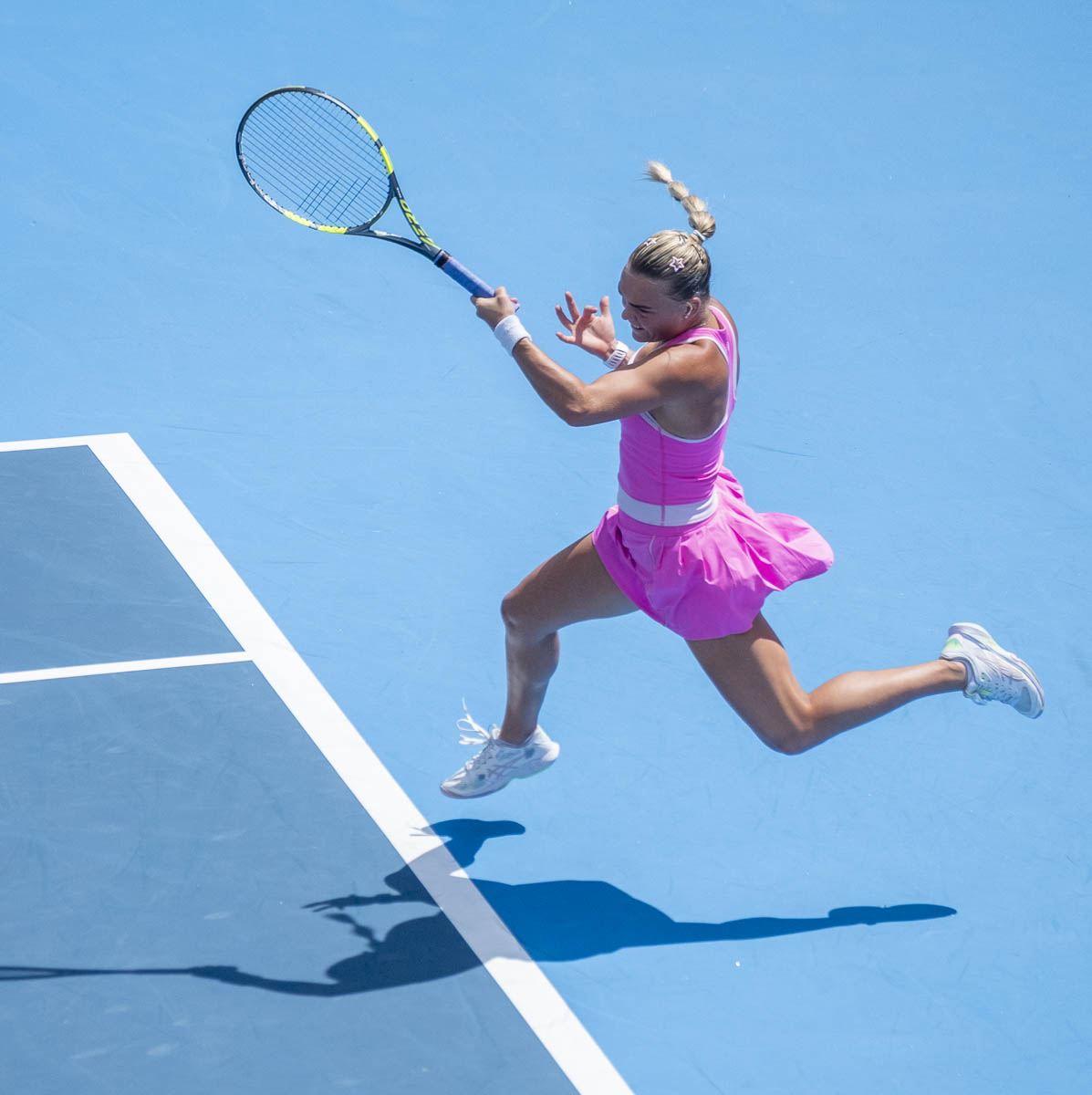
Sara Bejlek went to Cincinnati in August 2026 ranked outside the top 30 and beat four seeded players in a row, among them a two-time Grand Slam champion, a former Cincinnati winner and the world No. 1. At 20, in her first WTA 1000 semifinal, she had produced the run of the tournament on either tour.
She was born in Znojmo, in the south of the Czech Republic near the Austrian border, on Jan. 31, 2006, and lives in nearby Hrusovany nad Jevisovkou. She is left-handed with a two-handed backhand, and she is among the shortest players in the top 50 — a fact that shapes everything about how she plays.
The junior record was serious. She reached the semifinals of the 2022 French Open girls’ singles and won the girls’ doubles title there alongside Lucie Havlickova, and she climbed to No. 4 in the junior rankings. The Czech production line she came off has been the most productive in women’s tennis for two decades, and she trains and practices within it, alongside players including Karolina Muchova and Linda Noskova.
The professional climb was gradual rather than immediate. She won a WTA 125 title at Colina in 2023, then three more in 2025 at Makarska, Rende and Queretaro, a volume of second-tier winning that tends to precede a jump. That year she also reached her first tour-level quarterfinal in Prague and won her first Grand Slam main-draw match at Roland Garros, coming through qualifying and beating the 25th seed Marta Kostyuk in the opening round.
The jump came in February 2026 in Abu Dhabi, where she came through qualifying again and won the title, beating Ekaterina Alexandrova 7-6 (7-5), 6-1 in the final to become the first qualifier to win the tournament. It was her first WTA Tour title and it moved her toward a career-high ranking of No. 34, reached in April.
Her game is the interesting part. She does not overpower anyone and does not try to. She plays on tennis intelligence and variety — left-handed angles that open the court in directions right-handers are not used to defending, slice to change the rhythm, and defensive quality that turns rallies into questions of patience rather than power. Against opponents who want a straight ball-striking contest, she declines to have one. She has cited Rafael Nadal as a childhood idol and Petra Kvitova as a compatriot she looked up to, and the Nadal influence shows more in the shot selection than the intensity.
Cincinnati was the proof. She beat Barbora Krejcikova, a two-time major champion and a compatriot, then 16th seed Ekaterina Alexandrova, and then Aryna Sabalenka, the world No. 1, 7-6(7), 6-4, in a match settled by a first-set tie-break that went deep. In the quarterfinals she beat Madison Keys, the 2019 Cincinnati champion, 3-6, 6-4, 7-6 (5), losing the opening set and winning a final-set tie-break against one of the biggest hitters in the game. Three former Grand Slam champions in a single week, all of them beaten by a player conceding significant power in every exchange.
Grand Slam results remain the gap. She has yet to go beyond the second round at a major, losing in the first round in Melbourne in each of her four appearances and reaching the second round at Roland Garros in 2025 and 2026, where Iga Swiatek beat her 6-2, 6-3. Her only previous US Open main-draw appearance came in 2022, when she qualified at 16 and lost in the first round.
The run ended in the semifinals, where Coco Gauff pulled away 6-4, 6-1 after Bejlek had fought back from 1-4 to 4-4 in the first set. A week later in New York the pattern of her major record held: Cristina Bucșa, who had won three of her previous 17 matches, beat her 7-5, 4-6, 6-1 in the first round, according to the WTA. Turning weeks like Cincinnati into a first run past the second round at a major is the next step.
Grand Slam best results
- Australian Open: First round
- Roland Garros: Second round (2025, 2026)
- US Open: First round
Season Snapshot — September 27, 2026
- 2026 title: Abu Dhabi, as a qualifier (d. Ekaterina Alexandrova 7-6(5), 6-1)
- Cincinnati: Semifinal, her first at WTA 1000 level (d. Krejčíková, Alexandrova, Sabalenka, Keys; l. Gauff 6-4, 6-1)
- Other 2026 results: Quarterfinals in Prague and Athens
- 2026 Grand Slams: Roland Garros second round (l. Iga Swiatek); US Open first round (l. Cristina Bucșa)
This snapshot is dated and will change. The career record above does not.