Home Blog Page 89

Draper Loses to Medvedev After Hindrance Call at Indian Wells

0

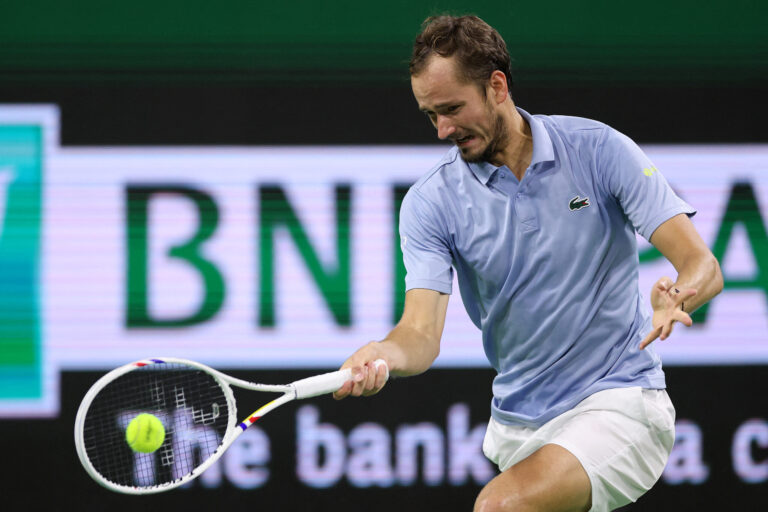
Jack Draper’s defense of his Indian Wells title ended in the quarterfinals on Thursday when Daniil Medvedev beat him 6-1, 7-5 at the BNP Paribas Open.

The 24-year-old Briton looked tired from his two-hour 35-minute win over Novak Djokovic the previous day. Medvedev, the 11th seed and fresh from lifting the trophy in Dubai, took charge early and never let go.

Medvedev broke in the opening game and built a 4-0 lead in the first set. Draper held once but could do little else against the Russian’s sharp backhands and flat power. The set lasted just 24 minutes.

The second set stayed even until 5-5. Draper served at 0-15 when the decisive moment arrived. Medvedev hit a deep forehand. Draper raised both arms wide, convinced the ball had gone long. The rally carried on for several more shots until Medvedev netted a backhand.

Draper took the point on court. Medvedev walked straight to chair umpire Aurélie Tourte and asked for a video review on hindrance. Tourte studied the footage and ruled that Draper’s arm movement had distracted his opponent. She awarded the point to Medvedev, making it 0-30.

The crowd reacted with loud boos. Draper hit an ace to reach 15-30 but lost the game on break point. Medvedev held serve to close out the match and reach the semi-finals for the fourth straight year.

At the net the players talked for several minutes. Medvedev told Draper he did not feel great about the call. Draper replied that he thought the match went to the stronger player, but the gesture had not distracted Medvedev enough.

Later Medvedev explained his position. “Was I distracted big time? No. Do I feel good about it? Not really. But I also don’t feel like I cheated or something,” he said. “I got a bit distracted. I let it go, I let the referee decide. I had a lot of calls against me in my life. To get one on my side feels good as well.”

Draper had told the umpire he believed the decision was wrong. He left the court after shaking hands with both Medvedev and Tourte.

The British player had reached the quarterfinals in only his second ATP event since the US Open last year. He had battled back from injury and produced a strong week before the physical toll of consecutive tough matches caught up.

Medvedev now stands one win from the final. He leads the tour with 17 victories this season and has won 16 sets in a row since his loss in Rotterdam.

The hindrance call brought attention to the rule that lets a player claim interference from an opponent’s action or noise. Video review allowed the umpire to check the moment in detail and make her decision.

Draper exits as the defending champion with credit for his run. His ranking will drop after the result, but the week showed he can still compete at the top level.

Medvedev moves forward with his familiar focus intact. He will face Carlos Alcaraz in the semi-finals after the Spaniard won his quarter-final.

The match closed out British singles interest at the tournament as Cameron Norrie also lost earlier on Thursday.

The Greatest Records in Roland Garros History

0

Roland Garros has been played since 1891 — making it one of the oldest and most storied tournaments in sport. Over more than 130 years of competition, the red clay of Paris has produced records of extraordinary magnitude: records of dominance that defy comparison, win streaks that ran for years, and feats of longevity and youth that have never been approached. This is a complete guide to the greatest numbers in French Open history.

The Most Untouchable Record in Tennis: Nadal’s 14 Titles

Rafael Nadal won the French Open 14 times. No player, male or female, has ever won more titles at a single Grand Slam in tennis history. No record in any Grand Slam is remotely close. The nearest men’s competitor is Björn Borg with six.

The nearest women’s competitor is Chris Evert with seven. Nadal won more than twice as many French Open titles as any other man in the Open Era.

He won his first French Open in 2005 at the age of 18 and his last in 2022 at the age of 35 — a span of 17 years between first and last title that is itself a record of consistency at a single Grand Slam.

His titles came in 2005, 2006, 2007, 2008, 2010, 2011, 2012, 2013, 2014, 2017, 2018, 2019, 2020, and 2022. The gap years — 2009, 2015, 2016 — were caused by injury rather than opponents, and in each of those three years he either didn’t compete or was not at full fitness.

He went 14-0 in French Open finals. In the entire history of the tournament, he never lost a Roland Garros final.

The Match Record: 112 Wins, 4 Losses

Titles alone do not capture the full scale of Nadal’s dominance on this court. His overall match record at Roland Garros — 112 wins against just 4 losses — is the most statistically dominant performance by any player at any Grand Slam in tennis history. He won 96.5 percent of his matches at this tournament across a 19-year career.

His four losses came against Robin Söderling in the fourth round in 2009, Novak Djokovic in the quarterfinals in 2015, Djokovic again in the quarterfinals in 2021, and Alexander Zverev in the quarterfinals in 2024.

Three of those four defeats came after he was already past his peak, and all of them required his opponent to produce some of the best clay-court tennis of their career.

For comparison, Roger Federer — widely regarded as one of the three greatest players ever — compiled 73 match wins at Roland Garros across 19 appearances, winning the title once. Novak Djokovic, who won three French Open titles, compiled the second-most match wins among active players. Neither came close to 112.

Chris Evert: Seven Titles and the 125-Match Win Streak

On the women’s side, Chris Evert’s record at Roland Garros stands as one of the most extraordinary in all of sport. She won seven French Open singles titles across nine final appearances — a final record of seven wins and two losses. Her overall clay-court win percentage across her career stands at approximately 90 percent.

But the number that most defines her relationship with the surface is the consecutive wins record. Between 1973 and 1979, Evert won 125 consecutive matches on clay — a streak that lasted six years and has never been threatened. During that run, she lost only seven sets. She was not merely dominant; she was functionally unbeatable on the surface for the better part of a decade.

Her nine French Open final appearances span from 1973 to 1986 — 13 years between first and last final. In that time, tennis changed around her, opponents came and went, the Open Era matured, and Evert remained a fixture in the deepest week in Paris. The nickname she earned — the Iron Princess — was not ironic.

Björn Borg: Six Titles, Eight Appearances, Two Losses

Before Nadal, the benchmark of clay-court supremacy was Björn Borg. Between 1974 and 1981, the Swede made eight appearances at Roland Garros, won six titles, and lost just twice.

His record of six French Open titles remained the Open Era men’s record for decades, and the efficiency of his overall Roland Garros career — a match record of 49 wins and just 2 losses — stands as one of the cleanest in Grand Slam history.

Borg won consecutive titles in 1974 and 1975, then added four straight from 1978 to 1981. He never lost a Roland Garros final. His two losses came in the quarterfinals in 1976 (to Adriano Panatta) and the fourth round in 1977 (to Guillermo Vilas, who went on to win the title that year).

In 1979 and 1980 he also won Wimbledon in the same calendar year — the last man to win both Roland Garros and Wimbledon in the same season until Roger Federer achieved the same feat in 2009.

The Youngest Champion in Open Era History: Michael Chang

In 1989, Michael Chang became the youngest man to win the French Open in the Open Era, claiming the title at 17 years, 3 months, and 20 days.

His run to the title included one of the most famous matches in Roland Garros history — his fourth-round victory over Ivan Lendl, the world number one, in which Chang served underhand during the final set and battled through severe cramps to win one of the most dramatic five-set matches the tournament had ever produced.

No man has won the French Open at a younger age in the Open Era since. Chang’s record has now stood for more than 35 years.

On the women’s side, Monica Seles holds the equivalent record. She won the French Open in 1990 at the age of 16 years and 6 months — the youngest women’s champion in the tournament’s modern history.

The Oldest Champion in Open Era History: Novak Djokovic

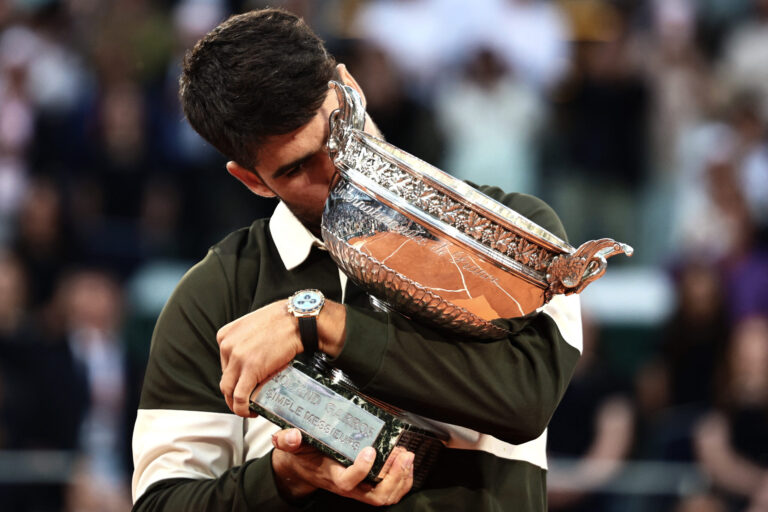
At the other end of the age spectrum, Novak Djokovic became the oldest French Open champion in the Open Era when he won the title in 2023 at 36 years and 20 days.

His victory over Casper Ruud in the final gave him a record 23rd Grand Slam singles title at the time — breaking the tie with Nadal — and demonstrated that the physical demands of a clay-court Grand Slam could still be conquered at an age when most players had long since retired.

The Most Match Wins in Roland Garros History

The all-time match wins leaderboard at Roland Garros in the men’s Open Era reads as a precise ranking of the greatest clay-court players in the history of the sport:

  • Rafael Nadal: 112 wins
  • Novak Djokovic: 80+ wins across 20+ appearances
  • Roger Federer: 73 wins across 19 appearances
  • Guillermo Vilas: 57 wins across 18 appearances
  • Andre Agassi: 51 wins
  • Ivan Lendl: 47 wins across 13 appearances (three titles, five finals)
  • Björn Borg: 49 wins across 8 appearances

Borg’s efficiency relative to appearances is the most striking entry on this list: 49 wins from just 8 tournaments is a rate of more than six wins per appearance — meaning he averaged reaching the final every single time he entered.

The Record No One Talks About: The Finals Streak

Between 2005 and 2014, Rafael Nadal reached the French Open final in every year he competed at the tournament. That is ten consecutive finals over a decade — a streak of consistency that has never been approached at any Grand Slam by any player in the Open Era.

He won nine of those ten finals; the only loss came in 2006 when he was beaten by… no one. Nadal won all ten finals he reached during that run.

To place that in context: reaching a Grand Slam final in a single year is the achievement of a career for most professional tennis players. Reaching ten consecutive finals at the same Grand Slam over a decade, winning all ten, is an achievement for which no adequate comparison exists.

The Most French Open Titles in Women’s History: The Full Picture

While Chris Evert’s seven titles leads the Open Era women’s record, the full historical picture is dominated by Suzanne Lenglen, the French legend who won six titles between 1920 and 1926 and is widely regarded as the first global superstar of women’s tennis.

Lenglen went years without losing a single set at Roland Garros; her dominance of the pre-Open Era tournament was so complete that one of the venue’s show courts bears her name.

In the Open Era, behind Evert’s seven, the most decorated women’s champions include Steffi Graf (six titles), Justine Henin (seven titles — equalling Evert), Monica Seles (three consecutive titles from 1990 to 1992), and Martina Navratilova (two titles, though clay was the one surface on which Evert regularly had the better of her great rival).

Henin’s seven titles, achieved between 2003 and 2007, remain the joint-record in the Open Era alongside Evert.

The Records That Never Fell: Who Never Won at Roland Garros

Part of what makes Roland Garros records meaningful is the list of extraordinary players who could never claim one. Pete Sampras, who won 14 Grand Slams in total and was world number one for six consecutive years, never won the French Open — his serve-and-volley game found no purchase on the red clay. John McEnroe, who came agonisingly close in 1984 when he led Ivan Lendl two sets to love in the final before losing, never won in Paris.

Boris Becker, Stefan Edberg, and Jimmy Connors — collectively the dominant forces in men’s tennis for much of the 1980s — also never added a Roland Garros title to their Wimbledon and US Open victories.

Venus Williams, despite reaching the final once, never won. Maria Sharapova’s clay-court game, formidable enough to produce a Roland Garros title in 2012, never delivered the sustained dominance that other surfaces did.

The French Open has always been the Grand Slam that reveals the limits of players who are otherwise great. The red clay is indifferent to reputation.

The Bottom Line

The records at Roland Garros are, as a collection, the most extreme in Grand Slam tennis. Nadal’s 14 titles and 112-4 match record, Evert’s 125-match clay winning streak, Borg’s efficiency across eight appearances, Chang’s teenage title, Djokovic’s late-career triumph at 36 — these are not merely impressive numbers.

They are the products of a surface so demanding, so specific in what it requires, and so unforgiving to those not built for it, that the players who master it leave marks unlike anything seen elsewhere in the sport.

Why Clay Specialists Thrive in Paris

0

Professional tennis is a sport that asks its best players to compete across three fundamentally different surfaces — clay, grass, and hard courts — each of which rewards different technical and physical qualities. The players who succeed consistently across all three are celebrated as all-court champions.

But Roland Garros has a specific relationship with a different kind of player — the clay court specialist, whose game is built specifically around the demands of the red surface and who arrives at the French Open not simply as a competitor but as a player in their natural competitive habitat.

Clay specialists do not simply perform well at Roland Garros. They disproportionately dominate it — accumulating titles, making deep runs, and defeating higher-ranked opponents with a consistency that the ranking system alone does not predict.

Understanding why requires understanding what clay court specialization actually means, what specific competitive advantages it confers at the French Open, and why the surface’s properties create such a pronounced gap between players whose games are optimized for clay and those whose are not.

What Clay Court Specialization Actually Means

Clay court specialization is not simply a preference for playing on clay or a comfort with the surface that comes from practicing on it regularly. It is a specific configuration of technical skills, physical development, and tactical approach that is optimized for the demands that clay imposes — and that may not be equally effective on faster surfaces where different qualities determine competitive outcomes.

A true clay court specialist has developed several specific competitive qualities that clay rewards and that their game is built around expressing.

Heavy topspin groundstrokes from both sides. The clay specialist’s primary offensive weapon is the heavy topspin groundstroke — particularly the forehand — that kicks above shoulder height on clay and forces opponents behind the baseline.

Generating heavy topspin consistently requires a specific swing path, a specific preparation, and the physical strength and flexibility in the shoulder, wrist, and core that the brush-up contact demands.

Players who have developed this technique from the beginning of their competitive development — typically by learning tennis on clay courts in Spain, South America, or other clay-dominant tennis cultures — have it as a natural part of their game.

Players who learned on hard courts must specifically develop it as an addition to their natural technique.

Physical endurance built for long rallies. Clay court specialists are conditioned specifically for the physical demands of clay court competition — the extended rallies, the sustained lateral movement, the repeated topspin generation across long matches.

Their training load and physical development reflect the specific endurance demands of winning on clay, which are greater than the equivalent demands on faster surfaces.

This physical preparation cannot be replicated in the weeks before Roland Garros by a player whose training year has been built around the different demands of hard court competition.

Tactical patience and construction. Clay court tennis requires building points through accumulated pressure rather than attempting to end them aggressively before the construction work is done.

The clay specialist has developed the tactical patience to sustain cross-court exchanges, wait for the right moment to attack, and resist the temptation to force pace through the clay’s resistance.

This tactical patience is partly a mental quality and partly a technical one — the confidence in one’s own topspin and movement to sustain long rallies without anxiety about their duration.

Sliding and clay-specific movement. The sliding technique that clay’s loose surface layer makes both possible and necessary is developed across years of competition on clay — it is not a skill that can be acquired in weeks.

Clay specialists slide into shots, recover their balance and positioning efficiently after wide balls, and use the surface’s properties to cover more court with less effort than their non-clay-specialist opponents.

This movement advantage compounds across long matches — the clay specialist arriving at later stages of a five-set match with less accumulated physical cost from movement than an opponent who has been stopping and resetting throughout.

The Competitive Advantages at Roland Garros

These clay court specialization qualities translate into specific competitive advantages at Roland Garros that explain the disproportionate success of clay specialists at the French Open.

The technical gap is largest at Roland Garros. On hard courts, the difference between a player with heavy topspin and a player with moderate topspin is meaningful but manageable — the surface is fast enough that pace and placement can compensate for lower topspin levels, and the lower bounce reduces the kick advantage of heavy topspin.

On clay, the same technical gap is amplified by the surface — the heavy topspin specialist’s kick becomes genuinely difficult to handle, while the moderate topspin player cannot compensate with pace because clay absorbs it. The clay specialist’s technical advantage is therefore at its maximum at Roland Garros in a way that it is not at any other Grand Slam.

The physical advantage compounds across the fortnight. A clay specialist arrives at Roland Garros in peak physical condition for clay court competition — having spent the preceding weeks of the clay season preparing specifically for these demands.

Their opponents — particularly those whose games are hard court-oriented — have transitioned from the Australian swing and the North American hard court preparation in the preceding months. The clay specialist’s physical preparation advantage is greatest at the tournament whose physical demands are highest.

The tactical advantage in specific matchups is decisive. The tactical adjustments required to compete effectively against heavy topspin on clay are specifically challenging for players whose technical games are not built around producing or handling those specific ball characteristics.

A hard court player whose backhand is optimized for handling flat balls at comfortable heights faces a genuinely different technical challenge when a clay specialist’s heavy topspin forehand starts kicking above their shoulder — and the adjustment required across five sets on clay is more difficult than the reverse adjustment a clay specialist makes when encountering pace on faster surfaces.

Spain: The Clay Specialist Production System

The most consistent source of clay court specialists in the history of professional tennis is Spain — a country whose tennis development infrastructure has been built almost entirely around clay courts and whose player development system has produced generations of Roland Garros champions.

Spain’s clay court dominance reflects infrastructure reality. The overwhelming majority of tennis courts in Spain — particularly across the south and east of the country where the most prominent tennis academies and development programs are located — are clay. Spanish junior players develop on clay from their earliest competitive experiences.

They learn to slide, to generate topspin, to construct points patiently, and to sustain the physical demands of clay court competition because that is the surface their competitive development is built around.

The Spanish player development system has historically emphasized physical conditioning alongside technical development — a recognition that clay court success requires not just the right technique but the endurance base to express it across long matches and long tournaments.

The combination of technical clay court development and specific physical conditioning for clay demands has made Spanish tennis the most consistent producer of Roland Garros champions in the Open Era.

Rafael Nadal is the most extreme expression of what the Spanish clay court development system can produce — a player whose technical profile was built from the beginning around the heavy topspin forehand, the physical endurance, and the tactical patience that clay court specialization requires.

His fourteen Roland Garros titles are in one sense a tribute to individual genius. In another sense they are the fullest expression of a development system that was specifically designed to produce clay court champions.

Beyond Nadal, Spain has produced multiple Roland Garros champions — Arantxa Sánchez Vicario, Conchita Martínez, Sergi Bruguera, Carlos Moya, Albert Costa, and most recently Carlos Alcaraz — whose collective record at the French Open is unmatched by any other nationality across the Open Era.

South America: The Clay Court Culture

South America — particularly Argentina, Chile, and Brazil — has produced a consistent stream of clay court specialists whose impact on Roland Garros extends beyond the specific champions the region has generated.

Argentine clay court culture is the most prominent in South America — the product of the same clay-dominant infrastructure that characterizes Spanish tennis development. Buenos Aires and the broader Argentine tennis development system have been clay-based since the country’s competitive development infrastructure was established, and Argentine players have developed the clay court qualities that Roland Garros rewards across generations of competitive development.

The Argentine clay court specialists who have had the most significant impact at Roland Garros include Guillermo Vilas — who won the French Open in 1977 and remains one of the great clay court players of the pre-Open Era modern period — and the 2004 finalist Guillermo Coria, whose clay court excellence was among the best of his era before injury reduced his competitive level in the later stages of his career.

The 2004 Roland Garros final between Guillermo Gaudio and Guillermo Coria — both Argentines — reflected the specific depth of South American clay court development and the degree to which the region’s player production system generates genuine Roland Garros-level clay court specialists rather than simply solid clay court performers.

Clay Specialists Versus All-Court Players at Roland Garros

The specific competitive dynamic between clay specialists and all-court players at Roland Garros is one of the tournament’s most consistent narratives — and the results of their encounters on the red clay reflect a competitive advantage for the specialist that the ranking system does not always predict.

All-court players — those who compete effectively across all three surfaces and who reach the later rounds of Grand Slams regardless of the surface — are at their most vulnerable at Roland Garros. Their technical games are not clay-optimized — they represent compromises between the different demands of different surfaces rather than the single-surface optimization that clay specialists bring to Paris.

The specific matchup between Novak Djokovic — the most complete all-court player in the history of men’s tennis — and Rafael Nadal — the most extreme clay court specialist the sport has produced — illustrates this dynamic in its most concentrated form. Djokovic’s all-court excellence has produced more Grand Slam titles than any other player in history and has included multiple Roland Garros titles.

But his record against Nadal specifically at Roland Garros — winning once in their multiple direct meetings — reflects the specific competitive advantage that Nadal’s clay court specialization confers even against the most complete all-court player the sport has ever produced.

The broader pattern across the Open Era confirms the dynamic. Players ranked outside the top 20 who have deep Roland Garros runs — reaching quarterfinals, semifinals, or finals — disproportionately represent clay court specialists whose overall ranking does not reflect their specific clay court quality.

Players ranked inside the top five who have struggled at Roland Garros — Sampras, McEnroe, Becker — are consistently the players whose technical games were least suited to clay.

The Clay Specialist’s Career Trade-Off

Clay court specialization at the level required to dominate Roland Garros involves a specific trade-off that shapes the career arc of the players who pursue it.

A game built specifically around clay court excellence — the heavy topspin, the physical endurance, the tactical patience — is not equally effective on the faster surfaces that constitute the majority of the professional calendar.

The serve-and-volley game that grass rewards is essentially incompatible with the clay specialist’s technical profile. The flat-hitting, pace-based approach that fast hard courts reward is undermined by the clay specialist’s technique, which generates topspin rather than pace.

This means that genuine clay court specialists — players whose games are fully optimized for clay rather than all-court balanced — tend to have more extreme competitive profiles than all-court players. They dominate the clay season and particularly Roland Garros. They are more competitive on clay than their overall ranking suggests. And they are typically less competitive on grass and fast hard courts than their overall ranking suggests.

The career trade-off is illustrated by the specific historical record — genuine clay specialists rarely win Wimbledon or the US Open, while all-court players who win both those events typically struggle to win Roland Garros as many times as their overall record might suggest. The specific optimization that clay court specialization requires comes at the cost of the versatility that winning across all surfaces demands.

Why Roland Garros Belongs to the Clay Specialists

The question of why clay specialists thrive at Roland Garros ultimately has a simple answer: the tournament is played on their surface, under their preferred conditions, across the distance that suits their specific physical and technical profile.

Roland Garros is not a neutral test that rewards universal excellence — it is a specific competitive environment that rewards the specific excellences that clay court specialization develops.

The broader tennis world celebrates all-court excellence — the players who win across all surfaces are the ones whose Grand Slam records are most complete, whose legacies are most fully expressed in the historical record, and whose competitive profiles are most admired in the abstract.

But Roland Garros specifically rewards the clay specialist — the player who has built their game around the demands of the red surface and who arrives in Paris as close to their competitive ceiling as the calendar allows.

When a clay specialist beats a higher-ranked all-court player at Roland Garros, the outcome is not an upset in the meaningful sense — it is the predictable result of a surface-specific competitive advantage expressing itself under the conditions where it is most powerful.

The clay specialist was not the better overall player. They were the better player on that surface, in that tournament, under those conditions. At Roland Garros, that is what winning requires.

Part of the Roland Garros series. Related: How Red Clay Changes Tennis at Roland Garros · Why Roland Garros Is the Hardest Grand Slam to Win · Rafael Nadal at Roland Garros — The Most Dominant Performance in Grand Slam History

The Architecture and Importance of Court Philippe-Chatrier

0

Every Grand Slam has a main show court whose architecture, history, and competitive significance make it more than simply the largest venue at the tournament. Centre Court at Wimbledon. Arthur Ashe Stadium at the US Open.

Rod Laver Arena at the Australian Open. Each of these courts carries the weight of its tournament’s identity — the place where the most important matches are played, the most significant moments occur, and the competitive history of the event is most completely written.

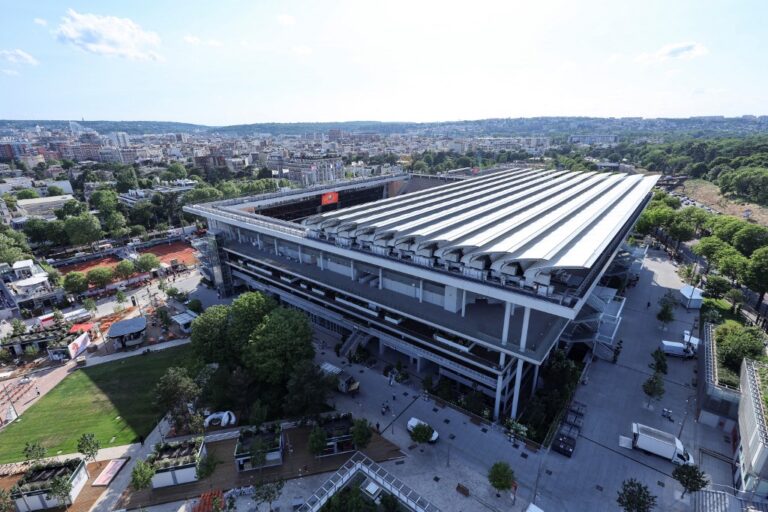
At Roland Garros, that court is Court Philippe-Chatrier. Named in 1988 after the man most responsible for transforming the French Open into the modern Grand Slam it became, Chatrier has hosted nearly a century of significant tennis — from the Four Musketeers era of the late 1920s through Nadal’s fourteen titles and the introduction of night sessions that have transformed the court’s competitive and commercial role in the twenty-first century.

Understanding Court Philippe-Chatrier — its physical design, its history, its recent transformation, and its specific role in the French Open’s identity — is understanding the physical center of the most distinctive Grand Slam in professional tennis.

The Physical Setting

Court Philippe-Chatrier sits at the heart of the Roland Garros complex in the 16th arrondissement of Paris — adjacent to the Bois de Boulogne, one of the French capital’s largest parks, and surrounded by the broader tournament campus that has expanded significantly through the renovation and extension projects of the past two decades.

The court’s red clay surface — the same crushed brick composition that covers every match court at Roland Garros — is maintained by the groundskeeping team whose management of moisture content, surface packing, and day-to-day condition directly determines the playing characteristics that competitors and viewers experience.

The stadium that surrounds the court has been rebuilt and expanded multiple times since the original facility opened in 1928. The current configuration holds approximately 15,000 spectators — expanded through successive renovations from the original capacity that accommodated the Davis Cup matches for which the venue was constructed.

The seating wraps around the court in a configuration that creates a contained, intimate atmosphere despite the stadium’s capacity — the specific acoustic and visual environment that has made Court Philippe-Chatrier one of the most recognizable and most discussed competitive venues in professional tennis.

The orientation of the court — running roughly north-south, with the main stands on the east and west sides — determines the sun and shadow patterns that players manage across day session matches. The specific light quality at different times of day on Court Philippe-Chatrier has been a recurring topic in player discussions of the court’s playing conditions — the afternoon sun angle creating specific visibility challenges for certain shot types at certain points in the competitive day.

The History of the Court and Its Name

The court that bears Philippe Chatrier’s name has been the center of Roland Garros since the stadium was constructed in 1928 — built in approximately six months to accommodate France’s Davis Cup defense following their 1927 victory. Its original name was simply the Court Central — the central court of a new facility built for a specific competitive purpose rather than conceived as the permanent home of a Grand Slam tournament.

The renaming in 1988 honored Philippe Chatrier — a former French Davis Cup player who became the president of the French Tennis Federation in 1973 and held that position until 1993, simultaneously serving as president of the International Tennis Federation from 1977 to 1991.

Chatrier’s influence on professional tennis extended far beyond the French Open — he was instrumental in the establishment of the ATP rankings system, the expansion of the Grand Slam structure, and the broader commercial development of professional tennis as a global sport.

At Roland Garros specifically, Chatrier’s presidency transformed the French Open from a respectable but somewhat underdeveloped Grand Slam into a commercially sophisticated major tournament with expanded facilities, improved prize money, and the global broadcast reach that made it competitive with Wimbledon and the US Open in the commercial landscape of professional tennis.

The court naming in 1988 — during his presidency and at the height of his influence on the sport — was a recognition of his contribution to the tournament and to the sport more broadly.

The specific significance of naming the court after Chatrier rather than after a player — the approach taken by the Australian Open with Rod Laver Arena — reflects a specific institutional philosophy at Roland Garros about honoring administrative and developmental contribution alongside competitive achievement.

The Lenglen Court, the Mathieu Court, and the Chatrier Court together honor the sport’s great champion, the sport’s great women’s champion, and the sport’s great administrator — a combination that reflects the French Tennis Federation’s specific approach to institutional memory.

The Retractable Roof: Transformation of the Court

The most significant physical transformation in the history of Court Philippe-Chatrier was the installation of the retractable roof — completed in 2020 and first used for its intended purpose of enabling night sessions in 2021 — that resolved the court’s most significant operational limitation and changed the French Open’s competitive and commercial possibilities.

The engineering challenge of installing a retractable roof over Court Philippe-Chatrier was substantially more complex than the equivalent projects at other Grand Slams. The existing stadium structure — built in 1928 and expanded multiple times without a roof ever being considered — was not designed to support the loads that a retractable roof system requires. The surrounding Roland Garros campus — dense with other facilities, courts, and infrastructure — limited the engineering approaches available.

The solution involved a cable-supported roof structure that transfers loads to foundations outside the existing stadium walls — a design that avoided the need to replace the stadium’s existing structure while providing the weather protection that night sessions required.

The specific roof design — which closes in approximately eight minutes when weather requires — reflects the engineering constraints of the site and the operational requirements of a tournament that needs rapid weather response.

The roof’s visual impact on the Court Philippe-Chatrier experience is significant beyond its operational function. The closed roof creates a specific acoustic and atmospheric environment — amplifying crowd noise, altering the light quality inside the stadium, and producing the contained intensity that distinguishes night session matches at Roland Garros from any other competitive environment in professional tennis.

Players who have competed under the closed roof consistently describe the specific atmosphere it creates — the crowd noise bouncing off the roof structure, the specific light of the floodlighting against the red clay — as unlike anything they experience at other venues.

The Night Session Atmosphere

The transformation of Court Philippe-Chatrier from a daytime-only venue to one capable of hosting prime-time night sessions has created a new competitive identity for the court that coexists with its century-long daytime history.

Night session matches on Court Philippe-Chatrier — beginning at 9:00 PM Paris time under the closed roof and the stadium lights — have generated some of the most discussed competitive moments of recent Roland Garros editions. The specific atmosphere of the court at night has been described by players, commentators, and spectators as creating a competitive intensity that daytime matches, for all their quality, do not always produce in the same concentrated form.

The acoustic properties of the closed roof transform the crowd’s engagement with the match — applause and reactions that would dissipate into the open air during day sessions are contained and amplified by the roof structure, creating a sound environment that players describe as more immediately present and more physically impactful than outdoor venues produce.

The crowd’s ability to influence the competitive atmosphere of a night session match on Court Philippe-Chatrier has been one of the most discussed features of the night session experience — both by players who have drawn energy from the partisan support and by players who have found the crowd hostility more difficult to manage under the roof than in an open stadium.

The visual identity of Court Philippe-Chatrier at night — the red clay illuminated by the stadium’s floodlighting, the roof structure visible overhead, the Parisian night visible through the gaps around the roof’s perimeter when conditions allow — has become one of the most distinctive visual images in professional tennis.

The court looks different at night. It feels different at night. And it has produced competitive moments that the daytime-only French Open of the previous 130 years could never have generated.

The Court’s Role in French Open Identity

Court Philippe-Chatrier is not simply the largest venue at Roland Garros — it is the physical expression of the French Open’s competitive identity and the place where the tournament’s most significant moments have been played and remembered.

Every Roland Garros singles final since the tournament moved to the current venue in 1928 has been played on this court. The Four Musketeers’ era titles, the great clay court champions of the amateur era, the Open Era’s defining matches from Borg’s dominance through Lendl, Evert, Graf, and Navratilova, Nadal’s fourteen titles, and the most recent generation of French Open champions — all of these competitive legacies were created on the same red clay surface that the court has maintained across nearly a century of competition.

The specific competitive milestones of the French Open’s history are inseparable from the physical setting where they occurred. Nadal’s first Roland Garros title in 2005 — the beginning of the most extraordinary individual relationship between a player and a Grand Slam venue in the history of the sport — was claimed on Court Philippe-Chatrier.

His fourteenth and final title in 2022, the farewell that the French Open crowd recognized as such even before Nadal himself confirmed it, was played and celebrated on the same court.

Graf’s 6–0, 6–0 final in 1988. Lendl’s comeback against McEnroe in 1984. Gaudio’s recovery from two sets down in 2004. Djokovic’s five-set victories that finally confirmed his status as a genuine Roland Garros champion.

The specific competitive narratives that define what the French Open is were all written on Court Philippe-Chatrier — the physical space whose dimensions, surface, and atmosphere have remained consistent across the sport’s evolution from the amateur era through the modern professional game.

Comparing Court Philippe-Chatrier to Other Grand Slam Show Courts

Each Grand Slam’s main show court has a specific identity shaped by its physical design, its history, and the specific competitive environment it creates. Understanding how Court Philippe-Chatrier compares to its equivalents at the other three Grand Slams illuminates what makes it specifically distinctive.

Centre Court at Wimbledon is the oldest Grand Slam show court — the venue that established the template for Grand Slam main show courts when it was constructed at the All England Club’s current Church Road site in 1922.

Its grass surface, its royal box, its traditional architecture, and the specific social and cultural identity of the All England Club give Centre Court a prestige that reflects the sport’s historical origins in ways that no other venue replicates.

The retractable roof installed in 2009 brought Centre Court into the modern era of weather-protected play while preserving the architectural identity that distinguishes it.

Arthur Ashe Stadium at the US Open is the largest tennis stadium in the world — holding approximately 24,000 spectators in a configuration that creates the specific scale and energy of New York’s Grand Slam.

The retractable roof installed in 2016 and the night session atmosphere that the US Open pioneered give Arthur Ashe a commercial and competitive identity built around scale, modernity, and the specific energy of late-night tennis in New York.

Rod Laver Arena at the Australian Open combines retractable roof capability with a hard court surface and the southern hemisphere summer context that gives the Australian Open its specific competitive identity. The arena’s modern construction — opened in 1988 as the Melbourne Park main court — reflects the Australian Open’s transition from a grass court Grand Slam to the modern hard court event it became in the same year.

Court Philippe-Chatrier’s distinctive qualities within this group are its clay surface — unique among Grand Slam main show courts — its Parisian urban setting, its history extending back to 1928, and the specific combination of traditional architecture and modern roof infrastructure that the 2020 renovation created.

It is simultaneously the most historically embedded Grand Slam main show court — built in the same location it has always occupied, named after a man who shaped it, hosting matches on the same surface it has always used — and the most recently transformed, through a roof installation that changed its operational possibilities more fundamentally than any previous modification.

The Court That Defines Clay Court Tennis

Court Philippe-Chatrier is, in the end, the physical center of the most surface-specific competitive environment in professional tennis. The red clay that has covered it for nearly a century is the defining characteristic of both the court and the tournament it hosts — the surface whose properties determine who wins Roland Garros, what competitive qualities are required to win it, and why the French Open’s champions are celebrated differently from champions at the other three Grand Slams.

The court’s architecture, history, and recent transformation are the setting within which those clay court stories are told — the contained stadium that amplifies the crowd’s engagement, the retractable roof that extended the court’s competitive hours into the Paris evening, and the specific atmosphere that nearly a century of significant tennis has created in a place whose identity is inseparable from the surface it has always been built around.

When the Roland Garros fortnight begins and the first match is played on Court Philippe-Chatrier, the court’s specific history is present in every point — not as an abstraction but as the accumulated competitive legacy of the physical space that has hosted the most demanding Grand Slam in professional tennis for longer than any other major has occupied its current venue.

Part of the Roland Garros series. Related: The History of Roland Garros — How the French Open Was Founded · Night Sessions at Roland Garros — How the French Open Schedule Changed · Why Roland Garros Is the Hardest Grand Slam to Win

How Red Clay Changes Tennis at Roland Garros

0

The red clay of Roland Garros is not simply a different color from the surfaces at the other Grand Slams. It is a fundamentally different playing environment — one that changes the physics of the ball, the tactics that succeed, the physical demands on players, and the specific qualities that competitive excellence requires.

Understanding what red clay actually does to tennis — how it changes the ball’s behavior, why it rewards certain playing styles and punishes others, and what it demands from players that no other surface requires — is the foundation for understanding why Roland Garros produces the competitive outcomes it does.

Clay court tennis at Roland Garros looks different from hard court tennis and grass court tennis because it is different — governed by physical properties that alter the game’s fundamental parameters in ways that the touring professional must specifically prepare for and that the casual viewer, once understood, can read in every rally they watch.

What Red Clay Actually Is

The surface at Roland Garros is not simply dirt or mud. It is a specific composition of crushed brick — historically from the terra cotta tiles of demolished buildings, now sourced and processed specifically for tennis court use — laid over a series of substrate layers that provide drainage, stability, and the specific playing characteristics that distinguish Roland Garros’s courts from other clay surfaces around the world.

The visible red layer is approximately three to five millimeters of crushed brick — fine enough to pack into a consistent playing surface but coarse enough to provide the friction properties that give clay its specific ball-interaction characteristics. Below the red layer are successive layers of clinker, gravel, and drainage material that together create the moisture management and structural stability the surface requires.

The specific composition of Roland Garros’s clay is maintained by a dedicated groundskeeping team that manages the moisture content, the packing density, and the surface condition of the courts across the tournament fortnight.

Clay courts must be watered before play to prevent the surface from drying out and cracking — dry clay produces a harder, faster surface with a lower bounce. Wet clay produces a slower, higher-bouncing surface that amplifies the specific characteristics that make clay court tennis distinct.

The specific moisture management at Roland Garros is therefore a direct determinant of the playing conditions that the tournament produces.

How Clay Changes Ball Physics

The physics of ball-surface interaction on clay are fundamentally different from hard courts and grass — and understanding those physical differences explains why clay court tennis looks and plays so differently.

Pace absorption is clay’s defining characteristic. When a tennis ball strikes a clay court surface, the friction between the ball and the clay is significantly higher than the friction between a ball and a hard court or grass court surface. That high friction absorbs the ball’s horizontal momentum — slowing the ball after the bounce more dramatically than on faster surfaces.

A ball hit at 120 kilometers per hour on hard courts may retain 80 or 85 percent of its pace after bouncing. The same ball on clay may retain only 60 to 70 percent of its pace — a reduction that changes the amount of time a player has to respond and the specific tactical options available to both players.

The bounce is higher and heavier. Clay’s friction properties do not simply slow the ball — they redirect some of its horizontal momentum into vertical momentum. The ball bounces higher on clay than on hard courts or grass, rising above the comfortable knee-to-shoulder strike zone that players optimize their groundstroke technique around.

Balls that bounce at shoulder height or above force players to adjust their swing mechanics upward — reducing leverage and making it harder to generate the pace and direction that comfortable-height contact produces.

Topspin is amplified by the surface interaction. A ball struck with heavy topspin arrives at the court surface already rotating forward — the topspin interacting with the clay’s friction to produce a more pronounced kick than the same ball would generate on a faster surface.

Clay amplifies topspin’s post-bounce behavior in ways that make heavy topspin more effective on clay than on any other surface — the high-kicking bounce it produces on clay is more difficult to handle than the equivalent bounce on hard courts, where the lower friction prevents the same degree of kick amplification.

Flat shots lose their pace advantage. A flat-hit groundstroke — struck with minimal spin and maximum pace — relies primarily on raw pace to create difficulty for the opponent. On hard courts and grass, that pace is largely preserved through the bounce, maintaining the time pressure on the opponent that the pace was designed to create.

On clay, the pace absorption means that the flat shot arrives at the opponent having lost a significant proportion of its pace — sitting up in a more comfortable strike zone and giving the opponent more time to react than the same shot would on a faster surface.

How Clay Changes Serving

The serve is the most powerful weapon in professional tennis — the shot that initiates every point and that generates more free points through aces and service winners than any other single shot. Clay reduces that weapon more dramatically than any other surface.

On grass and fast hard courts, a well-placed serve at pace gives the returner minimal time to respond. The ball bounces low and fast, skidding through before the returner can set their feet and generate a quality return.

Aces — serves the returner cannot touch — are common in serves of 200 kilometers per hour or more on grass. The serve’s dominance on fast surfaces is one of the reasons that serve-and-volley tactics, which exploit the short time between a serve landing and the returner’s response, were viable competitive strategies for decades.

On clay, the same serve — same pace, same placement — behaves fundamentally differently. The pace absorption reduces the ball’s velocity after bouncing. The higher bounce gives the returner more time to set their feet and prepare their swing.

The specific interaction between a powerful flat serve and the clay surface produces a ball that arrives at the returner more slowly and at a more comfortable height than the serve’s initial velocity would suggest — creating opportunities for aggressive returning that fast surfaces do not provide.

The practical consequence is that ace counts at Roland Garros are the lowest of any Grand Slam. Players who rely heavily on serving free points — who build their competitive strategies around first-serve dominance, short points, and the specific advantages that a powerful serve creates on faster surfaces — find those advantages significantly reduced at Roland Garros. The serve remains important on clay but it cannot be the primary competitive weapon that it is at Wimbledon or the US Open.

How Clay Changes Return of Serve

The same surface properties that reduce the serve’s effectiveness make the return of serve at Roland Garros more aggressive and more significant than at any other Grand Slam.

Returners at Roland Garros can stand closer to the baseline than at fast Grand Slams — the reduced serve pace and higher bounce giving them more time to read the serve’s direction and prepare a quality return. Top returners at Roland Garros can step inside the baseline on second serves and generate attacking returns that would be impossible against the same serve on grass or hard courts.

The quality of returning at Roland Garros is therefore higher than at other Grand Slams — not because returners are more skilled in general but because the surface’s specific properties create conditions where returning excellence can be expressed more fully.

The game’s best returners — players whose inside-the-baseline positioning and aggressive return technique make them the most dangerous players to serve to — are disproportionately dangerous at Roland Garros precisely because the clay surface gives their returning skills more room to operate.

How Clay Changes Rally Structure

The most visible consequence of clay’s physical properties is the change in rally structure — the specific way that points are constructed and resolved on the red surface.

Rallies are longer. The pace absorption means that shots that would end rallies on faster surfaces — baseline winners, aggressive approach shots, powerful passing shots — keep the ball in play on clay.

Points that would consist of three or four shots on grass or hard courts often extend to eight, ten, or fifteen shots on clay as both players sustain the exchanges that the surface’s pace reduction makes survivable.

Cross-court exchanges dominate. The high-percentage cross-court groundstroke — hit with topspin from baseline to baseline — is the rally staple of clay court tennis. The higher net clearance that topspin provides and the diagonal distance of the cross-court shot combine with clay’s pace absorption to make cross-court topspin exchange the fundamental rally currency of clay court tennis in a way that is less pronounced on faster surfaces.

Down-the-line attacks create different patterns. On hard courts, a well-struck down-the-line winner can end a point immediately through pace. On clay, the same shot loses pace through the surface and must be more precisely placed to win the point outright.

The attacking down-the-line shot on clay therefore plays a more positional role — opening the court for the subsequent cross-court winner — than the outright winner role it frequently fills on faster surfaces.

Defensive retrieving has more value. Clay’s pace absorption gives defenders more time to retrieve shots that would be winners on faster surfaces. A defensive player who can cover the court and return pace without necessarily generating pace — whose game is built around sustaining rallies, redirecting pace, and waiting for opponents to make errors — is more competitive on clay than on fast surfaces where their defensive qualities cannot compensate for the offensive disadvantage their game creates.

How Clay Changes Movement

The physical demands of moving on clay are different from moving on hard courts or grass in ways that have specific consequences for the competitive strategies that succeed at Roland Garros.

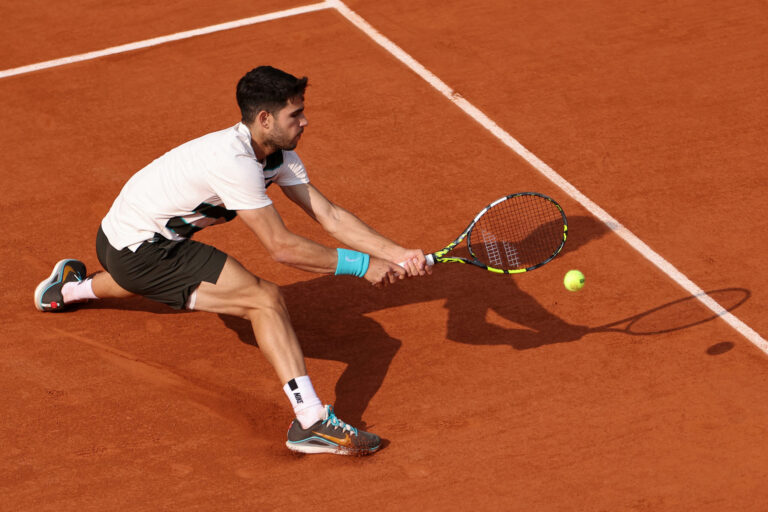
Sliding is possible and necessary. Clay’s loose surface layer allows players to slide into shots — using the surface’s friction properties to stop their movement gradually rather than abruptly.

Sliding on clay is a specific physical skill that clay court specialists develop and refine across years of competition — it allows them to cover more ground per movement, arrive at the ball in better balance, and recover their position after wide shots more efficiently than stopping abruptly would allow.

Players who have not developed sliding technique on clay must stop and reset in ways that cost them time and positioning relative to their clay court-trained opponents.

Lateral movement becomes paramount. The extended rallies of clay court tennis require players to cover significantly more court laterally than on faster surfaces — moving to wide balls, recovering to the center, moving to the next wide ball in a sustained cycle of lateral movement across long exchanges.

The physical conditioning required to sustain high-quality lateral movement across five-set matches on clay is greater than the equivalent requirement on faster surfaces where shorter points reduce the movement volume per match.

Court surface deterioration affects footwork. Over the course of a match — and particularly over the course of a two-week tournament — clay court surfaces develop worn areas near the baseline where players consistently position themselves.

These worn areas can affect footing and ball bounce in ways that hard courts do not — creating a specific unpredictability in the tournament’s later stages that the earlier rounds on fresher surfaces do not produce.

What Clay Rewards and What It Punishes

Synthesizing the physical properties of clay and their competitive consequences, it becomes clear that clay rewards a specific combination of competitive qualities and punishes their absence more severely than any other surface.

Clay rewards: Heavy topspin generation, physical endurance, lateral movement and court coverage, tactical patience and point construction, defensive retrieving, sliding technique, consistency over aggression.

Clay punishes: Reliance on serving free points, flat-hitting approaches that depend on pace retention, net-rushing tactics that depend on the serve’s time advantage, physical conditioning that prioritizes power over endurance, and the aggressive point-ending style that faster surfaces reward.

The players who have dominated Roland Garros across the Open Era — Nadal’s fourteen titles, Graf and Evert’s seven each, Borg’s six — represent the competitive profiles that these properties reward most completely.

Their games were built around the qualities that clay amplifies and away from the qualities that clay neutralizes — a specific optimization for the surface that produced the most extreme concentrations of Grand Slam excellence in the tournament’s history.

Reading Clay Court Tennis

Understanding what red clay does to the ball and to the competitive environment transforms how you watch Roland Garros. The extended rallies are not simply longer versions of hard court exchanges — they are the specific product of clay’s pace absorption creating rally structures that fast surfaces cannot generate.

The serve’s reduced dominance is not a function of the servers’ quality — it is the surface preventing the serve from operating as the dominant weapon it is elsewhere. The sliding movement of clay court specialists is not simply a stylistic preference — it is the specific physical adaptation that clay’s loose surface layer makes both possible and necessary.

Roland Garros looks different because it is different. Every element of the competitive environment — the ball physics, the rally structure, the movement patterns, the tactical approaches — is shaped by the specific properties of the red clay surface that has been the French Open’s defining characteristic for nearly a century. Reading those properties is reading the tournament itself.


Part of the Roland Garros series. Related: Why Roland Garros Is the Hardest Grand Slam to Win · Why Clay Specialists Thrive in Paris · The Architecture and Importance of Court Philippe-Chatrier

Why Roland Garros Is the Hardest Grand Slam to Win

0

Every Grand Slam is hard to win. Winning any of the four major championships requires seven consecutive victories over a fortnight against the deepest competitive field in professional tennis, under the specific physical and psychological pressures that Grand Slam competition generates.

The Australian Open’s heat. Wimbledon’s grass and tradition. The US Open’s crowd and night sessions. Each major has its own specific demands that make claiming its title a genuine test of competitive excellence across multiple dimensions.

But Roland Garros is harder. Not marginally harder — structurally, physically, and psychologically harder in ways that the sport’s historical record consistently confirms. The list of players who have dominated professional tennis across their careers but never won the French Open is longer than the equivalent list for any other Grand Slam.

The number of players who have won all four majors — the Career Grand Slam — is smaller than it would be if Roland Garros were as accessible as the other three. And the physical demands of competing across two weeks on the red clay surface are greater than at any other major — a fact that the sport’s players, coaches, and analysts acknowledge consistently and that the injury patterns of the professional calendar confirm.

This article examines why Roland Garros is the hardest Grand Slam to win — the specific surface properties, the physical demands, the tactical requirements, and the psychological challenges that make winning in Paris a fundamentally different achievement from winning at the other three majors.

The Clay Surface: Why It Changes Everything

The fundamental reason Roland Garros is the hardest Grand Slam to win is the surface it is played on. Red clay — crushed brick packed into a specific composition that absorbs pace, amplifies topspin, and produces the highest-bouncing, most physically demanding playing conditions in professional tennis — is not simply a different surface from the hard courts and grass of the other Grand Slams. It is a surface that rewards a specific and relatively rare combination of qualities in ways that the other surfaces do not.

Hard courts — the surface of the Australian Open and US Open — are the most neutral major surface. They reward all-around excellence without dramatically amplifying the advantage of any single playing style. A flat hitter can succeed.

A topspin player can succeed. A serve-dominant player can succeed. The surface is demanding but it does not impose the same specific requirements on successful competitors that clay imposes.

Grass — the surface of Wimbledon — rewards serving power and net play more specifically than hard courts but is not as extreme in its demands as clay. The low bounce keeps rallies shorter, which means that physical endurance is less critical than on clay, and the serve’s dominance creates more free points that reduce the reliance on sustained baseline construction.

Clay rewards physical endurance above all other qualities — and punishes its absence more completely than any other surface. The high bounce forces players behind the baseline. The slow pace extends rallies to lengths that hard courts and grass do not produce. The surface absorbs the pace of flat shots, reducing the effectiveness of serves and groundstrokes that would end points immediately on faster surfaces.

The physical demands of competing across five-set men’s matches on clay — sustaining the movement, the topspin generation, and the baseline construction that clay court success requires across four to five hours — are greater than the equivalent demands at any other Grand Slam.

The Physical Demands of Winning Seven Matches on Clay

Winning Roland Garros requires winning seven matches. That is the same number required at every Grand Slam. But the physical cost of winning seven matches on clay is meaningfully greater than the physical cost of winning seven matches on hard courts or grass — and that difference compounds across the fortnight in ways that make the final stages of the French Open uniquely demanding.

The average match duration at Roland Garros is longer than at any other Grand Slam. The combination of extended rallies, slower-paced exchanges, and the surface’s specific resistance to the pace-based point-endings that faster surfaces produce means that Roland Garros matches simply take longer — more points per game, more games per set, more physical expenditure per match than equivalent rounds at the Australian Open, Wimbledon, or US Open.

The cumulative physical toll of seven long matches across two weeks on a physically demanding surface creates a specific fatigue profile that players managing toward the final stages of Roland Garros experience differently from other majors.

A player who reaches the Roland Garros final has typically spent more time on court, covered more ground, generated more topspin, and sustained more physical wear than a player who has reached the final of any other Grand Slam.

This accumulated physical demand means that the Roland Garros final is not simply a match between two excellent players — it is a match between two players who have each endured the most physically demanding path to a Grand Slam final that professional tennis produces.

The specific quality of physical preparation that Roland Garros champions require is different from what other Grand Slam champions require — not just the technical clay court excellence but the endurance base that sustains that excellence across seven matches of extraordinary physical demand.

Surface-Specific Technical Requirements

Beyond the physical demands, Roland Garros imposes specific technical requirements that players whose games are optimized for faster surfaces must develop or acquire to compete effectively.

Heavy topspin is a necessity, not an option. On clay, a flat-hit groundstroke loses pace through the surface and sits up in the opponent’s comfortable strike zone — an invitation to attack rather than a weapon in its own right.

Heavy topspin — which kicks above shoulder height on clay, forces opponents behind the baseline, and generates physical pressure through the height and pace of the bounce — is the primary offensive weapon on the surface. Players who cannot generate heavy topspin consistently are playing with a fundamental tactical limitation at Roland Garros that faster surfaces do not expose.

Serve dominance is significantly reduced. The clay surface absorbs the pace of first serves and reduces their effectiveness more completely than any other Grand Slam surface. Players who rely heavily on serving free points — aces, service winners, and the rally-shortening effect of a powerful first serve — find those advantages dramatically reduced at Roland Garros. The serve is still important on clay, but its ability to dominate points as completely as at Wimbledon or the US Open is significantly curtailed.

Movement and court coverage become paramount. The extended rallies that clay produces mean that court coverage — the ability to reach and return balls that faster surfaces would allow to pass — is more important at Roland Garros than at any other Grand Slam.

Players with exceptional movement who can sustain that movement across five-set matches are significantly advantaged on clay over players with similar technical skills but inferior movement.

Patience and point construction replace aggression. On faster surfaces, aggressive baseline play — stepping inside the baseline, taking balls early, generating pace that opponents cannot handle — is the primary tactical approach. On clay, that aggression is often neutralized by the surface — the ball sits up and allows opponents to handle pace that would be unmanageable on hard courts.

Clay court success requires building points through patient construction, moving opponents around the court, creating openings through accumulated pressure rather than individual explosive shots.

The Career Grand Slam Test

The most revealing statistical evidence that Roland Garros is the hardest Grand Slam to win is the Career Grand Slam record — the list of players who have won all four majors across their careers.

The Career Grand Slam requires winning at Wimbledon, the US Open, the Australian Open, and Roland Garros. Players who have achieved all four are genuinely exceptional — the combination of all-surface excellence required to win at each major makes the Career Grand Slam a rare achievement. But the specific missing piece for players who have won three of the four majors but not the fourth is almost always Roland Garros.

Pete Sampras won fourteen Grand Slams including seven Wimbledons and five US Opens but never won Roland Garros. John McEnroe won seven Grand Slams across three surfaces but never won Roland Garros. Jimmy Connors won eight Grand Slams but never won Roland Garros. Stefan Edberg won six Grand Slams but never won Roland Garros. Boris Becker won six Grand Slams but never won Roland Garros.

The pattern is consistent — the players who failed to complete the Career Grand Slam are overwhelmingly players whose games were built around the serve-and-volley or flat-driving approaches that clay penalizes most severely.

Their failure to win Roland Garros was not a reflection of overall excellence — each of these players was among the most accomplished of their era. It was a reflection of the specific gap between their technical profiles and the specific demands of the clay court game.

On the women’s tour, the equivalent pattern is less extreme — the specific demands of clay court tennis in the women’s game are somewhat more accessible to all-round players than in the men’s game — but the same principle applies.

Players whose games are not specifically suited to clay have consistently found Roland Garros the most difficult of the four majors to add to their collection.

The Transition Challenge: From Other Surfaces to Clay

One of the specific challenges that makes Roland Garros harder than the other Grand Slams is the transition problem — the difficulty of arriving at the French Open in optimal competitive condition after a season that has been played primarily on hard courts.

The professional calendar year begins on hard courts in Australia and concludes on hard courts in North America and Europe. The clay court season — running from approximately April through Roland Garros in early June — is a relatively brief window in which players must transition from the fast, flat-ball game that hard courts reward to the topspin-heavy, physically demanding game that clay requires.

This transition is genuinely difficult for players whose games are hard court-oriented. The technical adjustments required — different swing paths, different court positions, different tactical constructions — take time to implement.

Players who arrive at Roland Garros having spent five months on hard courts are not playing the clay court game at its most refined level regardless of how much preparation time they have invested in the weeks before the tournament.

Clay court specialists — players whose games are built around clay court excellence — do not face the same transition problem. They have maintained clay court technique across the hard court months through training and have arrived at the clay season ready to compete at their clay court ceiling.

This asymmetry in transition difficulty is one of the structural factors that makes Roland Garros more accessible to clay specialists than to hard court players, and more difficult for hard court players than for clay specialists — regardless of overall ranking.

The Weather Factor

Roland Garros is the Grand Slam most affected by weather conditions — a factor that adds a specific layer of difficulty that the other majors, with their greater weather protection or more predictable climates, do not produce to the same degree.

Paris in late May and early June is not reliably warm and dry. The spring weather produces frequent cloud cover, occasional cold spells, and rain interruptions that have historically been one of the defining characteristics of the French Open experience.

Cool temperatures affect ball behavior on clay specifically — the ball sits heavier and bounces lower in cold conditions, changing the tactical parameters of clay court tennis in ways that players must adapt to mid-tournament.

Rain delays at Roland Garros have historically been more frequent and more disruptive than at other Grand Slams — a consequence of the Paris spring climate and, until 2020, the absence of a roof over Court Philippe-Chatrier.

The delays could extend matches across multiple days, disrupting rhythm and preparation in ways that the controlled environments of hard court Grand Slams do not produce.

The retractable roof has addressed the rain delay problem for Court Philippe-Chatrier but has not changed the broader weather reality of competing in Paris in spring. Courts without roof protection — including Courts Lenglen and Mathieu — remain weather-dependent, and the overall climate of the French Open fortnight continues to be one of the most variable of any Grand Slam.

The Psychological Demands

The psychological challenge of winning Roland Garros is different from the psychological challenge of winning other Grand Slams — and in certain specific ways it is more demanding.

Patience under sustained pressure. Clay court tennis requires maintaining tactical patience across long rallies and long matches in ways that faster surfaces do not. The temptation to force the pace — to try to end points aggressively before the construction work that clay requires has been completed — is one of the most common tactical errors on clay, and resisting it across seven matches over two weeks requires a specific form of psychological discipline.

Managing physical fatigue while maintaining technical quality. As the tournament progresses, the accumulated physical demands of clay court competition become a psychological challenge as well as a physical one. Maintaining the technical precision that clay requires — the swing mechanics, the court positioning, the topspin generation — when physically fatigued is harder than on faster surfaces where physical condition matters somewhat less.

Performing under the specific pressure of Roland Garros’s cultural significance. The French Open carries a specific cultural weight in the tennis world — its historical status as the most physically demanding Grand Slam, its association with the sport’s greatest clay court champions, and the specific awareness that winning it requires overcoming challenges that have defeated many great players creates a psychological environment that competitors at other majors do not face in quite the same way.

For players who have reached the later rounds of Roland Garros multiple times without winning, the psychological weight of previous near-misses adds a dimension of accumulated pressure that the other Grand Slams rarely produce.

The Evidence Is in the Records

The clearest evidence that Roland Garros is the hardest Grand Slam to win is not any single argument about surface or weather or physical demands — it is the accumulated record of professional tennis across the Open Era.

The Career Grand Slam list is shorter than it would be if Roland Garros were as accessible as the other three majors. The list of players who have dominated the sport without winning the French Open is longer than the equivalent list for any other Grand Slam.

The specific players who have won Roland Garros most frequently — Nadal, Graf, Evert, Borg — are players whose technical and physical profiles were specifically optimized for clay in ways that all-court players rarely match.

And the reactions of players who have finally won Roland Garros after years of attempting — the specific emotional intensity, the sense of relief alongside the joy, the acknowledgment of what was overcome to achieve the title — reflect something that winning on faster surfaces does not always produce in the same way.

Roland Garros is harder. The evidence is everywhere. The records confirm it. And the experience of every player who has competed at the French Open and either won it or failed to win it — knows it.

Part of the Roland Garros series. Related: How Red Clay Changes Tennis at Roland Garros · Why Clay Specialists Thrive in Paris · Rafael Nadal at Roland Garros — The Most Dominant Performance in Grand Slam History


Draper Gets First Win Over Djokovic at Indian Wells

0

Jack Draper fought off Novak Djokovic in a punishing three-set match Wednesday to reach the quarter-finals and keep his title defense on track at the BNP Paribas Open.

The British player came from a set down to win 4-6, 6-4, 7-6 (7-5) in a contest that tested both men’s fitness and resolve. This marked Draper’s first career victory over the 24-time Grand Slam champion and came in his second tournament back after missing nearly six months with an arm injury.

Draper dropped the opening set but responded strongly in the second. The real test arrived in the decider. An extraordinary 26-shot rally unfolded in the opening game as both players chased drop shots and lobs across the court. Djokovic eventually put away an overhead but collapsed onto the ground in exhaustion straight afterward.

That moment appeared to drain the 38-year-old Serb. Although he held serve, Draper broke him in the next service game. Serving for the match at 5-4, the Briton let the opportunity slip, which allowed Djokovic to force a tiebreak.

Djokovic led 4-3 in the tiebreak, but Draper stayed composed and closed it out 7-5 after more than two and a half hours on court. He relied on well-timed drop shots throughout to keep the former world number one moving.

After the match, Djokovic pointed to one key moment as the difference. “One point. It was great winning that point in that game, but I just ran completely out of gas.” He added that Draper’s missed chance at 5-4 briefly lifted his hopes.

“He played a sloppy game to close it out 5-4, and I got the crowd backing me and I felt the energy. It was so, so close.” The 38-year-old admitted he left the court with a bitter feeling after the narrow loss.

Draper spoke of the mindset that carried him through. “I came out here tonight and I won that match through determination and trying to problem-solve and do my best and have a great attitude.” Facing one of his heroes clearly meant a lot. “To come out here against Novak, for me the greatest tennis player there is, I’m just incredibly proud of myself.”

Draper now faces Daniil Medvedev in the quarter-finals on Thursday. The Russian reached the last eight with a straightforward 6-2, 6-4 win over American Alex Michelsen.

World number one Carlos Alcaraz stayed unbeaten in 2026 by beating Casper Ruud 6-1, 7-6 (7-2). He dominated the opening set and held firm in the tiebreak to extend his perfect start to 15-0 this season after titles at the Australian Open and the Qatar Open. Alcaraz said he felt completely in control early on. “My first set, I think I was unplayable to be honest. I was really, really happy about playing at that level.”

The Spaniard will next meet Cameron Norrie, who advanced with a 6-4, 6-2 victory over Australian qualifier Rinki Hijikata. Norrie, the 2021 Indian Wells champion, beat Alcaraz at the Paris Masters last year, which adds extra interest to their quarter-final.

Draper’s performance showed clear signs of his recovery and fighting spirit. The victory over Djokovic delivered one of the tournament’s most memorable points and sets up another tough test against Medvedev as the BNP Paribas Open moves into the quarter-final stage in the California desert.

What Makes Melbourne Park Different From Other Grand Slam Venues

The four Grand Slam venues are among the most recognizable sporting arenas in the world, but they are far more different from one another than they might appear on a television screen.

Melbourne Park — home of the Australian Open — stands apart from Wimbledon, Roland Garros, and Flushing Meadows in ways that go well beyond geography. Here’s what makes it genuinely unique.

It Was the First Venue in the World With a Retractable Roof on a Tennis Stadium

When Rod Laver Arena opened in 1988, it featured something no tennis venue — and no major sporting venue anywhere in the world — had ever had before: a fully retractable roof. The 700-tonne structure could open or close in around 20 minutes, allowing play to continue in rain or to be protected from Melbourne’s extreme summer heat.

Wimbledon, often regarded as the spiritual home of tennis, didn’t add a retractable roof to Centre Court until 2009 — more than two decades later. Roland Garros followed with a roof on Court Philippe-Chatrier in 2020. The US Open’s Arthur Ashe Stadium received its retractable roof in 2016.

Melbourne Park went further still. It is the only Grand Slam venue in the world with retractable roofs on three courts — Rod Laver Arena, Margaret Court Arena, and John Cain Arena — giving tournament directors far more flexibility to manage weather and extreme heat disruptions than any of its rivals can match.

It Sits in the Middle of the City

Melbourne Park’s location is one of its most distinctive qualities. The precinct sits on the edge of Melbourne’s central business district, just minutes from Flinders Street Station and the city centre, bordered by the Yarra River and the Melbourne Cricket Ground. It is as urban a Grand Slam setting as exists in world tennis.

Compare this to the other venues. The All England Club at Wimbledon is set in a quiet residential suburb in southwest London, accessed by a long queue and a short walk from the nearest tube station.

Roland Garros is tucked into the 16th arrondissement of Paris, hemmed in on all sides by residential streets and the Bois de Boulogne, with almost no room to grow. The USTA Billie Jean King National Tennis Center at Flushing Meadows sits in a large park in the New York borough of Queens — accessible but far from central.

Melbourne Park’s city-edge position means it integrates naturally into Melbourne’s broader sporting and entertainment precinct, sitting alongside the MCG, Marvel Stadium, and AAMI Park. The Tanderrum Bridge, which opened in 2017, physically connects the venue to Melbourne’s CBD, making it walkable from the city in a way that no other Grand Slam venue can claim.

It Is the Largest Tennis Precinct in the World by Total Capacity

Arthur Ashe Stadium in New York holds over 23,700 spectators — the largest individual tennis stadium on the planet. But in terms of total precinct capacity, Melbourne Park holds its own. The site can accommodate over 40,000 fans across its 35 outdoor courts and three main arenas, making the overall venue footprint among the most expansive in the sport.

The grounds-pass culture at Melbourne Park is a significant part of what this capacity enables. Unlike Wimbledon, where the queue for grounds access is a ritual unto itself, or Roland Garros, where the compact site limits how many fans can comfortably wander, Melbourne Park’s open precinct design invites fans to roam freely between courts, food outlets, fan activations, and live viewing areas.

The Australian Open has consistently broken Grand Slam attendance records in recent years, drawing over 1.2 million visitors across the 2025 tournament.

It Is a True Multi-Purpose Venue, Year-Round

Wimbledon’s grass courts are famously closed for most of the year to recover and be prepared for the following season. Roland Garros uses its clay courts for other events but is fundamentally a tennis-only complex. Melbourne Park, by contrast, functions as a major live entertainment and multi-sport venue throughout the year.

Rod Laver Arena and Margaret Court Arena host some of Australia’s biggest concert tours. John Cain Arena is a regular home for Melbourne United basketball (NBL) and two Super Netball teams — the Melbourne Vixens and the Collingwood Magpies.

The precinct has hosted ice skating, track cycling, beach volleyball, and international swimming events. Just two weeks after the 1988 Australian Open final, AC/DC played the first of five consecutive nights at what was then Centre Court. Pink Floyd followed shortly after.

This multi-purpose model was built into Melbourne Park’s DNA from the start — the venue was conceived by the Victorian Government as a public asset designed to deliver broad economic and social benefits to the state, not simply to host a tennis tournament once a year.

It Has Three Courts Named After Australian Legends

The naming of Melbourne Park’s three main courts tells a story about Australian tennis history that no other Grand Slam venue replicates.

Rod Laver Arena — the main show court — honors the Queenslander who won 11 Grand Slam singles titles and remains the only player in the Open Era to complete the calendar Grand Slam twice.

Margaret Court Arena recognizes the holder of the all-time record of 24 Grand Slam singles titles.

John Cain Arena — renamed in 2021 from Melbourne Arena — is named after a former Premier of Victoria rather than a tennis figure, but the court’s identity has evolved alongside the precinct’s history.

By contrast, Wimbledon’s courts are simply called Centre Court and Court 1. The US Open’s main arena bears the name of Arthur Ashe, the great American champion. Roland Garros names its courts after French tennis figures — Philippe Chatrier, Suzanne Lenglen, and Simonne Mathieu — but the stadium itself is named after a World War I aviator who played no tennis at all.

Only Melbourne Park has its two most prominent courts named after Australian Open champions.

It Has Changed Its Surface Three Times

No other Grand Slam has altered its playing surface as significantly or as often as the Australian Open at Melbourne Park. The tournament arrived at Flinders Park in 1988 on Rebound Ace, having left the grass courts of Kooyong behind.

After 20 years, concerns about the surface’s heat retention properties led to a switch in 2008 to Plexicushion Prestige — the blue surface that would become visually synonymous with the Australian Open for a decade. In 2020, the tournament switched again to GreenSet, the medium-fast acrylic surface in use today.

Wimbledon has played on grass since 1877. Roland Garros has played on clay since its inception. The US Open’s switch from grass to clay to hard court happened in the 1970s, before the modern era of the venue.

The Australian Open’s willingness to keep evolving its surface reflects a broader philosophy at Melbourne Park: this is a venue that prioritizes performance and innovation over tradition. For a deeper comparison with the other hard-court Slam, see Why the Australian Open Plays Differently from the US Open.

It Pioneered Technology in the Sport

Melbourne Park has a consistent track record of being first. The retractable roof was the most dramatic example, but the Australian Open has also been an early adopter of electronic line-calling technology.

The tournament was among the first Grand Slams to deploy Hawk-Eye electronic line judges across all courts, eventually moving to a fully automated system that eliminated human line judges entirely on the main show courts — a change that has since been adopted, with debate, at other majors.

The tournament has also embraced fan technology, data visualisation, and in-venue digital infrastructure earlier and more ambitiously than most of its counterparts. It was the first Grand Slam to launch a comprehensive tournament app and has consistently invested in the spectator experience as a competitive differentiator.

The Night Session Culture Is Built Into the Venue

The introduction of floodlit night tennis at Melbourne Park in 1988 transformed the Australian Open’s identity overnight. Where the old Kooyong club lacked the lighting infrastructure for evening play, Melbourne Park was purpose-built for it — and within a single tournament, night sessions became one of the defining experiences of the Slam.

Rod Laver Arena under the lights — roof closed, air conditioning running, packed crowd, big-name match in progress — is one of the most distinctive atmospheres in tennis. The venue’s design enables this in a way none of the other Slams can fully replicate. Wimbledon’s 11pm curfew and grass-court tradition limit night play. Roland Garros runs a single night-session match per evening. The US Open has its own electric night-session culture, but the venue is more sprawling and less enclosed than Rod Laver Arena.

The “Happy Slam” Reputation Is Venue-Driven

The Australian Open’s reputation as the “Happy Slam” — relaxed, fan-friendly, and welcoming — is not simply a matter of Australian culture. It is substantially a product of the venue itself.

Melbourne Park’s open grounds, warm January evenings, city-center location, and festival atmosphere create conditions for a tournament that feels different from the formality of Wimbledon, the grit and intensity of Roland Garros in the cold Paris spring, or the frenetic energy of New York’s late summer.

Players consistently rank Melbourne Park among the best venues they compete at. The off-court facilities, the player amenities, and the overall standard of the precinct were noted as world-class from opening day in 1988 — and decades of continued investment have kept that standard high.

It is no coincidence that many of the sport’s biggest names have produced some of their most memorable performances here.

Frequently Asked Questions

Why is Melbourne Park unique among Grand Slam venues? It was the first tennis venue in the world to feature a retractable roof (1988), remains the only Grand Slam with retractable roofs on three courts, sits in a city-centre location rather than a suburban park, operates as a multi-purpose year-round venue, and has changed its playing surface three times — none of which the other three Slams can match.

How many retractable roofs does Melbourne Park have? Three — covering Rod Laver Arena, Margaret Court Arena, and John Cain Arena. Wimbledon, Roland Garros, and the US Open each have one retractable roof, covering only their main show court.

How big is Melbourne Park? The precinct holds over 40,000 spectators across 35 outdoor courts and three main arenas, with Rod Laver Arena seating around 15,000 — making the overall venue footprint one of the largest in tennis. The 2025 Australian Open drew more than 1.2 million visitors.

Why is the Australian Open called the “Happy Slam”? The nickname reflects the tournament’s relaxed, festival atmosphere — driven substantially by Melbourne Park’s open grounds, summer climate, central city location, and multi-purpose design. Players have consistently described the AO as one of the most welcoming tournaments on the calendar.

Who are Melbourne Park’s three main arenas named after? Rod Laver Arena (the 11-time Grand Slam champion and the only Open Era player to complete the calendar Grand Slam twice), Margaret Court Arena (the holder of the all-time Grand Slam singles record at 24 titles), and John Cain Arena (a former Premier of Victoria — renamed from Melbourne Arena in 2021).

Has the Australian Open always been played at Melbourne Park? No. The tournament moved to Melbourne Park (then called Flinders Park) in 1988, switching from the grass courts of the Kooyong Lawn Tennis Club. For the full venue history, see How the Australian Open Found Its Home at Melbourne Park.

What other events are held at Melbourne Park? The venue hosts concerts, basketball, netball, ice skating, swimming, and other major sporting and entertainment events throughout the year. AC/DC famously played five consecutive nights at what was then Centre Court just two weeks after the 1988 Australian Open final.

The Bottom Line

Melbourne Park is not simply a Grand Slam venue that happens to be in Australia. It is a purpose-built, multi-use, city-integrated precinct that pioneered features the rest of world tennis eventually followed.

Three retractable roofs. A central city location. Year-round activation. A surface that has evolved with the sport. The first venue in the world to think about what a major tennis complex could be, rather than simply inheriting what one had always been. That combination of ambition, innovation, and scale is what sets it apart.

Australian Open Night Sessions Explained

Night sessions at the Australian Open are some of the most anticipated events on the tennis calendar — but they come with a scheduling structure, a ticketing system, and a history of controversy that first-time attendees and new fans don’t always know about. Here’s everything you need to understand before you go, or tune in.

When Did Night Sessions Begin at the Australian Open?

Night sessions at the Australian Open were born the moment the tournament moved to Melbourne Park in 1988. The new venue was purpose-built with floodlighting infrastructure that the old Kooyong Lawn Tennis Club simply didn’t have, making evening play possible for the first time in the tournament’s history.

The very first night session at Flinders Park — as Melbourne Park was then known — took place on January 11, 1988, the opening day of that inaugural tournament. Ivan Lendl and Martina Navratilova were the winners in the first-ever night matches, making them unlikely footnotes in Australian Open history. It was an immediate hit with fans and broadcasters, and night tennis has been a defining feature of the tournament ever since.

How the Session Structure Works

The Australian Open divides each day of competition into two separate ticketed sessions on its main show courts: a day session and a night session. These are distinct events, each requiring their own ticket.

Day sessions begin at 11:00am, with gates opening from 10:00am. Traditionally, two to three matches are scheduled on Rod Laver Arena and two to three on Margaret Court Arena during the day session.

Night sessions begin at 7:00pm, with night ticket holders permitted to enter the grounds from 5:00pm. Typically two matches are scheduled across the main courts during the evening — usually one on Rod Laver Arena and one on Margaret Court Arena.

An important practical note for ticket buyers: day session ticket holders cannot stay in the main stadiums for the night session.

They must vacate Rod Laver Arena and Margaret Court Arena at the conclusion of day play, though they may remain on the grounds and watch matches on the outside courts. Night session ticket holders, by contrast, cannot access the grounds before 5:00pm.

Why the Night Session Matters for Fans

Night sessions are where the biggest names are most often scheduled. Tournament directors use evening slots to showcase marquee players — the likes of Novak Djokovic, Carlos Alcaraz, Aryna Sabalenka, and Iga Świątek — when the largest audiences, both in-person and on television, are available.

As a result, night session tickets tend to be more expensive than day session equivalents, typically by around AU$15–20, because of the premium placed on the star power they’re likely to deliver.

The downside for fans is that because the draw is only released a few days before the tournament and the order of play is only confirmed the evening before each match day, it is impossible to guarantee which player you will see when you buy a night session ticket. You are buying access to the session, not a specific match.

The Late Night Problem

Night sessions at the Australian Open have a well-documented scheduling problem: they regularly run very, very late.

Because the day session on the main courts can feature up to three matches, delays from long earlier matches push the night session start time back. The night session itself then kicks off no earlier than 7:00pm — and when it features competitive five-set men’s matches, the final ball can be struck deep into the early hours of the morning.

The all-time record for the latest finish in Australian Open history belongs to Lleyton Hewitt and Marcos Baghdatis, whose first-round match in 2008 concluded at 4:33am. The second-latest finish came in 2023, when Andy Murray defeated Thanasi Kokkinakis at 4:05am after a five-set, five-hour-and-45-minute second-round battle.

Murray was candid afterwards, saying that finishing matches at 4 in the morning was not good for players and not good for the sport. Novak Djokovic echoed the sentiment, noting that even winning such a late match left players with a severely disrupted sleep cycle and insufficient time to recover before their next match.

The problem was still present in 2024, when Daniil Medvedev did not begin his second-round match until 11:16pm after two preceding matches on Rod Laver Arena overran.

The 2024 ATP and WTA Scheduling Rules — and Why the AO Doesn’t Have to Follow Them

In January 2024, the ATP and WTA jointly introduced scheduling rules for their own tour-level events aimed at reducing late-night finishes. The new framework set a cap of no more than five matches per day per court — three in the day session, two in the evening — with a recommended night session start of 6:30pm and a requirement that no new match start after 11:00pm except with specific approval.

As a Grand Slam, the Australian Open is governed independently by the International Tennis Federation rather than by the ATP and WTA. The tour-level rules do not apply to it. The Australian Open kept its 7:00pm night session start time and continued to schedule up to three day-session matches on the main courts when the rules took effect.

This is a recurring tension in tennis governance: rule changes the tours introduce to protect players don’t automatically extend to the four majors, which have their own scheduling authority. The same dynamic applies to the ATP’s new 2026 heat rule, which similarly doesn’t bind Grand Slams.

What the Australian Open Did to Fix It

Starting in 2024, the Australian Open expanded to a 15-day event by beginning on a Sunday rather than a Monday. As part of that change, the number of day session matches on the main show courts was reduced from three to a minimum of two, giving the schedule more breathing room before the night session begins.

The move was broadly welcomed as a practical improvement, though critics — including ESPN commentator John McEnroe — pointed out that the extra day also conveniently added another day of ticket and broadcast revenue.

Whether the change has fully solved the late-night problem remains a matter of ongoing debate: overruns still occur when earlier matches go long, and the 7:00pm night session start time has not been brought forward.

Players and commentators have continued to suggest further fixes, including starting night sessions at 6:00pm or 6:30pm, limiting the day session to two matches per court, or scheduling just one match per court in the evening with a backup plan for injury retirements. None of these changes has been formally adopted as of 2026.

Night Sessions and Television Scheduling

One reason the Australian Open’s late nights have persisted is the tournament’s unusually favourable position on the global broadcast calendar. Melbourne’s time zone — Australian Eastern Daylight Time, which is UTC+11 in January — puts the Australian Open in prime daytime viewing slots across major European and Asian markets.

A match finishing at 3:00am in Melbourne is reaching viewers in London, Paris, and Beijing during their evening hours. That broadcast value is considerable, and it creates a structural incentive for the tournament to pack as much marquee tennis into the evening hours as possible.

This tension between broadcast revenue, player welfare, and the live spectator experience is at the heart of the scheduling debate — and it is unlikely to be fully resolved as long as the commercial interests at stake remain so significant.

How Night Tennis Plays Differently

Beyond the scheduling debate, night tennis at Melbourne Park genuinely plays differently than day tennis. With the roof closed and the air conditioning engaged, the GreenSet hard court surface and the air conditions create a faster, lower-bouncing court than during sun-soaked day sessions. Hot air expands the gas in tennis balls, making them fly faster and bounce higher; cooler night conditions produce the opposite effect.

The crowd also feels different. Night sessions at Rod Laver Arena are some of the loudest, most electric atmospheres in tennis — the closed roof traps the noise, and the dedicated single-session audience that arrived after 5:00pm tends to be more vocal than day-session fans who have been on the grounds for hours.

For a sense of how other Grand Slam venues compare, see What Makes Melbourne Park Different From Other Grand Slam Venues.

Night Session Tickets: What You Need to Know

For anyone planning to attend, here are the key practical points:

  • Tickets are session-based, not match-based. You cannot buy a ticket to see a specific player. You buy access to a session and discover the order of play the night before.
  • Night session gates open at 5:00pm. Night ticket holders cannot enter earlier.
  • Day session holders must vacate the main arenas at the end of the day session, though they can stay on the grounds for outside court matches.
  • Night sessions typically feature two matches — one women’s match followed by one men’s match, or two singles matches across the two main courts.
  • Be prepared for a late finish. If the men’s match is competitive, you may be there well past midnight.
  • Public transport runs limited services after midnight on weekdays. Check train and tram schedules in advance, particularly for matches that may run deep into the night.

Frequently Asked Questions

When did night sessions begin at the Australian Open? On January 11, 1988, the opening day of the first tournament held at Melbourne Park. Ivan Lendl and Martina Navratilova won the inaugural night matches. The old Kooyong Lawn Tennis Club lacked the floodlighting infrastructure for night play.

What time do Australian Open night sessions start? 7:00pm Australian Eastern Daylight Time. Gates open at 5:00pm for night ticket holders. Day session holders must leave the main arenas before night play begins.

Can I see the same matches on a day session ticket and a night session ticket? No. Day and night sessions are separately ticketed events. Day ticket holders cannot stay in Rod Laver Arena or Margaret Court Arena for the night session, though they may remain on the grounds to watch outside-court matches.

What is the latest finish in Australian Open history? Lleyton Hewitt and Marcos Baghdatis finished their first-round match at 4:33am in 2008 — the all-time record. Andy Murray’s 4:05am win over Thanasi Kokkinakis in 2023 sits second. The Murray-Kokkinakis result prompted significant debate about late-night tennis and contributed to broader scheduling reforms.

Did the ATP and WTA’s 2024 scheduling rules fix late-night tennis? Partially, but those rules apply only to ATP and WTA tour events — not to the Grand Slams. The Australian Open made its own change in 2024 by expanding to a 15-day format and reducing main-court day-session matches, but the 7:00pm night session start was retained, and late finishes still occur when day-session matches overrun.

How is the Australian Open night session different from other Grand Slams? The Australian Open has the latest night session start (7:00pm) of the four Slams and uses the most pronounced day-vs-night session split. Wimbledon has limited night play due to its 11pm curfew. Roland Garros has only one night-session match per evening on Court Philippe-Chatrier. The US Open runs night sessions but with a different start time and structure. Of the four, the Australian Open has the most distinct day/night session culture.

Why can’t I find out which players I’ll see at a night session before buying? The Australian Open releases the order of play the evening before each day’s matches, and the draw itself is only released a few days before the tournament begins. Both schedules can shift based on weather, retirements, and earlier-match overruns. Tickets are sold for access to the session, not for a specific match.

The Bottom Line

Night sessions are one of the most electric experiences in tennis — Rod Laver Arena under the lights, with a full crowd and a big match in progress, is genuinely hard to match anywhere in the sport.

But they come with trade-offs: the uncertainty of not knowing who you’ll see, the real possibility of a very late finish, and an ongoing scheduling tension that the tournament has only partially addressed. Go in with realistic expectations, check the order of play the night before, and plan your transport home accordingly — and you’ll have a great time.

How the Australian Open Found Its Home at Melbourne Park

Melbourne Park has been home to the Australian Open since 1988, but the tournament’s journey to its current address is a story decades in the making — one involving overflowing crowds, a fading grass-court venue, a $94 million construction project, and a transformation that turned a distant fourth Grand Slam into one of the biggest sporting events in the Southern Hemisphere.

A Tournament That Never Stayed Still

For most of its early history, the Australian Open had no fixed home at all. First held in 1905 at the Warehouseman’s Cricket Ground in Melbourne — a venue now known as Albert Reserve — the tournament spent its first six decades bouncing between cities.

Melbourne, Sydney, Adelaide, Brisbane, and Perth all hosted at various points, and the tournament even travelled across the Tasman Sea on two occasions, to Christchurch in 1906 and Hastings in 1912.

The constant rotation made it difficult to build a loyal fan base or attract consistent top-level international players. Getting to Australia from Europe in the early 20th century involved a 45-day journey by ship, which discouraged many of the world’s best players from making the trip at all.

Even within Australia, the distances between cities meant many domestic players couldn’t easily travel to compete when the tournament was held interstate.

Kooyong: A Permanent Home at Last

The wandering era ended in 1972, when it was decided the Australian Open would settle permanently in Melbourne — the city that had consistently drawn the strongest crowds. The venue chosen was the Kooyong Lawn Tennis Club, a historic suburban club in the eastern Melbourne suburb of Kooyong whose iconic horseshoe-shaped grass stadium had opened in 1927.

The Kooyong era produced some of tennis’s most memorable moments. Rod Laver, Ken Rosewall, Evonne Goolagong, John McEnroe, Martina Navratilova, and Mats Wilander all competed there on the club’s grass courts. The 1972 tournament itself was won by Ken Rosewall, who at 37 years and 62 days remains the oldest Grand Slam singles champion in tennis history.

The tournament also went through a peculiar scheduling period during this era. The 1977 Australian Open was played twice — once in January and once in December — as organisers attempted to shift the calendar. The tournament then remained in December until 1985, before moving back to January, which meant the 1986 Australian Open was skipped entirely.

Why Kooyong Had to Go

By the early 1980s, it was becoming clear that Kooyong couldn’t keep pace with the tournament’s growth. The stadium held around 8,500 spectators — a fraction of what other Grand Slams could offer.

The grass courts required intensive maintenance and were vulnerable to Melbourne’s unpredictable summer weather. And the suburban club setting lacked the infrastructure needed to host a truly world-class event.

After the 1983 Australian Open, the International Tennis Federation formally urged the Lawn Tennis Association of Australia to find a new venue, citing Kooyong’s inadequacy for an event of this scale. Upgrade proposals for the club were explored but ultimately fell through.

The final tournament at Kooyong came in 1987. Perhaps sensing the end of an era, a record 140,000 fans attended that year’s event — the biggest crowd the old ground had ever seen. It was the last Australian Open played on grass.

Building Flinders Park: A $94 Million Gamble

In 1985, the Victorian Government identified a site on the edge of Melbourne’s central business district — Flinders Park, a former railyards precinct near the Yarra River — as the location for a new purpose-built National Tennis Centre. The project cost $94 million and was completed in two stages, with the first stage finished in 1987 in preparation for the 1988 tournament.

The new facility was unlike anything tennis had seen. Its centrepiece was a stadium court with a retractable roof — the first of its kind at any tennis venue in the world. The move also brought with it a new playing surface: Rebound Ace, a hard court material that replaced the grass courts of Kooyong and aligned the Australian Open with the US Open as a hard-court Grand Slam. For a fuller account of why Melbourne Park stands apart from other Slam venues, see What Makes Melbourne Park Different From Other Grand Slam Venues.

The reaction when the doors opened was immediate. The Age journalist Tim Colebatch wrote on January 12, 1988, that the National Tennis Centre was “a triumph,” describing spectators and players wandering through it “in a state of wonder at the scale, beauty and excellence of the facilities.” Chris Evert, a finalist that year, called it “pretty close” to the world’s best tennis complex.

1988: The Move Pays Off Immediately

The numbers told the story clearly. Compared with the 1987 tournament at Kooyong, the 1988 Australian Open at Flinders Park drew almost double the number of spectators — 266,436 in total, a 90 percent increase.

Stefan Edberg and Steffi Graf won the singles titles at the inaugural hard-court Australian Open. The tournament’s status, long considered a distant fourth among the four Grand Slams, began to rise.

Night tennis became a regular feature for the first time, enabled by the new facility’s lighting infrastructure. It was a change that would go on to define much of the Australian Open’s modern identity, producing some of the tournament’s most iconic late-night matches.

From Flinders Park to Melbourne Park

The venue continued to evolve through the 1990s. Ahead of the 1996 tournament, the second stage of the National Tennis Centre was completed, effectively doubling the size of the precinct. The expansion added a 3,000-seat Show Court 3 and Garden Square — a grassed public plaza with a giant screen where fans could watch the action outside the main stadiums.

It was also in 1996 that Flinders Park was officially renamed Melbourne Park by the Victorian Government. That same year marked another milestone: the Australian Open was finally granted ranking points equal to the other three Grand Slams, a recognition that the tournament had fully closed the prestige gap with Wimbledon, the French Open, and the US Open.

The Stadiums Get Their Names

The turn of the millennium brought further transformation. In 2000, a new multi-purpose 10,500-seat stadium opened at Melbourne Park, making the venue the first facility in the world to have two roofed tennis stadiums. That arena — now known as John Cain Arena — debuted for tennis at the 2001 Australian Open.

In 2000, the main Centre Court was renamed Rod Laver Arena, honoring the Australian legend who won 11 Grand Slam singles titles and remains the only player in the Open Era to complete two calendar-year Grand Slams.

Three years later, the Show Court 1 was renamed Margaret Court Arena, recognizing the Australian who holds the all-time record of 24 Grand Slam singles titles.

Changing the Surface (Twice)

The switch from grass to hard court in 1988 was just the first of several surface changes at Melbourne Park. Rebound Ace served as the tournament’s surface for 20 years, but by the mid-2000s, concerns about its heat retention — the dark green surface absorbed and radiated significant warmth in Melbourne’s summer conditions — led to calls for a change.

In 2008, Rebound Ace was replaced by Plexicushion Prestige, a blue cushioned acrylic surface that was lighter in color and offered a slightly different pace of play. Mats Wilander remains the only player in history to have won the Australian Open on both grass and hard courts, having triumphed at Kooyong in 1983 and at Flinders Park in 1988.

Then in 2020, Plexicushion was replaced by GreenSet, the surface currently in use. GreenSet is classified by the ITF as a Category 4 (Medium Fast) surface and plays noticeably faster than its predecessor. For more on how the current surface compares to other hard-court Slams, see Why the Australian Open Plays Differently From the US Open.

The Modern Melbourne Park

The Melbourne Park of today looks almost nothing like the Flinders Park that opened in 1988. Decades of investment and expansion have transformed the precinct into one of the world’s premier sporting venues. A major redevelopment program that ran through the 2010s added new facilities, upgraded existing stadiums, and expanded the footprint of the precinct significantly.

The Tanderrum Bridge, opened in 2017, connected Melbourne Park to the city’s edge for the first time, integrating the venue into the broader urban fabric of Melbourne’s CBD. Food, entertainment, and festival infrastructure have grown to match the tournament’s ambition, with the Australian Open now positioning itself as much as an entertainment event as a sporting one.

The 2020 Australian Open injected A$387.7 million into the Victorian economy, and over the preceding decade, the tournament had contributed more than A$2.71 billion in economic benefits to the state.

Frequently Asked Questions

When did the Australian Open move to Melbourne Park? In 1988, when the tournament shifted from the Kooyong Lawn Tennis Club to the newly built National Tennis Centre at Flinders Park. The site was officially renamed Melbourne Park in 1996.

Why did the Australian Open leave Kooyong? Kooyong Lawn Tennis Club had grown too small for a modern Grand Slam. Its 8,500-seat stadium, vulnerable grass surface, and limited infrastructure couldn’t support the tournament’s growth. After the 1983 AO, the ITF formally pressed the Lawn Tennis Association of Australia to find a new venue, and the 1987 tournament — drawing a record 140,000 fans — was the last played on grass.

How much did Melbourne Park cost to build? A$94 million for the first stage, completed in 1987 by the Victorian Government as a purpose-built National Tennis Centre. A second stage in 1996 effectively doubled the precinct’s size.

Where did the Australian Open used to be played before Melbourne? The tournament had no fixed home for its first six decades. Melbourne, Sydney, Adelaide, Brisbane, and Perth all hosted at various points, along with two editions in New Zealand (Christchurch in 1906 and Hastings in 1912). It settled at Kooyong in Melbourne in 1972.

What surface was the Australian Open played on before Melbourne Park? Grass. The tournament was played on grass courts throughout its time at Kooyong (1972–1987). The move to Flinders Park in 1988 brought the switch to a hard court (Rebound Ace), aligning the AO with the US Open as a hard-court Grand Slam.

Who won the first Australian Open at Melbourne Park? Stefan Edberg won the men’s title and Steffi Graf won the women’s title at the inaugural 1988 tournament at Flinders Park. The event drew 266,436 fans — nearly double the previous year’s attendance at Kooyong.

Was the Australian Open ever played outside Australia? Yes. The tournament was held in New Zealand on two occasions — in Christchurch in 1906 and Hastings in 1912 — back when the Australasian Championships covered both countries.

Has the Australian Open ever been skipped? The 1986 Australian Open was skipped entirely when organisers shifted the tournament from December back to January. The 1977 tournament had earlier been played twice (once in January and once in December) during the original calendar shift.

The Bottom Line

The move to Melbourne Park in 1988 was the single most consequential decision in the Australian Open’s history. What had been a charming but limited grass-court tournament at a suburban club became, within a generation, one of the biggest and most commercially significant sporting events on the global calendar.

The retractable roof, the hard court surface, the central location, and the capacity to grow — all of it traces back to that $94 million bet placed by the Victorian Government in 1985. It paid off in full.