
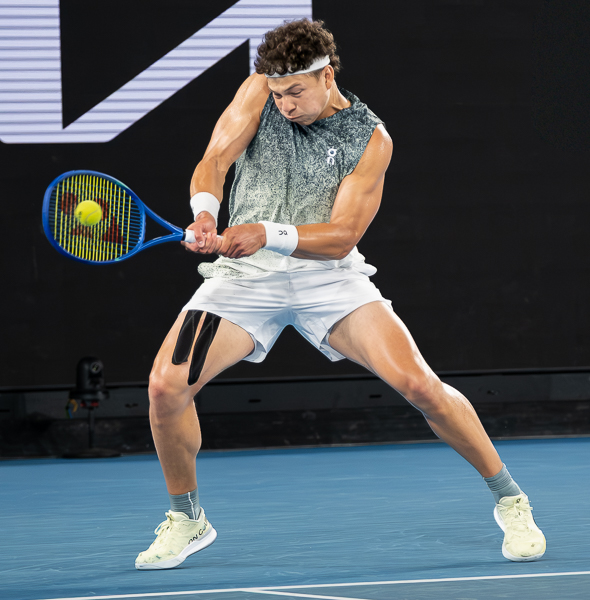
Ben Shelton went from NCAA singles champion to Grand Slam finalist in four years, powered by one of the biggest left-handed serves in the game and an athletic, explosive style. He reached his first major final at the 2026 US Open, beating defending champion Carlos Alcaraz in a five-set quarterfinal that finished at 3:33 a.m. — the latest finish in tournament history — and then Frances Tiafoe 4-6, 6-3, 6-3, 7-5 in an all-American semifinal.
In the final, Alexander Zverev beat him 6-3, 7-6(2), 5-7, 6-2, and Andy Roddick’s 2003 US Open title remains the last major won by an American man. Shelton was the first Black American man to reach the US Open final since Arthur Ashe in 1972, and the first to reach any major final since MaliVai Washington at Wimbledon in 1996. “You’re one of the very best players in the world, maybe the best player in the world this year,” he told Zverev afterwards, according to ESPN.
Quick facts
- Full name: Benjamin Todd Shelton
- Nationality: United States (born Atlanta, Georgia; based in Orlando)
- Born: October 9, 2002 (age 23)
- Height: 6 ft 4 in (1.93 m)
- College: Florida — NCAA singles champion, 2022
- Turned pro: 2022
- Plays: Left-handed, two-handed backhand
- Coach: Bryan Shelton (his father)
- Identity: Explosive lefty with a huge serve and forehand
Season Snapshot — September 27, 2026
- Current standing: world No. 4, a career high, after entering the US Open at No. 9
- US Open: runner-up (l. Alexander Zverev 6-3, 7-6(2), 5-7, 6-2), after beating Carlos Alcaraz in the quarterfinals and Frances Tiafoe in the semifinals
- 2026 titles: Dallas Open (indoor hard), BMW Open in Munich (clay), Stuttgart Open (grass), Canadian Open (outdoor hard)
- All four surfaces: by the ITA’s count, that made him the eighth man in ATP history to win titles on all four surfaces in a single calendar year
- Munich: the first American man to win a clay title at ATP 500 level or above since Andre Agassi at the 2002 Italian Open
- Career titles: 7, including Masters 1000s at the 2025 and 2026 Canadian Open
- Previous best major results: semifinals at the 2023 US Open and the 2025 Australian Open; a Wimbledon quarterfinal in 2025
- Coach: Bryan Shelton, his father, who also coached him at Florida
This snapshot is dated and will change. The career record below does not.
Game overview
Shelton’s game starts with a left-handed serve that ranks among the most powerful on tour, backed by a big forehand and rare athleticism. Coached by his father, Bryan, he has matured quickly from a raw, all-or-nothing hitter into a more complete player, though the serve-and-power combination remains the engine of everything he does.
Playing style and strengths
Serve. A huge lefty delivery that produces aces and free points and bails him out of trouble.
Forehand and athleticism. Explosive power off the forehand and elite movement for his size.
Improving all-court game. Steady development under his father’s coaching, broadening his options.
Pressure points and vulnerabilities
- Consistency on second serve and in extended baseline rallies
- Backhand and return reliability against the very best
- Converting big-match firepower into closing out top opponents
- Beating the very top seeds over five sets, a barrier the Alcaraz quarterfinal broke
Career milestones
- 2022: NCAA singles champion at Florida
- 2023: US Open semifinal as a 20-year-old, his major breakthrough
- 2025: Australian Open semifinal; Wimbledon quarterfinal; maiden Masters 1000 title at the Canadian Open; career-high World No. 5
- 2026: titles on all four surfaces; a second Canadian Open; a first Grand Slam final at the US Open
- Established himself as the No. 1 American man
Grand Slam record in context
Shelton’s major record now runs through a first Grand Slam final, at the 2026 US Open, after semifinals at the 2023 US Open and the 2025 Australian Open and a Wimbledon quarterfinal in 2025. The hard-court majors remain the most likely route for a serve-led game, and New York in particular has rewarded it. The 2026 season complicates the idea that he is only a hard-court player, though: he won on clay in Munich and on grass in Stuttgart in the same year.
Grand Slam best results
- Australian Open: Semifinal (2025)
- Roland Garros: Fourth round (2025)
- Wimbledon: Quarterfinal (2025)
- US Open: Runner-up (2026)
What to watch next
- Zverev — now 0-6 against the German, the player who has stood in his way in two finals
- Turin — a place at the Nitto ATP Finals after a four-title season
- Backing it up — the Asian swing and the indoor season, and a first major title in 2027
Related reading
- US Open 2026 Men’s Final — Zverev vs Shelton
- Shelton Held Every Game in the Fifth, and Ended the Title Defense at 3:33 a.m.
- Tiafoe’s Second Serve Carried Him for One Set, and Shelton Won the Other Three
- Last American Man to Win a Grand Slam
- Tennis Rankings Explained