

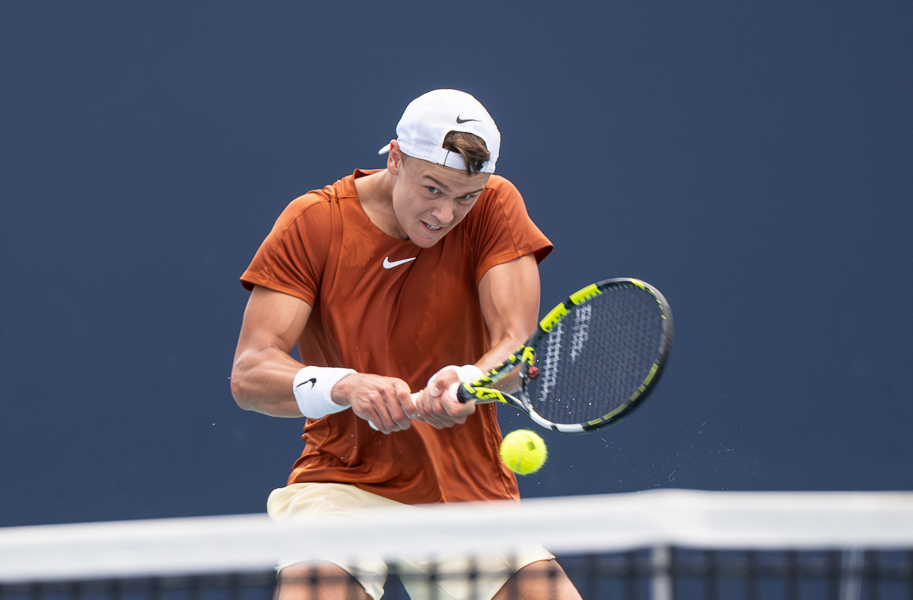
Holger Rune is back. The Danish former world No. 4 tore his left Achilles tendon at the Stockholm Open in October 2025 and did not play a competitive match for 11 months. He returned in September 2026 for Denmark’s Davis Cup World Group I tie against Bulgaria in Copenhagen, beat Iliyan Radulov in his first match, and the next day edged Grigor Dimitrov 3-6, 6-3, 7-6(4) to keep Denmark alive in a 3-2 win, according to the ATP Tour. “It has been 11 months of hard work and I can’t wait to see all my fans and all the Danish people and all the fans around the world again,” he had said on Instagram when announcing the return.
Before the injury, Rune was one of the most dangerous young players on tour: a Masters 1000 champion at 19, a five-time titlist and a 2023 Nitto ATP Finals qualifier. The questions now are how quickly he regains his movement and ranking after a year away, and whether the explosiveness that defined his game comes back with it.
Quick facts
- Full name: Holger Rune
- Nationality: Denmark
- Born: April 29, 2003
- Height: 6 ft 2 in (1.88 m)
- Turned pro: 2020
- Plays: Right-handed, two-handed backhand
- Career titles: 5, including the 2022 Paris Masters
- Career high: World No. 4 (2023)
- Identity: Aggressive, all-court shotmaker with a big forehand and competitive fire
Game overview
At full health, Rune is an aggressive, flat-hitting shotmaker with a heavy forehand, a strong serve and the competitive intensity that produced wins over the very best as a teenager. After an Achilles rupture, the first thing to watch is movement: whether he changes direction without hesitation and trusts the leg in long rallies. Against Dimitrov he held his nerve in the deciding tiebreak after failing to serve the match out at 5-4, the ATP Tour reported.
Playing style and strengths
Forehand and power. A heavy, aggressive forehand that can take over rallies.
Shotmaking and variety. Drop shots, angles and improvisation that make him dangerous and watchable.
Competitive intensity. A fierce on-court temperament that, channelled well, lifts his level against top opponents.
Pressure points and vulnerabilities
- The Achilles: durability over a full schedule after only three matches back
- A ranking that fell steeply during the layoff, meaning unseeded draws on his return
- Match sharpness after 11 months without competition
- Converting his ceiling into deeper major runs, having never reached a Grand Slam semifinal
Career milestones
- 2022: Roland Garros quarterfinal; maiden Masters 1000 title at the Paris Masters at 19, beating Novak Djokovic in the final
- 2023: Quarterfinals at Roland Garros and Wimbledon; career-high world No. 4; Nitto ATP Finals debut
- 2025: Barcelona Open title, beating Carlos Alcaraz in the final
- 2025: Tore his left Achilles at the Stockholm Open in October
- 2026: Returned after 11 months with two Davis Cup singles wins in Copenhagen
Grand Slam record in context
Rune’s major record is the clearest unfinished business: three quarterfinals, two in Paris and one at Wimbledon, but no semifinal. He missed all four majors in 2026 while recovering. The comeback resets that timeline, and the first real test at a major will be the 2027 Australian Open, where his best is the fourth round.
Grand Slam best results
- Australian Open: Fourth round (2023, 2025)
- Roland Garros: Quarterfinal (2022, 2023)
- Wimbledon: Quarterfinal (2023)
- US Open: Third round (2022)
What to watch next
- The tour return: he lost his first ATP Tour match back, to Kyrian Jacquet in Tokyo, and entered Shanghai on a protected ranking. The test now is how the Achilles responds to back-to-back weeks.
- Movement: whether his explosiveness comes back to pre-injury levels.
- Ranking rebuild: how quickly he climbs back toward seeding territory for the 2027 majors.
Related reading
- Carlos Alcaraz Profile
- Novak Djokovic Profile
- Tennis Rankings Explained
- ATP Masters 1000 Guide
- Grand Slams Explained
Season Snapshot — October 7, 2026
- Status: Returned from a left Achilles tear sustained in Stockholm in October 2025
- ATP ranking: No. 195
- 2026 record: 2-1
- 2026 matches: Davis Cup World Group I, Denmark d. Bulgaria 3-2 in Copenhagen; d. Iliyan Radulov and d. Grigor Dimitrov 3-6, 6-3, 7-6(4). First ATP Tour match back: lost to Kyrian Jacquet 6-3, 6-1 in the first round in Tokyo on October 1
- This week: Entered the Shanghai Masters on a protected ranking, the only player in the singles draw to do so; first-round match against Daniel Altmaier
- Coaches: Lars Christensen and Kenneth Carlsen, as listed by the ATP
- 2026 Grand Slams: Did not play (injury)
- Career high: World No. 4 (2023)
This snapshot is dated and will change. The career record above does not.