

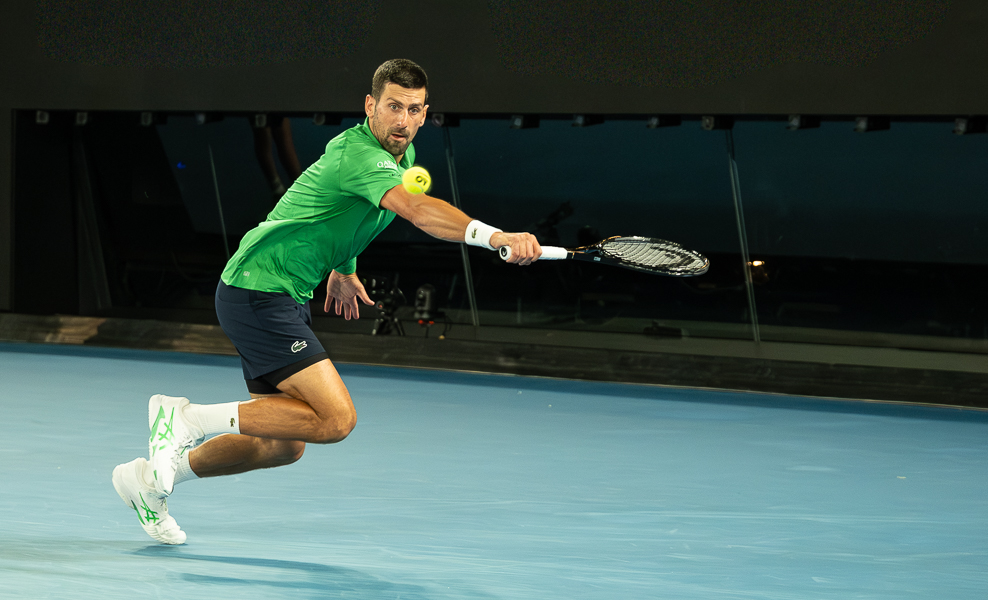
Novak Djokovic is, by most measures, the most accomplished male player in tennis history: 24 Grand Slam titles, a record number of weeks at World No. 1, and a near-complete sweep of the sport’s records. At 39, he is no longer the dominant force he was, but 2026 showed he can still reach the sport’s biggest stages: he beat Jannik Sinner to reach the Australian Open final, which he lost to Carlos Alcaraz, and reached the Wimbledon semifinals.
The defining storyline is still the chase for a record-breaking 25th major, and the second half of 2026 made it harder. At Wimbledon he came through a five-set quarterfinal against third seed Félix Auger-Aliassime before Sinner beat him in straight sets. At the US Open he arrived with questions about his health and lost in the first round to Mariano Navone. The profile is an all-time great in a late, record-hunting phase, still capable of deep runs but now managing his body from event to event.
Quick facts
- Full name: Novak Djokovic
- Nationality: Serbia (born Belgrade)
- Born: May 22, 1987
- Height: 6 ft 2 in (1.88 m)
- Turned pro: 2003
- Plays: Right-handed, two-handed backhand
- Career majors: 24 — a men’s record — including 10 Australian Opens and four US Opens
- Identity: The most decorated man in tennis history, an all-court master and elite returner
Season snapshot — September 24, 2026
- Australian Open: Runner-up; beat Sinner in the semifinals, lost the final to Alcaraz
- Roland Garros: Third round, losing to João Fonseca from two sets up
- Wimbledon: Semifinal as the No. 7 seed; beat Félix Auger-Aliassime 7-6(10), 3-6, 6-3, 6-7(4), 7-6(4) in the quarterfinals, then lost to Sinner 6-4, 6-4, 6-4
- US Open: First-round loss to Mariano Navone after arriving with health questions
- Records extended in 2026: First man to reach 400 career Grand Slam match wins; record 82nd major main-draw appearance; a seventh major final after turning 35, an Open Era record
This snapshot is dated and will change. The career record elsewhere on this page does not.
Game overview
Djokovic’s game is built on the best return in the sport’s history, elite movement and flexibility, and a backhand that remains a benchmark. The physical margins have narrowed with age, and full seasons are now beyond him, but his ability to raise his level for the majors — a final in Melbourne and a semifinal at Wimbledon in 2026 — keeps him a threat to anyone over best-of-five when he is healthy.
Playing style and strengths
Return of serve. Historically the greatest returner the game has seen, still capable of neutralizing the biggest servers.
Movement and flexibility. Court coverage and elasticity that let him turn defense into offense.
Big-match experience. No one has played or won more major matches; the know-how remains an edge in tight fifth sets, as his Wimbledon quarterfinal showed.
Pressure points and vulnerabilities
- Health: he entered the US Open with fitness questions and lost in the first round
- Age: at 39, sustaining peak level across two weeks is increasingly difficult
- Sinner and Alcaraz, who ended his two deepest major runs of 2026
- A reduced schedule and the match rhythm that comes with fewer tournaments
Career milestones
- A men’s-record 24 Grand Slam titles, including 10 at the Australian Open
- Record total weeks at World No. 1 and record year-end No. 1 finishes
- Completed the career Grand Slam (multiple times over) and won Olympic gold in 2024
- 2026: 400th major match win and a 38th major final, at 38 years old; a Wimbledon semifinal
Grand Slam record in context
Djokovic’s major record is the deepest in the men’s game: titles at every Slam, a record 10 in Melbourne, and more major match wins than anyone in history. His 2026 majors ran final, third round, semifinal, first round — a season that captures both his enduring class and the reality of his age. The two deepest runs ended against the players who now define the era: Alcaraz in Melbourne, Sinner at Wimbledon.
Grand Slam best results
- Australian Open: Champion (10 titles)
- Roland Garros: Champion (2016, 2021, 2023)
- Wimbledon: Champion (7 titles)
- US Open: Champion (4 titles)
What to watch next
- Fitness — how much of the autumn he plays after the US Open
- Melbourne — the site of 10 of his titles and his best chance at a 25th major
- The 25th major — whether he can win one more to stand alone atop the all-time list