

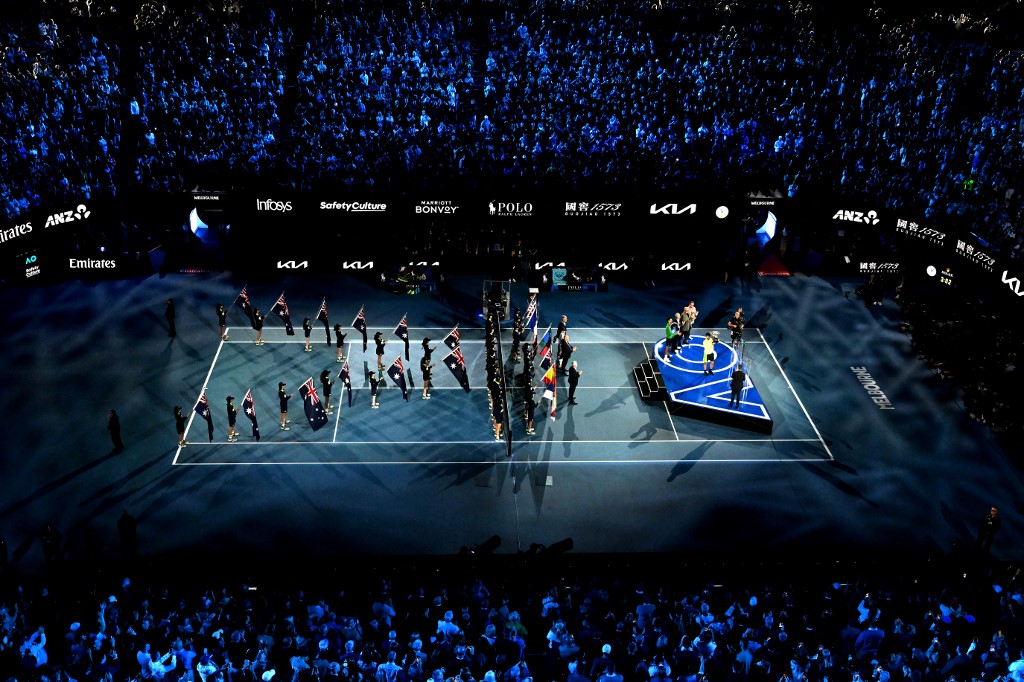
The Australian Open opens the Grand Slam calendar each January in Melbourne, launching the professional tennis season on outdoor hard courts at Melbourne Park. As one of the four major championships, it awards 2,000 ranking points to singles champions and sets the tone for the ATP and WTA seasons. Often known as the “Happy Slam” for its open, festival atmosphere, the event is the most-attended Grand Slam by total visitors and has consistently broken attendance records over the past decade.
Founded in 1905 as the Australasian Championships and part of the Open Era since 1968, the tournament has evolved into one of the largest sporting events in the Southern Hemisphere. This guide explains how the Australian Open is structured, how the draws work, how ranking points and prize money are distributed, and what distinguishes it from the other Grand Slams.
Where It Is Played
Venue: Melbourne Park
City: Melbourne, Australia
Surface: Outdoor hard court (GreenSet acrylic)
Main stadium: Rod Laver Arena (approximately 15,000 seats)
Other roofed arenas: Margaret Court Arena, John Cain Arena
Retractable roofs: Three (the most of any Grand Slam venue)
Melbourne Park has hosted the Australian Open since 1988, when the tournament moved from the grass courts of the Kooyong Lawn Tennis Club to a purpose-built precinct on the edge of Melbourne’s central business district. The venue introduced the first retractable roof on a tennis stadium anywhere in the world, and remains the only Grand Slam venue with retractable roofs on three courts — giving the tournament more flexibility to manage heat and weather than any of its peers. For the full venue history, see How the Australian Open Found Its Home at Melbourne Park.
The Surface
The Australian Open is played on GreenSet, a medium-fast acrylic hard court surface introduced in 2020 to replace the long-running Plexicushion Prestige. GreenSet is classified by the ITF as a Category 4 (Medium Fast) surface — playing notably faster than its predecessor and faster than the US Open’s Laykold (Category 2, Medium Slow), the other hard court Grand Slam. The ball travels faster and stays lower on GreenSet than on the US Open surface, rewarding flatter, more aggressive hitters while still permitting topspin-based games.
The Australian Open has changed its hard court surface three times since switching from grass in 1988 — from Rebound Ace (1988–2007) to Plexicushion (2008–2019) to GreenSet (2020–present) — reflecting Tennis Australia’s willingness to evolve the playing conditions over time. For a deeper comparison with the other hard court Grand Slam, see Why the Australian Open Plays Differently From the US Open.
Tournament Format
Main draw size:
- 128-player singles draw (men and women)
- 64-team doubles draw (men’s, women’s, and mixed)
- Junior, wheelchair, and legends competitions also held
Match format:
- Men’s singles: best of five sets
- Women’s singles: best of three sets
- All sets use tiebreaks at 6–6 (regular tiebreak to 7 points)
- Final-set tiebreak: first to 10 points at 6–6 in the deciding set (consistent across all four Slams since 2022)
The Australian Open expanded to a 15-day event starting in 2024, beginning on a Sunday rather than the traditional Monday to give the schedule more breathing room around late-finishing night matches. For more on how that change affected the evening schedule, see Australian Open Night Sessions Explained.
How the Draw Works
The singles draw includes 128 players, of whom 32 are seeded based on their ATP or WTA ranking at the entry deadline. The draw is structured to keep the top players apart in the early rounds:
- The top two seeds cannot meet before the final
- Seeds 1–4 cannot meet before the semifinals
- Seeds 1–8 are placed to avoid meeting before the quarterfinals
- Unseeded players are drawn randomly into the bracket
Additional players enter through one of three routes. Direct acceptance by ranking covers the bulk of the field. Qualifying takes place during the preliminary rounds the week before the main draw, with 128 players competing across three rounds for 16 main-draw spots in each singles event. Wild cards are awarded by Tennis Australia at its discretion, with a portion typically reserved for Australian players, reciprocal arrangements with the other Slams, and exceptional returning players.
Ranking Points Distribution
Grand Slams award the most ranking points of any events on tour. The singles points structure breaks down as follows:
| Round | ATP (men) | WTA (women) |
|---|---|---|
| Winner | 2,000 | 2,000 |
| Finalist | 1,300 | 1,300 |
| Semifinalist | 800 | 780 |
| Quarterfinalist | 400 | 430 |
| Round of 16 | 200 | 240 |
| Round of 32 | 100 | 130 |
| Round of 64 | 50 | 70 |
| Round of 128 | 10 | 10 |
These points apply within the 52-week rolling ranking systems on both tours. For the full mechanics of how rankings are calculated, see How Tennis Rankings Work, WTA Rankings Explained, and ATP Rankings Explained.
Prize Money
The Australian Open distributes prize money across every round of competition, including qualifying. The 2026 edition offered a record total purse of A$111.5 million — the first time the tournament has crossed nine figures — with the singles champion earning A$4.15 million and the first-round loser receiving A$150,000. The full breakdown is announced by Tennis Australia each year, with men’s and women’s events offering equal prize money at every round since 2001.
Official prize money figures are released by Tennis Australia in the weeks before each tournament.
The Trophies
The men’s singles champion receives the Norman Brookes Challenge Cup, first presented in 1934 and named after the Australian who won Wimbledon in 1907 and again in 1914 and became a foundational figure in Australian tennis administration.
The women’s singles champion receives the Daphne Akhurst Memorial Cup, named in honour of the five-time Australian Championships winner of the 1920s who died at age 29 in 1933. Daphne Akhurst’s name has been on the women’s trophy since 1934.
Both trophies are permanent — winners receive a replica trophy to keep.
Scheduling Structure
- Two-week main draw, expanded to 15 days from 2024
- Preliminary rounds and qualifying held the week before the main draw
- Day sessions and night sessions on the main show courts (separate ticketing)
- Played in mid-to-late January through early February
- Extreme Heat Policy in place (see how the AO Heat Stress Scale works)
As the first Grand Slam of the calendar year, the Australian Open often shapes the season’s early ranking narratives and sets the tone for the year’s storylines.
What Makes the Australian Open Unique
- First major of the season — the only Slam that opens the year, played when many of the sport’s biggest names are at peak off-season conditioning
- Three retractable roofs — the only Slam venue with that level of weather protection across multiple courts
- City-centre location — Melbourne Park sits on the edge of Melbourne’s CBD, walkable from the city in a way no other Slam venue can match
- The “Happy Slam” identity — a relaxed, festival atmosphere driven by Melbourne’s summer climate, the open grounds, and the venue’s multi-purpose design
- Highest attendance of any Slam — the AO draws more than 1.2 million visitors annually
- Surface evolution — the only Slam that has changed its main playing surface multiple times in the modern era
- A pioneer in technology — the first Slam to introduce a retractable roof, an early adopter of Hawk-Eye Live electronic line calling, and a leader in fan technology
For a fuller comparison with the other major venues, see What Makes Melbourne Park Different From Other Grand Slam Venues.
How It Compares to the Other Grand Slams
| Tournament | Surface | Surface Category | Typical Pace |
|---|---|---|---|
| Australian Open | Hard (GreenSet) | Category 4 | Medium Fast |
| Roland Garros | Clay | Category 1 | Slow |
| Wimbledon | Grass | Category 5 | Fast |
| US Open | Hard (Laykold) | Category 2 | Medium Slow |
Surface variation across the four majors is central to player legacies. Only a handful of players in tennis history have completed the career Grand Slam — winning at least one title at each of the four majors — making it one of the sport’s most exclusive achievements.
Frequently Asked Questions
When is the Australian Open played? The main draw runs over two weeks in mid-to-late January, with the qualifying rounds and preliminary events in the week before. Since 2024, the tournament has expanded to a 15-day format starting on a Sunday.
Where is the Australian Open played? At Melbourne Park, a purpose-built tennis precinct on the edge of Melbourne’s central business district. The main court is Rod Laver Arena.
What surface is used at the Australian Open? GreenSet, a medium-fast acrylic hard court surface in use since 2020. It is classified by the ITF as Category 4 (Medium Fast).
How many players are seeded? 32 in each singles draw, based on ATP and WTA rankings at the entry deadline.
How many ranking points does the Australian Open champion receive? 2,000 points — the maximum for any single tournament outside of an undefeated Nitto ATP Finals or WTA Finals run.
What are the trophies called? The men’s trophy is the Norman Brookes Challenge Cup. The women’s trophy is the Daphne Akhurst Memorial Cup. Both have been awarded under those names since 1934.
Why is it called the “Happy Slam”? The nickname reflects the tournament’s relaxed atmosphere, summer climate, open grounds, and festival-style fan experience — features Melbourne Park was deliberately designed to deliver. Players have consistently described it as one of the most welcoming tournaments on the calendar.
How much prize money does the Australian Open offer? The 2026 edition offered a record A$111.5 million total prize pool, the first time the tournament crossed nine figures. The singles champion earned A$4.15 million, with prize money increases applied to every round.