

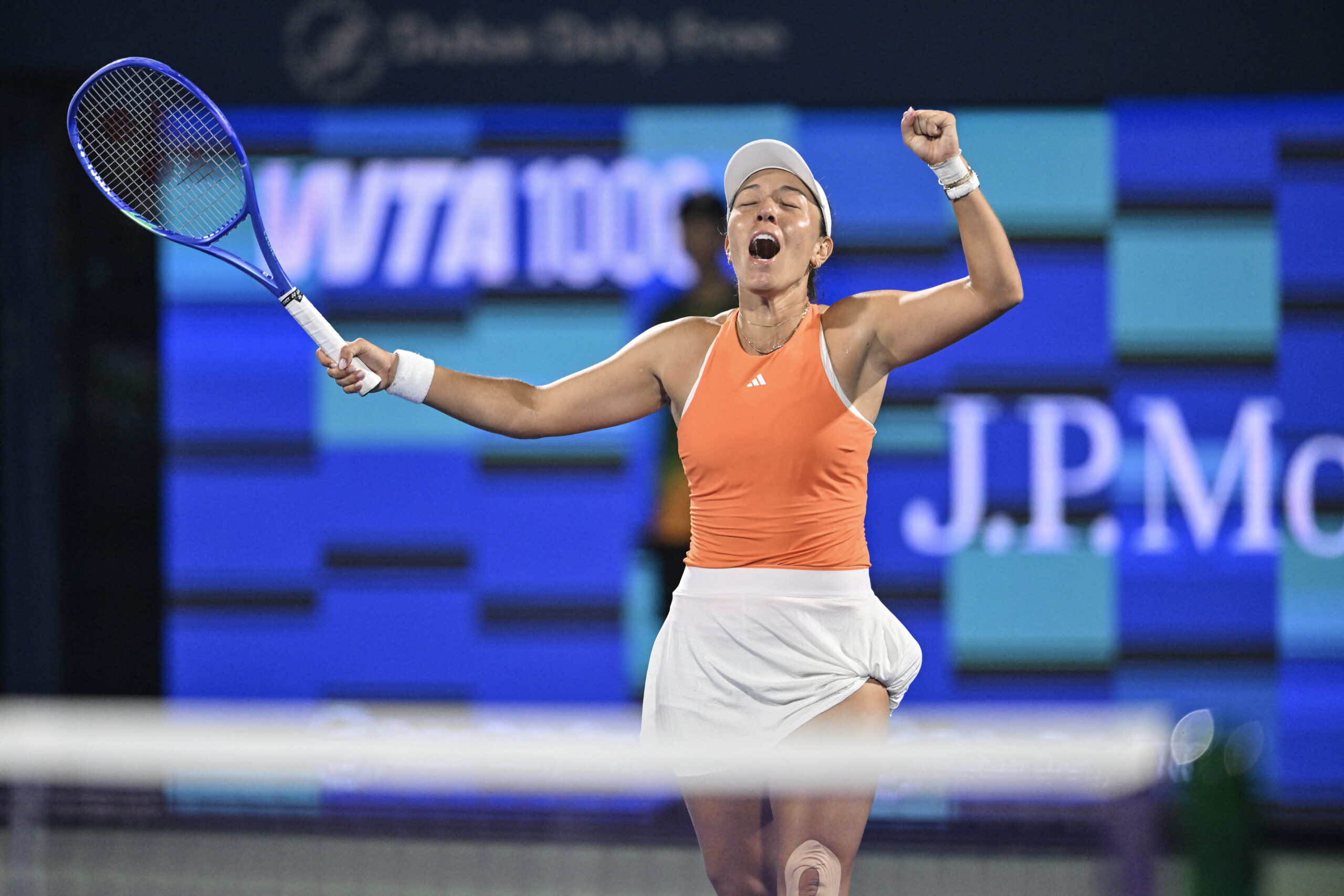
WTA 1000 tournaments are the highest tier of women’s professional tennis below the Grand Slams. The singles champion earns 1,000 ranking points, and results at this level shape the race for world No. 1, Grand Slam seedings and qualification for the WTA Finals.
The tier is not uniform. Ten events carry the WTA 1000 label, but they divide into two groups with different draw sizes, different qualifying structures and different weight inside the ranking formula. That split is the key to reading the tier correctly, and it is the part most summaries leave out.
What Is a WTA 1000 Tournament?
The “1000” refers to the ranking points awarded to the singles champion. WTA 1000 events draw the strongest fields outside the majors, carry the largest prize money below Grand Slam level, feed directly into Grand Slam seedings and shape the year-end standings. They sit at the same tier position as ATP Masters 1000 events, which are covered in the Masters 1000 guide.
The category was created in the WTA’s 2021 schedule reorganization, which merged the former Premier Mandatory and Premier 5 tiers into a single WTA 1000 designation with numeric naming that mirrors the ATP’s. For the first three seasons the tier held nine events, only four of them mandatory. The category expanded to ten events in 2024, and all ten became mandatory at that point.
How Many WTA 1000 Tournaments Are There?
There are ten. Eight are played on outdoor hard courts and two on clay.
Combined and Non-Combined Events
The WTA divides the ten into seven combined events and three non-combined events. The distinction is not cosmetic. It determines draw size, qualifying structure and how a result counts toward a player’s ranking.
The seven combined events are Indian Wells, Miami, Madrid, Rome, the Canadian Open, Cincinnati and Beijing. Each is staged alongside a men’s tournament, and each uses a 96-player singles draw.
The three non-combined events are Doha, Dubai and Wuhan. Each uses a 56-player draw.
“Combined” refers to a WTA event running concurrently with an ATP event, not to the ATP event’s tier. Beijing’s men’s counterpart is an ATP 500 rather than a Masters 1000, and Beijing still counts as combined. Doha and Dubai both host ATP tournaments at the same venues, but in separate weeks — the 2026 Dubai women’s event ran 15 to 21 February and the men’s event 23 to 28 February. That separation is why both sit on the non-combined side.
The alignment is exact. Every combined event is a 96-draw and every non-combined event is a 56-draw. Once that is clear, the rest of the tier’s structure follows from it.
Season Snapshot — 2026 WTA 1000 Calendar
Accurate as of the 2026 season. Event membership and draw sizes have changed before and may change again.
| Tournament | Location | Surface | Draw | Classification |
|---|---|---|---|---|
| Qatar Open | Doha, Qatar | Hard | 56 | Non-combined |
| Dubai Tennis Championships | Dubai, UAE | Hard | 56 | Non-combined |
| Indian Wells Open | Indian Wells, USA | Hard | 96 | Combined |
| Miami Open | Miami, USA | Hard | 96 | Combined |
| Madrid Open | Madrid, Spain | Clay | 96 | Combined |
| Italian Open | Rome, Italy | Clay | 96 | Combined |
| Canadian Open | Toronto / Montreal, Canada | Hard | 96 | Combined |
| Cincinnati Open | Mason, Ohio, USA | Hard | 96 | Combined |
| China Open | Beijing, China | Hard | 96 | Combined |
| Wuhan Open | Wuhan, China | Hard | 56 | Non-combined |
Draw Sizes and Match Format
WTA 1000 events use one of two singles formats.
96-Player Draws
Thirty-two players are seeded and all thirty-two receive a first-round bye, entering in the round of 64. The rest of the field is filled by direct entries, eight wild cards and twelve qualifiers drawn from a 48-player, two-round qualifying event. A seeded champion wins six matches. A player entering in the opening round needs seven.
56-Player Draws
Sixteen players are seeded and the top eight receive a first-round bye, entering in the round of 32. Qualifying is a 32-player, two-round draw producing eight qualifiers. A champion with a bye wins five matches; everyone else needs six.
All matches at both draw sizes are best-of-three sets with standard tiebreak scoring. Best-of-five is not used on the WTA Tour.
Ranking Points at WTA 1000 Events
Singles points by round, for both draw formats:
| Round reached | 96-player draw | 56-player draw |
|---|---|---|
| Champion | 1,000 | 1,000 |
| Runner-up | 650 | 650 |
| Semifinal | 390 | 390 |
| Quarterfinal | 215 | 215 |
| Round of 16 | 120 | 120 |
| Round of 32 | 65 | 65 |
| Round of 64 | 35 | Round not played |
| Opening round | 10 | 10 |
The two scales are identical from the title down to the round of 32. The only difference sits at the bottom. The 96-draw has one extra round, so its opening-round losers take 10 points and its round-of-64 losers take 35, while the 56-draw skips the round of 64 entirely and pays its opening-round losers 10.
Qualifying Points
Qualifying is scored the same way at both draw sizes. Reaching the main draw through qualifying is worth 30 points, losing in the final qualifying round 20, and losing in the first qualifying round 2.
Are WTA 1000 Tournaments Mandatory?
Yes. All ten have been mandatory since 2024. A player aged 18 or older who fails to play a WTA 1000 mandatory commitment tournament takes a zero-point result for that event on her rolling 52-week ranking. Exemptions are available for injury and other defined circumstances.
How WTA 1000 Results Count Toward the Rankings
A WTA singles ranking is built from a maximum of 18 results over a rolling 52-week period, and the composition of those 18 is fixed:
- The four Grand Slams
- The best six results from the seven combined WTA 1000 events
- The best result from the three non-combined WTA 1000 events
- The next best seven results from any other eligible tournaments
Points earned at the WTA Finals count as a nineteenth result on top of the 18. The full mechanics of the system are set out in WTA Rankings Explained.
Two consequences of that structure are easy to miss.
First, no individual WTA 1000 holds a guaranteed place on a ranking. Because six of the seven combined events count and one of the three non-combined events counts, a player’s weakest combined result and two of her three non-combined results fall outside the protected slots.
Second, those displaced results are not discarded. They drop into the pool competing for the seven floating places, alongside her WTA 500 and 250 results. A strong week at a non-combined 1000 that misses the protected slot can still outscore a WTA 500 title and hold a place in the 18.
The commitment rule and the counting rule are separate rules doing separate jobs. A player must enter all ten events; only seven of those results occupy reserved positions in the ranking. The gap between those two numbers is where most confusion about the tier begins.
Because the points at stake dwarf anything below Slam level, deep runs at WTA 1000 events do more to separate the top of the ranking than results anywhere else on the calendar.
Surfaces and Scheduling
Eight WTA 1000 tournaments are played on outdoor hard courts and two on clay. The clay pair, Madrid and Rome, falls in the spring and forms the final tier-level preparation before Roland Garros.
The hard-court events are spread across three distinct phases. The season opens with the Middle East pair in February, followed by the Indian Wells and Miami double in March. The summer brings the North American series, where the Canadian Open and the Cincinnati Open are the last 1000-level events before the US Open and carry the bulk of the seeding consequences for it, a sequence covered in full in the North American hard-court swing explainer. The Asian autumn closes the tier with Beijing and Wuhan.
WTA 1000 Compared With Other Tour Levels
| Level | Champion’s points | Typical singles draw |
|---|---|---|
| Grand Slam | 2,000 | 128 |
| WTA 1000 | 1,000 | 56 or 96 |
| WTA 500 | 500 | 28 to 48 |
| WTA 250 | 250 | 32 |
Grand Slams remain the sport’s most prestigious events and pay double at the top. But a Slam comes around four times a year, while the WTA 1000 tier delivers ten opportunities at half the points. Across a full season, the 1000s do more cumulative work in setting the ranking order than the majors do.
Frequently Asked Questions
How many WTA 1000 tournaments are there?
Ten. Seven are combined events with 96-player draws and three are non-combined events with 56-player draws.
Are WTA 1000 tournaments mandatory?
Yes. All ten have been mandatory since 2024 for eligible players aged 18 and over, subject to injury and other defined exemptions. Missing one produces a zero-point result on the 52-week ranking.
What is the difference between a combined and a non-combined WTA 1000?
A combined event runs concurrently with an ATP tournament; a non-combined event does not. Combined events use 96-player draws and non-combined events use 56-player draws, and the two groups are treated differently in the ranking formula.
How many ranking points does a WTA 1000 champion receive?
One thousand, at both draw sizes.
Do all ten WTA 1000 results count toward a player’s ranking?
No. The ranking reserves places for the best six of the seven combined events and the best one of the three non-combined events. Results outside those seven slots compete for the seven remaining places alongside WTA 500 and 250 results.
What surfaces are WTA 1000 events played on?
Eight are on outdoor hard courts. Two, Madrid and Rome, are on clay.
Do WTA 1000 results affect Grand Slam seedings?
Yes. Slam seedings are set from the 52-week rankings, which WTA 1000 results feed directly.
Steven Hodel / Global Tennis News