

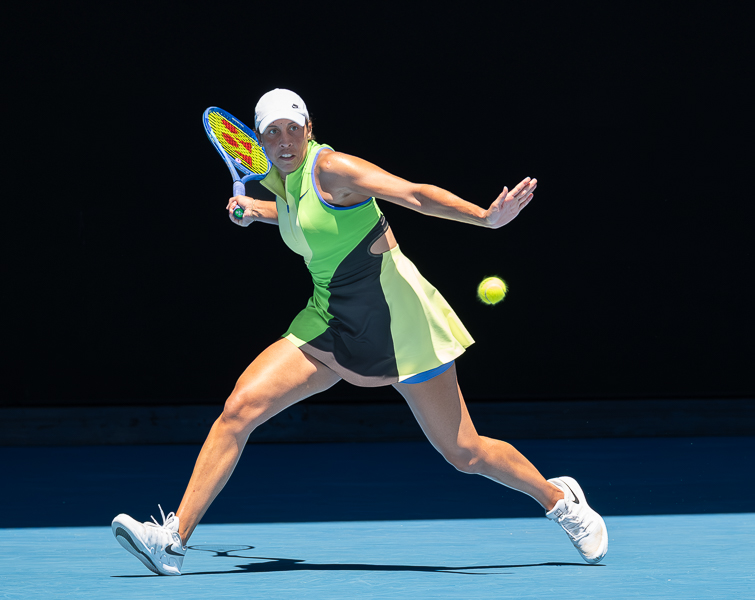
Madison Keys has always played tennis with the same underlying belief: hit through the court, take control early, and accept the risk that comes with that kind of ambition.
Her game is built on first-strike power. When she’s timing the ball cleanly, she can beat anyone because she doesn’t need long rallies or perfect patterns. She needs a handful of short sequences where her serve and forehand do the damage.
The downside is obvious too: when timing slips, errors arrive quickly because her style doesn’t leave much room to coast.
Quick facts
- Tour: WTA
- Plays: Right-handed, two-handed backhand
- Identity: Serve-and-forehand power hitter, first-strike attacker
- Best-known surface: Hard courts (and dangerous on fast conditions)
- Signature trait: Forehand pace that can end points instantly
Snapshot
Keys is an attacker. She wants to be the one deciding the point. Her serve creates short returns, her forehand punishes anything in the middle of the court, and her backhand holds enough that opponents can’t simply camp on one wing.
When Keys plays well, the match can feel like it’s being played at her speed. When she doesn’t, it can feel chaotic. That’s the price of her style.
Playing style and strengths
Serve as a platform
Keys’s serve sets up quick points and keeps her service games stable even when her ground game is uneven. In power-driven matches, that stability is everything.
Forehand as a finishing weapon
Her forehand is the headline tool. She hits it flat and hard, and she’s willing to pull the trigger early in rallies. Against players who sit back, that forehand can take away time and space immediately.
Taking the ball early
Keys likes early contact. She wants the point to stay short enough that she’s not forced to defend repeatedly.
Mental willingness to attack
Not every power player is willing to keep swinging under pressure. Keys often is. That commitment is part of why she can win big matches when confidence is high.
Pressure points and vulnerabilities
- When opponents extend rallies and force extra shots, her error rate can rise.
- Heavy defense and high balls can disrupt timing, especially if she starts pressing.
- If her first serve percentage drops, she can be pulled into longer return games where breaks become harder to avoid.
Her toughest matchups are often against elite defenders who refuse to give her clean timing.
Career milestones
Keys has spent years in the upper tier of the tour because her baseline power travels. She’s produced major runs, signature wins against top players, and seasons where her game looked capable of winning the biggest titles.
Her career arc has often been about managing the balance between aggression and control: keeping the same identity while tightening the error margins.
Grand Slam record in context
At Grand Slams, Keys’s style can be explosive because conditions often reward power and because the draw always contains opponents who can be overwhelmed.
Over two weeks, the challenge is sustaining timing and decision-making through different opponents and different match scripts. When she’s serving well and striking cleanly, she can run deep. When she’s off by a small margin, she can exit early because her game doesn’t rely on grinding.
Ranking and season context
Keys’s ranking trajectory is often tied to confidence and timing. When she’s playing freely, she stacks points quickly. When timing slips, results can swing because her style has less built-in “safe mode” than more defensive players.
What to watch next
Keys is always a threat on hard courts and in faster conditions. The question is whether she can maintain controlled aggression: swinging big without forcing the issue on every ball.
When she does, she becomes one of the most dangerous draw floaters in the sport because her peak level can end matches quickly.