

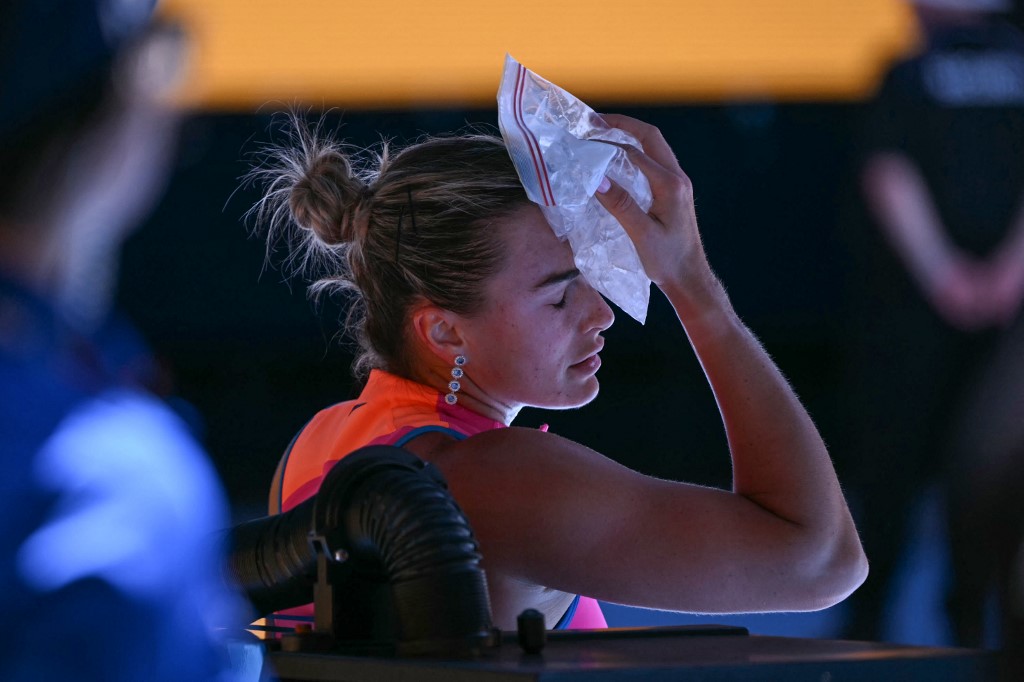
Every January, Melbourne’s scorching summer heat turns the Australian Open into a battle not just between opponents, but against the elements. Here’s everything you need to know about how tournament officials protect players when temperatures soar.
Why the Heat Rules Exist
The Australian Open is held in Melbourne every January, right in the heart of the Southern Hemisphere summer. While Melbourne is generally cooler than cities further north, extreme heat events are a regular feature of the tournament.
The heat policy was first formally invoked during the 1997 quarterfinals, and over the decades that followed, officials continued refining the rules in response to dangerous conditions on court.
The most significant turning point came in 2014, when four consecutive days of temperatures between 41.5°C and 43.9°C (107–111°F) caused a record nine first-round retirements.
Players suffered from heat-related illness, and ball kids and spectators were also affected. That controversy accelerated a complete overhaul of the policy, leading to the modern system in use today.
The Heat Stress Scale: A 1-to-5 System
In 2019, the Australian Open introduced the AO Heat Stress Scale (AO HSS), replacing earlier temperature-threshold systems with a more comprehensive and scientifically grounded approach. Rather than relying on air temperature alone, the scale combines four climate factors that together determine how much stress the human body is under:
- Air temperature (measured in the shade)
- Radiant heat (the intensity of direct sunlight)
- Relative humidity
- Wind speed
These factors are continuously monitored across Melbourne Park throughout the tournament day. The resulting score — ranging from 1 to 5 — determines what action tournament officials must take.
What Each Level Means
Level 1 — Temperate conditions Play proceeds normally with no special interventions required.
Level 2 — Moderate heat stress Standard monitoring continues. Players are advised to stay well hydrated before and during their matches.
Level 3 — Elevated heat stress Players are encouraged to increase hydration and use active cooling strategies such as ice towels, cooling vests, and fans during changeovers.
Level 4 — High heat stress The Tournament Referee gains discretion to offer extended breaks between sets — 10 minutes for men’s and women’s singles, and 15 minutes for wheelchair singles. These breaks allow players to recover, cool down, and rehydrate under supervision.
Level 5 — Extreme heat stress (play suspended) When the scale reaches 5, the Tournament Referee suspends the start of new matches on outside courts. For matches already underway, play is paused at the next natural break point before being stopped. The retractable roofs on Rod Laver Arena, Margaret Court Arena, and John Cain Arena are closed to provide climate-controlled conditions.
Who Makes the Call?
The Tournament Referee holds ultimate authority over invoking the Extreme Heat Policy. They consult real-time Heat Stress Scale data measured across multiple points within the Melbourne Park precinct and assess whether conditions warrant intervention.
Importantly, the scale is not just about the air temperature reading — a day that feels “just hot” to spectators can still register a dangerous level on the scale if humidity is high or radiant heat from the sun is intense.
Tennis Australia’s Chief Medical Officer plays a key advisory role, providing guidance based on the latest sports medicine research into heat tolerance, sweat rates, and core body temperature management.
Does the Heat Policy Apply to All Players Equally?
Not entirely. The system accounts for physiological differences between player groups. Wheelchair athletes, for example, have limited ability to regulate body temperature compared to able-bodied players, so their thresholds for intervention are adjusted accordingly. Junior players are also given different considerations, given that younger athletes may be more vulnerable to heat-related illness.
A Brief History of the Rules
The heat policy has been revised multiple times as organisers responded to real-world events and advances in sports science:
- 1997: Heat rule first invoked at the tournament (quarterfinal round).
- 1998: Formal policy introduced; play halted if air temperature reached 40°C (104°F).
- 2003: Threshold lowered to 35°C (95°F), with the Wet-Bulb Globe Temperature (WBGT) introduced as an additional measure.
- 2014: Deadly heat across four days exposed weaknesses in the policy; nine players retired in round one alone.
- 2015: WBGT threshold raised to 32.5°C to allow more play in dry heat; critics argued the change prioritised broadcast scheduling over player safety.
- 2019: The current AO Heat Stress Scale introduced, combining air temperature, radiant heat, humidity, and wind speed into a unified 1–5 rating system.
The ATP’s New 2026 Heat Rule
Effective from the 2026 season, the ATP Board approved a structured heat rule for men’s tour-level singles matches, finally bringing the men’s tour into line with the WTA — which has had a heat rule in place since 1992. The new rule applies to ATP best-of-three singles matches and is based on the Wet-Bulb Globe Temperature index.
The rule introduces two specific thresholds. When the WBGT reaches 30.1°C or higher during either of the first two sets, a 10-minute cooling break may be requested by either player after the second set, applying to both players. During the break, players may use cooling measures, change clothing, shower, hydrate, and receive coaching under the supervision of ATP medical staff.
When the WBGT exceeds 32.2°C, play is suspended entirely until conditions improve.
The new rule came in response to a series of brutal matches at the 2025 Shanghai Masters, where humidity exceeded 80 percent for consecutive days. Defending champion Jannik Sinner stopped a match due to severe leg cramps, Novak Djokovic was visibly ill on court during a victory, and several players retired or required medical intervention. The ATP Board moved within weeks of the tournament to formalise a tour-wide policy.
Importantly, the new ATP rule does not apply to the four Grand Slams, which retain their own independently developed heat policies. The Australian Open continues to use its 1-to-5 Heat Stress Scale, the US Open and Roland Garros use their own WBGT-style guidance, and Wimbledon — where heat is rarely the dominant climate issue — has lighter provisions in place.
The Role of the Retractable Roofs
One of the Australian Open’s greatest assets in managing extreme heat is the retractable roofs on its three main stadiums: Rod Laver Arena, Margaret Court Arena, and John Cain Arena — making Melbourne Park the only Grand Slam venue with three retractable roofs. When the heat policy is triggered, the roofs can be closed and the arenas air-conditioned, creating substantially cooler conditions for players and spectators alike.
Courts without roofs — the outer and show courts where many early-round matches are played — have no such protection. When the Heat Stress Scale hits Level 5, no new matches are started on those courts, and any match in progress is halted at the next available break point.
How the Heat Rules Affect Match Play
Beyond the formal scale thresholds, hot weather affects how the Australian Open plays in ways that ripple through every match. Hot air expands the gas inside tennis balls, making them fly faster and bounce higher than the same ball would on a cool evening. The GreenSet surface absorbs and radiates heat across the court itself, which can affect player footwork and recovery between points.
Night sessions at Rod Laver Arena, when the roof can be closed and the air conditioning engaged, often play in conditions completely different from the day-session matches earlier — and those differences show up clearly in match statistics across multiple AO tournaments.
Frequently Asked Questions
What is the AO Heat Stress Scale? It’s a 1-to-5 rating system the Australian Open uses to measure heat stress on court. The scale combines four factors — air temperature, radiant heat from the sun, humidity, and wind speed — into a single number. Each level triggers specific actions, from standard monitoring at Level 1 to suspended play at Level 5.
At what temperature does play get suspended at the Australian Open? There is no single temperature threshold. Play on outside courts is suspended when the AO Heat Stress Scale reaches Level 5 — the determination is based on the combined climate metrics, not just air temperature. On a humid day, the scale can reach Level 5 even when the air temperature is below extreme.
Who decides if play continues during extreme heat? The Tournament Referee, working with Tennis Australia’s Chief Medical Officer and using real-time data from the Heat Stress Scale measured across multiple points in Melbourne Park.
What is the 2026 ATP heat rule and how does it differ from the Australian Open’s? The ATP’s 2026 heat rule applies to ATP tour-level events and uses Wet-Bulb Globe Temperature to trigger cooling breaks (at 30.1°C) and match suspension (at 32.2°C) in best-of-three singles. The Australian Open is a Grand Slam, governed by its own AO Heat Stress Scale, and is not bound by the ATP’s policy. The two systems coexist independently.
Has the heat rule actually saved players? Records of injury reduction are hard to attribute to any single policy change, but the post-2014 overhaul did eliminate the worst single-day retirement counts the tournament had recorded. Tennis Australia continues to revise the policy in response to real conditions and player feedback.
Do the heat rules apply to all players the same way? No. Wheelchair athletes have lower thresholds for intervention because their ability to regulate body temperature is reduced. Junior players also receive adjusted considerations. Able-bodied professional players follow the standard 1-to-5 scale.
Can players use the heat rules tactically? The rule structure is designed to make tactical use difficult. Cooling breaks at Level 4 apply to both players in a match, are time-limited, and are supervised. Some critics have argued that the scale itself can be invoked strategically when conditions are borderline, but the Tournament Referee retains final discretion.
The Bottom Line
The Australian Open’s Extreme Heat Policy is among the most sophisticated in professional sport, combining real-time environmental monitoring with medically informed thresholds. It has evolved significantly over the decades, driven by hard lessons learned during some of the tournament’s most gruelling days — and the ATP’s 2026 catch-up policy reflects the broader recognition that heat management is no longer optional in modern tennis.
While the policy cannot eliminate the challenge of playing tennis in a Melbourne summer, it ensures that when conditions become truly dangerous, player health comes first.