Home Blog Page 88

The History and Meaning of Centre Court at Wimbledon

0

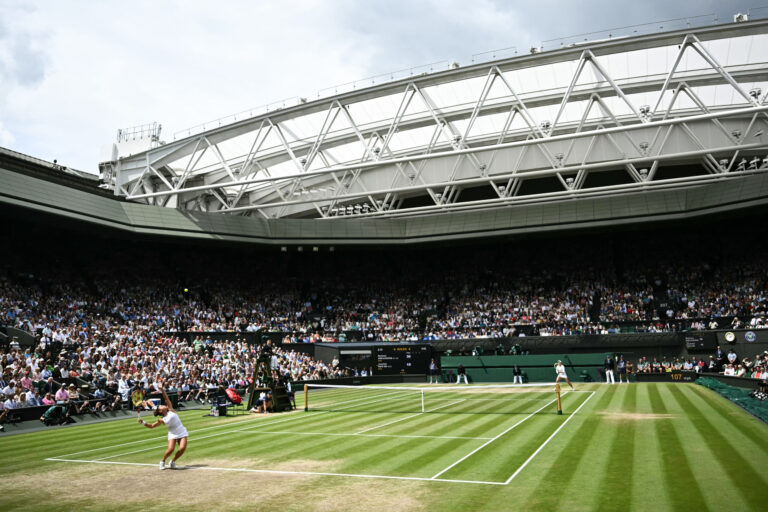
Centre Court at Wimbledon is widely regarded as the most famous tennis court in the world. It has hosted every Wimbledon singles final since 1922, survived a World War II bombing, been rebuilt in stages across a century, and accumulated a weight of history that no other tennis venue can approach.

Here is the complete story of how it came to be, how it changed, and why it still matters.

Why It Is Called Centre Court

The name has a literal origin that most people never know. At the All England Croquet Club’s original site on Worple Road in Wimbledon, the courts were laid out in a grid. In 1881, the two middle courts of the middle row were combined to form a single, larger principal court. Because it sat at the centre of all the other courts, it was called Centre Court.

When the club relocated to Church Road in 1922, the name travelled with it — even though the new Centre Court was not, at first, geographically central to the other courts at the new site.

It was not until a further four courts were added in 1980 that Centre Court’s location in the grounds again matched its name. The name had outlasted its original meaning by nearly 60 years before reality caught up with it.

From Worple Road to Church Road: The 1922 Move

By the end of the First World War, tennis had grown far beyond what the Worple Road site could accommodate. Public appetite for the sport had expanded dramatically, crowds were exceeding the venue’s capacity, and the All England Club needed a larger, purpose-built home. In 1920, land at Church Road was purchased and construction began soon after.

It took thousands of tons of shingle, sand, and cement — and a little over nine months — to complete the court. The all-important turf was imported from Cumberland. The new Centre Court opened on 26 June 1922, with a combined seating and standing capacity in the region of 13,000.

The design by architect Captain Stanley Peach reflected the character of its era: reserved, intimate, structured, and unmistakably British. Wooden bench seating, an open-air bowl, and a partial roof over the stands that shielded some spectators from rain while leaving the court itself fully exposed to the English summer sky.

The first match played on the new Centre Court was an opening-round men’s singles tie between Algernon Kingscote and Leslie Godfree, won by Kingscote in straight sets after a rain-affected start. King George V and Queen Mary attended the opening day — beginning a relationship between Centre Court and the Crown that has continued without interruption ever since. Suzanne Lenglen went on to dominate the women’s singles that year, conceding only a handful of games on her way to the title.

A Bomb, Repairs, and Decades of Evolution

Centre Court survived the Second World War — but only just. In October 1940, five 500lb bombs struck the stadium during an air raid, destroying 1,200 seats. The Championships were suspended entirely from 1940 to 1945, and the grounds served as a working farm and as an ARP headquarters during the war years.

Although the Championships resumed in 1946, the court was not fully repaired until 1949. That the fabric of the building survived at all — let alone that it was restored and returned to competitive use — reflects the practical resilience that has characterized the All England Club throughout its history.

Post-war, the changes came steadily. The famous Clubhouse balcony was added in 1955. The East Building was constructed in 1967, followed by the North Building in 1975. Each addition increased capacity modestly while attempting to preserve the intimate character of the original bowl.

In 1979, the original roof was raised by one metre to allow capacity to be increased by 1,088. Further building work came in 1992 with a replacement of the roof and a modified support structure, which gave 3,601 seats a clearer view of the court that had previously been restricted by roof supports.

The Retractable Roof: An Engineering Solution to a Century-Old Problem

Rain has been disrupting play at Centre Court since 1877 — the very first Wimbledon final was postponed by rain. For most of the court’s history, this was simply accepted as part of the English summer experience. Players waited. Spectators sheltered. Play resumed when the weather allowed.

The tradition of the Wimbledon rain delay became so embedded in British culture that it generated its own rituals, including the occasions when Cliff Richard would spontaneously perform for restless crowds on Centre Court while waiting for the weather to pass.

The decision to build a retractable roof came after years of debate and was catalyzed most dramatically by the 2008 men’s final between Roger Federer and Rafael Nadal — a match that lasted nearly seven hours, was interrupted twice by rain, and ended in near-darkness as officials debated whether to suspend play for the night.

The match is widely regarded as one of the greatest in tennis history; it also made the case for the roof more powerfully than any administrative argument could.

The engineering challenge was formidable. The primary design requirement was that the roof must not block the natural light that sustains the grass — the most important thing to determine was how not to block the sunlight that feeds the world’s most visible patch of turf.

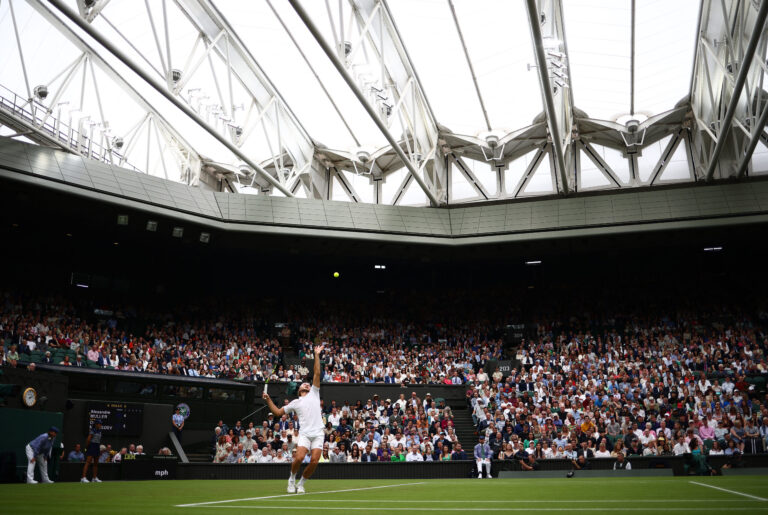
The result is a hydraulically operated structure of translucent fabric supported by steel trusses, spanning roughly 5,200 square metres when fully deployed. The translucent PTFE fabric, supplied by W.L. Gore and Associates, transmits around 40 percent of natural light — enough to maintain the grass in playable condition when the roof is closed.

The roof’s ten trusses each weigh 100 tonnes, with total moving and fixed weight of around 3,000 tonnes. Each truss moves along a track at 214 millimetres per second, driven by hydraulic jacks, and the two sections meet in an overlapping seam above the middle of the court.

The roof takes around 10 minutes to close, during which time play is suspended. The full transition from outdoor to indoor play can take up to 45 minutes once the air-conditioning system acclimatizes the stadium for indoor grass competition.

That air-management system is as critical as the roof itself. A closed Centre Court with nearly 15,000 people generating body heat and breath moisture creates conditions that could, without intervention, produce condensation on the underside of the roof fabric or sweating on the grass surface — either of which would make the court slippery and unplayable.

The system maintains humidity and temperature within a narrow band that keeps both the grass and the playing conditions safe.

The retractable roof was unveiled in April 2009 and tested with a capacity audience during an exhibition match on 17 May 2009, featuring Andre Agassi, Steffi Graf, Tim Henman, and Kim Clijsters.

The first competitive use came on 29 June 2009, during a fourth-round women’s singles match. The first full match played under the closed roof was between Andy Murray and Stanislas Wawrinka, which ended at 10:38pm — later than any Centre Court match in history to that point.

The Kipling Inscription

Etched into the wall above the players’ entrance to Centre Court are two lines from Rudyard Kipling’s 1910 poem If: “If you can meet with Triumph and Disaster / And treat those two impostors just the same.”

The inscription was in place by the 2008 Championships — that year, Federer and Nadal each recorded a recitation of the passage for a feature aired during rain delays at the men’s final — and has greeted players walking onto the court ever since.

It is placed at eye level, in a simple elegant font, so that every player entering Centre Court passes it in the moments before they step onto the most famous court in the world. The quote symbolizes the mental resilience required in professional tennis, aligning with Wimbledon’s emphasis on graceful conduct under pressure.

Whether it helps, or whether players notice it at all when the adrenaline of a Wimbledon match is already rising, is impossible to know. But its placement is deliberately intentional: the All England Club chose to remind every player, at the most consequential moment of their working day, that the outcome — whatever it is — should be received with equanimity.

The choice of Kipling is itself characteristically Wimbledon. If is one of the most recognizable poems in the English language, taught in British schools for generations, and its values — stoicism, self-control, perseverance, dignity in both victory and defeat — are precisely the values the All England Club has always believed Wimbledon should embody.

What Centre Court Has Witnessed

The history of Centre Court is, in a very real sense, the history of tennis. Every Wimbledon singles final since 1922 has been played on this court. The list of champions who have won on it spans the entire story of the sport’s development: Suzanne Lenglen, Helen Wills Moody, Fred Perry, Don Budge, Maureen Connolly, Rod Laver, Billie Jean King, Björn Borg, Martina Navratilova, John McEnroe, Steffi Graf, Pete Sampras, Serena Williams, Roger Federer, Rafael Nadal, and Novak Djokovic have all lifted the Wimbledon trophy here.

Martina Navratilova won nine Wimbledon singles titles on this court — more than any other player. Roger Federer won eight. Pete Sampras and Serena Williams each won seven. The combined weight of those records on a single court, across a century of competition, is without parallel in sport.

The court has also hosted moments that transcended tennis entirely. Billie Jean King’s victories here in the 1970s, delivered in the same years she was fighting for equal prize money and recognition for women’s tennis worldwide, gave Centre Court a cultural significance beyond sport.

Arthur Ashe’s 1975 victory — the first Black man to win Wimbledon singles — was achieved on this court, in front of a full house, in the same year he was publicly advocating for change in a sport whose traditions did not always welcome it.

Centre Court and the Olympics

Centre Court has been part of two Olympic Games. In 1908, the London Olympics included tennis at the original Worple Road site. More than a century later, Centre Court — along with No. 1 Court and No. 2 Court — hosted the tennis competition at the 2012 Summer Olympics.

Andy Murray won gold at the London Games on Centre Court, defeating Roger Federer in the final on the same court where Federer had beaten him in the Wimbledon final just four weeks earlier. Murray described winning in front of a home crowd on Centre Court as one of the most significant moments of his career — a turning point in what had been, until then, a complicated relationship with the court.

The Meaning of the Court

Centre Court means something beyond its function as a playing surface. It is the physical location where the sport’s longest continuous tradition has been enacted — where the same tournament has been held, on the same grass, by the same institution, for over a century. Other Grand Slam venues are larger, louder, more commercially powerful. None of them carries this particular weight.

The court’s meaning is inseparable from what it asks of the people who play on it. The Kipling inscription. The silence of 15,000 people between points. The knowledge that every player who has ever been great in this sport has stood on this exact rectangle of grass and been tested.

Players describe the experience, more often than not, in terms that go beyond the technical vocabulary of tennis. They say it is different. They say you feel it before the first ball is struck.

The Bottom Line

Centre Court at Wimbledon is a building that has been bombed, rebuilt, incrementally expanded, given a roof after decades of delay, and etched with poetry. It has hosted more than a century of finals, an Olympic gold medal match, and some of the most significant moments in the history of professional sport.

Its grass surface is maintained at 8 millimetres — a detail that requires year-round attention, specific seed varieties, and precise mowing schedules. Its name derives from a court layout that no longer exists. And it remains, by the consensus of players, officials, and observers across every era of the sport, the most important tennis court in the world.
Why Wimbledon Feels Different From the Other Grand Slams

0

Every Grand Slam has a personality, but only one of them feels like arriving somewhere that exists outside of ordinary time. The Australian Open is a festival. The French Open is an examination. The US Open is a spectacle.

Wimbledon is something else entirely — a fortnight in which a private club in southwest London imposes its values on the entire sport, and the sport accepts them without complaint. Here is why Wimbledon feels different, and why that difference is felt by everyone who enters the grounds.

The Location Does Something to You Before You Arrive

Getting to Wimbledon is not like getting to any other Grand Slam. You take the District Line on the London Underground — one of the oldest metro lines in the world — to Southfields or Wimbledon station, and then you walk. Past Victorian terraces. Through quiet residential streets. Past front gardens where homeowners rent their driveways as car parks and sell cups of tea from card tables.

The approach to the All England Club does not feel like arriving at one of the world’s great sporting venues. It feels like walking into a particularly well-attended village fete.

This is not an accident. Wimbledon sits in SW19, a leafy, well-heeled suburb of London where tennis has been played since the 1870s. The All England Club is not an arena dropped into an urban landscape, like Arthur Ashe Stadium rising from the Flushing Meadows park infrastructure of Queens.

It is a private members’ club with manicured grounds, a clubhouse, and a Members’ Enclosure from which spectators have watched The Championships since 1877. The neighborhood has shaped the tournament, and the tournament has shaped the neighborhood. You feel it on the approach in a way you simply cannot replicate at any of the other three Slams.

Centre Court Is Smaller Than You Expect

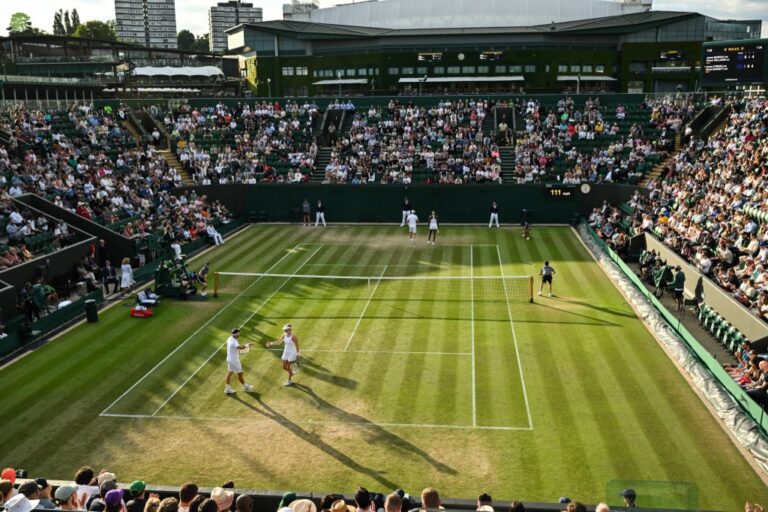
First-time visitors to Centre Court almost universally report the same surprise: it is more intimate than television suggests. The court holds just under 15,000 spectators — roughly 9,000 fewer than Arthur Ashe Stadium in New York, and the reason Centre Court feels so different from the US Open’s main arena.

The stands wrap tightly around the playing surface. The upper tier is close enough that you can read a player’s expression clearly. The grass is, from almost any seat in the house, strikingly present — a luminous rectangle of green that draws the eye in a way that blue hard courts and red clay simply do not.

The intimacy of the space produces a specific kind of quiet. When 15,000 people at Centre Court go silent — as they do between points, and as they are expected to do during play — the silence is full and complete in a way that a crowd of that size almost never achieves. It is a communal act of attention, and you feel its weight the moment you experience it.

Players notice it too. Many have described the sensation of walking onto Centre Court for the first time as unlike anything else in sport — the combination of the history, the silence, the grass, and the almost theatrical sense of occasion producing a physical response that no other venue replicates.

The Silence Is Enforced by Social Pressure, Not Rules

Wimbledon has no formal rule requiring crowd silence during points. There is no announcement, no sign, no instruction given to spectators when they take their seats.

The silence is maintained entirely through social convention — through the shared understanding, absorbed through decades of television coverage and cultural transmission, that at Wimbledon, you do not speak during a rally. You do not cheer mid-point. You certainly do not make noise that might disturb a player’s concentration.

The contrast with the US Open is total. At Arthur Ashe Stadium, the crowd cheers during points, reacts audibly to errors, and brings the habits of New York sports culture to the tennis. At Centre Court, the crowd waits.

They applaud at the end of a rally. They hold their breath during a long exchange. And when something extraordinary happens — a between-the-legs winner, a match point saved, a great champion’s final bow — the release of that held breath into sudden, complete noise is one of the most powerful sounds in sport precisely because of the silence that preceded it.

This dynamic — silence as the baseline, noise as the exception — is specific to Wimbledon among the Grand Slams. The tennis feels more serious. The points feel more consequential. The players feel closer. The whole occasion feels, without any announcement or instruction, like something that matters.

There Is No Advertising on Centre Court

Sit in the stands of Arthur Ashe Stadium, Court Philippe-Chatrier, or Rod Laver Arena, and you are surrounded by sponsor branding. Boards around the court. Digital displays. Branded everything. This is the commercial reality of professional tennis in the 21st century, and it is entirely normal at three of the four Grand Slams.

Centre Court at Wimbledon has no advertising. The courtside boards are dark green. The background visible behind the players when a camera frames a shot from the baseline is the green of the stands, not a sponsor’s logo.

The visual cleanliness of the Wimbledon television picture — white players on green grass against green stands, with no branding competing for attention — is distinctive and deliberate, and it has been maintained in the face of commercial pressure that would have broken any less resolute institution.

Catherine, Princess of Wales has been Patron of the All England Club since 2016, taking over the role from Queen Elizabeth II. The relationship between the Club and the British royal family is one of the structural reasons the tournament has been able to resist certain commercial arrangements. It is not the only reason, but it is part of the picture.

The Walk Onto Centre Court Is a Ritual

At most Grand Slams, players walk onto the court. At Wimbledon, they are accompanied onto Centre Court through a specific ceremonial walk that has been part of the tournament’s identity for generations.

The last thing a player sees before stepping onto the court is a line from Rudyard Kipling’s 1910 poem If, etched into the wall of the players’ corridor: “If you can meet with Triumph and Disaster / And treat those two impostors just the same.”

Dan Bloxham, the All England Club’s Head Coach and Master of Ceremonies during The Championships, accompanies players on that walk. His job may be to ensure players arrive on time, but the role is far more personal — managing nerves, restoring calm, and upholding tradition in the most quietly pivotal moments of the tournament.

Players have described the walk as the moment Wimbledon becomes real — when the sounds of the club, the smell of the grass, and the rising murmur of an expectant crowd combine into something that no amount of preparation fully equips you for.

The walk is not unique to Wimbledon in the technical sense — players walk onto courts at every tournament. But the deliberateness of it, the poetry on the wall, the specific person whose job it is to guide you through it, and the weight of everything that has happened on that court before you — all of it makes the Centre Court walk-on one of the distinctive experiences in professional sport.

Henman Hill: The Grand Slam Without a Ticket

One of Wimbledon’s most beloved spaces is not a court at all. The grassy bank outside No. 1 Court — known for years as Henman Hill, and more recently as Murray Mound — is where fans without show-court tickets gather to watch matches on a large screen, picnic, drink Pimm’s, and experience the tournament from the outside in.

The collective reaction of thousands of people on that hill to a key moment on Centre Court — a gasp when a favorite is broken, a roar when a match point is saved — is one of the defining sounds of the British sporting summer.

No other Grand Slam has an equivalent. The Melbourne Park grounds pass allows fans to wander outer courts freely, but there is no single gathering point with the cultural resonance of the Hill. Roland Garros has terraces and promenades, but nothing that functions as a democratic, informal civic space in the same way.

The US Open has general admission areas, but Queens in late August is not a picnic-on-grass situation in the way that southwest London in early July can occasionally be. Henman Hill is Wimbledon in miniature — tradition, informality, community, and the specific quality of English summer light, all in one place.

The Queue Is Part of the Experience

The Wimbledon Queue — the line of fans camping outside the grounds to purchase day-of tickets — has been part of the tournament since 1927 and has developed into something that is, for many participants, as memorable as the tennis itself.

The Queue has its own published code of conduct, its own etiquette, and its own social world. Campers arrive with tents, folding chairs, and food. Communities form over days of waiting.

Several hundred of the very best Centre Court seats are released each day of the tournament for queue-goers — a number that, alongside No. 1 Court and No. 2 Court allocations, makes Wimbledon effectively the only Grand Slam where determination and a sleeping bag can put a true tennis fan on the most prestigious court in the sport.

That guarantee — that access to the world’s most famous tennis court is available to anyone with the patience to wait for it — is one of the quietly important things about Wimbledon’s identity.

It does not resolve the tournament’s broader issues with exclusivity and ticket access, but it is a genuine and maintained commitment to democratic access at the very top of the house.

The Weather Is a Participant

No other Grand Slam has the same relationship with the weather as Wimbledon. The tournament is held in late June and early July in England — a country whose summer climate is sufficiently unreliable that rain interruptions have been a feature of The Championships for as long as the tournament has existed.

The retractable roof on Centre Court, installed in 2009, and the roof on No. 1 Court, added in 2019, have reduced disruption on the main show courts — but the outer courts remain exposed, and English weather does not observe the tournament schedule.

Rain at Wimbledon is not an inconvenience. It is, in a deeply British way, part of the occasion. Spectators are experienced in the ritual of the rain delay — the sudden covering of the court, the retreat to hospitality areas, the patient waiting with a glass of Pimm’s until play resumes.

The uncertainty of whether a match will be completed in a day, or whether it will be interrupted three times before the light fades and the 11pm curfew intervenes, adds a specific unpredictability to the Wimbledon experience that no other Grand Slam — all held in climates considerably more reliable than southwest London’s — can produce.

The Bottom Line

Wimbledon feels different because everything about it — the location, the grass, the silence, the advertising-free Centre Court, the walk-on ceremony, the Queue, the Hill, the weather, and the unbroken continuity of an institution that has been doing this since 1877 — is the product of deliberate choices maintained over generations.

It is not trying to be the biggest, the loudest, or the most commercially successful Grand Slam. It is trying to be Wimbledon. And the consistency with which it achieves that, year after year, in the face of every pressure to be something else, is precisely what makes it feel unlike anything else in sport.

Wimbledon’s All-White Dress Code Explained

0

Of all the traditions that define Wimbledon, none is more immediately visible or more strictly enOf all the traditions that define Wimbledon, none is more immediately visible or more strictly enforced than the requirement that every player dress almost entirely in white.

The rule has survived for nearly 150 years, been tested by some of the greatest players in tennis history, and sparked genuine controversy over its effect on female athletes. Here is the complete story of where the rule came from, exactly what it requires, and why it endures.

Where the Rule Came From

The origins of the all-white rule lie in Victorian attitudes toward the human body — specifically toward perspiration.

When lawn tennis was first played in the 1870s and 1880s, the sport was a social activity enjoyed by the British upper class on private lawns, at garden parties, and in settings where standards of propriety governed everything, including what one wore and how one appeared while physically exerting oneself.

Sweat stains were considered improper and unseemly, particularly for women, for whom any public display of physical exertion was laden with social judgement.

White clothing concealed perspiration better than coloured fabrics, and it was considered both more breathable and more modest — two qualities Victorian sport highly valued.

In its first 85 years, Wimbledon did not actually have a formal rule requiring white. White was a fashion and a tradition — the overwhelming preference of players and spectators alike — but it was not codified.

Players were technically permitted to wear other colours from 1877 right through to 1962, when the All England Club’s management committee decided that the rule needed to be formal. It came into force at the 1963 Championships and has been with the tournament ever since.

What followed is one of sport’s more unusual regulatory histories: while every other Grand Slam has relaxed its dress requirements over the decades, Wimbledon’s rules have, with one specific exception, become stricter over time.

Exactly What the Rules Require

The current Wimbledon dress code is detailed, precise, and leaves very little to interpretation. The key requirements are:

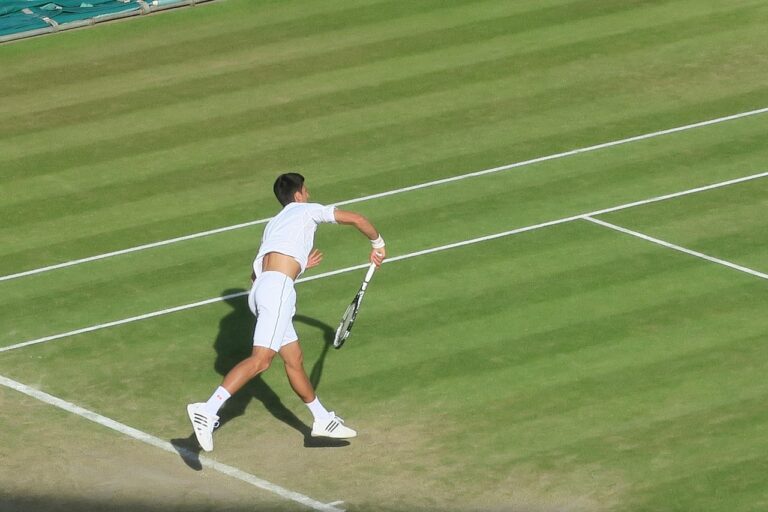
  • All clothing must be “almost entirely white.” White does not include off-white or cream.
  • A single trim of colour is permitted — but it must be no wider than one centimetre at the collar or cuff. If officials question whether a trim is within specification, they will produce a tape measure.
  • The rule applies the moment a player steps onto any court at the All England Club — for practice sessions and warm-ups as well as matches.
  • Undergarments that are visible, or that may become visible during play due to perspiration, must also be completely white, except for a single trim no wider than one centimetre.
  • Shoes must be almost entirely white, including the soles.
  • Caps, headbands, wristbands, and socks must all be white.
  • Equipment and medical supports should be white, though colour is permitted if medically necessary.
  • Small sponsor logos on clothing may contain colour.

If a player is found to be in violation, tournament officials will request an outfit change. This applies before the match, during the match, and at any point the player is on court.

The Rule’s Key Revisions

Since its formal introduction for the 1963 Championships, the all-white rule has been revised on a handful of occasions — and the direction of those revisions tells its own story.

1963: The “predominantly white” rule, with a one-centimetre colour trim restriction, takes effect at the Championships for the first time. The change had been agreed by the management committee in late 1962.

1995: The language is tightened to specify that white “does not include off-white or cream” — a clarification prompted by players testing the boundaries of what counted as white.

2014: The rules are significantly extended following a series of high-profile incidents. Shoes are formally brought within the code — soles included — and the undergarment rule is tightened to cover any item visible due to perspiration. The wording shifts from “predominantly white” to “almost entirely white.” It is the most comprehensive tightening since the rule’s original introduction.

2023: In the only genuine loosening of the rules since 1962, Wimbledon — having announced the change in late 2022 — permits female players to wear dark-coloured undershorts beneath their white skirts or shorts.

The change followed years of criticism from players and former players about the physical and psychological burden the all-white rule placed on women competing during their menstrual cycles.

The Incidents That Forced Changes

Several players are widely credited with triggering each of the rule’s significant revisions. The first was Brazilian player Maria Bueno, whose 1962 outfit — a white dress designed by Ted Tinling, with shocking pink lining visible during play — was the immediate prompt for the management committee’s decision to make the all-white rule formal for the first time. The other names are familiar to any tennis fan.

Andre Agassi did not merely break the rules — he boycotted the tournament entirely because of them. Between 1988 and 1990, Agassi refused to play at Wimbledon, citing the all-white dress code as incompatible with his personal style.

At a time when the long hair, the denim shorts, and the bold colours were as much a part of his public profile as his tennis, the requirement to play in all white was, in his view, archaic.

He returned in 1991, wore white without complaint, and won the title in 1992. He remains the most prominent player in history to have openly boycotted a Grand Slam over its dress requirements.

Roger Federer — eight-time Wimbledon champion and the most decorated grass-court player in history — ran afoul of the rules in 2013 when he arrived for his first-round match wearing white shoes with orange soles.

The shoes were predominantly white. The soles were bright orange. Officials reviewed the situation and asked Federer not to wear them again. He complied and switched to white-soled shoes for his second match. The incident directly prompted the 2014 rule update extending the dress code to shoes and their soles.

Venus Williams provided the third significant catalyst. In her 2017 first-round match against Elise Mertens, the pink straps of her sports bra became visible during play, and officials asked her to change at the next change of ends.

She did, returning to court in regulation white. The incident, alongside several other women’s-tour grievances about the impractical application of the undergarment rule, contributed to the broader pressure that eventually produced the 2023 concession.

The Controversies the Rule Has Generated

Beyond those pivotal players, the dress code has generated a long catalogue of incidents across its history that range from the absurd to the genuinely troubling.

In 1949, American player Gertrude “Gussie” Moran requested permission to wear a colourful outfit, was denied, and instead appeared in a white dress with lace-trimmed white undershorts that were occasionally visible during play.

The visibility of the lace was deemed scandalous enough to generate newspaper headlines across Britain and the United States. The chair umpire was reportedly distracted. Moran herself was bemused by the reaction.

In 1985, American player Anne White arrived on court wearing a full-length white catsuit. It was entirely white. It met every specification of the dress code as it stood at the time. The chair umpire suspended her match at the end of the first set due to fading light and asked her to wear something more appropriate the following day.

She did. She lost. The incident has since become one of the most frequently cited examples of Wimbledon’s instinct to enforce not just the letter of the rules but the spirit of a particular idea of what players should look like.

In 2014 — the year after Federer’s orange soles prompted a rewrite — tournament officials were reported to have asked several female players to remove or replace bras whose straps showed a colour that violated the code.

Pat Cash, the 1987 Wimbledon champion, criticised the enforcement on BBC Radio 5 Live, describing it as having gone ridiculous. Martina Navratilova, nine-time Wimbledon champion, said officials had gone too far when they told her that a blue-striped skirt she was wearing as a guest was not up to code.

Nick Kyrgios has collided with the rules on multiple occasions. At the 2022 Championships he was fined for wearing a red cap and red Air Jordans during a match and trophy presentation — a deliberate provocation that he has been open about.

He wears what he wants, accepts any consequences, and does not consider himself bound by rules he disagrees with. In 2015 he turned an official purple-and-green Wimbledon headband inside out so that only the white lining was visible, and wore it that way through a match.

The 2023 Concession and What It Meant

The 2023 change permitting dark undershorts was the first meaningful relaxation of the rules in the code’s 61-year formal history, and its significance went beyond the specific garment it covered.

Players had been speaking publicly about the issue for years before Wimbledon acted. British player Heather Watson said she had gone on the contraceptive pill in a previous year to stop herself from menstruating during the tournament, specifically to avoid the anxiety of playing in all-white during her period. F

ormer Olympic champion Monica Puig and Australian player Daria Saville both spoke publicly about the mental stress the rule created. Judy Murray described the prospect of a visible leak under TV cameras as a traumatic experience and called publicly for a change in late 2022.

Coco Gauff, speaking after the rule change was announced, said it would relieve a lot of stress for her and other women in the locker room. The testimony of players across multiple generations made clear that the rule’s psychological impact on female competitors was real, practical, and had been acknowledged privately within the sport for far longer than it had been discussed publicly.

The concession was narrow — dark undershorts only, with everything visible from the outside still required to be white — but it represented an acknowledgement by the All England Club that maintaining tradition and protecting player welfare are not always compatible, and that when they conflict, some adjustment is possible.

Why the Rule Endures

The All England Club has been consistent in explaining why the rule remains in place. The all-white requirement is part of Wimbledon’s DNA — as emblematic and individual as the grass courts and the strawberries and cream.

Together with the all-green backdrop and the absence of advertising on Centre Court, the all-white attire brings focus to the tennis itself. Unlike at other Grand Slams, where blinking billboards, loud music, and sponsor branding are constant sensory presences, Wimbledon’s aesthetic brings a calm and focus that is deliberate and defended.

There is also an egalitarian argument that is rarely made but carries some weight: having all competitors wear the same colour makes the tournament visually neutral in a way that serves the event’s identity. Roger Federer in white and an unseeded qualifier in white look, from the stands, like they are playing the same game under the same conditions.

The visual hierarchy that clothing brands create at other Grand Slams — where a Nike athlete and an Adidas athlete are immediately identifiable by their kit’s colour scheme — is erased at Wimbledon. Whether that matters to anyone beyond the All England Club itself is debatable, but the argument is genuinely made.

The US Open maintained its own all-white rule until 1972, when it became the first international event to permit coloured tennis clothing. The Australian Open and French Open have always been comparatively relaxed. Wimbledon is the last Grand Slam standing, defending a rule that every other major tournament has long since abandoned — and, in its own assessment, the better for it.

The Bottom Line

The all-white dress code is not a marketing exercise or a public relations strategy. It is the most visible expression of a philosophy that the All England Club has held since 1877: that Wimbledon is not merely a tennis tournament, but a specific kind of occasion with specific standards, and that those standards apply to everyone who steps onto its courts regardless of ranking, reputation, or personal preference.

It has been tested by Agassi’s boycott, Federer’s orange soles, Venus Williams’s pink bra, Kyrgios’s red Jordans, and the quiet testimony of dozens of female players for whom the rule created practical difficulties that went unaddressed for decades. The rule has bent — slightly, in 2023 — but it has not broken. In all likelihood, it will not.

How Wimbledon’s Grass Courts Affect Playing Style

0

Grass is the surface on which tennis was invented, and Wimbledon is the only Grand Slam still played on it. But what exactly does grass do to the game?

The answer goes deeper than “the ball bounces low” — it reaches into physics, physiology, tactics, and a deliberately engineered change to the surface itself that transformed the kind of tennis Wimbledon produces. Here is a complete guide to what grass does to tennis, and why Wimbledon rewards the players it does.

The Physics of Grass

Every surface in tennis is defined by two fundamental properties: how fast the ball travels through the air after bouncing, and how high it bounces. Grass sits at one extreme of both scales simultaneously — it is both the fastest surface and the one that produces the lowest bounce of any Grand Slam.

The reason is friction. Grass courts have lower friction and absorb more energy during the bounce. As a result, the ball bounces low due to loss of vertical speed, but bounces fast due to lower friction and smaller loss of horizontal speed.

In practical terms: when a ball lands on grass, the blades and the soil beneath absorb some of the energy that would otherwise push the ball upward, while simultaneously offering very little horizontal resistance.

The ball stays low and keeps moving fast — the opposite of what happens on clay, where high friction grips the ball and redirects energy upward into a high, slow bounce.

The coefficient of restitution — the measure of how much vertical energy the ball retains after bouncing — is lower on grass than on any other Grand Slam surface. The soft soil absorbs much of the impact’s energy.

The ball skids rather than bounces. A player who grew up on clay or hard courts, arriving at Wimbledon for the first time, often describes the ball as feeling like it barely comes up at all — like trying to return a shot that has already gone past before they had time to set up.

The Serve Becomes a Weapon Unlike Anywhere Else

No surface amplifies the serve more powerfully than grass, and no tournament demonstrates this more clearly than Wimbledon. The combination of the fast, low surface means that a powerful serve skids through the court at an angle and height that gives the receiver almost no time to react.

On clay, a 220 km/h serve bounces high and slow enough for even a world-class receiver to set up and drive a return. On grass, the same serve barely clears knee height off the bounce and arrives at the receiver in a fraction of the time.

The effective difficulty of returning a serve on grass is categorically different from returning the same serve on any other surface — which is why aces and unreturned serves constitute a substantially higher proportion of points at Wimbledon than at Roland Garros or even the hard-court Slams.

Flat serves down the T and wide slice serves that curve off the court are particularly punishing on grass. A slice serve hit wide in the deuce court can skid off the surface at an angle that pulls the receiver entirely off the court, leaving the entire court open for a first-volley winner. This shot, barely threatening on clay, can be a point-ender on grass virtually every time it is executed well.

Why Serve-and-Volley Was Born on Grass

Traditionally, serve-and-volley tennis has been the route to success on grass, with returners having less time to react to the serve and good volleyers able to dominate the forecourt. The logic is straightforward.

If a serve forces a weak, defensive return, and the surface keeps the ball low and fast, the optimal strategy is to follow the serve to the net and put the weak return away with a volley before the rally can develop. On clay, the same strategy fails because the return sits up high enough to be driven aggressively past the incoming player. On grass, it works because everything happens faster and lower.

The great Wimbledon champions of the pre-2001 era were almost exclusively serve-and-volley players. John McEnroe, Boris Becker, Stefan Edberg, and Pete Sampras — four of the most decorated grass-court champions in history — all built their Wimbledon games around the serve-and-volley, each in their own technical variation.

In the 2001 Wimbledon final, Goran Ivanisevic and Pat Rafter served and volleyed on every first and second serve. Not most serves. Every serve. The tactical choice was total.

The worn path that developed along the middle of the service box toward the net at Wimbledon — visible in photographs from the McEnroe and Sampras eras — was literally the footprint of the serve-and-volley game inscribed into the turf.

Players made that run so many times across a fortnight that the grass was stripped bare and the soil exposed. The court was recording the dominant tactical choice of the era in its own surface.

The 2001 Surface Change That Transformed the Tournament

One of the least-discussed but most consequential decisions in modern tennis history occurred at Wimbledon at the turn of the millennium. Stung by criticism that the men’s game had become too predictable because of the domination of big servers, the All England Club worked with the Sports Turf Research Institute on a change to the composition of its lawns.

After the 2000 Championships, the courts were re-seeded. From 2001 onward, the surface was no longer 70 percent ryegrass and 30 percent creeping red fescue — it became 100 percent perennial ryegrass.

The change was agronomic on the surface — perennial ryegrass is more durable and wears more consistently across a two-week tournament — but its tactical consequences were profound. A harder, more compact soil significantly increases the coefficient of restitution, generating a higher bounce.

The most lethal change for the classic attacking game was not the modest reduction in horizontal speed, but the drastic increase in the height of the bounce. A higher bounce is the antithesis of an effective approach volley.

The new surface was in place for the 2001 Championships, but its effect was masked that year by two things: heavy rain that softened the courts, and a men’s final between two players — Ivanisevic and Rafter — whose games were so firmly committed to serve-and-volley that no surface change was going to stop them charging the net. The 2001 final remains one of the great serve-and-volley exhibitions in Wimbledon history. It is also the last one.

By the following year, when the courts had dried out and a different kind of player reached the final, the change was unmistakable. Lleyton Hewitt and David Nalbandian, two baseliners, contested the 2002 final almost entirely from behind the baseline. Net approaches were rare. The grass that had hosted serve-and-volley specialists for a hundred years was now hosting a baseline match.

The numbers from the years that followed sharpened the picture. When Roger Federer won his first Wimbledon title in 2003, he served and volleyed on 48 percent of his service points.

Nine years later, when he won his seventh title, that figure was under 10 percent. Tour-wide, serve-and-volley use at Wimbledon dropped from nearly one-third of all points in 2002 to under seven percent by 2018.

Modern Wimbledon grass is still faster than hard courts but significantly slower than the pre-2001 surface. It still rewards serving and net play. But it no longer makes baseline tennis impossible, as it functionally did throughout the 1980s and 1990s. The modern Wimbledon is a contested territory between serve-first and baseline-first players, rather than a surface where only one approach is viable.

Topspin: Why It Works Less Well on Grass

The dominant weapon of clay-court tennis — heavy topspin — loses a significant portion of its effectiveness on grass, and the physics explain why. On clay, topspin interacts with the high-friction surface to produce a bounce that kicks upward above shoulder height.

On grass, the low friction means the surface cannot amplify the topspin rotation the same way. The ball still carries its topspin forward, but it stays lower than on any other surface, diminishing the high-bouncing kick effect that makes topspin so useful on clay.

This is why players who rely almost exclusively on heavy topspin groundstrokes — a style the clay-court season actively rewards and reinforces — often find Wimbledon the most technically disorienting adjustment of the year. Their primary weapon has been partially disarmed.

The practical response is to flatten shots out. Flat, penetrating shots that stay low are far more effective at rushing an opponent. This requires a different swing path and a different contact point than heavy topspin, and players who have not practiced flat driving groundstrokes regularly throughout the year must recalibrate quickly in the few weeks between Roland Garros and Wimbledon.

Movement: No Sliding, More Stability

Clay-court movement and grass-court movement are almost opposites. On clay, sliding into groundstrokes is not just permitted but necessary — the loose surface encourages and enables it. On grass, sliding is dangerous.

Players wear special grass-court shoes with a completely flat sole, partly for traction and partly because grippy soles damage the turf. Moving on grass is about balance and precision, not sliding. Players need small, controlled steps to stay stable on a surface that can be slippery, particularly in the first week when the turf is still lush.

The footwork adjustment required for grass is one of the most physically demanding aspects of the transition from the clay season. The surface is unforgiving of mistimed steps — slips and falls are more common at Wimbledon than at any other Grand Slam.

The requirement to stay low — bending the knees deeply to get down to the level of a skidding ball — is physically taxing in a different way from clay. On clay, the muscular challenge is endurance across long rallies.

On grass, it is the constant low-posture demand of reaching balls that barely rise off the surface, combined with the need to change direction quickly on a surface that offers less traction than clay or hard courts.

How the Courts Change Through the Tournament

Wimbledon’s grass is not the same surface in the first round as it is in the final. The courts are mowed daily to a height of 8 millimetres, but as the tournament progresses and the turf is worn down, the courts become less treacherous and potentially more unpredictable on the bounce as players have to navigate areas — usually near the baseline — where the grass is worn bare. After a week or so of competition, the courts develop a large patch of exposed dirt that can generate awkward bounces.

This is a unique feature of grass that has no parallel at the other Grand Slams. A clay court at Roland Garros plays more slowly as the tournament progresses, because the surface compacts and moisture builds up, but it remains essentially consistent in its bounce behaviour.

Wimbledon’s Centre Court in the second week, with a bare dirt patch near both baselines, is a materially different playing environment from Centre Court in the first round. Players who survive to the second week must adjust to a surface that has been partially transformed by the matches played on it before them.

The Players Grass Creates

The list of Wimbledon’s greatest champions reflects the specific technical demands the surface imposes — and how those demands have shifted across eras.

Martina Navratilova has been the most successful singles player at Wimbledon, winning nine titles between 1978 and 1990. Her serve-and-volley game and aggressive net presence were essentially unstoppable on the pre-2001 surface across a decade.

On the men’s side, Roger Federer won eight titles — the most in the Open Era — and did so almost entirely after the surface had been slowed. His combination of a flat, penetrating serve, exceptional volleying instincts, and footwork efficiency on the slick surface is the clearest demonstration of what modern grass-court excellence looks like: a player as comfortable trading groundstrokes from the baseline as he was coming to the net, but who used the surface’s still-considerable serve reward to dictate terms from the first ball.

Novak Djokovic is the third figure who belongs in the conversation. His seven Wimbledon titles, accumulated almost entirely from the baseline, are the single most compelling piece of evidence for how completely the surface has changed.

A player whose game is built around return depth, defensive court coverage, and groundstroke consistency — none of which were viable Wimbledon strategies in the Sampras era — has won the tournament more times than any active player.

The grass that once made baseline tennis impossible is now a surface on which the greatest baseliner of the modern era is, by some measures, the greatest grass-court player of his generation.

The Bottom Line

Wimbledon’s grass is not simply a surface. It is a set of physical conditions that systematically favours certain players, rewards certain technical choices, and punishes others — and it changed significantly in 2001 in ways that reshaped the entire tactical landscape of the tournament without most spectators ever knowing.

The ball bounces low and fast. The serve dominates. Topspin is partially disarmed. Movement requires caution and balance rather than the sliding abandon of clay. The courts deteriorate through the fortnight. And all of it combines to produce a two-week tournament that plays unlike anything else in tennis — as it has, in one form or another, since 1877.

Why Wimbledon Is the Most Traditional Tournament in Tennis

0

Every sport has a cathedral. Tennis has Wimbledon. Since its first championship in 1877, the All England Lawn Tennis and Croquet Club has maintained a set of customs, rituals, and standards that have no equivalent in professional sport — a living, functioning insistence that some things do not need to change simply because the world around them has.

Here is a complete guide to the traditions that make Wimbledon unlike anything else in tennis, and why they still matter.

The Oldest Grand Slam in the World

Wimbledon has been contested since 1877 — 12 years before the Eiffel Tower was built, 19 years before the modern Olympic Games began, and 91 years before the Open Era brought professional players into Grand Slam competition.

The first champion was Spencer Gore, who won a 22-player tournament on the croquet lawns of a private club in southwest London, watched by a small crowd and attended by no international press whatsoever. The prize was a silver cup.

That same club — the All England Lawn Tennis and Croquet Club — still organises The Championships today. No other Grand Slam is run by an institution with such an unbroken line of continuity. The Australian Open moved venues, changed surfaces, and relocated between cities for decades before settling in Melbourne.

The French Open was built in eight months for a 1928 Davis Cup final. The US Open changed surfaces twice and moved across Queens. Wimbledon has been held at Church Road since 1922, when it moved to its current location to accommodate demand. Everything else — the grass, the rituals, the rules, the food — has remained in place with extraordinary consistency.

The All-White Dress Code

No tradition at Wimbledon is more immediately recognisable — or more strictly enforced — than the requirement that all players wear white. From the moment competitors step onto any court at the All England Club, for practice or for matches, they must be dressed in white. Not off-white. Not cream. The rulebook is explicit: white does not include off-white or cream.

The rule traces its origins to the Victorian era, when perspiration was considered socially unseemly. White clothing was believed to make sweat less visible — a practical solution to an etiquette concern that feels, from a modern vantage point, almost comically distant.

The formal dress code was introduced for the 1963 Championships and tightened in 2014, when Roger Federer’s appearance in orange-soled shoes the previous year prompted the rule’s extension to cover shoe soles. Accent colors are now permitted only if the trim is no wider than one centimeter at the collar or cuff. Anything beyond that, and players are asked to change.

The rule has been challenged by some of the sport’s biggest names and has never yielded. Venus Williams was asked to change in 2017 after pink bra straps became visible during her match. Andre Agassi boycotted the tournament from 1988 to 1990 in protest at the code.

The one significant concession came in late 2022, when the All England Club announced that female players would be permitted to wear dark-coloured undershorts beneath their skirts — a change that took effect at the 2023 Championships and followed years of public testimony from players about the anxiety of playing in all-white during their menstrual cycles. The exemption applies only to undershorts. Everything visible from the outside remains white.

The Grass Courts and the 8mm Rule

Wimbledon is the only Grand Slam still played on grass — the surface on which lawn tennis was invented and on which the tournament has been played without interruption since 1877. It is also the only Grand Slam whose playing surface is genuinely irreplaceable. You cannot build a grass court in a few weeks.

You cannot simply switch to an alternative in a warm-weather period. Wimbledon’s courts are tended year-round by a groundskeeping team that has spent decades perfecting the science of maintaining a surface that is, by its nature, both beautiful and fragile.

The grass is cut to exactly 8 millimetres — a standard maintained across all courts throughout The Championships. The seed mix has been 100 percent perennial ryegrass since 2001, when the All England Club switched from the previous 70/30 ryegrass and fescue combination in order to make the courts more durable and consistent across a two-week tournament.

The tournament begins a few weeks after the French Open ends — a gap chosen partly to allow the courts maximum recovery time from the previous year’s use, partly to give the grass-court swing in the UK and continental Europe a meaningful runway. When play concludes, the courts are immediately rested and the preparation cycle begins again.

The grass produces a playing style unique among the Grand Slams: low, fast, skidding bounces that reward serving, net play, and flat, aggressive groundstrokes. It is the surface on which the serve-and-volley game reached its zenith, where players like John McEnroe, Stefan Edberg, and Pete Sampras dominated with serve-first tennis that was essentially impossible to replicate on clay or hard courts.

The grass is not merely the surface the tournament is played on. It is the reason Wimbledon produces the kind of tennis it does.

Strawberries and Cream: A Tudor Origin Story

The most iconic food in sport may be the bowl of strawberries and cream served at Wimbledon — and its origin story predates the tournament itself by more than 350 years. Historians believe that Thomas Wolsey, Henry VIII’s almoner, was the first person to serve the combination at a banquet. Henry was a tennis fan, and he continued to serve strawberries and cream at matches on his royal tennis courts at Hampton Court Palace.

When the first Wimbledon Championship was held in 1877, the early summer timing of the tournament coincided perfectly with the brief British strawberry harvest — in an era before refrigerated transportation, fresh strawberries were a genuine seasonal luxury available only for a few weeks each year.

The combination of the timing, the Tudor precedent, and the upper-class social character of the event embedded the dish into Wimbledon’s identity from its earliest editions.

The strawberries are sourced from Kent and gathered fresh each morning. In a typical fortnight, more than 30 tonnes of strawberries and thousands of litres of cream are served across the grounds — close to 200,000 portions a year. The price has risen over time, but the dish itself has not changed. It remains two ingredients: strawberries and cream.

Pimm’s: The Drink of the Fortnight

Alongside the strawberries and cream, the Pimm’s Cup has become the defining drink of The Championships. Pimm’s has been served at Wimbledon for decades, with dedicated Pimm’s bars on the grounds since the early 1970s.

A gin-based fruit cup served with lemonade and garnished with mint, cucumber, orange slices, and strawberries, it is quintessentially British in character — gently alcoholic, visually elaborate, and deeply associated with summer garden parties and outdoor sporting events of the kind that Britain’s climate allows only intermittently.

Hundreds of thousands of glasses are consumed across the fortnight, and the drink has become as synonymous with the tournament’s identity as the white dress code or the grass courts.

It is worth noting that the Pimm’s at Wimbledon is served in plastic cups — glass vessels are not permitted on the show courts for safety reasons — which means that the tournament’s most refined tradition is regularly consumed from the same kind of vessel used at stadium concerts. This detail has somehow never undermined the Pimm’s mystique whatsoever.

The Queue

No tradition at Wimbledon is more democratic, more British, or more genuinely peculiar to a sports event of this stature than the Queue. Every day of The Championships, a number of show-court tickets — for Centre Court, Court 1, and Court 2 — are made available for purchase on the day, allocated on a first-come, first-served basis to those who line up outside the grounds.

The Queue has existed in some form since 1927. It has its own code of conduct, published annually by the All England Club, which governs behavior, reserved spaces, and the etiquette of temporary absence. Stewards manage the Queue throughout the night. Campers arrive with tents, sleeping bags, folding chairs, and in recent years have organised informal social communities that last for days.

The Queue exists for a reason that is almost entirely contrary to the commercial logic of modern sport: it gives ordinary people access to the world’s most prestigious tennis tournament without requiring them to secure tickets months in advance through a ballot, a debenture arrangement, or a corporate hospitality package.

The fact that you can get into Wimbledon for a modest amount of money if you are willing to sleep outside in a queue in southwest London, maintained year after year by the All England Club, is one of the least discussed but most important expressions of what Wimbledon believes itself to be.

The Royal Box

Royal patronage at Wimbledon dates to the early twentieth century, when King George V began attending the Championships at the old Worple Road site. The Royal Box on Centre Court was created when the club moved to Church Road in 1922 and holds 74 seats, offering the best sightlines of any position in the stadium.

Guests are invited personally by the Chairman of the All England Club and are received for lunch, tea, and drinks — making a Royal Box invitation one of the more formal sporting hospitality occasions in the British social calendar.

The dress code for the Royal Box is strict: smart attire including a jacket and tie for men, and elegant daywear for women. Women are specifically asked not to wear hats, as they obstruct the view of other guests — a detail that captures the very particular character of Wimbledon’s approach to etiquette: even in the Royal Box, practicality and consideration for others take precedence over personal display.

Lewis Hamilton was turned away from the Box in 2015 after arriving in a tie-less floral shirt, chinos, and a fedora, declining the offer of a tie and blazer.

Until 2003, players were required to bow or curtsy toward the Royal Box upon entering and leaving Centre Court. The tradition was quietly ended by Prince Edward, Duke of Kent, then president of the All England Club, who described it as an anachronism.

Exceptions were maintained for the late Queen Elizabeth II and, at the time, the then-Prince of Wales — meaning that players entering Centre Court during the 2010 Championships, when the Queen attended for the first time in 33 years, observed the bow.

Catherine, Princess of Wales has been Wimbledon’s Patron since 2016 and is a regular presence at The Championships, typically in the tournament’s official colors of deep green and purple. She presents the singles trophies to the men’s and women’s champions on finals weekend.

Rufus the Hawk

Among Wimbledon’s less solemn traditions, few are more beloved than Rufus — the Harris hawk employed by the All England Club as official bird deterrent. In addition to boasting a social media following that many professional tennis players might envy, Rufus plays a pivotal role in keeping the skies clear during the tournament.

His role includes patrolling the grounds each morning before play begins, frightening away the pigeons and other birds whose presence on the meticulously maintained courts would be both a practical and a ceremonial problem.

Rufus has, over the years, become something of a minor celebrity in his own right — recognized internationally, the subject of news coverage when he has occasionally gone missing, and possessed of an official All England Club security pass with the title “bird scarer.” His daily pre-match patrol is as much a part of the rhythm of Wimbledon as the first serve on Centre Court.

The Curfew

In an era when Australian Open matches sometimes finish at 4am and the US Open night session regularly runs past midnight, Wimbledon maintains a strict 11pm curfew on all play.

The rule exists not because of sentiment, but because the All England Club sits in a residential suburb of London and has long-standing obligations to its neighbors that predate floodlighting, televised night sessions, and the commercial pressures that have pushed other Grand Slams to schedule ever later into the night.

The curfew applies regardless of lighting — even on Centre Court and No. 1 Court, where retractable roofs and floodlights allow play to continue after sunset. When 11pm arrives, play stops.

Matches left unfinished are resumed the following morning, which means that a player who has built a lead late at night must come back the next day and potentially face a different set of nerves, recovery, and tactical challenges.

The curfew has produced its share of memorable interventions. In the 2018 men’s semi-final between Novak Djokovic and Rafael Nadal, play was suspended at 11pm with the match tied at two sets all, the roof closed, and the players in mid-rally form. They returned the next afternoon and Djokovic eventually won in five.

Andy Murray’s matches across his Wimbledon career repeatedly bumped up against the curfew, with several being suspended or rescheduled to avoid breaching it. The rule is non-negotiable: not even a Grand Slam semi-final between two of the greatest players in history is permitted to disturb the neighbours after 11pm.

The Bottom Line

Wimbledon’s traditions are not affectations. They are the accumulated evidence of an institution that has, for nearly 150 years, chosen to do things a particular way and defended that choice against every commercial, competitive, and cultural pressure to do otherwise.

The grass courts, the white clothing, the strawberries, the Queue, the Royal Box, the hawk, the curfew — none of these exist for their own sake. They exist because the All England Club believes, and has always believed, that The Championships are not just a tennis tournament.

They are the tennis tournament. And that distinction, maintained with extraordinary consistency across nearly 150 years, is precisely what makes Wimbledon the most traditional event in sport.

How New York City Shaped the US Open

0

Every Grand Slam has a city. Wimbledon has London. Roland Garros has Paris. The Australian Open has Melbourne. But none of those tournaments wears its city’s identity as visibly, as loudly, or as unapologetically as the US Open wears New York. The tournament is not merely held in New York.

It thinks like New York, sounds like New York, looks like New York, and carries the contradictions of New York — its scale, its diversity, its noise, its commerce, and its complicated history — in everything it does.

It Is Built on New York’s Past

The ground the US Open stands on is New York history compressed into 46 acres. Flushing Meadows-Corona Park was, before Robert Moses transformed it for the 1939 World’s Fair, the Corona Ash Dump — a vast, reeking mound of coal-burning refuse and garbage that F. Scott Fitzgerald immortalised in The Great Gatsby as the “valley of ashes.”

The Long Island Railroad ran through it. Scavenging by humans and rats was common. It was, in the words of the era, one of the most desolate stretches of land in New York City.

Moses pushed through the eviction of the residents and businesses on the surrounding land and transformed the site for the 1939 World’s Fair, which promised a utopian future — “The World of Tomorrow” — to a city still emerging from the Depression.

The 1964 World’s Fair followed in the same location, constructing the Singer Bowl that would eventually become Louis Armstrong Stadium and, later, be demolished and rebuilt as the 14,053-seat arena it is today.

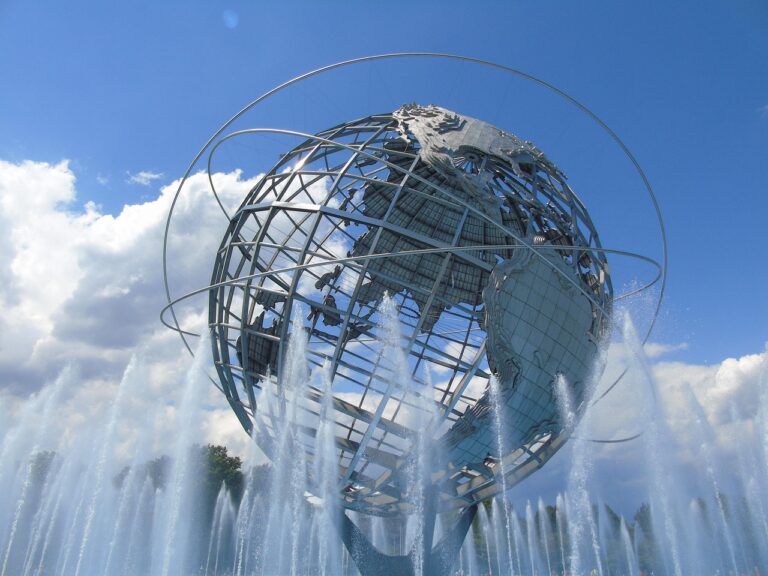
The Unisphere — the 140-foot stainless steel globe commissioned for the 1964 Fair that still stands beside Arthur Ashe Stadium — is visible from the upper tiers of the main stadium, connecting the tennis tournament to the World’s Fair optimism of mid-century New York with every sightline.

No other Grand Slam is built on this kind of accumulated civic history. Wimbledon sits on a quiet residential lawn in southwest London that has been a private tennis club since 1868. Roland Garros was built quickly for a 1928 Davis Cup final and has barely expanded since. The US Open’s location is a palimpsest of New York ambition, transformation, and reinvention — which is to say it is very New York indeed.

It Was Dragged to New York Against Tennis’s Wishes

The US Open’s relationship with New York began not with a grand vision but with a fight. When the tournament was held at the Newport Casino in Rhode Island from 1881 to 1914, it was a genteel, upper-class social event — exactly the kind of refined, exclusive occasion that Newport’s Gilded Age society favored.

In 1911, a group of New York tennis players, led by Karl H. Behr, began petitioning to move it to the city. Tennis’s establishment resisted strenuously: a New York Times report from February 1911 noted that the arguments were “powerfully arrayed against Newport,” but there was no credible alternative application.

By 1915, 100 players had signed a petition arguing that most tennis clubs, players, and fans were located in the New York City area, and that the sport’s development demanded the tournament move there.

The vote at the annual USNLTA meeting was 128 to 119 — a narrow majority that overrode the objections of eight former national singles champions. The tournament moved to the West Side Tennis Club in Forest Hills, Queens, and never looked back.

That founding tension — between tennis’s inherited preference for exclusivity and New York’s insistence on scale — has never fully been resolved. It simply found a new expression at each stage of the tournament’s development. And at each stage, New York won.

Queens Is Not Manhattan — and That Matters

The US Open is not held in Manhattan. It is held in Queens — the most ethnically diverse urban area in the United States, and one of the most diverse in the world, where over 160 languages are spoken and no single ethnic group constitutes a majority.

Flushing, the neighborhood immediately surrounding the tennis center, is home to one of the largest Chinese communities outside of Asia, as well as large Korean, South Asian, and Latin American populations.

The area around the 7 train — the subway line that runs directly to the tournament from Midtown Manhattan — has been described by demographers as the most ethnically diverse urban corridor on earth.

The crowds entering the National Tennis Center each year reflect that diversity. Spectators speak dozens of languages on the grounds and bring elements of their cultures with them — an everyday reality at Flushing Meadows that has no equivalent at any other Grand Slam.

It was not a coincidence. It was Queens. The crowds at the US Open reflect the demographics of New York City in a way that no other Grand Slam reflects its host city’s population — because no other Grand Slam is embedded in a neighborhood that looks and sounds like the whole world at once.

Compare this to Wimbledon, held in a predominantly white, upper-middle-class residential suburb of London where the crowd, even today, skews sharply toward the demographic profile of those who could afford Wimbledon tickets, accommodation in southwest London, and the cultural capital to navigate the All England Club’s protocols. The US Open is not that.

It has never been that. The 7 train from Flushing to Grand Central costs a flat fare regardless of who is riding it.

The Stadium Sounds Like the City

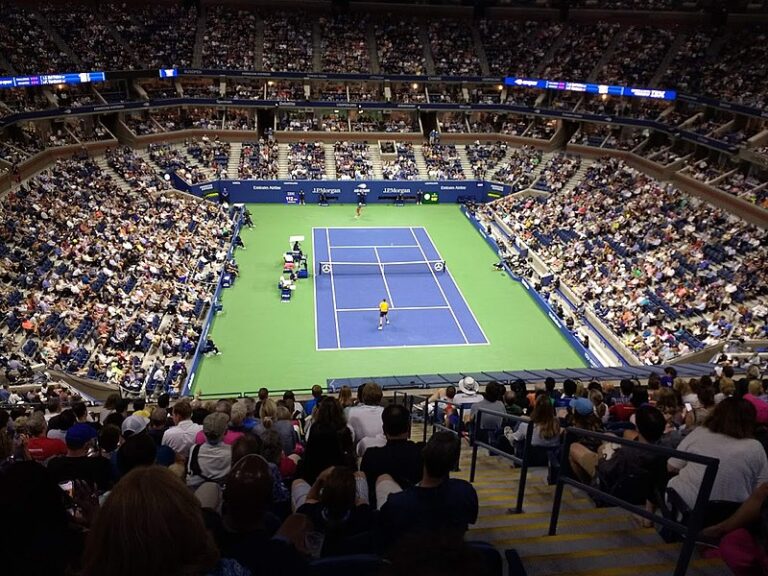
New York is loud. It is loud in ways that other cities are not — a product of density, infrastructure, and a cultural permission to express yourself at volume that is baked into the city’s identity. Arthur Ashe Stadium is loud in exactly the same way and for exactly the same reasons.

Jimmy Connors called it “a concrete zoo, a huge monster place.” John McEnroe — a New York native — compared the atmosphere to going to a baseball game. Both observations were meant to capture something real: the US Open crowd does not observe the conventions of tennis etiquette in the way that Wimbledon’s or Roland Garros’s crowds do. It cheers during points.

It reacts audibly to errors. It brings the habits of Yankees fans and Knicks fans to a tennis stadium and applies them without apology.

The stadium also carries the literal sounds of New York above and around it. LaGuardia Airport is less than five miles away, and aircraft on departure paths climb directly over the complex throughout the day.

The 7 train runs alongside the site. At any given moment during an outer court match at the US Open, the ambient sonic backdrop includes crowd noise, food vendor calls, aircraft engines, and the rumble of the subway — a combination that is, in its way, a precise acoustic portrait of Queens in late August.

The Commerce Is Unapologetically New York

New York has never been shy about money, and neither has the US Open. The tournament operates one of the most commercially aggressive environments of any Grand Slam — premium food, celebrity-filled hospitality suites, fashion partnerships, music performances, and a corporate presence that would feel out of place at Wimbledon but is entirely natural at Flushing Meadows.

The Honey Deuce — the tournament’s signature cocktail of Grey Goose vodka, lemonade, and Chambord raspberry liqueur — sold a record 738,459 units at the 2025 US Open, generating roughly $17 million in revenue at $23 per drink. It is not a subtle drink.

It is a New York drink: overpriced, slightly outrageous, wildly popular, and utterly committed to its own existence. It has become one of the most recognized symbols of the tournament worldwide, which is another way of saying it has become one of the most recognized symbols of the US Open’s relationship with New York consumer culture.

The premium placed on celebrity attendance — a feature of the US Open that has no real equivalent at the other Slams — is similarly New York in character. Serena Williams’s farewell in 2022 drew Oprah Winfrey, Bill Clinton, Hugh Jackman, Spike Lee, and Anna Wintour to a first-round match.

The US Open night session on Arthur Ashe Stadium has become, in the cultural calendar of New York City, an event — something to be seen at, not merely watched. This conflation of tennis with celebrity, fashion, and social status is not a corruption of what the tournament should be. It is a direct expression of what New York is.

It Named Its Courts After People Who Changed America

The naming of the US Open’s venues tells its own New York story. Arthur Ashe Stadium honours a man who grew up barred from tennis courts by segregation and became the first Black man to win three different Grand Slams.

Louis Armstrong Stadium honors the jazz musician who grew up in poverty in New Orleans, moved to New York, and became one of the most influential artists in the history of American music — and whose house museum sits in Corona, Queens, less than a mile from the stadium that bears his name.

The Billie Jean King National Tennis Center honors the woman whose 1973 “Battle of the Sexes” match against Bobby Riggs became one of the most-watched sporting events in television history and whose advocacy transformed the economics of women’s professional sport.

Ashe. Armstrong. King. Three people who used excellence in their respective fields to push America toward something more equitable. The US Open’s real estate carries their names not because they were the most commercially valuable naming options available, but because the tournament made a series of deliberate decisions to honor people who meant something larger than their sport or their art.

This is a New York impulse — the instinct to memorialize those who changed things, on whatever wall or building or public space is available.

Wimbledon’s courts are named Centre Court and Court 1. The contrast is not subtle.

It Has Always Reflected New York’s Contradictions

New York is a city of extraordinary wealth and persistent inequality, of world-class cultural institutions and desolate forgotten neighbourhoods, of immigrants who built everything and systems that excluded them. The US Open contains all of those contradictions in miniature.

It is the Grand Slam that charges the most for premium tickets and also the one with the most accessible grounds passes. It is the tournament that names its stadium after a civil rights activist and simultaneously sells $23 cocktails to investment bankers in luxury suites.

It draws crowds from 160 countries and nations and produces some of the sport’s most racially and nationally diverse rosters of champions — and it also exists within an industry that, for most of its history, was overwhelmingly white and wealthy.

These contradictions are not failures of the US Open. They are reflections of the city it inhabits. New York has always been a place where the aspiration and the reality exist in uncomfortable proximity, where the Unisphere promises a world of tomorrow while the 7 train underneath it runs decades behind schedule.

The US Open does not resolve those tensions. It expresses them. Which is, in the end, the most New York thing it could possibly do.

The Bottom Line

The Australian Open is held in Melbourne, but it could, in theory, be held in Sydney. Roland Garros is in Paris, but the French Open’s identity is more about clay than about the city. Wimbledon is inextricably linked to the All England Club, but the All England Club is a private institution that happens to be in London, not a product of it.

The US Open could not exist anywhere other than New York. Its scale, its noise, its diversity, its commerce, its contradictions, and the names on its buildings are all specific to one city. The tournament does not merely take place in New York.

It is New York — the loudest, most complicated, most self-contradictory, and most alive version of what a tennis tournament can be when it stops trying to be tennis and becomes something bigger.

What Makes Arthur Ashe Stadium So Important

0

Arthur Ashe Stadium is the largest tennis arena in the world, the centerpiece of the biggest Grand Slam tournament on earth, and a venue named after one of the most consequential figures in the history of American sport. Understanding why it matters requires knowing both the building and the man it honors — because the two stories are inseparable.

Who Arthur Ashe Was

Arthur Robert Ashe Jr. was born on July 10, 1943, in Richmond, Virginia — a city where segregation governed daily life. His mother died when he was six years old, and he was raised by his father, a parks caretaker whose job gave the young Ashe access to the tennis courts at Brook Field Park in North Richmond. It was there, on courts he would otherwise have been barred from using, that he first picked up a racket.

Jim Crow restrictions barred Ashe from competing in most elite junior tournaments reserved for white players throughout his adolescence. He graduated as valedictorian of his high school class, earned a full scholarship to UCLA, and in 1963 became the first African American selected for the U.S. Davis Cup team. He graduated with a business degree in 1966 and served two years as a commissioned officer in the U.S. Army while continuing to compete.

On August 29, 1968, on the grass of the West Side Tennis Club at Forest Hills, Ashe defeated Tom Okker in the final of the inaugural US Open to become the first African American man to win a Grand Slam singles title. He was still an amateur — which meant he couldn’t accept the prize money — and he was seeded fifth, behind four Australians.

He went on to win the Australian Open in 1970 and Wimbledon in 1975, defeating Jimmy Connors in the final of the latter in one of the most tactically remarkable upsets in Grand Slam history. He remains the only Black man ever to have won the singles title at the US Open, the Australian Open, and Wimbledon.

Heart disease forced his retirement in 1980. During bypass surgery in 1983, a blood transfusion left him HIV-positive — a diagnosis he kept private until 1992, when a journalist was about to break the story and Ashe chose to make the announcement himself.

In the final year of his life, he became one of the world’s most prominent AIDS activists, founding the Arthur Ashe Foundation for the Defeat of AIDS and addressing the World Health Organization on World AIDS Day in December 1992. Sports Illustrated named him Sportsman of the Year in 1992. He died on February 6, 1993, at the age of 49.

Beyond tennis, Ashe helped found the Association of Tennis Professionals (ATP) in 1972 — the organization that unionized the professional tour. He co-founded the National Junior Tennis League to provide tennis access to underserved youth. He was arrested outside the South African Embassy in Washington D.C. in 1985 protesting apartheid, and arrested again at the White House in 1992 advocating for Haitian refugees.

He wrote eight books, contributed to The Washington Post and Time magazine, and spent much of his post-playing career dismantling the barriers that had constrained him as a child. He was, as historian Ray Arsenault wrote, “the Jackie Robinson of men’s tennis.”

The Idea That Became a Stadium

The stadium that bears his name was not planned from the beginning of the USTA’s tenure at Flushing Meadows. When the National Tennis Center opened in 1978, its center court was Louis Armstrong Stadium — a renovated version of the old Singer Bowl, a 1960s concert arena that had hosted Jimi Hendrix and Janis Joplin before being converted into a tennis facility.

The idea for a new, purpose-built centre court came in January 1977, when USTA president William Hester spotted the underused Singer Bowl on a flight approach into LaGuardia Airport and arranged with the City of New York to use the site for tennis.

The National Tennis Center opened in 1978, but it became clear through the following decade that the tournament had outgrown its centerpiece. Armstrong Stadium, with a capacity of around 20,000, was expanded and modified repeatedly — but as the US Open grew in commercial scale and global profile, those fixes were no longer sufficient.

In 1993 — the year Ashe died — the USTA broke ground on a new main stadium. The project cost $254 million and was designed by Detroit-based firm ROSSETTI, led by architect Gino Rossetti. The site chosen for the new stadium had previously been occupied by the United States Pavilion from the 1964 World’s Fair, which was demolished in 1977.

The stadium opened in August 1997 as the world’s largest dedicated tennis venue, with a seating capacity of 23,771, including 90 luxury suites, five restaurants, and a two-level players’ lounge.

It was named Arthur Ashe Stadium at its opening — a decision made four years after Ashe’s death, in recognition of a man whose victories had been played on grass courts a mile away at Forest Hills, and whose legacy had shaped the sport’s relationship with American society for a generation.

The Scale of the Building

Arthur Ashe Stadium holds 23,771 spectators — more than any other tennis stadium in the world, by a significant margin. The next largest Grand Slam main courts — Court Philippe-Chatrier at Roland Garros, Centre Court at Wimbledon, and Rod Laver Arena in Melbourne — each hold approximately 15,000. Ashe is larger than all three combined would be if you subtracted one.

The stadium is octagonal in plan and rises steeply, its upper tiers pushing spectators far above the court level. The court surface sits well below street level, which contributes to the sense of enclosure even in the open-air configuration.

When full for a night session match, with nearly 24,000 people reacting simultaneously, the volume inside the bowl is unlike anything in tennis — and by many accounts unlike anything in any sport conducted in an arena of this type.

The facility features five restaurants, 90 luxury suites, and a two-level players’ lounge. Every year during the US Open’s two-week event, the National Tennis Center hosts over 750,000 people, including fans, sponsors, and athletes — making it the largest tennis event in the world.

The Retractable Roof: Engineering on an Extraordinary Scale

The original 1997 stadium was built without a roof. For nearly two decades, it was the only Grand Slam main court in the world without weather protection — and the consequences were felt acutely. Rain delays disrupted scheduling regularly, and five consecutive US Open men’s singles finals from 2008 to 2012 were affected by inclement weather. In 2010, the USTA initiated a master planning process to find a solution.

The challenge was formidable. The primary structural challenge was designing a retractable roof for a venue that was not structurally designed to carry any additional load, compounded by poor soils from the site’s history as a former dump for New York City’s coal ash — which required foundations driven deep into the ground to reach bedrock.

The solution ROSSETTI designed — the same firm that had built the original stadium — is among the most technically ambitious structures in sport. The lightweight, octagonal roof measures 520 by 520 feet, covered with 190,000 square feet of Teflon-coated fiberglass membrane that blocks 90 percent of solar radiation while maintaining daylight transmission.

It is supported by eight steel columns, each sitting on concrete bases driven 175 to 200 feet into the ground. The 250-by-250-foot retractable opening — the largest of any tennis stadium in the world — can be opened or closed in under 10 minutes, with computers monitoring over four dozen sensors tracking movement, wind speeds, seismic activity, motor speed, and torque simultaneously.

The roof cost $150 million and was part of a broader $550 million renovation of the National Tennis Center. It was completed in time for the 2016 US Open. Its first use during a match came when rain fell during a night session — and the roof’s acoustic effect, trapping crowd noise inside the bowl rather than releasing it upward, immediately changed the atmosphere of the stadium in ways players noticed from the first point.

The Ongoing Transformation

Arthur Ashe Stadium is not standing still. An $800 million renovation is currently underway, designed by ROSSETTI — the firm’s third major project at the venue — including significant renovations to the stadium itself and the creation of a new Player Performance Center. The renovation will add approximately 2,000 new courtside seats and expand premium hospitality offerings. All construction is expected to be completed by 2027.

The renovation will bring restaurants, retail, and expanded hospitality inside the stadium bowl itself for the first time, transforming the in-venue experience for spectators who previously had to exit the building to access food and shopping.

The broader National Tennis Center campus has also undergone continuous transformation. The 85 percent redesign completed between 2013 and 2018 rebuilt Louis Armstrong Stadium — now holding 14,053 seats with its own retractable roof — and added a new Grandstand court seating 8,125.

The result is a precinct with four roofed venues and 22 courts that has no direct equivalent in world tennis for sheer scale and infrastructure investment.

The Name Means Something

The decision to name the world’s largest tennis stadium after Arthur Ashe was not a commercial arrangement or a naming rights deal. It was a tribute — to a man who had grown up barred from the sport by segregation, reached its summit through extraordinary talent and determination, and then used his platform to fight for others for the rest of his life.

The stadium name has carried weight in the decades since. Arthur Ashe Kids’ Day, an annual free event held at the National Tennis Center since the stadium opened in 1997, celebrates Ashe’s commitment to youth development through tennis clinics, live performances, and educational activities.

Attendance reached a record 47,875 participants in 2024. Proceeds support the National Junior Tennis and Learning network — the program Ashe co-founded to provide tennis and life skills to underserved youth.

The ESPY Award for courage in sport — one of the most prestigious individual honours in American athletics — is called the Arthur Ashe Courage Award. Recipients have included Muhammad Ali, Nelson Mandela, Pat Tillman, Caitlyn Jenner, and Simone Biles.

The award carries Ashe’s name because, as the selection committee has consistently framed it, courage and the willingness to stand for something larger than sport were the defining qualities of his life.

The Moments That Defined the Stadium

In less than three decades, Arthur Ashe Stadium has accumulated a history of its own. The Williams sisters have dominated its night sessions across two eras of women’s tennis, with Serena Williams winning six US Open titles on its blue courts. Roger Federer, Rafael Nadal, and Novak Djokovic have contested some of their most celebrated matches here.

The 2001 women’s final — Venus against Serena, the first Grand Slam final between two sisters — was moved to a prime-time Saturday night slot in recognition of its cultural significance, changing the television landscape for women’s tennis permanently.

Serena Williams’s farewell at the 2022 US Open brought a crowd that included Oprah Winfrey, Bill Clinton, Hugh Jackman, and Spike Lee to a first-round match — a level of celebrity attention that reflected the intersection of sport, culture, and history that the stadium has come to represent. Billie Jean King came onto the court afterwards. The crowd didn’t want it to end.

The stadium has hosted events well beyond tennis. It served as a venue for the 2019 Fortnite World Cup, with a $30 million prize pool. It has hosted professional basketball and professional wrestling. The Westminster Kennel Club Dog Show used it in 2023 and 2024 while displaced from Madison Square Garden. Its scale and infrastructure have made it one of the most versatile large-format venues in New York City.

The Bottom Line

Arthur Ashe Stadium matters for reasons that extend well beyond its capacity figures and roof engineering. It is the largest tennis arena in the world, built to contain a tournament that has become the sport’s biggest annual event.

It is a venue that has been continuously invested in, rebuilt, and expanded to remain at the frontier of what a sports facility can be. And it carries the name of a man who grew up barred from tennis courts by the color of his skin, became the first Black man to win three different Grand Slams, and spent the rest of his life making the world more fair.

The stadium’s scale is impressive. The name above the entrance is the reason it matters.

How the US Open Changed When It Moved to Hard Courts

0

The US Open is the only Grand Slam in tennis history to have been played on three different surfaces. It started on grass, briefly experimented with clay, and has been played on hard courts since 1978 — a change that coincided with a new venue, a new city identity, and a fundamental shift in the kind of tennis the tournament produces. Here is the full story of how that transformation happened and what it changed.

The Grass Era: Newport to Forest Hills (1881–1974)

The tournament that would eventually become the US Open began in 1881 at the Newport Casino in Newport, Rhode Island, on grass courts. At the time, grass was the dominant surface for tennis across the world — Wimbledon had been played on it since 1877, and the sport’s upper-class origins in the manicured lawns of English country houses meant that grass was simply what serious tennis was played on.

The tournament moved to the West Side Tennis Club in Forest Hills, Queens, in 1915, eventually settling permanently there after a brief stint at the Germantown Cricket Club in Philadelphia in the early 1920s.

The Forest Hills venue opened a 14,000-seat stadium in 1924, and the US National Championships — as it was still called — became one of the premier annual sporting events in the United States.

The grass era produced champions who were products of a surface that rewarded serving, net play, and low, skidding groundstrokes. The great names of the pre-Open Era — Bill Tilden, Don Budge, Jack Kramer, Pancho Gonzales, Rod Laver — all competed on the grass of Forest Hills.

When the Open Era began in 1968, opening professional players to Grand Slam competition for the first time, the West Side Tennis Club was still a grass venue, and it produced two more grass-court US Open champions: Arthur Ashe in 1968 and Stan Smith in 1971, among others. Jimmy Connors won the final grass-court US Open in 1974.

The 1970 Tiebreak: The US Open Rewrites Tennis Scoring

Before the surface changed, the US Open made another revolutionary change to the sport. In 1970, at Forest Hills, the US Open became the first Grand Slam tournament to introduce the tiebreak — the most significant scoring innovation in modern tennis history.

The tiebreak was the invention of Jimmy Van Alen, a wealthy Newport tennis enthusiast and founder of the International Tennis Hall of Fame, who had spent two decades advocating for a way to shorten matches and make tennis more television-friendly. Bill Talbert, the US Open tournament director, agreed to test Van Alen’s system in 1970 in what was officially called the “nine-point sudden-death tiebreak” — a first-to-five-points format with a sudden-death point at 4–4 if the score reached that level.

The introduction was visible. When a set reached 6–6, a red flag bearing the letters “S” and “D” (for Sudden Death) and a smaller “V” crossed with an “A” (for Van Alen) was raised at the chair umpire’s seat. Arthur Ashe described it at the time: “It’s eerie what the tiebreakers do. Those red flags are out and the crowd is absolutely silent.”

Most of the top players disliked the format. The matches felt too short. The fate of an entire set could turn on a single sudden-death point. But the fans loved it, the television broadcasters loved it, and the New York Times called the change “the most revolutionary step the sport has ever taken in its scoring system.”

The nine-point sudden-death tiebreak eventually gave way to the more familiar first-to-seven-points format with a two-point margin requirement — the version used at every Grand Slam today. But the US Open’s willingness to be the first major to try a wholesale rewrite of how tennis was scored set the pattern for everything that would follow. When the surface change came four years later, the institution had already established itself as the Grand Slam most willing to experiment.

The Brief Clay Experiment: 1975–1977

In 1975, the USTA made a decision that surprised the tennis world: the grass courts at Forest Hills were converted to Har-Tru, a green clay surface made from crushed igneous basalt. The change was driven by two factors.

Complaints about the unpredictability of the grass bounce had grown louder — the Forest Hills surface was widely regarded as among the least consistent in major tennis, with its heavily worn patches producing erratic, unreliable bounces that frustrated players.

At the same time, tournament officials were looking for ways to make the event more television friendly, and the slower green clay surface produced longer rallies and more sustained baseline exchanges, which broadcast executives believed would hold viewers better than the short, sharp points of grass-court tennis.

Floodlights were installed for the clay years, enabling night sessions for the first time — a change that proved so popular it would be retained permanently when the surface changed again.

The three-year clay era produced three distinct champions in each discipline. On the men’s side, Manuel Orantes won in 1975, Jimmy Connors in 1976, and Guillermo Vilas in 1977. On the women’s side, Chris Evert won all three editions.

Connors’s 1976 victory was notable for its opponent: he defeated Björn Borg in the final, beating the reigning French Open champion on clay — the very surface Borg owned — a result that underlined the difference between the American green clay and the red clay of Paris.

Vilas’s 1977 title was part of an extraordinary season in which he won 59 singles matches in a row at one point, finishing the year with 145 wins and just 14 losses.

Despite the quality of the tennis produced, the clay era did not outlast its initial trial. Three years was long enough for the USTA to conclude that the green clay experiment had served its purpose, and when the tournament moved venues in 1978, the opportunity arose to change the surface one final time.

The 1978 Move to Flushing Meadows and Hard Courts

The USTA National Tennis Center in Flushing Meadows, Queens, opened in 1978 — and with it came the hard court surface that has defined the US Open ever since. The new facility was built specifically to accommodate the rapid growth of professional tennis and the tournament’s expanding commercial ambitions. Forest Hills had charm, but it was fundamentally a private club with a public tennis tournament bolted onto it. Flushing Meadows was purpose-built for scale.

The surface chosen was DecoTurf, a rubberized acrylic hard-court compound manufactured by California Products Corporation. In its early years at Flushing Meadows, the courts were painted green — the same color the venue had used on clay, and a holdover from the previous era’s visual identity.

It wasn’t until 2005 that the inside of the courts was repainted blue, creating the distinctive color scheme that is now synonymous with the US Open. The blue court with the green surrounds — introduced as part of a broader site renovation — was retained through all subsequent changes to the specific surface product used.

In 2020, DecoTurf was replaced after 41 years by Laykold, manufactured by Advanced Polymer Technology. The switch was driven by the desire to find a surface better suited to the hot and humid late-August conditions at Flushing Meadows.

Laykold was already in use at the New York Open and the Miami Masters, and tournament officials were confident it would perform more reliably in the specific environmental conditions the US Open presents.

The playing characteristics of the two surfaces are similar — both are classified as medium-slow hard courts — but the Laykold surface was designed with improved heat dissipation properties.

How Hard Courts Changed the Style of Play

The switch from grass to hard courts — even via the brief clay interlude — fundamentally changed the kind of tennis the US Open rewarded and therefore the kind of player who could win it.

On grass, serving and net play dominated. Points were short, volleys were decisive, and the serve-and-volley game that ruled professional tennis from the 1950s through the 1970s found its best expression at the net. Forest Hills produced champions who came forward: Connors, Ashe, Smith, Laver. The game was fast, low, and decided in a flurry of net exchanges.

Hard courts changed that equation in several ways. The bounce is higher and more consistent than on grass, giving baseliners more time to set up and more reliable contact points. The surface is fast enough to reward a big serve, but not so fast that the serve dominates completely.

It produces a middle ground that suits a broader range of players than either grass or clay, which is part of why the hard-court era of the US Open produced a much more diverse roster of champions.

The baseline game, which had been at a structural disadvantage on grass, became viable and then dominant. Ivan Lendl — who had struggled on the serve-and-volley grass of Forest Hills in his early career — won three US Open titles on hard courts between 1985 and 1987, each time rewarded by a surface that suited his powerful, relentless baseline game.

Pete Sampras won five US Open titles on hard courts by combining a dominant serve with hard-court athleticism in a way that translated far less effectively to clay. Serena Williams, whose serve-baseline combination was ideally suited to a medium-fast hard court, won six US Open titles — the most of any player in the Open Era.

What the Move Meant for American Players

The shift to hard courts had particular significance for American tennis. The United States had historically struggled on red clay — the surface that rewarded the grinding, high-topspin baseline game of Spain and South America — and the brief green clay era at Forest Hills had not fundamentally altered that picture, even though American players performed reasonably well on the faster American green clay.

Hard courts were, and remain, the dominant surface in the United States at club level. American players grew up on hard courts, developed their games on hard courts, and were most comfortable on hard courts.

The move to a permanent hard-court US Open aligned the tournament’s surface with the surface that American players knew best — a structural advantage that contributed to a long period of American dominance at Flushing Meadows through the 1980s, 1990s, and 2000s.

The contrast with Roland Garros is instructive. American players have won the French Open 13 times since 1968, compared to dozens of titles for Spain alone. At the US Open on hard courts, American players have been among the most successful in the tournament’s history.

Jimmy Connors: The Only Player to Win on All Three Surfaces

The surface transitions at the US Open created one of the sport’s most remarkable statistical footnotes. Jimmy Connors is the only player in history to have won the US Open on three different surfaces — grass in 1974, clay in 1976, and hard courts in 1978, 1982, and 1983. His five US Open titles span all three eras and stand as a testament to an adaptability that no other player has matched at this tournament.

On the women’s side, Chris Evert is the only player to have won the US Open on two surfaces — clay in 1975, 1976, and 1977, and hard courts in 1978, 1980, 1982, and 1984. Her 1978 hard court title came in the very first year the tournament played at Flushing Meadows, making her the last US Open clay court champion and the first US Open hard court champion in successive years.

The Venue Transformation: From Private Club to New York Institution

The surface change was inseparable from the venue change, and the venue change transformed what the US Open was as an event. Forest Hills, for all its history, was a private tennis club in a residential neighbourhood. It had atmosphere and tradition, but it was not built for the commercial and cultural ambitions that professional tennis was developing in the late 1970s.

Flushing Meadows changed everything. The new USTA National Tennis Center was a public facility — built on public land in a public park — designed from the outset to be a major entertainment venue as well as a sporting one.

The immediate increase in capacity, the accessibility of the new location via subway, and the night session infrastructure that came with the new venue all contributed to a rapid rise in attendance and television viewership.

In 1997, the opening of Arthur Ashe Stadium — named after the man who had won the inaugural US Open on the grass of Forest Hills in 1968 — gave the tournament the largest tennis arena in the world, with over 23,000 seats.

The stadium’s 2016 retractable roof completed a transformation that had begun with the decision to pour a hard court surface on a former wild marshland in Queens nearly four decades earlier.

The Bottom Line

The US Open’s three surfaces are not merely a curiosity of tennis history. They represent three distinct identities for a tournament that has never been content to stay still. The grass era produced serve-and-volley champions on a club lawn in Queens. The three-year clay experiment produced baseline grinders and television-friendly rallies.

And the hard court era — now approaching its fiftieth year at Flushing Meadows — produced the US Open as the world knows it today: loud, fast, commercially dominant, and set on a blue acrylic court in a 23,000-seat stadium that could not be more different from the manicured lawns of Newport, Rhode Island, where it all began in 1881.

US Open Night Sessions Explained

0

The US Open night session at Arthur Ashe Stadium is one of the most electric settings in professional tennis. Stars under the lights, nearly 24,000 fans who came ready to make noise, and a New York City atmosphere that no other Grand Slam can replicate.

But the night session also has a specific structure, a set of ticketing rules, and a history that first-time attendees often don’t fully understand. Here’s everything you need to know.

How the Session Structure Works

The US Open divides each day of play into two ticketed sessions: a day session and a night session. These are separate events that require separate tickets, and the rules around access are specific.

Day sessions begin at 11:00am on Louis Armstrong Stadium and the Grandstand, and at 12:00pm on Arthur Ashe Stadium. Gates open at 9:30am for day session ticket holders. Up to three matches may be scheduled on Arthur Ashe during the day, with additional matches running simultaneously on Louis Armstrong and the outer courts.

Night sessions begin at 7:00pm. Night ticket holders may enter the grounds from 6:00pm. Night sessions are run on Arthur Ashe Stadium and, during the early rounds, on Louis Armstrong Stadium as well. Evening sessions typically feature one women’s match followed by one men’s match on Ashe, and one additional match on Armstrong when that stadium is in night session rotation.

In 2025, the US Open expanded its main draw to 15 days for the first time, adding a Sunday start to the schedule — meaning one extra day of opening-round play and a slightly longer fortnight overall.

An important distinction for ticket buyers: Arthur Ashe Stadium day and night session tickets are entirely separate. A day session Ashe ticket does not grant access to the reserved seating in Ashe during the night session — but it does allow the holder to remain on the grounds and access general admission seating at Armstrong Stadium and the outer courts. Night session Ashe ticket holders cannot access the grounds before 6:00pm.

A Grounds Pass, by contrast, is primarily a daytime ticket. It allows access to all outer courts and general admission areas at Armstrong and the Grandstand, but not reserved seating in Ashe. Some evening Grounds Passes are sold for select dates when Armstrong is still in night session rotation — but availability varies by date, and the official daily schedule should be checked before purchase.

Why Night Sessions Are the Most Coveted Tickets

Night session tickets are consistently the most sought-after and most expensive tickets at the US Open, for a simple reason: the biggest names play at night. Tournament directors schedule marquee players — those highest in the rankings and with the largest public profiles — in the evening sessions to maximise television viewership and in-venue atmosphere.

During the early rounds in particular, the night session on Ashe almost always features at least one top-ten player, and often one of the tournament’s primary title contenders.

There is, however, an important caveat. The draw is released only a few days before the tournament begins, and the order of play is only confirmed the evening before each match day.

When you buy a night session ticket, you are purchasing access to the session — not a guaranteed seat to see a specific player. You will know who is scheduled to play roughly 18 hours before the session begins, but not at the time of purchase.

This uncertainty is simply part of the US Open experience, and it means that while night sessions reliably deliver top-level tennis, they cannot promise which specific top-level player you will see.

The History of Night Sessions at the US Open

Night tennis at the US Open has a longer history than many fans realise. The tournament moved to its current location at Flushing Meadows in 1978, and Arthur Ashe Stadium — the original centre court — was designed with floodlights from the outset.

Evening matches were a feature of the tournament’s identity at Flushing Meadows almost from the beginning, and the development of the venue’s broadcast infrastructure through the 1980s and 1990s entrenched the night session as a commercial and cultural cornerstone of the tournament.

The addition of the retractable roof on Arthur Ashe Stadium in 2016 changed the night session in ways that went beyond weather protection. When the roof is closed, the stadium becomes an acoustic chamber.

What was already a loud venue became, under a closed roof, something categorically different — an enclosed arena of nearly 24,000 people in which the sound of the crowd has nowhere to go but back down onto the court. Several players who first experienced this in 2016 remarked that even mid-round matches felt like finals, simply because the noise was so overwhelming.

Louis Armstrong Stadium also gained a retractable roof as part of a broader $600 million renovation of the Billie Jean King National Tennis Center.

Armstrong’s roof, completed ahead of the 2018 tournament, brought a second weather-protected venue to the site and allowed the US Open to introduce formal night sessions at Armstrong as well as Ashe — expanding the number of evening tickets available and reducing the scheduling disruption caused by New York’s unpredictable late-summer weather.

The Biggest Night Session Moments in US Open History

The US Open night session has produced some of the most celebrated matches in tennis history. Arthur Ashe Stadium under the lights has an ability to amplify drama that no other tennis venue can match, and the moments that have occurred there at night form some of the sport’s most enduring memories.

Few nights in Grand Slam history compared to the opening match of the 2022 US Open, when Serena Williams played what turned out to be the first match of her farewell tournament. Williams had announced in Vogue that she would be stepping away from tennis after the tournament, and Arthur Ashe reacted accordingly.

Celebrities packed the stands — Hugh Jackman, Mike Tyson, Spike Lee, Bill Clinton, Anna Wintour, Queen Latifah among them — and the atmosphere was described by those present as closer to a once-in-a-generation boxing event than a first-round tennis match. After Williams won in straight sets, Billie Jean King came onto the court and Oprah Winfrey narrated a tribute.

The chair umpire could barely make herself heard above the noise. Williams told the crowd afterwards: “I feel so comfortable on this court, in front of everyone here. The crowd was crazy.”

The 2001 women’s final — the first Grand Slam final ever contested between two sisters — was moved to a prime-time Saturday evening slot for the first time in tournament history, in recognition of the cultural weight of the Venus vs. Serena matchup. It changed the television landscape for women’s tennis permanently.

Matches between Roger Federer, Rafael Nadal, and Novak Djokovic under the Ashe lights have repeatedly produced the kind of tennis that only this court seems to draw out — the combination of the crowd, the scale, and the history of the venue pushing performances to extremes that other environments rarely reach.

The Late Finish Problem

Like the Australian Open, the US Open night session has a well-documented tendency to run very late. Night matches beginning at 7:00pm that involve competitive five-set men’s singles can finish after midnight, sometimes well after.

When the day session on Ashe overruns — which happens regularly when three matches are scheduled — the night session start time is pushed back from its scheduled 7:00pm slot, compounding the problem further.

The US Open’s late finishes are less notorious than the Australian Open’s record-breaking early-morning conclusions — the AO holds the all-time record with matches finishing past 4:00am — but they are nonetheless a practical reality for night session ticket holders to plan around.

Matches that go five sets in both the women’s and men’s sessions can result in a final ball struck close to 2:00am. Public transport in New York runs through the night on the subway, which helps, but the journey from Flushing Meadows to Manhattan at 1:30am on a weeknight is not a quick one.

The Armstrong Night Session: The Hidden Gem

While Arthur Ashe commands most of the attention, the night sessions at Louis Armstrong Stadium offer something that Ashe, for all its grandeur, cannot: proximity. Armstrong holds 14,053 seats — just over half the capacity of Ashe — and its more intimate geometry puts spectators much closer to the action.

The court fills quickly with atmosphere despite its smaller size, and several players have noted that Armstrong at night can feel as intense as Ashe, simply because the crowd is closer.

Armstrong night session tickets are typically significantly cheaper than Ashe equivalents, and the quality of tennis on offer during the early rounds is often indistinguishable — seedings below the top ten regularly produce exceptional matches on Armstrong that attract less attention simply because they are not on the main stage.

For fans who want to experience the US Open at close range without paying Ashe prices, an Armstrong night session ticket in the first week is consistently one of the better value propositions in Grand Slam tennis.

Practical Information for Ticket Buyers

  • Night session gates open at 6:00pm. Night ticket holders cannot enter the grounds before this time.
  • Night sessions begin at 7:00pm. Matches on both Ashe and Armstrong (during Armstrong’s first-week night session rotation) start at this time.
  • You are buying a session, not a specific match. The order of play is announced the evening before each match day — not at the time of ticket purchase.
  • Day session Ashe ticket holders can stay on the grounds after the day session ends, with access to general admission areas at Armstrong and outer courts — but not reserved seats in Ashe for the evening.
  • Grounds Pass holders are primarily limited to day sessions, though select dates do offer evening Grounds Passes when Armstrong is in night session rotation. Availability varies by date.
  • Armstrong night sessions are available only during the first week of the tournament. After that, all reserved night session tickets are Ashe-only.
  • Be prepared for a late finish. If the men’s match is competitive, you may not leave until after midnight. The New York City subway runs 24 hours, and the 7 train from Mets-Willets Point to Grand Central takes approximately 20 minutes.
  • Tickets go on general sale in late May or early June. American Express cardholders typically get presale access several days earlier.

The Bottom Line

The US Open night session at Arthur Ashe Stadium is the loudest, most charged, most unpredictable environment in Grand Slam tennis.

It is a New York institution as much as a sporting event — a place where the biggest names in tennis perform in front of nearly 24,000 people who came specifically to make noise, under a roof that traps every decibel and sends it back down onto the court.

Go in knowing that you’ll find out who you’re watching the night before, that the match may run late, and that the experience is unlike anything else in the sport. There is nothing quite like it in tennis, and very little like it in sport.

Why the US Open Feels Like the Loudest Grand Slam

0

Every Grand Slam has a personality. Wimbledon is hushed and reverential. Roland Garros is passionate but contained. The Australian Open is relaxed and festival-like. And then there is the US Open — a tournament that Frances Tiafoe once described as “insane loud,” that Novak Djokovic called “the biggest stadium and the loudest stadium in our sport,” and that sports journalist Molly McElwee compared to a soccer match rather than a tennis tournament.

The noise at Flushing Meadows is not accidental. It is the product of architecture, geography, culture, and New York City itself.

It Starts With the Stadium

Arthur Ashe Stadium holds 23,859 spectators, making it the largest tennis arena in the world by a significant margin. The next largest Grand Slam main court — Roland Garros’s Court Philippe-Chatrier — holds around 15,000. Wimbledon’s Centre Court holds approximately 15,000. Rod Laver Arena in Melbourne holds around 15,000.

Arthur Ashe Stadium seats roughly 9,000 more people than the next biggest Grand Slam center court. Nine thousand more people making noise, reacting to points, rising to their feet — that difference alone would make the US Open louder than any other major.

But sheer capacity is only part of the story. The geometry of Arthur Ashe Stadium amplifies the crowd in ways that a simple headcount cannot capture. The stands rise steeply around the court, enclosing it in a near-continuous wall of spectators.

When 23,000 people react simultaneously to a match point or an unexpected winner, the sound that results is genuinely unlike anything in tennis — and, as several players have noted, unlike anything in most sports.

The Roof Made It Louder

In 2016, Arthur Ashe Stadium gained a retractable roof — a $150 million structure that is the largest retractable opening in tennis. It was built to protect matches from New York’s late-summer rainstorms, which had historically caused significant scheduling disruption at the tournament. It solved that problem. It also, somewhat unexpectedly, created a new one: noise.

When the roof is closed, the stadium becomes an acoustic chamber. The crowd noise that would previously have dissipated upward into the open sky is instead reflected back down into the bowl of the arena.

During the roof’s debut in 2016, Rafael Nadal observed that even when the roof was only partially closed, the noise level inside the arena was noticeably different from what he had experienced at previous US Opens. The chair umpire attempted to quiet the crowd at least fifteen times during one match alone — to no effect whatsoever.

The roof’s acoustic material was not designed with sound absorption as a primary goal, in contrast to the roof on Court Philippe-Chatrier at Roland Garros, which was engineered with acoustic absorption explicitly in mind. The result at Arthur Ashe is a covered environment that, when full, is arguably the loudest indoor sporting arena in the world.

The Planes and the Trains

The noise at the US Open is not confined to the crowd. The USTA Billie Jean King National Tennis Center sits in Flushing Meadows, Queens — less than five miles from LaGuardia Airport.

Aircraft on their departure paths climb directly over the complex throughout the day and evening, producing a low overhead rumble that interrupts points with regularity and has been a source of frustration for players since the tournament moved to its current location in 1978. No other Grand Slam contends with regular aircraft noise of this kind during play.

The Flushing Meadows complex also sits adjacent to one of the busiest transit hubs in the New York Metropolitan Area. Trains on the 7 line — the subway that connects Midtown Manhattan to the grounds — run frequently throughout the tournament, and the sounds of the city’s infrastructure form a constant ambient backdrop to play on the outer courts that has no parallel at Wimbledon, Roland Garros, or Melbourne Park.

The Music Between Points

At Wimbledon, changeovers are quiet. The crowd settles, players towel off, and the grounds return to something close to silence. The US Open takes a different approach entirely. Music plays during changeovers on Arthur Ashe Stadium — loud, high-energy music, a rotating playlist that has included tracks like “Danza Kuduro” by Don Omar and “Move Your Feet” by Junior Senior.

The speakers that deliver this music to nearly 24,000 spectators are not operating at conversational volume. This practice reflects a deliberate philosophy at the US Open: the tournament wants to feel like a major entertainment event, not merely a sports competition.

The music keeps the crowd energized between games, maintains the atmosphere during slower patches of play, and signals to spectators that this is not an environment that demands or rewards the kind of decorum associated with the sport’s more traditional venues.

The contrast with Wimbledon — where applause at the wrong moment is still frowned upon in some quarters — could not be more stark.

The New York Crowd Is Different

The attitude of the crowd at Arthur Ashe Stadium is as important as its size. The US Open draws its audience primarily from New York City and the surrounding metropolitan area — one of the most sports-saturated cities in the world, where fans are accustomed to expressing themselves loudly and without much concern for convention.

These are people who attend Yankees games, Knicks games, Giants games. They bring those habits to Flushing Meadows.

The result is a crowd that cheers during points, reacts audibly to errors, and does not observe the tradition of silence during play that tennis etiquette technically demands. Players notice this immediately.

Martina Navratilova, who won on every surface and in every conceivable environment across her Hall of Fame career, noted that the noise at Arthur Ashe was uniquely disorienting — explaining that in tennis, you hear the ball before you see it, and that when that auditory signal is drowned out by crowd noise, tracking the ball becomes genuinely harder.

Caroline Garcia, who reached the 2022 US Open semifinals, was direct: the crowd in New York was noisier than at any other Grand Slam, full stop.

The size of the stadium also has an unexpected psychological effect. Because Arthur Ashe is so large, spectators in the upper tiers are far from the action and tend to move around, chat, and generally behave more like they are attending a large stadium event than a tennis match.

Some players find this liberating. Emma Navarro noted that the sense of not having every set of eyes in the building fixed on her was actually calming. Others find it destabilising — particularly when the background noise of 23,000 people conducting their own conversations becomes the sonic backdrop to a crucial moment in a match.

The Honey Deuce Effect

The US Open’s signature cocktail — the Honey Deuce, a combination of Grey Goose vodka, lemonade, and Chambord raspberry liqueur garnished with honeydew melon balls in a branded souvenir cup — has become one of the tournament’s defining cultural symbols. In 2025, the USTA sold a record 738,459 Honey Deuces across the tournament — more than $17 million in revenue at $23 per drink, and an average of one cocktail every 1.5 seconds across the fortnight.

This detail is not merely trivia. A tournament crowd that has been drinking steadily through an August afternoon in New York is a crowd that is going to be louder, more uninhibited, and more volatile than the same crowd sober.

The free-flowing availability of alcohol throughout the grounds is a structural contributor to the atmosphere at Flushing Meadows in a way that is not true at Wimbledon or Roland Garros to the same degree.

How Players Respond to It

The US Open crowd divides players more clearly than at any other Grand Slam. Some thrive on it. Frances Tiafoe, who reached the 2022 semifinals, is perhaps the clearest example — a player who feeds off crowd energy, who rouses the Arthur Ashe audience deliberately, and who has described the atmosphere at the US Open as the greatest in sport. Tiafoe recalled facing Carlos Alcaraz there: the noise was such that 23,000 people felt like 23 million.

Serena Williams produced some of her most celebrated performances on this court precisely because her connection with the New York crowd was electric. The stadium wanted her to win, and its 23,000 occupants were not shy about communicating that.

When Williams played her farewell matches at the 2022 US Open, the atmosphere at Arthur Ashe was described by those present as unlike anything tennis had produced before.

But the same environment unnerves others. Players accustomed to the quieter, more structured atmospheres of Wimbledon or Roland Garros can find the constant background noise of Arthur Ashe genuinely disruptive.

The inability to hear the ball clearly, the unpredictability of when the crowd will react and how loudly, the sense that the audience is a participant in the match rather than a witness to it — these are genuine psychological challenges that require adjustment.

Not every player makes that adjustment successfully, and the US Open draw has historically produced its share of upsets from players who found the environment of Arthur Ashe simply too much to manage.

Is It Good for Tennis?

The US Open’s noise is a source of ongoing debate within the sport. Critics — often including players and traditionalists — argue that the crowd noise undermines the concentration that tennis demands, that it unfairly disadvantages certain players over others, and that the rowdy atmosphere is incompatible with the technical and mental demands of elite competition.

The US Open has the most unruly crowds in Grand Slam tennis, and this is not universally celebrated. Defenders argue the opposite: that the US Open crowd makes tennis more accessible, more exciting, and more relevant to a mainstream sports audience that would not engage with a quieter, more formal event.

The US Open has consistently been one of the most watched and most commercially successful Grand Slams, and the atmosphere at Arthur Ashe is a significant part of that appeal. The argument that diversity of environment strengthens the tour — that a Grand Slam that demands something genuinely different from players is a healthy thing — has real merit.

What is not in dispute is that the US Open feels different. It sounds different. It demands something different from the players who want to win it. And that difference — loud, chaotic, electric, unmistakably New York — is precisely what makes it one of the most compelling two weeks in tennis.

The Bottom Line

The US Open is the loudest Grand Slam because nearly everything about it conspires to produce noise: the biggest stadium in tennis, a roof that traps sound rather than releasing it, aircraft overhead, trains nearby, music between points, a crowd that doesn’t observe traditional tennis etiquette, and hundreds of thousands of Honey Deuces flowing through the stands across the fortnight. Each of those factors would contribute something on its own.

Together, they produce an atmosphere that has no equivalent in the sport — and that has defined the US Open’s identity as the most chaotic, most electric, and most unapologetically loud event in tennis.