

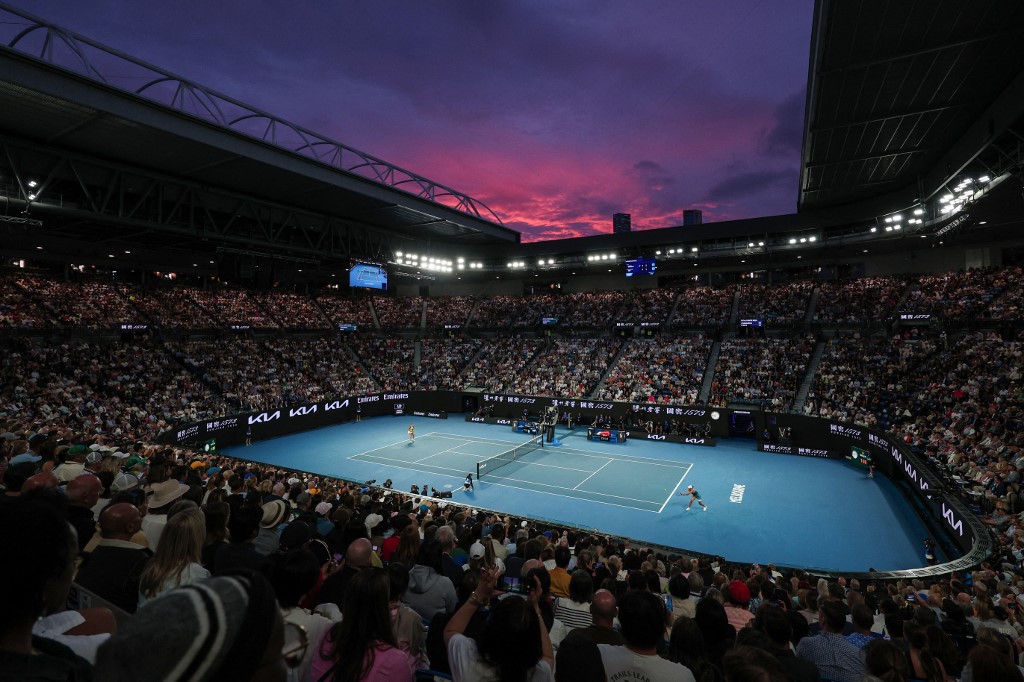
Rod Laver Arena at Melbourne Park is the heart of the modern Australian Open. It opened in 1988 with the world’s first retractable roof on a tennis stadium, hosts every Australian Open final, has witnessed the ten titles of Novak Djokovic, and remains the most architecturally significant tennis venue built in the modern era — a stadium that changed what was possible for the sport.
Here is the complete story of how it came to be, how it changed, and why it still matters.
Why It Is Called Rod Laver Arena
The arena was not called Rod Laver Arena when it opened. From its launch on 11 January 1988 until the end of the 1999 tournament, the main show court at Flinders Park (later Melbourne Park) was simply called Centre Court — a generic descriptor that matched the convention used at Wimbledon, the US Open’s original Louis Armstrong Stadium, and most major tennis venues of the era.
In January 2000, Centre Court was formally renamed Rod Laver Arena. Laver himself appeared at the renaming ceremony — held at the start of the 2000 Australian Open — to inaugurate the new identity. The decision to rename the main court after Laver reflected both his unique achievements in the sport and his specific role in establishing Australia’s modern tennis heritage.
The Margaret Court Arena was named in 2003, recognising the Australian women’s player who holds the all-time Grand Slam singles title record with twenty-four major championships. The third roofed show court, originally called Vodafone Arena, then Hisense Arena, then Melbourne Arena, was finally renamed John Cain Arena in 2021 — after a former Premier of Victoria, rather than a tennis figure.
Who Rod Laver Is
Rod Laver was born in Rockhampton, Queensland, in 1938 — a left-handed Australian who would become one of the greatest players in the history of the sport. He is the only player in tennis history to have won the calendar-year Grand Slam twice — capturing all four major championships in a single calendar year in 1962 (as an amateur) and again in 1969 (as a professional in the first year of the Open Era).
No other player, male or female, has accomplished this twice.
Laver’s eleven Grand Slam singles titles include three Australian Championships (1960, 1962, 1969) — his 1969 Australian Open title being the first leg of his Open Era calendar Grand Slam. He was world number one for seven consecutive years between 1964 and 1970, won 200 career singles titles across all levels of professional tennis, and was inducted into the International Tennis Hall of Fame in 1981.
Laver’s combination of achievements — the calendar-year Grand Slam twice, his sustained dominance across both the amateur and Open Era periods, his role in the transition between those eras as one of the first major champions to turn professional — made him the natural choice for the honour of having Melbourne Park’s main court named after him.
His attendance at major Australian Open finals across the decades since the 2000 renaming has reinforced the connection between the player and the court. Players who win the Australian Open men’s singles title receive the Norman Brookes Challenge Cup with Laver himself frequently present at the trophy ceremony — a continuity of presence that gives the arena a living connection to its namesake.
From Kooyong to Flinders Park: The 1988 Move
For the first eighty-three years of the Australian Open’s history, the tournament had no purpose-built main stadium. The 1972-1987 period at the Kooyong Lawn Tennis Club used the club’s existing horseshoe-shaped grass stadium — a 1927 structure that held approximately 8,500 spectators and was increasingly inadequate for a modern Grand Slam.
The decision to build a new National Tennis Centre at Flinders Park — a former railyards precinct on the edge of Melbourne’s central business district — was made in 1985 by the Victorian Government, with construction beginning later that year. The project cost A$94 million and was completed in two stages, with the first stage finished in late 1987 in preparation for the 1988 Australian Open.
The new Centre Court was designed by Australian architects led by Philip Cox, with the engineering for the retractable roof structure representing one of the most ambitious projects undertaken in Australian stadium construction. Its capacity of around 15,000 spectators was nearly double Kooyong’s, and the deliberate choice of a hard court surface — Rebound Ace — broke completely with the eighty-three years of grass court tradition at the Australian Championships.
The inaugural Australian Open at Flinders Park began on 11 January 1988. Stefan Edberg and Steffi Graf were the first men’s and women’s singles champions on the new court. The tournament drew 266,436 fans across the fortnight — a 90 percent increase over the 1987 tournament’s attendance at Kooyong, and vindication of the Victorian Government’s investment within a single edition of the tournament.
The 1988 Australian Open marked the beginning of the venue’s modern era and the start of the structural transformation that would eventually close the prestige gap between the Australian Open and the other three Grand Slams.
The First Retractable Roof in Tennis
The most consequential feature of Rod Laver Arena — the engineering achievement that gave the venue its initial international profile — was the retractable roof installed as part of the original 1988 construction. It was the first retractable roof at any tennis stadium anywhere in the world.
The technical challenge in 1985-1987 was substantial. There was no global precedent for a retractable roof on a tennis stadium — the engineering had to be developed essentially from first principles. The Toronto Skydome (now Rogers Centre) had opened in 1989 with a retractable roof, but that was a much larger multi-purpose stadium with very different operational requirements. Tennis demanded specific tolerances around natural light preservation, ventilation when closed, and rapid deployment between matches.
The Centre Court roof — as it was called at the time — consisted of a steel-truss structure weighing approximately 700 tonnes that could open or close in about twenty minutes. The roof slides horizontally on tracks rather than folding or retracting in segments, with two halves meeting at the centre of the court when fully closed. When open, the two halves rest at opposite ends of the stadium, exposing the playing surface to natural sky.
The decision to add a retractable roof reflected Melbourne’s specific climate challenges. Unlike Wimbledon, which faced rain disruption, the Australian Open’s primary weather threat was extreme summer heat and occasionally severe storms. A roof that could close during peak heat hours or sudden weather events would protect players, spectators, and the broadcast schedule in ways no previous tennis venue had been able to manage.
The roof’s success at the 1988 Australian Open immediately influenced how the other Grand Slam venues approached weather protection. Wimbledon’s Centre Court roof was unveiled in 2009 — twenty-one years after Rod Laver Arena’s. Arthur Ashe Stadium at the US Open received its roof in 2016 — twenty-eight years after. Court Philippe-Chatrier at Roland Garros got its roof in 2020 — thirty-two years after. Melbourne Park’s pioneering decision in the mid-1980s established a standard that the rest of world tennis took decades to match.
By 2018, Margaret Court Arena (2015) and John Cain Arena (2018) had also received retractable roofs, making Melbourne Park the only Grand Slam venue with retractable roofs on three courts — a level of weather protection no other major can match.
Modernisation and Renovation
Rod Laver Arena has undergone several significant renovation phases since its opening. The most substantial recent transformation came as part of the Melbourne Park Redevelopment program, which ran across the 2010s and into the 2020s.
The 2017-2018 renovations to Rod Laver Arena upgraded the player areas, expanded the corporate hospitality facilities, modernised the audio-visual systems, and improved the broadcast infrastructure throughout the venue. The seating bowl itself was substantially preserved, maintaining the intimate sightlines that the original Cox design had prioritised, while the surrounding facilities were brought to modern Grand Slam standards.
The court surface itself has changed three times since the arena opened.
Rebound Ace was the original surface, in use from 1988 to 2007.
Plexicushion Prestige replaced it from 2008 to 2019, introducing the blue colour that has become visually synonymous with the Australian Open.
GreenSet — a medium-fast acrylic hard court surface — has been in use since 2020, and is classified by the ITF as Category 4 (Medium Fast). For more on the surface comparisons across the modern Slam circuit, see Why the Australian Open Plays Differently From the US Open.
The audio-visual system at Rod Laver Arena now includes one of the most advanced video display setups in international tennis, with 360-degree LED screens, Hawk-Eye electronic line calling, and the broadcasting infrastructure that has supported the Australian Open’s coverage to more than 200 countries.
What Rod Laver Arena Has Witnessed
The history of Rod Laver Arena, in less than four decades, has accumulated as much competitive significance as some venues with twice the lifespan. Every Australian Open men’s singles final since 1988 has been played on this court. Every women’s singles final since 1988 has been played here. The court has hosted some of the most significant moments in the modern era of the sport.
Novak Djokovic’s ten Australian Open titles between 2008 and 2023 have made Rod Laver Arena the most successful court for any player at any Grand Slam venue in the Open Era. His 10-for-10 final record at the AO is the most successful final-stage performance at any single Slam by any player. Djokovic’s 33-match winning streak between 2018 and 2024, matching the previous AO record set by Monica Seles, was played entirely on Rod Laver Arena.
Roger Federer’s six Australian Open titles between 2004 and 2018 included the 2017 final win over Rafael Nadal — Federer’s first Grand Slam title in nearly five years, achieved at age thirty-five in a five-set comeback that became one of the most celebrated late-career performances in tennis history.
The 2012 men’s singles final between Djokovic and Nadal — five hours and fifty-three minutes of play — remains the longest Grand Slam final by playing time in tennis history. Both players were so depleted at the trophy ceremony that organisers brought out chairs for them to sit during speeches. The match is widely regarded as one of the greatest in tennis history.
Ash Barty’s 2022 women’s singles title — the first Australian women’s Grand Slam championship in 44 years — produced one of the most celebrated moments in Rod Laver Arena’s history. Her straight-sets win over Danielle Collins in front of a home crowd ended a drought that had stretched back to Chris O’Neil’s 1978 title at Kooyong.
Serena Williams’s seven Australian Open titles — the Open Era women’s record — all came on this court, including her 2017 victory while in the early stages of pregnancy with her first child.
Carlos Alcaraz’s 2026 Australian Open title completed his career Grand Slam set, defeating Novak Djokovic in the final at the age of twenty-two — making Alcaraz the youngest player in the Open Era to win all four Grand Slam titles.
The list of champions who have lifted the Norman Brookes Challenge Cup or Daphne Akhurst Memorial Cup on this court reads like a comprehensive record of the modern game’s greatest players.
Night Sessions and the Australian Open’s Distinctive Schedule
One feature that distinguishes Rod Laver Arena from other Grand Slam main courts is the central role of the night session in the tournament’s identity. Night tennis at Melbourne Park began on the venue’s opening day in 1988 — making Rod Laver Arena one of the original purpose-built night-tennis venues in Grand Slam tennis.
The combination of the closed roof during peak Melbourne heat hours, the floodlit court at night, the dark blue surface, and the packed crowd produces an atmosphere that is distinctively associated with the modern Australian Open. Night sessions at Rod Laver Arena have produced some of the most memorable matches in the tournament’s modern history — and the Australian Open’s commercial positioning as a prime-time evening event for Asian and European broadcast markets has been built substantially around this arena.
The 2024 transition to a 15-day tournament — beginning on a Sunday rather than the traditional Monday — was driven in significant part by the need to manage the schedule of Rod Laver Arena and Margaret Court Arena across the night session calendar, after years of concern about late-finishing matches. The most notorious example — Lleyton Hewitt and Marcos Baghdatis finishing at 4:33am in 2008 — happened on this court.
Multi-Purpose Use Outside the Australian Open
Unlike Wimbledon’s Centre Court — which is used almost exclusively during The Championships fortnight — Rod Laver Arena is in operation year-round as one of Melbourne’s premier entertainment venues. The arena hosts major concert tours, including international acts that perform multi-night residencies, basketball matches when Melbourne United plays NBL fixtures at the venue, and various other sporting and entertainment events.
This multi-purpose model was built into the arena’s design from 1988. The Victorian Government conceived the facility as a public asset that would deliver year-round economic and social benefits to the state, not simply a tennis venue for two weeks each January. AC/DC played five consecutive nights at what was then Centre Court just two weeks after the 1988 Australian Open final concluded — establishing the multi-use model that has continued for nearly four decades.
The combination of tennis prestige and entertainment versatility makes Rod Laver Arena one of the most commercially valuable indoor venues in Australia, and the revenue generated from its non-tennis use supports both Tennis Australia’s broader infrastructure investments and the ongoing maintenance of the precinct.
The Meaning of the Arena
Rod Laver Arena means something specific in the architectural and commercial development of professional tennis. It is the venue that proved a retractable roof was possible at a tennis stadium — a proof of concept that the rest of world tennis has spent the subsequent decades adopting and refining.
It is the venue that gave the Australian Open the infrastructure to make the leap from the smallest of the four Grand Slams to one of the most commercially powerful and most-attended events in world sport. The arena’s combination of capacity, weather protection, technological ambition, and operational flexibility was unprecedented when it opened — and remains the model that other major tennis venues have aspired to emulate.
The arena’s meaning is also inseparable from the player whose name it carries. Rod Laver’s two calendar-year Grand Slam achievements — separated by seven years, accomplished as both an amateur and a professional, executed across all four surfaces of the era — represent a level of competitive excellence that no other player has matched. Naming the main court of the modern Australian Open after Laver tied the venue’s identity to the highest achievement available in the sport, and his continued presence at major tournament events has reinforced that connection across the decades.
Players who win at Rod Laver Arena describe the experience in terms that go beyond the technical vocabulary of tennis. The combination of the dark blue court, the closed roof during night sessions, the packed crowd, and the awareness of the history that has been made here produces a competitive setting that experienced players consistently rank among the most distinctive in the sport.
The Bottom Line
Rod Laver Arena is a building that was conceived as a leap forward — a purpose-built tennis stadium with a retractable roof, designed to give Melbourne the infrastructure to host a world-class Grand Slam that the Kooyong Lawn Tennis Club could no longer support.
It has hosted more than three and a half decades of Australian Open finals, the longest Grand Slam final in tennis history, the entirety of Djokovic’s ten-title run, multiple comeback titles from Federer, the first Australian women’s Slam championship in 44 years, and the career Slam completion of Carlos Alcaraz.
Its retractable roof — the first of its kind in tennis — established a standard that took the rest of the sport over three decades to match across all four Grand Slams. Its multi-purpose design has made it one of the most commercially valuable indoor venues in Australia outside the tennis fortnight. Its name honours the only player in tennis history to win the calendar-year Grand Slam twice.
Rod Laver Arena is the heart of the modern Australian Open. Everything that distinguishes Melbourne Park from the other Grand Slam venues — the weather flexibility, the night-session culture, the technological ambition, the commercial success, the rich modern competitive history — flows from the arena that opened in January 1988.
Part of the Australian Open series. Related: The Australian Open Guide · What Makes Melbourne Park Different From Other Grand Slam Venues · Australian Open Records — Titles, Matches, and Statistics