

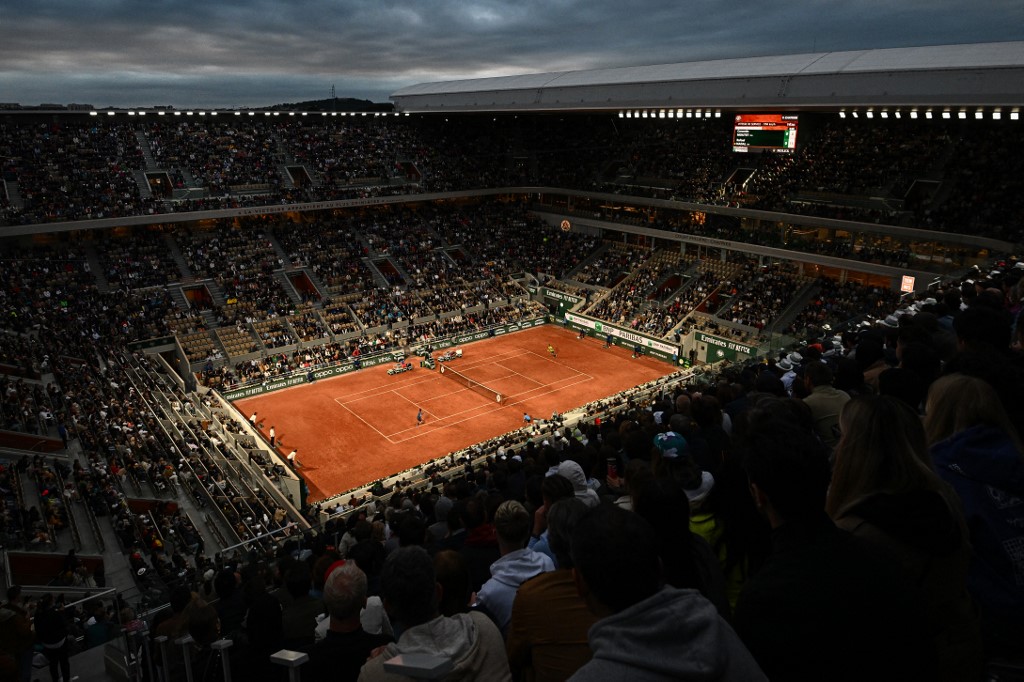
For the first 130 years of its existence, Roland Garros was a daytime tournament. Matches began in the morning, continued through the afternoon, and concluded — weather permitting — before darkness fell over the Bois de Boulogne.
The absence of a roof over Court Philippe-Chatrier made evening tennis impossible when Paris’s spring weather turned hostile, and the absence of permanent floodlighting made it impractical even when conditions were favorable.
Roland Garros was defined as much by what it could not do as by what it did — and what it could not do was compete with the Australian Open and US Open’s prime-time broadcast windows that had become one of the most commercially significant features of those tournaments.
That changed in 2021. The installation of the retractable roof over Court Philippe-Chatrier — completed in time for the 2020 Roland Garros but first used for its intended purpose of enabling night sessions in 2021 — transformed the French Open’s scheduling possibilities and created a new competitive and commercial dimension that has permanently altered how the tournament operates.
Why Roland Garros Was the Last Grand Slam to Get Night Sessions
Understanding why night sessions arrived at Roland Garros later than at the other Grand Slams requires understanding the specific constraints that made evening play at the French Open so much more difficult than at its counterparts.
The US Open has held night sessions since the early years of the Open Era — the combination of Arthur Ashe Stadium’s indoor-adjacent design, New York’s warm summer evenings, and the commercial imperative of prime-time American broadcast windows making evening tennis an early priority.
Night matches at Flushing Meadows under the lights became one of the defining characteristics of the US Open experience and generated some of the most intensely atmospheric moments in Grand Slam history.
The Australian Open added night sessions as its facilities expanded — Melbourne’s summer evenings and Rod Laver Arena’s retractable roof making prime-time matches commercially viable and producing the night session atmosphere that has become one of the Australian Open’s most compelling features.
Wimbledon’s relationship with evening tennis is different — the All England Club’s traditions and its approach to artificial lighting mean that matches extend into the evening rather than being scheduled specifically for night sessions, though the Centre Court roof has allowed play to continue later than the purely weather-dependent scheduling of previous eras permitted.
Roland Garros faced the most significant structural barrier to night sessions of any Grand Slam. The Paris spring climate — cooler than Melbourne’s summer or New York’s late summer, with evenings that drop to temperatures that affect ball behavior and player comfort — made evening tennis on clay specifically challenging.
The clay surface absorbs moisture differently at night, the ball behaves differently in cooler conditions, and the physical demands of clay court competition are amplified when temperatures fall.
Most significantly, the absence of a roof over Court Philippe-Chatrier meant that scheduling matches for a specific evening start time was commercially unreliable — a rain shower at 9:00 PM Paris time had no solution available, which made selling prime-time broadcast windows around night sessions an unacceptable commercial risk.
The retractable roof resolved the commercial risk. The question of whether the playing conditions — the cooler temperatures, the different ball behavior, the physically demanding surface — were suitable for the players remained a more complex one.
The 2020 Roof Installation and the 2021 Launch
The retractable roof over Court Philippe-Chatrier was originally scheduled for completion before the 2020 Roland Garros — itself a tournament already disrupted by the Covid-19 pandemic that moved the French Open from its traditional May-June window to September-October of that year.
The 2020 Roland Garros was played under unusual conditions on multiple fronts — the pandemic restrictions limiting attendance, the autumn scheduling producing different weather and different ball behavior from the normal spring edition, and the new roof being available for weather protection for the first time.
Night sessions were not introduced in 2020 — the combination of the delayed scheduling, the unusual competitive context, and the operational caution appropriate for the first year of roof use meant that the full night session program was deferred.
The 2021 Roland Garros — returning to the traditional May-June schedule — became the first French Open to feature officially scheduled night sessions. The decision to introduce them was commercially driven and editorially significant.
For the first time in the tournament’s history, Roland Garros could offer broadcasters a guaranteed prime-time match window — a match beginning at 9:00 PM Paris time that would be played regardless of weather conditions and that could be marketed to international audiences as a specific broadcast event rather than a daytime schedule that might run late.
The first night session matches at Roland Garros generated significant media attention — both for the competitive quality of the matches scheduled into the prime-time window and for the specific atmosphere that the combination of floodlighting, the red clay surface, the closed roof, and the Court Philippe-Chatrier crowd created.
How Night Sessions Work at Roland Garros
The night session format at Roland Garros follows a structure that has evolved across the editions since 2021 but whose core elements have remained consistent.
Night sessions begin at 9:00 PM Paris time — Central European Time during the French Open period. The session typically features one match on Court Philippe-Chatrier, occasionally two if the first match concludes early enough for a second to begin at a reasonable hour.
The night session ticket is separate from the day session ticket — holders of day session tickets do not automatically have access to the night session, and the night session has its own audience that arrives as the day session audience departs.
The matches selected for night sessions are typically among the most commercially attractive of each day’s schedule — top seeds, high-profile rivalries, or matches with specific broadcast value in key markets.
The selection process involves the Roland Garros tournament direction in consultation with broadcasters and commercial partners, reflecting the specific broadcast priorities that the prime-time window serves.
The competitive implications of night session scheduling have been one of the most discussed topics since their introduction. Players scheduled for night sessions face specific conditions that differ from day sessions — the cooler evening temperatures, the different behavior of the clay under artificial lighting and closed-roof conditions, and the later start time that disrupts the preparation routines that professional players build around match timing.
The Player Reaction to Night Sessions
The introduction of night sessions at Roland Garros has not been universally welcomed by the players who compete in them — and the specific concerns raised reflect genuine competitive issues rather than simple preference.
The temperature problem is the most frequently cited concern. Paris spring evenings are significantly cooler than the daytime conditions that clay court tennis is designed for — temperatures dropping to the low teens Celsius in some evening sessions.
Cool temperatures affect ball behavior on clay specifically — the ball sits heavier, bounces lower, and travels slightly differently than under the warmer conditions of the afternoon. These behavioral differences are not simply discomfort factors — they genuinely affect the tactical and physical parameters of clay court tennis in ways that players must adapt to.
Rafael Nadal was among the most prominent critics of the specific conditions that certain night sessions produced. His 2021 semifinal match against Diego Schwartzman — scheduled as a night session — was played under conditions that Nadal described as affecting ball behavior in ways that made his normal clay court game less effective than it would have been during a day session.
His concerns reflected both his specific experience of how the surface behaves differently at night and his broader perspective on whether the commercial rationale for night sessions was being adequately balanced against competitive fairness considerations.
Other players have raised concerns about the scheduling process itself — the perceived unpredictability of which matches are selected for night sessions, the limited notice players receive about their session timing, and the disruption to preparation routines that a 9:00 PM start time creates compared to the mid-morning or afternoon starts that most clay court scheduling produces.
The French Tennis Federation has responded to player concerns with scheduling adjustments — providing more notice of night session assignments, adjusting the specific conditions management approach under the roof, and engaging with player representatives about how the night session format can be managed more equitably.
The specific balance between commercial imperatives and competitive fairness in night session scheduling remains an ongoing discussion within the tournament’s governance.
The Commercial Logic of Night Sessions
The commercial rationale for Roland Garros night sessions is straightforward — and understanding it explains both why the tournament introduced them and why they are certain to remain a permanent feature of the French Open calendar regardless of player concerns about specific conditions.
Prime-time broadcast windows are among the most commercially valuable assets in major sports. A match beginning at 9:00 PM Paris time airs at 8:00 PM in London, 3:00 PM in New York, and in prime-time slots across multiple European markets — creating a guaranteed broadcast event that can be specifically marketed to audiences across the tournament’s most commercially significant territories.
Before night sessions, Roland Garros’s broadcast value was limited by the daytime scheduling structure — matches that began in the morning or afternoon reached audiences at times that competed with working hours in European markets and overnight hours in North American markets. The prime-time window that the US Open and Australian Open had long used to generate their highest broadcast audiences was unavailable.
Night sessions resolved this commercial limitation. The broadcast value of a guaranteed prime-time match window at Roland Garros — featuring the tournament’s most commercially attractive players in front of the Court Philippe-Chatrier crowd — is substantially higher than the equivalent daytime coverage, and that broadcast value translates directly into the commercial revenues that fund the tournament’s prize money, facilities development, and broader operations.
The specific prize money increases that Roland Garros has implemented in the years since night sessions were introduced reflect partly the expanded commercial revenues that prime-time broadcasting has generated — a direct connection between the scheduling innovation and the financial structure of the tournament that players compete within.
How Night Sessions Changed the Roland Garros Experience
For fans watching Roland Garros — whether at the tournament in Paris or through broadcast coverage internationally — night sessions have created a new dimension of the French Open experience that the daytime-only format could not provide.
The visual identity of Roland Garros at night is distinctive in ways that the daytime tournament is not. The red clay surface under floodlighting, the closed roof creating an atmospheric enclosure that amplifies crowd noise, the specific light quality of Court Philippe-Chatrier in the evening — these visual and atmospheric elements create a viewing experience that is genuinely different from the daytime French Open and that has generated some of the most photographed and most discussed match environments in recent Grand Slam history.
The crowd atmosphere at night sessions has been consistently noted as among the most intense in contemporary Grand Slam tennis — the enclosed roof preventing the crowd noise from dissipating into the open air and creating a contained intensity that outdoor daytime tennis rarely produces.
Players who have competed in night sessions frequently describe the specific atmosphere of Court Philippe-Chatrier under the roof as unlike any other competitive environment in professional tennis.
For international audiences — particularly those in North American time zones who previously faced overnight viewing for Roland Garros coverage — night sessions have created a more accessible broadcast window that has expanded the tournament’s viewership in markets where daytime scheduling had limited its audience reach.
The Night Session Legacy
Five years after their introduction, Roland Garros night sessions have become as established a feature of the French Open as the red clay surface or the Court Philippe-Chatrier architecture.
The competitive concerns that accompanied their introduction have been partially addressed through scheduling adjustments and operational improvements. The commercial benefits have been realized in expanded broadcast revenues and prize money. And the specific atmosphere of night tennis on clay under the Parisian roof has produced competitive moments that the daytime-only French Open could never have generated.
The night sessions are not simply a scheduling addition. They are the clearest expression of Roland Garros’s evolution from a tournament defined by its historical traditions and structural limitations into one that has found ways to maintain those traditions while expanding its commercial reach and competitive drama in ways that the sport’s changing broadcast landscape requires.
The red clay of Court Philippe-Chatrier was the same surface it has always been before night sessions were introduced. Under the lights, enclosed by the roof, in the Paris evening — it has become something new.
Part of the Roland Garros series. Related: How to Watch Roland Garros — Broadcast, Schedule, and Streaming Guide · The History of Roland Garros — How the French Open Was Founded · The Architecture and Importance of Court Philippe-Chatrier