

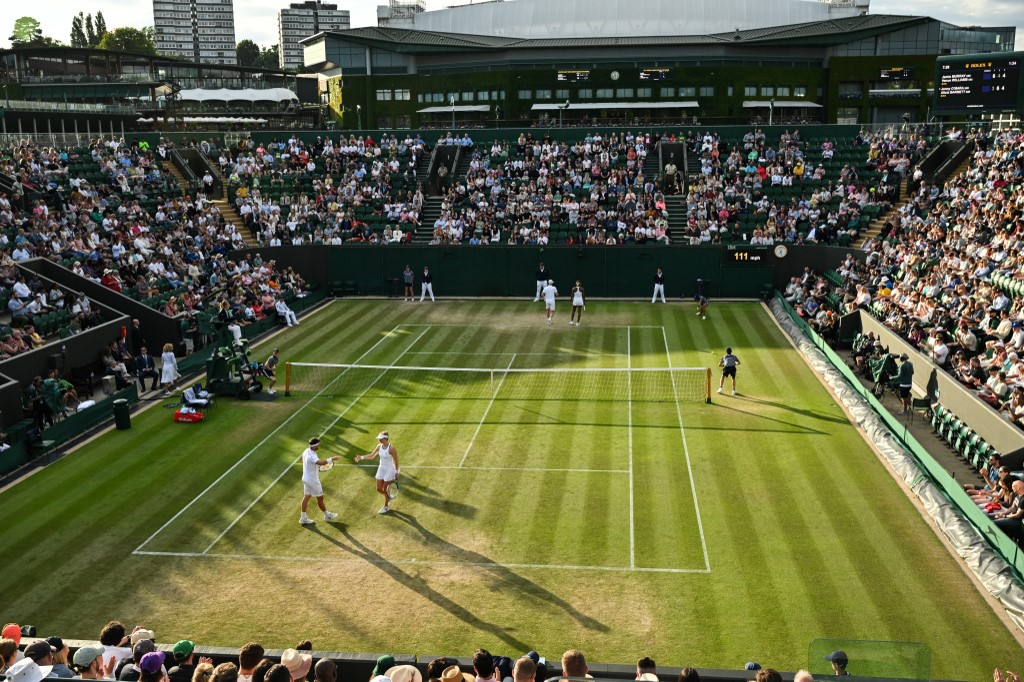
Every sport has a cathedral. Tennis has Wimbledon. Since its first championship in 1877, the All England Lawn Tennis and Croquet Club has maintained a set of customs, rituals, and standards that have no equivalent in professional sport — a living, functioning insistence that some things do not need to change simply because the world around them has.
Here is a complete guide to the traditions that make Wimbledon unlike anything else in tennis, and why they still matter.
The Oldest Grand Slam in the World
Wimbledon has been contested since 1877 — 12 years before the Eiffel Tower was built, 19 years before the modern Olympic Games began, and 91 years before the Open Era brought professional players into Grand Slam competition.
The first champion was Spencer Gore, who won a 22-player tournament on the croquet lawns of a private club in southwest London, watched by a small crowd and attended by no international press whatsoever. The prize was a silver cup.
That same club — the All England Lawn Tennis and Croquet Club — still organises The Championships today. No other Grand Slam is run by an institution with such an unbroken line of continuity. The Australian Open moved venues, changed surfaces, and relocated between cities for decades before settling in Melbourne.
The French Open was built in eight months for a 1928 Davis Cup final. The US Open changed surfaces twice and moved across Queens. Wimbledon has been held at Church Road since 1922, when it moved to its current location to accommodate demand. Everything else — the grass, the rituals, the rules, the food — has remained in place with extraordinary consistency.
The All-White Dress Code
No tradition at Wimbledon is more immediately recognisable — or more strictly enforced — than the requirement that all players wear white. From the moment competitors step onto any court at the All England Club, for practice or for matches, they must be dressed in white. Not off-white. Not cream. The rulebook is explicit: white does not include off-white or cream.
The rule traces its origins to the Victorian era, when perspiration was considered socially unseemly. White clothing was believed to make sweat less visible — a practical solution to an etiquette concern that feels, from a modern vantage point, almost comically distant.
The formal dress code was introduced for the 1963 Championships and tightened in 2014, when Roger Federer’s appearance in orange-soled shoes the previous year prompted the rule’s extension to cover shoe soles. Accent colors are now permitted only if the trim is no wider than one centimeter at the collar or cuff. Anything beyond that, and players are asked to change.
The rule has been challenged by some of the sport’s biggest names and has never yielded. Venus Williams was asked to change in 2017 after pink bra straps became visible during her match. Andre Agassi boycotted the tournament from 1988 to 1990 in protest at the code.
The one significant concession came in late 2022, when the All England Club announced that female players would be permitted to wear dark-coloured undershorts beneath their skirts — a change that took effect at the 2023 Championships and followed years of public testimony from players about the anxiety of playing in all-white during their menstrual cycles. The exemption applies only to undershorts. Everything visible from the outside remains white.
The Grass Courts and the 8mm Rule
Wimbledon is the only Grand Slam still played on grass — the surface on which lawn tennis was invented and on which the tournament has been played without interruption since 1877. It is also the only Grand Slam whose playing surface is genuinely irreplaceable. You cannot build a grass court in a few weeks.
You cannot simply switch to an alternative in a warm-weather period. Wimbledon’s courts are tended year-round by a groundskeeping team that has spent decades perfecting the science of maintaining a surface that is, by its nature, both beautiful and fragile.
The grass is cut to exactly 8 millimetres — a standard maintained across all courts throughout The Championships. The seed mix has been 100 percent perennial ryegrass since 2001, when the All England Club switched from the previous 70/30 ryegrass and fescue combination in order to make the courts more durable and consistent across a two-week tournament.
The tournament begins a few weeks after the French Open ends — a gap chosen partly to allow the courts maximum recovery time from the previous year’s use, partly to give the grass-court swing in the UK and continental Europe a meaningful runway. When play concludes, the courts are immediately rested and the preparation cycle begins again.
The grass produces a playing style unique among the Grand Slams: low, fast, skidding bounces that reward serving, net play, and flat, aggressive groundstrokes. It is the surface on which the serve-and-volley game reached its zenith, where players like John McEnroe, Stefan Edberg, and Pete Sampras dominated with serve-first tennis that was essentially impossible to replicate on clay or hard courts.
The grass is not merely the surface the tournament is played on. It is the reason Wimbledon produces the kind of tennis it does.
Strawberries and Cream: A Tudor Origin Story
The most iconic food in sport may be the bowl of strawberries and cream served at Wimbledon — and its origin story predates the tournament itself by more than 350 years. Historians believe that Thomas Wolsey, Henry VIII’s almoner, was the first person to serve the combination at a banquet. Henry was a tennis fan, and he continued to serve strawberries and cream at matches on his royal tennis courts at Hampton Court Palace.
When the first Wimbledon Championship was held in 1877, the early summer timing of the tournament coincided perfectly with the brief British strawberry harvest — in an era before refrigerated transportation, fresh strawberries were a genuine seasonal luxury available only for a few weeks each year.
The combination of the timing, the Tudor precedent, and the upper-class social character of the event embedded the dish into Wimbledon’s identity from its earliest editions.
The strawberries are sourced from Kent and gathered fresh each morning. In a typical fortnight, more than 30 tonnes of strawberries and thousands of litres of cream are served across the grounds — close to 200,000 portions a year. The price has risen over time, but the dish itself has not changed. It remains two ingredients: strawberries and cream.
Pimm’s: The Drink of the Fortnight
Alongside the strawberries and cream, the Pimm’s Cup has become the defining drink of The Championships. Pimm’s has been served at Wimbledon for decades, with dedicated Pimm’s bars on the grounds since the early 1970s.
A gin-based fruit cup served with lemonade and garnished with mint, cucumber, orange slices, and strawberries, it is quintessentially British in character — gently alcoholic, visually elaborate, and deeply associated with summer garden parties and outdoor sporting events of the kind that Britain’s climate allows only intermittently.
Hundreds of thousands of glasses are consumed across the fortnight, and the drink has become as synonymous with the tournament’s identity as the white dress code or the grass courts.
It is worth noting that the Pimm’s at Wimbledon is served in plastic cups — glass vessels are not permitted on the show courts for safety reasons — which means that the tournament’s most refined tradition is regularly consumed from the same kind of vessel used at stadium concerts. This detail has somehow never undermined the Pimm’s mystique whatsoever.
The Queue
No tradition at Wimbledon is more democratic, more British, or more genuinely peculiar to a sports event of this stature than the Queue. Every day of The Championships, a number of show-court tickets — for Centre Court, Court 1, and Court 2 — are made available for purchase on the day, allocated on a first-come, first-served basis to those who line up outside the grounds.
The Queue has existed in some form since 1927. It has its own code of conduct, published annually by the All England Club, which governs behavior, reserved spaces, and the etiquette of temporary absence. Stewards manage the Queue throughout the night. Campers arrive with tents, sleeping bags, folding chairs, and in recent years have organised informal social communities that last for days.
The Queue exists for a reason that is almost entirely contrary to the commercial logic of modern sport: it gives ordinary people access to the world’s most prestigious tennis tournament without requiring them to secure tickets months in advance through a ballot, a debenture arrangement, or a corporate hospitality package.
The fact that you can get into Wimbledon for a modest amount of money if you are willing to sleep outside in a queue in southwest London, maintained year after year by the All England Club, is one of the least discussed but most important expressions of what Wimbledon believes itself to be.
The Royal Box
Royal patronage at Wimbledon dates to the early twentieth century, when King George V began attending the Championships at the old Worple Road site. The Royal Box on Centre Court was created when the club moved to Church Road in 1922 and holds 74 seats, offering the best sightlines of any position in the stadium.
Guests are invited personally by the Chairman of the All England Club and are received for lunch, tea, and drinks — making a Royal Box invitation one of the more formal sporting hospitality occasions in the British social calendar.
The dress code for the Royal Box is strict: smart attire including a jacket and tie for men, and elegant daywear for women. Women are specifically asked not to wear hats, as they obstruct the view of other guests — a detail that captures the very particular character of Wimbledon’s approach to etiquette: even in the Royal Box, practicality and consideration for others take precedence over personal display.
Lewis Hamilton was turned away from the Box in 2015 after arriving in a tie-less floral shirt, chinos, and a fedora, declining the offer of a tie and blazer.
Until 2003, players were required to bow or curtsy toward the Royal Box upon entering and leaving Centre Court. The tradition was quietly ended by Prince Edward, Duke of Kent, then president of the All England Club, who described it as an anachronism.
Exceptions were maintained for the late Queen Elizabeth II and, at the time, the then-Prince of Wales — meaning that players entering Centre Court during the 2010 Championships, when the Queen attended for the first time in 33 years, observed the bow.
Catherine, Princess of Wales has been Wimbledon’s Patron since 2016 and is a regular presence at The Championships, typically in the tournament’s official colors of deep green and purple. She presents the singles trophies to the men’s and women’s champions on finals weekend.
Rufus the Hawk
Among Wimbledon’s less solemn traditions, few are more beloved than Rufus — the Harris hawk employed by the All England Club as official bird deterrent. In addition to boasting a social media following that many professional tennis players might envy, Rufus plays a pivotal role in keeping the skies clear during the tournament.
His role includes patrolling the grounds each morning before play begins, frightening away the pigeons and other birds whose presence on the meticulously maintained courts would be both a practical and a ceremonial problem.
Rufus has, over the years, become something of a minor celebrity in his own right — recognized internationally, the subject of news coverage when he has occasionally gone missing, and possessed of an official All England Club security pass with the title “bird scarer.” His daily pre-match patrol is as much a part of the rhythm of Wimbledon as the first serve on Centre Court.
The Curfew
In an era when Australian Open matches sometimes finish at 4am and the US Open night session regularly runs past midnight, Wimbledon maintains a strict 11pm curfew on all play.
The rule exists not because of sentiment, but because the All England Club sits in a residential suburb of London and has long-standing obligations to its neighbors that predate floodlighting, televised night sessions, and the commercial pressures that have pushed other Grand Slams to schedule ever later into the night.
The curfew applies regardless of lighting — even on Centre Court and No. 1 Court, where retractable roofs and floodlights allow play to continue after sunset. When 11pm arrives, play stops.
Matches left unfinished are resumed the following morning, which means that a player who has built a lead late at night must come back the next day and potentially face a different set of nerves, recovery, and tactical challenges.
The curfew has produced its share of memorable interventions. In the 2018 men’s semi-final between Novak Djokovic and Rafael Nadal, play was suspended at 11pm with the match tied at two sets all, the roof closed, and the players in mid-rally form. They returned the next afternoon and Djokovic eventually won in five.
Andy Murray’s matches across his Wimbledon career repeatedly bumped up against the curfew, with several being suspended or rescheduled to avoid breaching it. The rule is non-negotiable: not even a Grand Slam semi-final between two of the greatest players in history is permitted to disturb the neighbours after 11pm.
The Bottom Line
Wimbledon’s traditions are not affectations. They are the accumulated evidence of an institution that has, for nearly 150 years, chosen to do things a particular way and defended that choice against every commercial, competitive, and cultural pressure to do otherwise.
The grass courts, the white clothing, the strawberries, the Queue, the Royal Box, the hawk, the curfew — none of these exist for their own sake. They exist because the All England Club believes, and has always believed, that The Championships are not just a tennis tournament.
They are the tennis tournament. And that distinction, maintained with extraordinary consistency across nearly 150 years, is precisely what makes Wimbledon the most traditional event in sport.