

Every Grand Slam has a city. Wimbledon has London. Roland Garros has Paris. The Australian Open has Melbourne. But none of those tournaments wears its city’s identity as visibly, as loudly, or as unapologetically as the US Open wears New York. The tournament is not merely held in New York.
It thinks like New York, sounds like New York, looks like New York, and carries the contradictions of New York — its scale, its diversity, its noise, its commerce, and its complicated history — in everything it does.
It Is Built on New York’s Past
The ground the US Open stands on is New York history compressed into 46 acres. Flushing Meadows-Corona Park was, before Robert Moses transformed it for the 1939 World’s Fair, the Corona Ash Dump — a vast, reeking mound of coal-burning refuse and garbage that F. Scott Fitzgerald immortalised in The Great Gatsby as the “valley of ashes.”
The Long Island Railroad ran through it. Scavenging by humans and rats was common. It was, in the words of the era, one of the most desolate stretches of land in New York City.
Moses pushed through the eviction of the residents and businesses on the surrounding land and transformed the site for the 1939 World’s Fair, which promised a utopian future — “The World of Tomorrow” — to a city still emerging from the Depression.
The 1964 World’s Fair followed in the same location, constructing the Singer Bowl that would eventually become Louis Armstrong Stadium and, later, be demolished and rebuilt as the 14,053-seat arena it is today.
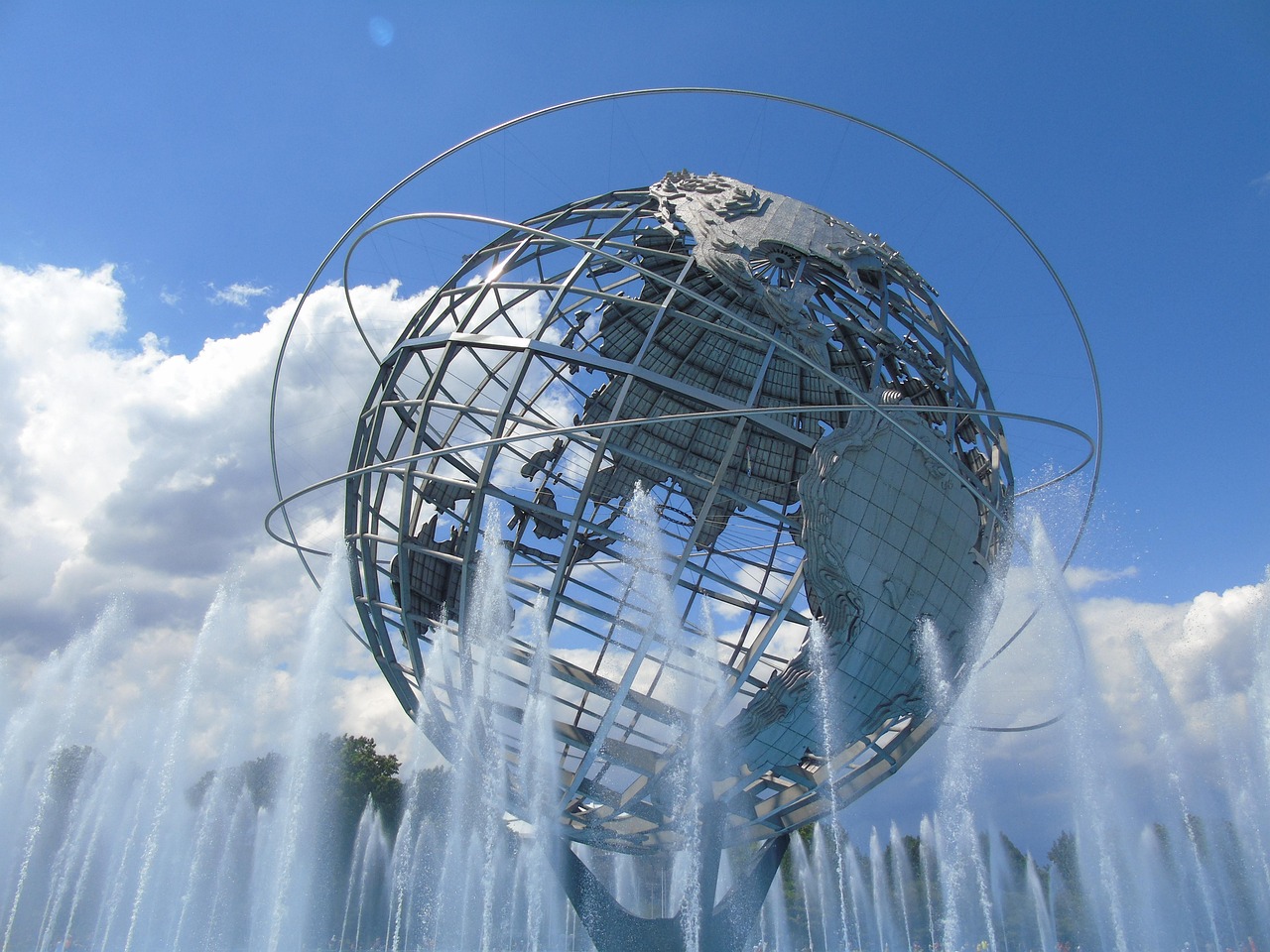
The Unisphere — the 140-foot stainless steel globe commissioned for the 1964 Fair that still stands beside Arthur Ashe Stadium — is visible from the upper tiers of the main stadium, connecting the tennis tournament to the World’s Fair optimism of mid-century New York with every sightline.
No other Grand Slam is built on this kind of accumulated civic history. Wimbledon sits on a quiet residential lawn in southwest London that has been a private tennis club since 1868. Roland Garros was built quickly for a 1928 Davis Cup final and has barely expanded since. The US Open’s location is a palimpsest of New York ambition, transformation, and reinvention — which is to say it is very New York indeed.
It Was Dragged to New York Against Tennis’s Wishes
The US Open’s relationship with New York began not with a grand vision but with a fight. When the tournament was held at the Newport Casino in Rhode Island from 1881 to 1914, it was a genteel, upper-class social event — exactly the kind of refined, exclusive occasion that Newport’s Gilded Age society favored.
In 1911, a group of New York tennis players, led by Karl H. Behr, began petitioning to move it to the city. Tennis’s establishment resisted strenuously: a New York Times report from February 1911 noted that the arguments were “powerfully arrayed against Newport,” but there was no credible alternative application.
By 1915, 100 players had signed a petition arguing that most tennis clubs, players, and fans were located in the New York City area, and that the sport’s development demanded the tournament move there.
The vote at the annual USNLTA meeting was 128 to 119 — a narrow majority that overrode the objections of eight former national singles champions. The tournament moved to the West Side Tennis Club in Forest Hills, Queens, and never looked back.
That founding tension — between tennis’s inherited preference for exclusivity and New York’s insistence on scale — has never fully been resolved. It simply found a new expression at each stage of the tournament’s development. And at each stage, New York won.
Queens Is Not Manhattan — and That Matters
The US Open is not held in Manhattan. It is held in Queens — the most ethnically diverse urban area in the United States, and one of the most diverse in the world, where over 160 languages are spoken and no single ethnic group constitutes a majority.
Flushing, the neighborhood immediately surrounding the tennis center, is home to one of the largest Chinese communities outside of Asia, as well as large Korean, South Asian, and Latin American populations.
The area around the 7 train — the subway line that runs directly to the tournament from Midtown Manhattan — has been described by demographers as the most ethnically diverse urban corridor on earth.
The crowds entering the National Tennis Center each year reflect that diversity. Spectators speak dozens of languages on the grounds and bring elements of their cultures with them — an everyday reality at Flushing Meadows that has no equivalent at any other Grand Slam.
It was not a coincidence. It was Queens. The crowds at the US Open reflect the demographics of New York City in a way that no other Grand Slam reflects its host city’s population — because no other Grand Slam is embedded in a neighborhood that looks and sounds like the whole world at once.
Compare this to Wimbledon, held in a predominantly white, upper-middle-class residential suburb of London where the crowd, even today, skews sharply toward the demographic profile of those who could afford Wimbledon tickets, accommodation in southwest London, and the cultural capital to navigate the All England Club’s protocols. The US Open is not that.
It has never been that. The 7 train from Flushing to Grand Central costs a flat fare regardless of who is riding it.
The Stadium Sounds Like the City
New York is loud. It is loud in ways that other cities are not — a product of density, infrastructure, and a cultural permission to express yourself at volume that is baked into the city’s identity. Arthur Ashe Stadium is loud in exactly the same way and for exactly the same reasons.
Jimmy Connors called it “a concrete zoo, a huge monster place.” John McEnroe — a New York native — compared the atmosphere to going to a baseball game. Both observations were meant to capture something real: the US Open crowd does not observe the conventions of tennis etiquette in the way that Wimbledon’s or Roland Garros’s crowds do. It cheers during points.
It reacts audibly to errors. It brings the habits of Yankees fans and Knicks fans to a tennis stadium and applies them without apology.
The stadium also carries the literal sounds of New York above and around it. LaGuardia Airport is less than five miles away, and aircraft on departure paths climb directly over the complex throughout the day.
The 7 train runs alongside the site. At any given moment during an outer court match at the US Open, the ambient sonic backdrop includes crowd noise, food vendor calls, aircraft engines, and the rumble of the subway — a combination that is, in its way, a precise acoustic portrait of Queens in late August.
The Commerce Is Unapologetically New York
New York has never been shy about money, and neither has the US Open. The tournament operates one of the most commercially aggressive environments of any Grand Slam — premium food, celebrity-filled hospitality suites, fashion partnerships, music performances, and a corporate presence that would feel out of place at Wimbledon but is entirely natural at Flushing Meadows.
The Honey Deuce — the tournament’s signature cocktail of Grey Goose vodka, lemonade, and Chambord raspberry liqueur — sold a record 738,459 units at the 2025 US Open, generating roughly $17 million in revenue at $23 per drink. It is not a subtle drink.
It is a New York drink: overpriced, slightly outrageous, wildly popular, and utterly committed to its own existence. It has become one of the most recognized symbols of the tournament worldwide, which is another way of saying it has become one of the most recognized symbols of the US Open’s relationship with New York consumer culture.
The premium placed on celebrity attendance — a feature of the US Open that has no real equivalent at the other Slams — is similarly New York in character. Serena Williams’s farewell in 2022 drew Oprah Winfrey, Bill Clinton, Hugh Jackman, Spike Lee, and Anna Wintour to a first-round match.
The US Open night session on Arthur Ashe Stadium has become, in the cultural calendar of New York City, an event — something to be seen at, not merely watched. This conflation of tennis with celebrity, fashion, and social status is not a corruption of what the tournament should be. It is a direct expression of what New York is.
It Named Its Courts After People Who Changed America
The naming of the US Open’s venues tells its own New York story. Arthur Ashe Stadium honours a man who grew up barred from tennis courts by segregation and became the first Black man to win three different Grand Slams.
Louis Armstrong Stadium honors the jazz musician who grew up in poverty in New Orleans, moved to New York, and became one of the most influential artists in the history of American music — and whose house museum sits in Corona, Queens, less than a mile from the stadium that bears his name.
The Billie Jean King National Tennis Center honors the woman whose 1973 “Battle of the Sexes” match against Bobby Riggs became one of the most-watched sporting events in television history and whose advocacy transformed the economics of women’s professional sport.
Ashe. Armstrong. King. Three people who used excellence in their respective fields to push America toward something more equitable. The US Open’s real estate carries their names not because they were the most commercially valuable naming options available, but because the tournament made a series of deliberate decisions to honor people who meant something larger than their sport or their art.
This is a New York impulse — the instinct to memorialize those who changed things, on whatever wall or building or public space is available.
Wimbledon’s courts are named Centre Court and Court 1. The contrast is not subtle.
It Has Always Reflected New York’s Contradictions
New York is a city of extraordinary wealth and persistent inequality, of world-class cultural institutions and desolate forgotten neighbourhoods, of immigrants who built everything and systems that excluded them. The US Open contains all of those contradictions in miniature.
It is the Grand Slam that charges the most for premium tickets and also the one with the most accessible grounds passes. It is the tournament that names its stadium after a civil rights activist and simultaneously sells $23 cocktails to investment bankers in luxury suites.
It draws crowds from 160 countries and nations and produces some of the sport’s most racially and nationally diverse rosters of champions — and it also exists within an industry that, for most of its history, was overwhelmingly white and wealthy.
These contradictions are not failures of the US Open. They are reflections of the city it inhabits. New York has always been a place where the aspiration and the reality exist in uncomfortable proximity, where the Unisphere promises a world of tomorrow while the 7 train underneath it runs decades behind schedule.
The US Open does not resolve those tensions. It expresses them. Which is, in the end, the most New York thing it could possibly do.
The Bottom Line
The Australian Open is held in Melbourne, but it could, in theory, be held in Sydney. Roland Garros is in Paris, but the French Open’s identity is more about clay than about the city. Wimbledon is inextricably linked to the All England Club, but the All England Club is a private institution that happens to be in London, not a product of it.
The US Open could not exist anywhere other than New York. Its scale, its noise, its diversity, its commerce, its contradictions, and the names on its buildings are all specific to one city. The tournament does not merely take place in New York.
It is New York — the loudest, most complicated, most self-contradictory, and most alive version of what a tennis tournament can be when it stops trying to be tennis and becomes something bigger.