

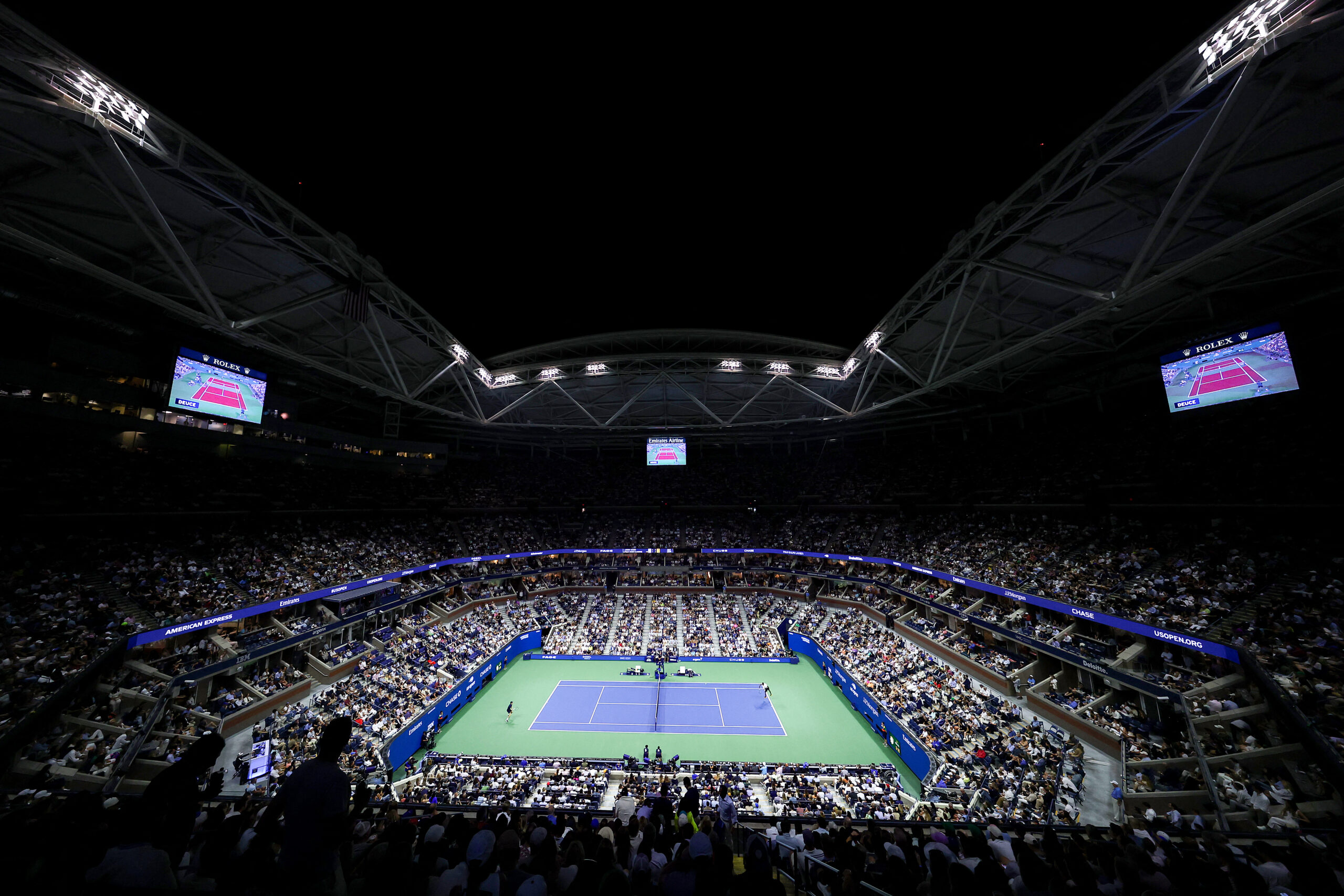
The US Open night session at Arthur Ashe Stadium is one of the most electric settings in professional tennis. Stars under the lights, nearly 24,000 fans who came ready to make noise, and a New York City atmosphere that no other Grand Slam can replicate.
But the night session also has a specific structure, a set of ticketing rules, and a history that first-time attendees often don’t fully understand. Here’s everything you need to know.
How the Session Structure Works
The US Open divides each day of play into two ticketed sessions: a day session and a night session. These are separate events that require separate tickets, and the rules around access are specific.
Day sessions begin at 11:00am on Louis Armstrong Stadium and the Grandstand, and at 12:00pm on Arthur Ashe Stadium. Gates open at 9:30am for day session ticket holders. Up to three matches may be scheduled on Arthur Ashe during the day, with additional matches running simultaneously on Louis Armstrong and the outer courts.
Night sessions begin at 7:00pm. Night ticket holders may enter the grounds from 6:00pm. Night sessions are run on Arthur Ashe Stadium and, during the early rounds, on Louis Armstrong Stadium as well. Evening sessions typically feature one women’s match followed by one men’s match on Ashe, and one additional match on Armstrong when that stadium is in night session rotation.
In 2025, the US Open expanded its main draw to 15 days for the first time, adding a Sunday start to the schedule — meaning one extra day of opening-round play and a slightly longer fortnight overall.
An important distinction for ticket buyers: Arthur Ashe Stadium day and night session tickets are entirely separate. A day session Ashe ticket does not grant access to the reserved seating in Ashe during the night session — but it does allow the holder to remain on the grounds and access general admission seating at Armstrong Stadium and the outer courts. Night session Ashe ticket holders cannot access the grounds before 6:00pm.
A Grounds Pass, by contrast, is primarily a daytime ticket. It allows access to all outer courts and general admission areas at Armstrong and the Grandstand, but not reserved seating in Ashe. Some evening Grounds Passes are sold for select dates when Armstrong is still in night session rotation — but availability varies by date, and the official daily schedule should be checked before purchase.
Why Night Sessions Are the Most Coveted Tickets
Night session tickets are consistently the most sought-after and most expensive tickets at the US Open, for a simple reason: the biggest names play at night. Tournament directors schedule marquee players — those highest in the rankings and with the largest public profiles — in the evening sessions to maximise television viewership and in-venue atmosphere.
During the early rounds in particular, the night session on Ashe almost always features at least one top-ten player, and often one of the tournament’s primary title contenders.
There is, however, an important caveat. The draw is released only a few days before the tournament begins, and the order of play is only confirmed the evening before each match day.
When you buy a night session ticket, you are purchasing access to the session — not a guaranteed seat to see a specific player. You will know who is scheduled to play roughly 18 hours before the session begins, but not at the time of purchase.
This uncertainty is simply part of the US Open experience, and it means that while night sessions reliably deliver top-level tennis, they cannot promise which specific top-level player you will see.
The History of Night Sessions at the US Open
Night tennis at the US Open has a longer history than many fans realise. The tournament moved to its current location at Flushing Meadows in 1978, and Arthur Ashe Stadium — the original centre court — was designed with floodlights from the outset.
Evening matches were a feature of the tournament’s identity at Flushing Meadows almost from the beginning, and the development of the venue’s broadcast infrastructure through the 1980s and 1990s entrenched the night session as a commercial and cultural cornerstone of the tournament.
The addition of the retractable roof on Arthur Ashe Stadium in 2016 changed the night session in ways that went beyond weather protection. When the roof is closed, the stadium becomes an acoustic chamber.
What was already a loud venue became, under a closed roof, something categorically different — an enclosed arena of nearly 24,000 people in which the sound of the crowd has nowhere to go but back down onto the court. Several players who first experienced this in 2016 remarked that even mid-round matches felt like finals, simply because the noise was so overwhelming.
Louis Armstrong Stadium also gained a retractable roof as part of a broader $600 million renovation of the Billie Jean King National Tennis Center.
Armstrong’s roof, completed ahead of the 2018 tournament, brought a second weather-protected venue to the site and allowed the US Open to introduce formal night sessions at Armstrong as well as Ashe — expanding the number of evening tickets available and reducing the scheduling disruption caused by New York’s unpredictable late-summer weather.
The Biggest Night Session Moments in US Open History
The US Open night session has produced some of the most celebrated matches in tennis history. Arthur Ashe Stadium under the lights has an ability to amplify drama that no other tennis venue can match, and the moments that have occurred there at night form some of the sport’s most enduring memories.
Few nights in Grand Slam history compared to the opening match of the 2022 US Open, when Serena Williams played what turned out to be the first match of her farewell tournament. Williams had announced in Vogue that she would be stepping away from tennis after the tournament, and Arthur Ashe reacted accordingly.
Celebrities packed the stands — Hugh Jackman, Mike Tyson, Spike Lee, Bill Clinton, Anna Wintour, Queen Latifah among them — and the atmosphere was described by those present as closer to a once-in-a-generation boxing event than a first-round tennis match. After Williams won in straight sets, Billie Jean King came onto the court and Oprah Winfrey narrated a tribute.
The chair umpire could barely make herself heard above the noise. Williams told the crowd afterwards: “I feel so comfortable on this court, in front of everyone here. The crowd was crazy.”
The 2001 women’s final — the first Grand Slam final ever contested between two sisters — was moved to a prime-time Saturday evening slot for the first time in tournament history, in recognition of the cultural weight of the Venus vs. Serena matchup. It changed the television landscape for women’s tennis permanently.
Matches between Roger Federer, Rafael Nadal, and Novak Djokovic under the Ashe lights have repeatedly produced the kind of tennis that only this court seems to draw out — the combination of the crowd, the scale, and the history of the venue pushing performances to extremes that other environments rarely reach.
The Late Finish Problem
Like the Australian Open, the US Open night session has a well-documented tendency to run very late. Night matches beginning at 7:00pm that involve competitive five-set men’s singles can finish after midnight, sometimes well after.
When the day session on Ashe overruns — which happens regularly when three matches are scheduled — the night session start time is pushed back from its scheduled 7:00pm slot, compounding the problem further.
The US Open’s late finishes are less notorious than the Australian Open’s record-breaking early-morning conclusions — the AO holds the all-time record with matches finishing past 4:00am — but they are nonetheless a practical reality for night session ticket holders to plan around.
Matches that go five sets in both the women’s and men’s sessions can result in a final ball struck close to 2:00am. Public transport in New York runs through the night on the subway, which helps, but the journey from Flushing Meadows to Manhattan at 1:30am on a weeknight is not a quick one.
The Armstrong Night Session: The Hidden Gem
While Arthur Ashe commands most of the attention, the night sessions at Louis Armstrong Stadium offer something that Ashe, for all its grandeur, cannot: proximity. Armstrong holds 14,053 seats — just over half the capacity of Ashe — and its more intimate geometry puts spectators much closer to the action.
The court fills quickly with atmosphere despite its smaller size, and several players have noted that Armstrong at night can feel as intense as Ashe, simply because the crowd is closer.
Armstrong night session tickets are typically significantly cheaper than Ashe equivalents, and the quality of tennis on offer during the early rounds is often indistinguishable — seedings below the top ten regularly produce exceptional matches on Armstrong that attract less attention simply because they are not on the main stage.
For fans who want to experience the US Open at close range without paying Ashe prices, an Armstrong night session ticket in the first week is consistently one of the better value propositions in Grand Slam tennis.
Practical Information for Ticket Buyers
- Night session gates open at 6:00pm. Night ticket holders cannot enter the grounds before this time.
- Night sessions begin at 7:00pm. Matches on both Ashe and Armstrong (during Armstrong’s first-week night session rotation) start at this time.
- You are buying a session, not a specific match. The order of play is announced the evening before each match day — not at the time of ticket purchase.
- Day session Ashe ticket holders can stay on the grounds after the day session ends, with access to general admission areas at Armstrong and outer courts — but not reserved seats in Ashe for the evening.
- Grounds Pass holders are primarily limited to day sessions, though select dates do offer evening Grounds Passes when Armstrong is in night session rotation. Availability varies by date.
- Armstrong night sessions are available only during the first week of the tournament. After that, all reserved night session tickets are Ashe-only.
- Be prepared for a late finish. If the men’s match is competitive, you may not leave until after midnight. The New York City subway runs 24 hours, and the 7 train from Mets-Willets Point to Grand Central takes approximately 20 minutes.
- Tickets go on general sale in late May or early June. American Express cardholders typically get presale access several days earlier.
The Bottom Line
The US Open night session at Arthur Ashe Stadium is the loudest, most charged, most unpredictable environment in Grand Slam tennis.
It is a New York institution as much as a sporting event — a place where the biggest names in tennis perform in front of nearly 24,000 people who came specifically to make noise, under a roof that traps every decibel and sends it back down onto the court.
Go in knowing that you’ll find out who you’re watching the night before, that the match may run late, and that the experience is unlike anything else in the sport. There is nothing quite like it in tennis, and very little like it in sport.