

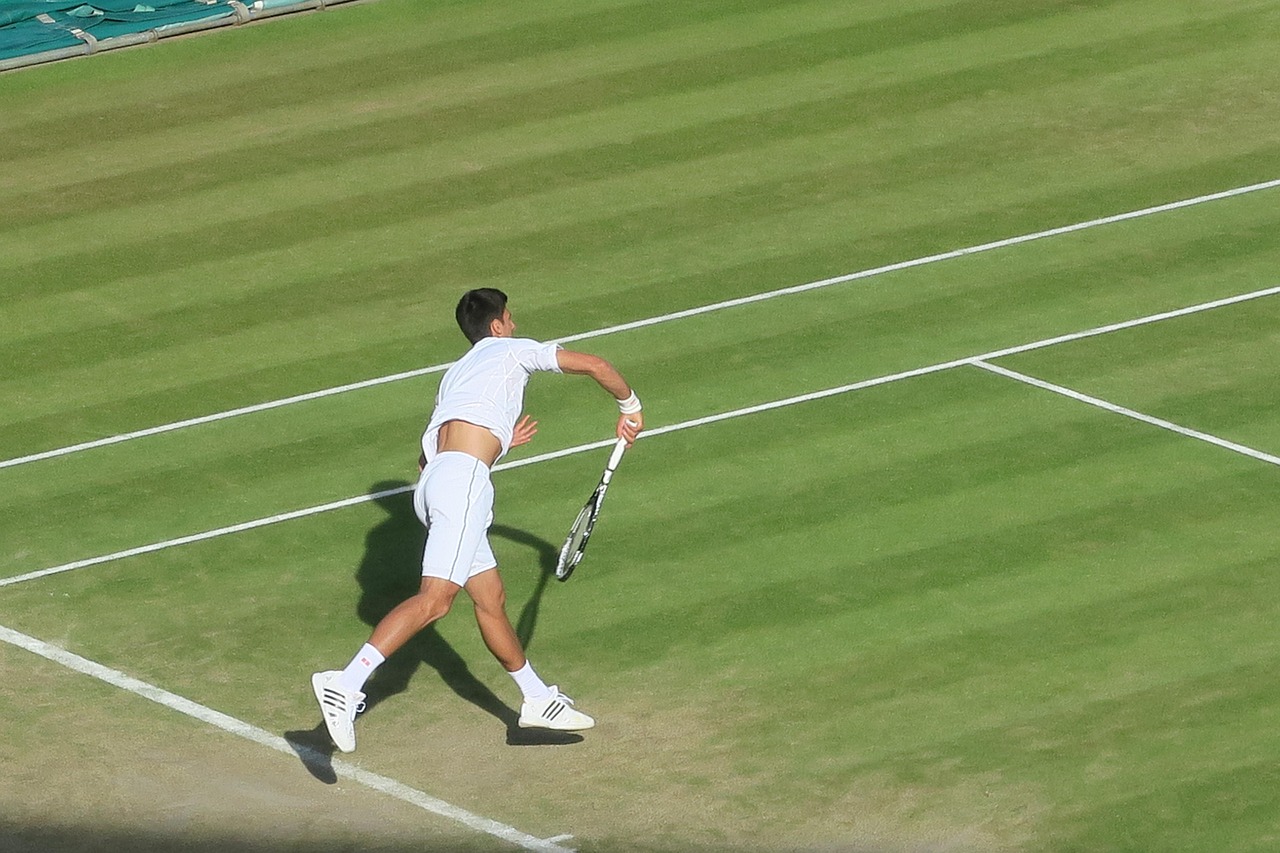
Of all the traditions that define Wimbledon, none is more immediately visible or more strictly enOf all the traditions that define Wimbledon, none is more immediately visible or more strictly enforced than the requirement that every player dress almost entirely in white.
The rule has survived for nearly 150 years, been tested by some of the greatest players in tennis history, and sparked genuine controversy over its effect on female athletes. Here is the complete story of where the rule came from, exactly what it requires, and why it endures.
Where the Rule Came From
The origins of the all-white rule lie in Victorian attitudes toward the human body — specifically toward perspiration.
When lawn tennis was first played in the 1870s and 1880s, the sport was a social activity enjoyed by the British upper class on private lawns, at garden parties, and in settings where standards of propriety governed everything, including what one wore and how one appeared while physically exerting oneself.
Sweat stains were considered improper and unseemly, particularly for women, for whom any public display of physical exertion was laden with social judgement.
White clothing concealed perspiration better than coloured fabrics, and it was considered both more breathable and more modest — two qualities Victorian sport highly valued.
In its first 85 years, Wimbledon did not actually have a formal rule requiring white. White was a fashion and a tradition — the overwhelming preference of players and spectators alike — but it was not codified.
Players were technically permitted to wear other colours from 1877 right through to 1962, when the All England Club’s management committee decided that the rule needed to be formal. It came into force at the 1963 Championships and has been with the tournament ever since.
What followed is one of sport’s more unusual regulatory histories: while every other Grand Slam has relaxed its dress requirements over the decades, Wimbledon’s rules have, with one specific exception, become stricter over time.
Exactly What the Rules Require
The current Wimbledon dress code is detailed, precise, and leaves very little to interpretation. The key requirements are:
- All clothing must be “almost entirely white.” White does not include off-white or cream.
- A single trim of colour is permitted — but it must be no wider than one centimetre at the collar or cuff. If officials question whether a trim is within specification, they will produce a tape measure.
- The rule applies the moment a player steps onto any court at the All England Club — for practice sessions and warm-ups as well as matches.
- Undergarments that are visible, or that may become visible during play due to perspiration, must also be completely white, except for a single trim no wider than one centimetre.
- Shoes must be almost entirely white, including the soles.
- Caps, headbands, wristbands, and socks must all be white.
- Equipment and medical supports should be white, though colour is permitted if medically necessary.
- Small sponsor logos on clothing may contain colour.
If a player is found to be in violation, tournament officials will request an outfit change. This applies before the match, during the match, and at any point the player is on court.
The Rule’s Key Revisions
Since its formal introduction for the 1963 Championships, the all-white rule has been revised on a handful of occasions — and the direction of those revisions tells its own story.
1963: The “predominantly white” rule, with a one-centimetre colour trim restriction, takes effect at the Championships for the first time. The change had been agreed by the management committee in late 1962.
1995: The language is tightened to specify that white “does not include off-white or cream” — a clarification prompted by players testing the boundaries of what counted as white.
2014: The rules are significantly extended following a series of high-profile incidents. Shoes are formally brought within the code — soles included — and the undergarment rule is tightened to cover any item visible due to perspiration. The wording shifts from “predominantly white” to “almost entirely white.” It is the most comprehensive tightening since the rule’s original introduction.
2023: In the only genuine loosening of the rules since 1962, Wimbledon — having announced the change in late 2022 — permits female players to wear dark-coloured undershorts beneath their white skirts or shorts.
The change followed years of criticism from players and former players about the physical and psychological burden the all-white rule placed on women competing during their menstrual cycles.
The Incidents That Forced Changes
Several players are widely credited with triggering each of the rule’s significant revisions. The first was Brazilian player Maria Bueno, whose 1962 outfit — a white dress designed by Ted Tinling, with shocking pink lining visible during play — was the immediate prompt for the management committee’s decision to make the all-white rule formal for the first time. The other names are familiar to any tennis fan.
Andre Agassi did not merely break the rules — he boycotted the tournament entirely because of them. Between 1988 and 1990, Agassi refused to play at Wimbledon, citing the all-white dress code as incompatible with his personal style.
At a time when the long hair, the denim shorts, and the bold colours were as much a part of his public profile as his tennis, the requirement to play in all white was, in his view, archaic.
He returned in 1991, wore white without complaint, and won the title in 1992. He remains the most prominent player in history to have openly boycotted a Grand Slam over its dress requirements.
Roger Federer — eight-time Wimbledon champion and the most decorated grass-court player in history — ran afoul of the rules in 2013 when he arrived for his first-round match wearing white shoes with orange soles.
The shoes were predominantly white. The soles were bright orange. Officials reviewed the situation and asked Federer not to wear them again. He complied and switched to white-soled shoes for his second match. The incident directly prompted the 2014 rule update extending the dress code to shoes and their soles.
Venus Williams provided the third significant catalyst. In her 2017 first-round match against Elise Mertens, the pink straps of her sports bra became visible during play, and officials asked her to change at the next change of ends.
She did, returning to court in regulation white. The incident, alongside several other women’s-tour grievances about the impractical application of the undergarment rule, contributed to the broader pressure that eventually produced the 2023 concession.
The Controversies the Rule Has Generated
Beyond those pivotal players, the dress code has generated a long catalogue of incidents across its history that range from the absurd to the genuinely troubling.
In 1949, American player Gertrude “Gussie” Moran requested permission to wear a colourful outfit, was denied, and instead appeared in a white dress with lace-trimmed white undershorts that were occasionally visible during play.
The visibility of the lace was deemed scandalous enough to generate newspaper headlines across Britain and the United States. The chair umpire was reportedly distracted. Moran herself was bemused by the reaction.
In 1985, American player Anne White arrived on court wearing a full-length white catsuit. It was entirely white. It met every specification of the dress code as it stood at the time. The chair umpire suspended her match at the end of the first set due to fading light and asked her to wear something more appropriate the following day.
She did. She lost. The incident has since become one of the most frequently cited examples of Wimbledon’s instinct to enforce not just the letter of the rules but the spirit of a particular idea of what players should look like.
In 2014 — the year after Federer’s orange soles prompted a rewrite — tournament officials were reported to have asked several female players to remove or replace bras whose straps showed a colour that violated the code.
Pat Cash, the 1987 Wimbledon champion, criticised the enforcement on BBC Radio 5 Live, describing it as having gone ridiculous. Martina Navratilova, nine-time Wimbledon champion, said officials had gone too far when they told her that a blue-striped skirt she was wearing as a guest was not up to code.
Nick Kyrgios has collided with the rules on multiple occasions. At the 2022 Championships he was fined for wearing a red cap and red Air Jordans during a match and trophy presentation — a deliberate provocation that he has been open about.
He wears what he wants, accepts any consequences, and does not consider himself bound by rules he disagrees with. In 2015 he turned an official purple-and-green Wimbledon headband inside out so that only the white lining was visible, and wore it that way through a match.
The 2023 Concession and What It Meant
The 2023 change permitting dark undershorts was the first meaningful relaxation of the rules in the code’s 61-year formal history, and its significance went beyond the specific garment it covered.
Players had been speaking publicly about the issue for years before Wimbledon acted. British player Heather Watson said she had gone on the contraceptive pill in a previous year to stop herself from menstruating during the tournament, specifically to avoid the anxiety of playing in all-white during her period. F
ormer Olympic champion Monica Puig and Australian player Daria Saville both spoke publicly about the mental stress the rule created. Judy Murray described the prospect of a visible leak under TV cameras as a traumatic experience and called publicly for a change in late 2022.
Coco Gauff, speaking after the rule change was announced, said it would relieve a lot of stress for her and other women in the locker room. The testimony of players across multiple generations made clear that the rule’s psychological impact on female competitors was real, practical, and had been acknowledged privately within the sport for far longer than it had been discussed publicly.
The concession was narrow — dark undershorts only, with everything visible from the outside still required to be white — but it represented an acknowledgement by the All England Club that maintaining tradition and protecting player welfare are not always compatible, and that when they conflict, some adjustment is possible.
Why the Rule Endures
The All England Club has been consistent in explaining why the rule remains in place. The all-white requirement is part of Wimbledon’s DNA — as emblematic and individual as the grass courts and the strawberries and cream.
Together with the all-green backdrop and the absence of advertising on Centre Court, the all-white attire brings focus to the tennis itself. Unlike at other Grand Slams, where blinking billboards, loud music, and sponsor branding are constant sensory presences, Wimbledon’s aesthetic brings a calm and focus that is deliberate and defended.
There is also an egalitarian argument that is rarely made but carries some weight: having all competitors wear the same colour makes the tournament visually neutral in a way that serves the event’s identity. Roger Federer in white and an unseeded qualifier in white look, from the stands, like they are playing the same game under the same conditions.
The visual hierarchy that clothing brands create at other Grand Slams — where a Nike athlete and an Adidas athlete are immediately identifiable by their kit’s colour scheme — is erased at Wimbledon. Whether that matters to anyone beyond the All England Club itself is debatable, but the argument is genuinely made.
The US Open maintained its own all-white rule until 1972, when it became the first international event to permit coloured tennis clothing. The Australian Open and French Open have always been comparatively relaxed. Wimbledon is the last Grand Slam standing, defending a rule that every other major tournament has long since abandoned — and, in its own assessment, the better for it.
The Bottom Line
The all-white dress code is not a marketing exercise or a public relations strategy. It is the most visible expression of a philosophy that the All England Club has held since 1877: that Wimbledon is not merely a tennis tournament, but a specific kind of occasion with specific standards, and that those standards apply to everyone who steps onto its courts regardless of ranking, reputation, or personal preference.
It has been tested by Agassi’s boycott, Federer’s orange soles, Venus Williams’s pink bra, Kyrgios’s red Jordans, and the quiet testimony of dozens of female players for whom the rule created practical difficulties that went unaddressed for decades. The rule has bent — slightly, in 2023 — but it has not broken. In all likelihood, it will not.