

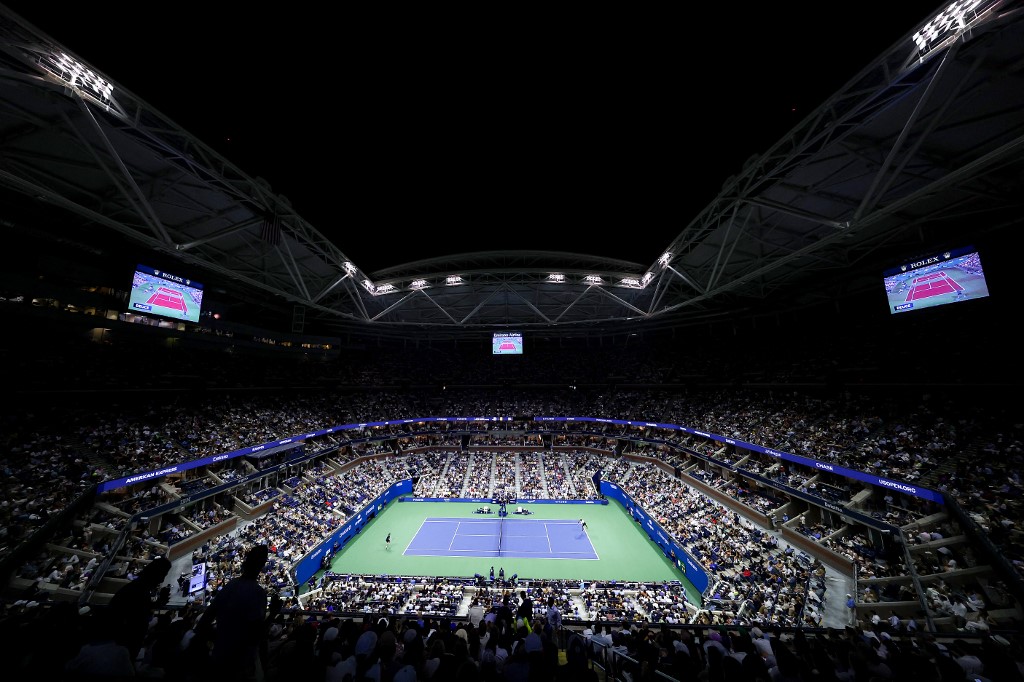
The US Open closes the Grand Slam calendar each year, bringing the professional tennis season to New York in late summer. Played on outdoor hard courts at the USTA Billie Jean King National Tennis Center in Flushing Meadows, Queens, it is the fourth and final major of the year, the largest tennis tournament in the world by capacity and attendance, and the only Grand Slam to have been contested on three different surfaces in its history.
First held in 1881 and part of the Open Era since 1968, the US Open is known for its night-session culture, its enormous crowds, and its commercial scale. This guide explains how the tournament is structured, how the draws work, how ranking points and prize money are distributed, and what distinguishes the final Grand Slam of the year from the three that precede it.
Where It Is Played
Venue: USTA Billie Jean King National Tennis Center City: Queens, New York, United States Surface: Outdoor hard court (Laykold) Main stadium: Arthur Ashe Stadium (capacity 23,771, retractable roof since 2016) Secondary show courts: Louis Armstrong Stadium (capacity approximately 14,000, retractable roof since 2018), Grandstand (capacity 8,125)
The US Open is the only Grand Slam to have been played on three different surfaces — grass (1881–1974), green clay (1975–1977), and hard court (1978 to present). The current surface is Laykold, a rubberised acrylic compound that replaced DecoTurf in 2020 after 42 years. The courts are painted blue inside the lines and green outside — a colour scheme introduced in 2005 that has since become one of the tournament’s most recognisable visual signatures.
Tournament Format
Main Draw Size
- 128-player singles draws (men and women)
- 64-team men’s and women’s doubles draws
- 32-team mixed doubles draw
- Junior, wheelchair, and invitational competitions
Match Format
- Men’s singles: Best of five sets
- Women’s singles: Best of three sets
- Final-set tiebreak: First to 10 points at 6–6 in the deciding set
The US Open was the first Grand Slam to introduce the tiebreak, adopting Jimmy Van Alen’s nine-point sudden-death tiebreak in 1970 at Forest Hills. The current 10-point final-set tiebreak format has been used at the US Open since 2022, when all four Grand Slams aligned on a single format.
How the Draw Works
The US Open singles draw includes 128 players, with 32 seeds. The bracket mechanics, including how the halves and quarters are built, are covered in full in the US Open draw explainer.
- Seeds are distributed to prevent early-round matchups
- The top two seeds cannot meet before the final
- Seeds 1–4 cannot meet before the semi-finals
- Unseeded players are drawn randomly into the bracket
- Qualifiers earn entry through a three-round qualifying tournament held on-site at Flushing Meadows the week before the main draw begins
- Wild cards are awarded by the USTA, typically to American players, returning veterans, and emerging international talents
Seeding is based directly on the ATP and WTA rankings at the entry cutoff date. Unlike Wimbledon, the US Open has never used a surface-specific seeding adjustment.
The last significant event before the cutoff is the Cincinnati Open, a combined Masters 1000 and WTA 1000 staged roughly a week earlier. That makes it the final opportunity for players to alter the rankings their seeding depends on.
Ranking Points Distribution (Singles)
As a Grand Slam, the US Open awards the maximum ranking points.
- The ATP and WTA award the same 2,000 points to the champion and 1,300 to the runner-up, but the two tours diverge from the semi-finals down.
| Round | ATP | WTA |
|---|---|---|
| Champion | 2,000 | 2,000 |
| Finalist | 1,300 | 1,300 |
| Semi-finalist | 800 | 780 |
| Quarter-finalist | 400 | 430 |
| Round of 16 | 200 | 240 |
| Round of 32 | 100 | 130 |
| Round of 64 | 50 | 70 |
| Round of 128 | 10 | 10 |
Points apply within the 52-week ATP and WTA ranking systems. As the final Grand Slam of the year, the US Open frequently has a significant impact on year-end rankings and qualification for the ATP and WTA Finals.
Prize Money
The US Open has carried the largest total prize purse in professional tennis across recent editions, and the USTA has raised the figure in successive years, with a stated emphasis on increasing pay in the early rounds and in qualifying. Totals and round-by-round breakdowns are set annually and confirmed in the weeks before the main draw, so the figures below are dated to the most recent completed championships. A fuller treatment sits in the US Open prize money guide.
The US Open was the first Grand Slam to offer equal prize money to men and women, adopting the policy in 1973 — driven by a campaign led by Billie Jean King, who threatened a boycott by the top women if equal pay was not introduced. That year, John Newcombe and Margaret Court each received $25,000. Equal pay has been maintained at the US Open every year since, decades before Roland Garros (2006), Wimbledon (2007), and the Australian Open (2008) followed suit.
Season Snapshot — 2025 Championships
The figures in this block are dated and are refreshed after each edition. They reflect the 2025 US Open, the most recent completed championships, which carried a total purse of $90 million, a 20 percent rise on the $75 million offered in 2024. Both singles champions received $5 million. Prize money for the 2026 championships had not been published when this block was last updated on 28 July 2026; the USTA confirmed the 2025 figures in early August of that year, so the 2026 totals are expected on a similar timetable.
2025 singles prize money by round:
| Round | Prize Money (USD) |
|---|---|
| Champion | $5,000,000 |
| Finalist | $2,500,000 |
| Semi-finalist | $1,260,000 |
| Quarter-finalist | $660,000 |
| Round of 16 | $400,000 |
| Round of 32 (third round) | $237,000 |
| Round of 64 (second round) | $154,000 |
| Round of 128 (first round) | $110,000 |
Doubles winners (men’s and women’s) split $1 million per pair. Mixed doubles champions split $1 million per pair under the format introduced in 2025, which moved the event into the week before the main draw. Qualifying first-round losers received $27,500, with totals scaling up through the three rounds of qualifying. Figures above are 2025; see the note at the top of this snapshot.
Scheduling Structure
- Two-week main draw across approximately 15 days, preceded by qualifying and Fan Week
- Late August through early September, concluding on the Sunday of Labor Day weekend
- Day sessions and evening night sessions on Arthur Ashe Stadium and (during the first week) Louis Armstrong Stadium
- Singles finals: women’s on the second Saturday afternoon, men’s on the second Sunday afternoon
- Late finishes are common, with night session matches occasionally running past 1:00 am
The US Open does not have a curfew. Matches on roofed stadiums can continue indefinitely if weather, light, or scheduling require it — a structural difference from Wimbledon’s 11pm cut-off and a source of some of the latest Grand Slam finishes in modern tennis.
What Makes the US Open Unique
- Final Grand Slam of the year, frequently shaping year-end rankings and ATP/WTA Finals qualification
- Arthur Ashe Stadium, the largest tennis venue in the world at 23,771 seats — roughly 8,500 more than Court Philippe Chatrier, the next-largest Grand Slam main court
- The Honey Deuce, the tournament’s signature lemonade-vodka-raspberry cocktail, served by the tens of thousands daily and now one of the most recognisable food and drink traditions in tennis
- Night sessions under the lights of Arthur Ashe — the loudest, most electric setting in Grand Slam tennis and consistently the most expensive ticket
- The blue and green court colour scheme, introduced in 2005 and now synonymous with the tournament’s visual identity
- A surface history unique among the Slams, having been played on grass, clay, and hard courts
- The first Grand Slam with equal prize money, since 1973
- The largest crowds at any tennis tournament, with attendance that has grown alongside the expansion of the main draw to 15 days
How It Compares to Other Grand Slams
| Tournament | Month | Surface | Conditions | Typical Pace |
|---|---|---|---|---|
| Australian Open | January | Hard (Plexicushion/GreenSet) | Outdoor, hot | Medium |
| Roland Garros | May–June | Red clay | Outdoor | Slow |
| Wimbledon | June–July | Grass | Outdoor | Fast |
| US Open | August–September | Hard (Laykold) | Outdoor, humid | Medium-fast |
The US Open hard court typically plays slightly faster than the Australian Open’s hard court, with the late-summer heat and humidity in New York adding a distinctive physical demand that the other Slams do not produce in the same way.
Frequently Asked Questions
When is the US Open played? Late August through early September, with the men’s singles final traditionally held on the Sunday of Labor Day weekend.
How many players are seeded? 32 in each singles draw.
How many ranking points does the champion receive? 2,000 points — the maximum at any tournament on the calendar.
What surface is used? Outdoor hard court — Laykold, a rubberised acrylic compound, since 2020.
Does the US Open offer equal prize money for men and women? Yes. The US Open was the first Grand Slam to adopt equal prize money, doing so in 1973 — more than 30 years before Roland Garros, Wimbledon, and the Australian Open followed.
Who has won the most US Open titles in the Open Era? Jimmy Connors won five titles between 1974 and 1983 — across all three surfaces. Pete Sampras and Roger Federer each won five on hard courts. On the women’s side, Chris Evert and Serena Williams each won six titles in the Open Era. Full title, match and streak breakdowns sit in US Open records.
Is there a curfew at the US Open? No. Unlike Wimbledon’s 11pm cut-off, the US Open allows matches to continue regardless of the hour, which has produced some of the latest finishes in Grand Slam history.
What is the Honey Deuce? The tournament’s signature cocktail — a mix of lemonade, vodka, and Chambord raspberry liqueur, garnished with three melon balls in the shape of tennis balls. Tens of thousands are sold daily during the tournament.
When did the US Open start? The first US National Championships were held in 1881 at the Newport Casino in Newport, Rhode Island, making it the second-oldest Grand Slam after Wimbledon (1877). The tournament moved to Forest Hills in 1915 and to its current Flushing Meadows site in 1978. That full arc is traced in the history of the US Open.
More on the US Open
- Why the US Open Is the Hardest Grand Slam to Win
- The Greatest US Open Finals Ever Played
- Why the US Open Feels Like the Loudest Grand Slam
- How New York City Shaped the US Open
- How to Watch the US Open — Broadcast, Schedule and Streaming
- Getting to the US Open — the 7 Train
- Cincinnati Open Guide — the Last Hard-Court Tune-Up