

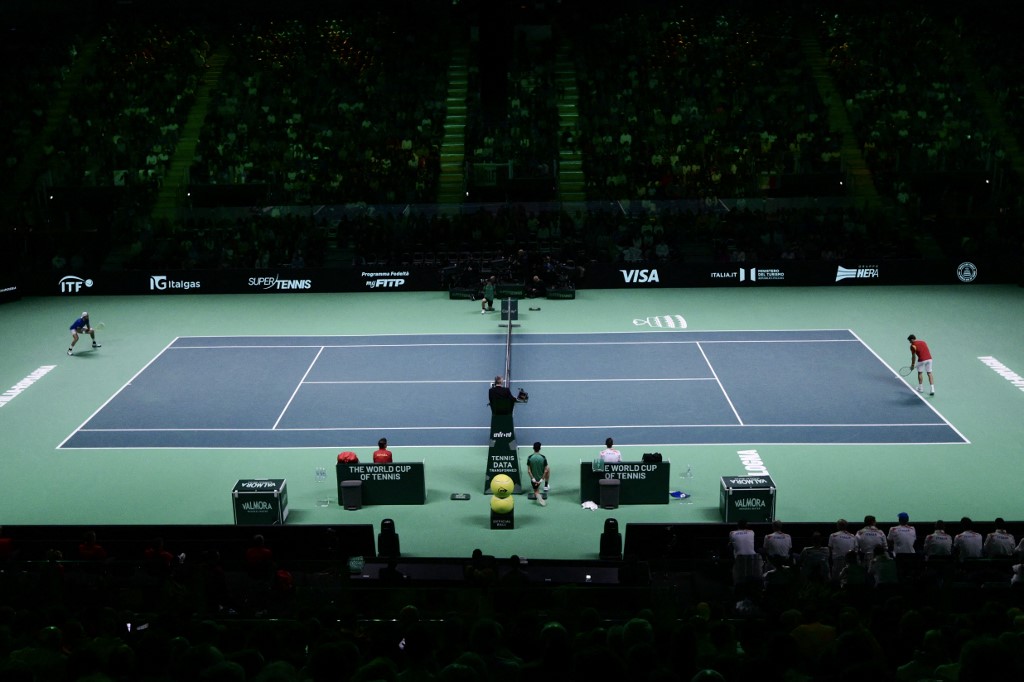
Italy named Flavio Cobolli, Lorenzo Musetti, Luciano Darderi, Simone Bolelli and Andrea Vavassori for the Davis Cup Final 8 on 26 October, without Jannik Sinner. That list is not final. Under the 2026 Davis Cup Regulations, captain Filippo Volandri can still change up to three of those five players until 11 a.m. on Monday 23 November, the day before play starts in Bologna, and he does not need an injury to do it.
Davis Cup team selection runs in two stages. A nation first nominates a squad to the ITF weeks in advance. The captain then selects who plays singles and doubles from that squad on the day of each tie. Each stage has its own deadline and its own rules for late changes. The format around them is covered in how Davis Cup works.
The Nomination Deadline
For the Finals, nations send their team nominations to the ITF 28 days before the Monday of the week of the event. With the 2026 Final 8 starting on Tuesday 24 November, the Monday was 23 November and the deadline Monday 26 October, the day the eight squads were announced.
A player has to be cleared to be nominated. By 28 days before the event, the ITF must either have approved his eligibility or have received a complete application for a special exemption from his nation. The ITF also has an absolute right to refuse a nation’s nomination of any player or captain.
How Many Players a Team Names
- A non-playing captain and four or five players, or
- A playing captain and three or four players.
The nomination lists the players in order of merit without saying who will play singles or doubles. For the Finals, order of merit is based on the ATP singles rankings published on the Monday of the event week, and protected rankings are not used. If those rankings are not out in time, the most recent singles rankings apply. A player without an ATP ranking is placed by ITF ranking, then World Tennis Number, then national ranking, then the captain’s own order.
Only nominated players can be selected for matches, which is why the nomination matters more than the headline names on it.
Changing the Squad After the Deadline
Before the nomination deadline, a nation can change its list at any time. After it, a nation can change a maximum of three nominated players up to 11 a.m. local time on the day before play starts at the Finals. The regulation sets no medical condition for those changes; the limits are the number of players and the clock.
A non-playing captain can be changed at any time before his nation’s first match. If a captain has to leave the court during a match, only one of his nation’s nominated players can take his place.
Once play has started, the squad is effectively fixed. The exception is for the Finals only: if three or more players are, in the referee’s opinion, unable to play through illness or injury, the ITF Executive Director, consulting the Davis Cup Committee where possible and the referee, may let the nation replace one or more of them. Unless the injury or illness is obvious, each player must first be examined by the Independent Doctor, who completes an ITF Medical Certification form, and the Executive Director can attach conditions.
Changes go to the ITF before the referee arrives on site, and to the referee after that. Either way, the other nations are told.
Picking the Players for Each Tie
A Final 8 tie is two singles and a doubles, all on one day. The No. 2 singles players meet first, then the No. 1s, then the doubles, and the nation that wins two matches wins the tie.
No later than one hour before the scheduled start of each tie, the captain gives the referee his two singles players, in order of merit, and his two doubles players. The higher-ranked of the two singles players is No. 1. After that deadline, the singles lineup cannot be changed except under the illness and injury rule below.
The doubles stays open much longer. At the Finals, a captain can change his doubles pair up to 15 minutes after the second singles match ends, or 10 minutes if the interval before the doubles has been cut to 20 minutes, as long as the substitute comes from the nominated squad. The interval before the doubles is a maximum of 30 minutes, reduced to 20 if neither player from the second singles is in the doubles.
Injuries, Doctors and Coming Back
If a selected player is ill, injured or meets another unavoidable hindrance, the referee may allow him to be replaced, and his doubles partner too, from the nominated squad. A player withdrawn from a singles match this way can still be picked for the doubles. The opposing captain gets a chance to answer with a change of his own: up to one hour after notification for a replacement made the day before play, or up to 15 minutes before the match for one made on a playing day.
Both the replacement and a later return to play need the Independent Doctor’s examination and the ITF Medical Certification form unless the injury is obvious. So a player replaced for injury can come back in a later tie once he is cleared, which is a different question from the medical timeouts a player can take during a match.
A player withdrawn for disciplinary reasons is treated differently. He can be replaced only with the referee’s permission and cannot play again in that event, though he can return in later editions.
Dead Rubbers, Walkovers and Withdrawals
In the quarterfinals and semifinals, the doubles is still played after one nation has won both singles, unless both nations and the referee agree otherwise. A dead doubles is best of three sets with a 10-point match tiebreak in the third. In the final, a 2-0 lead after the singles ends the tie, and the doubles is not played.
A walkover is scored 6-0, 6-0. A retirement is recorded as if the match had been completed, so 6-1, 4-3 retired becomes 6-1, 6-3. A nation that withdraws during the Finals is not replaced.
Who Is Eligible
A player must be male, have turned 14 by the Monday of the event week, be in good standing and not have represented another nation in a previous edition of the Davis Cup, other than the Junior Davis Cup, or at the Olympic tennis event. On nationality, he must hold citizenship and a valid passport and have held that passport for at least 24 months in the past five years, or, where there is a genuine reason he has no passport, have lived in the nation for 60 consecutive months. A player who does not qualify can apply for a special exemption at least three months before the tie, showing a sufficient, genuine connection and commitment to the nation. The wider picture is in how tennis players change nationality.
Nomination also feeds Olympic eligibility, which depends on national-team call-ups; see LA28 Olympic tennis eligibility. The women’s team competition is covered in how the Billie Jean King Cup works.
Season Snapshot (as of 6 November 2026)
The 2026 Davis Cup Final 8 is at the BolognaFiere Arena from 24 to 29 November. Quarterfinals: Czechia v Canada on Tuesday 24 November, Italy v Korea on Wednesday 25 November, and Great Britain v Germany and Austria v Spain on Thursday 26 November. The semifinals are on 27 and 28 November and the final on 29 November. Italy, champions in each of the last three editions, are without Sinner, whose season is over, and Volandri named Matteo Berrettini, Matteo Arnaldi and Lorenzo Sonego as further options. Berrettini withdrew from the Paris Masters on 5 November with an elbow injury. Canada, who beat France to reach Bologna, nominated Felix Auger-Aliassime, Denis Shapovalov, Gabriel Diallo, Liam Draxl and Duncan Chan. Spain go into what David Ferrer has said is his last event as captain. No official squad changes had been announced. The full list of past champions is in Davis Cup winners.
This snapshot is dated and will change. The career record above does not.