

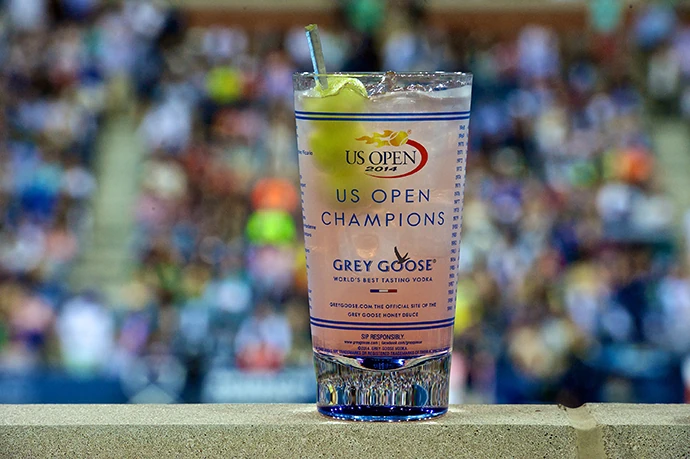
In the entire history of professional tennis, no food or drink has come to define a tournament as completely as the Honey Deuce has come to define the US Open. Wimbledon has strawberries and cream. Roland Garros has its café terrace culture. The Australian Open has its summer festival atmosphere. The US Open has a $23 cocktail — vodka, lemonade, a splash of raspberry liqueur, and three honeydew melon balls speared on a tennis-ball-yellow plastic stick — and the entire identity of the tournament has, in less than two decades, organised itself around it.
Here is the complete story of the Honey Deuce, the drink that began as a brand ambassador’s whim at a Hampton Bays farm stand and became one of the most commercially successful sports concessions in history.
The Origin: A Drive Through the Hamptons
The Honey Deuce was born in 2006, when Grey Goose vodka became the official beverage sponsor of the US Open. Grey Goose’s parent company Bacardi had signed a sponsorship deal with the USTA that included rights to create a signature cocktail for the tournament, and the brand turned to one of New York’s most respected mixologists to design it.
Nick Mautone was, by then, a hospitality veteran with one of the most distinguished resumes in New York food and drink. He had served as managing partner at Gramercy Tavern, the Danny Meyer restaurant that had become one of the defining American dining establishments of the 1990s. He had written cocktail books. He had served as a brand ambassador for Grey Goose for several years. He was, in industry terms, exactly the kind of figure Grey Goose would tap to design a drink that needed to be both editorial and operational — refined enough to feel premium, simple enough to serve to tens of thousands of customers in a stadium environment.
The brief was specific. Grey Goose needed a cocktail that could be assembled quickly by bartenders working under pressure, that would hold up in the late-summer New York heat, that would be visually distinctive enough to photograph well, and that would taste good enough to keep selling for years. Mautone, working from his home in the Hamptons, set out to invent it.
The breakthrough came at a farm stand in Hampton Bays, New York. Mautone had stopped to pick up ingredients for a summer dessert salad he was making for guests — a recipe that called for honeydew melon balls. As he was preparing the salad at home, he looked at the melon balls and had what he later described as a “thunderbolt” moment: they looked exactly like tennis balls.
“Holy cow, these look just like tennis balls,” Mautone recalled telling himself. “So, from that moment on, I knew that that was the garnish, non-negotiable.”
He took the idea to Grey Goose, who loved the visual concept. The US Open’s food service operations team was initially less enthusiastic — making honeydew melon balls in the volume the tournament would require seemed logistically impossible. The solution arrived when the team found a specialty supplier capable of producing hundreds of thousands of fresh-cut melon balls daily and shipping them on demand to the tournament. The operational problem was solved. The Honey Deuce was about to be born.
The Recipe
Mautone tried several variations of the cocktail before settling on the final recipe — including one early version that used blackberry liqueur rather than raspberry. The final recipe, in place since the cocktail’s debut at the 2007 US Open, is straightforward enough that millions of people have made it at home in the years since:
- 1¼ oz Grey Goose vodka
- ¾ oz fresh lemonade
- ½ oz Chambord black raspberry liqueur
- 3 honeydew melon balls, speared on a yellow plastic skewer as garnish
- Served over ice in a tall, branded US Open glass
The presentation is what makes it work. The lemonade and vodka produce a pale yellow base. The Chambord, when added carefully, sinks slowly to the bottom of the glass and creates a layered red-into-yellow gradient that looks intentional and elegant. The melon balls float at the top of the glass, three pale green spheres in a row, immediately recognisable as a stylised tennis ball arrangement. The yellow skewer holding the melon balls is itself in the colour of a tennis ball — every element of the drink’s visual identity is referencing the sport it was designed to accompany.
The name has the same dual function. “Honey” comes from honeydew. “Deuce” is the tennis term for a 40-40 score. The cocktail’s identity is, in every respect, calibrated to be inseparable from the tournament.
The Commercial Story
The Honey Deuce’s commercial trajectory across nearly two decades is one of the most successful single-product sports concession stories in modern sport. The cocktail launched in 2007 at a reasonable but not aggressive price point. Sales grew steadily through the late 2000s and early 2010s as the drink became established as the US Open’s signature offering. By the mid-2010s, the Honey Deuce had become one of the most photographed cocktails in international sport, with social media accelerating its spread well beyond the boundaries of Flushing Meadows.
The numbers from recent years are extraordinary:
- 2023: approximately 460,000 sold, generating around $9.9 million in revenue
- 2024: more than 556,000 sold, generating nearly $13 million in revenue
- 2025: a record 738,459 sold, generating roughly $17 million in revenue at $23 per drink
The 2025 figure works out to roughly 35,000 Honey Deuces sold per day across the 21-day Fan Week and main draw, or one cocktail every 1.5 seconds across the entire fortnight. Total Honey Deuce sales since the cocktail’s 2007 debut have exceeded 2.8 million units.
Grey Goose’s sponsorship with the US Open, originally signed in 2006, has been renewed multiple times. The most recent extension, in 2023, locked in the partnership through at least 2028, with the Honey Deuce at the centre of the relationship.
The Price History and the Souvenir Cup
The Honey Deuce has not always cost $23. Across its 18-year history, the price has climbed steadily from its original launch level — fluctuating between $18 and $22 for most of the 2010s and early 2020s before reaching $23 in recent editions. Each price increase has generated brief discussion in tennis media about the cocktail’s affordability, but sales have continued to grow at every price point, suggesting that the drink’s appeal is not particularly sensitive to its cost within reasonable limits.
The souvenir cup is part of why. The Honey Deuce is served in a tall, branded US Open glass — typically featuring the year’s tournament logo, sometimes featuring artwork specific to the edition — that buyers can keep and take home. The souvenir element transforms the purchase into something closer to merchandise than a single-serve beverage, and many fans now treat the collection of Honey Deuce cups across multiple US Opens as a fan tradition in its own right.
This is a deliberate design choice. The transaction is not just for the drink. It is for the drink, the experience of drinking it at the US Open, and the souvenir cup that becomes the physical record of the experience. The $23 price point is, when considered in those terms, more competitive than it initially appears.
How the Honey Deuce Became a Cultural Object
The Honey Deuce’s transformation from a successful tournament cocktail into a genuine cultural phenomenon happened gradually through the 2010s and accelerated dramatically in the early 2020s. Several factors contributed.
The rise of social media — particularly Instagram and later TikTok — gave the cocktail a visual platform that suited it perfectly. The drink’s distinctive appearance, the souvenir cup, and the ritual of holding it up against the backdrop of Arthur Ashe Stadium produced exactly the kind of content that social platforms reward. Influencers, celebrities, and ordinary fans posted Honey Deuce photographs by the tens of thousands, every year, multiplying the cocktail’s reach far beyond what traditional advertising could have achieved.
Celebrity attention helped. The US Open has long been the most celebrity-attended Grand Slam, and the Honey Deuce became a default prop in the photographs that came out of celebrity-filled hospitality suites. Serena Williams was photographed drinking one. Beyoncé and Jay-Z were photographed drinking them. The drink’s association with high-profile fan culture cemented its status as a status object in its own right.
The combination of New York consumer culture and tennis’s late-summer prominence in the American sports calendar also contributed. The US Open occupies the cultural space just before the football season begins, with baseball winding down and basketball months away. For two weeks each year, tennis becomes one of the most-discussed sports in American media — and the Honey Deuce became one of the most-discussed elements of that conversation.
How It Compares to Other Grand Slam Drinks
The Honey Deuce occupies a place in the US Open’s cultural identity comparable to what Pimm’s occupies at Wimbledon — but the comparison reveals as much about the differences between the two tournaments as the similarities.
Pimm’s at Wimbledon has been served since the early 1970s and sells in the hundreds of thousands of glasses per fortnight. It is gently alcoholic, visually elaborate, and consumed throughout afternoons at the All England Club. It is, in the way Wimbledon prefers, understated — a drink that fits the tournament’s general aesthetic of restrained tradition.
The Honey Deuce is none of those things. It is louder. It is more visually aggressive. It costs nearly four times what a glass of Pimm’s at Wimbledon costs. It generates more than ten times the revenue per tournament. It comes in a branded souvenir cup that buyers actively want to keep. It is photographed, posted on social media, and recreated at home parties across the United States in ways that Pimm’s has never been.
This is not a flaw. It is the point. The Honey Deuce was designed for a different kind of tournament than Wimbledon’s — a tournament that has always been louder, larger, more commercially aggressive, and more aligned with American mass consumer culture. The cocktail succeeds at the US Open because it matches the institution that hosts it. It would not succeed at Wimbledon. Pimm’s would not succeed at Flushing Meadows.
The Bottom Line
The Honey Deuce began as a brand ambassador’s idea at a Hampton Bays farm stand and has become, in less than two decades, the single most commercially successful sports concession of the modern era. It has sold more than 2.8 million units, generated tens of millions of dollars in revenue, and become inseparable from the visual and cultural identity of the US Open.
What makes it work is the combination of design and timing. The cocktail looks like the tournament it accompanies — the tennis-ball garnish, the souvenir cup, the social-media-ready presentation. It arrived at exactly the moment that social media was beginning to transform how sporting events were experienced and shared.
It is priced expensively enough to feel premium, but not so expensively that ordinary fans cannot have one. And it has been supported by a sponsorship relationship between Grey Goose and the US Open that has lasted nearly two decades, with no signs of weakening.
Nick Mautone, the mixologist who created the drink, lives in Seattle now and still occasionally makes the cocktail at home — with one small variation. He adds a splash of sparkling wine, he has said in interviews, when he makes it for himself. The original recipe, served by the hundreds of thousands every September at Arthur Ashe Stadium, remains what it has always been: a $23 vodka cocktail with a layered red-and-yellow gradient and three pale green melon balls floating at the top. It is, by widespread agreement, the most distinctive concession item in professional tennis. It is also, by the metrics that matter to the people who count revenue, one of the most successful.