

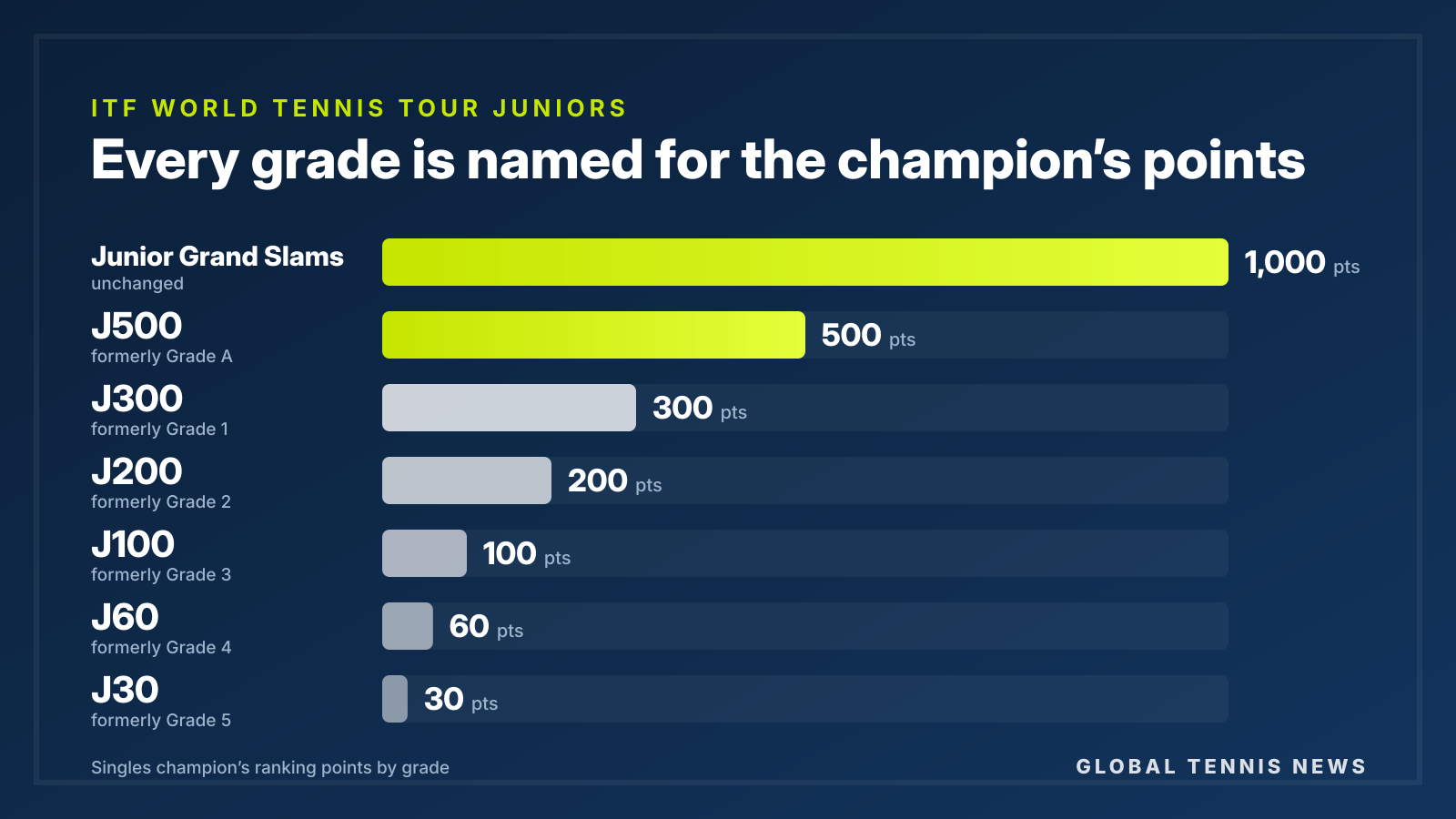
Junior tennis has its own tour, the ITF World Tennis Tour Juniors, and its own ranking. Every tournament on it carries a grade, and since 1 January 2023 each grade has been named for the number of ITF junior ranking points the singles champion earns. A J300 title is worth 300 points, a J30 title 30. Above the six graded levels sit the four junior Grand Slams, worth 1,000 to the champion.
This explainer sets out the grades, the full points table, who is allowed to play, how players get into a draw and how the deadlines work. The figures for 2026 regulations are collected in the dated Season Snapshot at the end.
The Grades and Their Old Names
The ITF replaced the old letter-and-number grades with point-based names for the 2023 season, so that a grade would tell a player what it was worth. The conversion:
- Junior Grand Slams: unchanged
- Grade A became J500
- Grade 1 became J300
- Grade 2 became J200
- Grade 3 became J100
- Grade 4 became J60
- Grade 5 became J30
Older results, player biographies and tournament histories still use the old names. An event described as a Grade A before 2023 is the equivalent of a J500 today.
Points by Grade
Singles points for each round reached, from winner to the round of 32:
- Junior Grand Slams and Youth Olympics: 1,000, 700, 490, 300, 180, 90
- J500: 500, 350, 250, 150, 90, 45
- J300: 300, 210, 140, 100, 60, 30
- J200: 200, 140, 100, 60, 36, 18
- J100: 100, 60, 36, 20, 10, 5
- J60: 60, 36, 18, 10, 5 (to the round of 16)
- J30: 30, 18, 9, 5, 2 (to the round of 16)
Doubles points from winner down, per player: junior Grand Slams 750, 525, 367, 225, 135; J500 375, 262, 187, 112, 67; J300 225, 157, 105, 75, 45; J200 150, 105, 75, 45, 27; J100 75, 45, 27, 15, 7; J60 45, 27, 14, 7; J30 25, 13, 6, 3. The year-end World Tennis Tour Junior Finals sit on their own scale, with 850 for the champion and 600 for the runner-up. Points from the national-team events in our Davis Cup and Billie Jean King Cup Junior Finals guide carry their own points, awarded per win.
Three rules decide whether a result scores. No points are awarded until a player has won a main-draw round. Advancing through a first-round bye does not count as a win. Advancing by walkover, or because an opponent retired after the match started, does.
What Changes From Grade to Grade
The grades are not only a points scale. The 2026 regulations set a minimum singles main draw of 48 players for a J500, 32 for a J300, J200, J100 and J60, and 16 for a J30. From the 2026 season, J30 and J60 events may also use a round-robin stage that feeds an elimination draw; every grade from J100 upwards is elimination only.
The higher grades also carry stricter staging rules. A J500 must stream two courts from the quarterfinals, provide live scoring for every match with a chair umpire, seat at least 250 people on its main show court and use ball persons for the finals. Chair umpires appear earlier in the draw as the grade rises, a structure covered in our explainer on tennis officials.
Off-court coaching is permitted in qualifying and the main draw at J100 level and above, and at J30 and J60 events only in matches with a chair umpire. On-court coaching is not allowed at any grade. The professional equivalents are in our tennis coaching rules explainer. Main-draw singles is the best of three tiebreak sets; qualifying and doubles use a 10-point match tiebreak in place of a third set.
Who Can Play
The junior tour is for players aged 18 and under, and every player needs an IPIN, the ITF player identification number used to enter and withdraw. Getting one requires a set of short ITF Academy courses, and players who reach the top 500 must complete an additional education module.
Younger players are limited in how many tournaments they may play. The ITF age eligibility chart:
- Aged 11 or 12: no tournaments.
- 13: 10 tournaments, plus four more for a player in the top 50 of the ITF junior ranking.
- 14: 14 tournaments, plus four more for a top-20 player.
- 15: 18 tournaments, plus four more for a top-20 player.
- 16: 25 tournaments.
- 17 and 18: unrestricted.
How Players Get Into a Draw
Acceptance is by ITF junior ranking as of the Monday before the entry deadline. Players tied on ranking are separated by their ITF World Tennis Number, and then by lot. Juniors who already hold a professional ranking are treated separately: players ranked ATP 750 or better or WTA 400 or better are always accepted at the bottom of the main-draw list.
Each draw also sets aside places. A 64-player main draw has eight wild cards, eight qualifiers and up to two special exempts. J300 events and below reserve one or two places for players aged 16 and under from the region, accepted on their World Tennis Number; J500 events have no such places. Players who lose in the last round of qualifying are first in line as lucky losers. The way those entry types appear on a draw sheet is covered in our guide on how to read a tennis draw.
Deadlines
Junior deadlines fall on fixed weekdays at 14:00 GMT. For J30 to J200 events, the singles entry deadline is the Tuesday 20 days before the tournament week, the withdrawal deadline is the Tuesday 13 days before, and the freeze deadline is the Wednesday five days before. J500 events and junior Grand Slams use earlier entry deadlines of 20, 27, 34 or 41 days. Withdrawing after the deadline can bring a late-withdrawal penalty; an alternate may withdraw at any time without one.
Where the Junior Tour Leads
The junior ranking is a stepping stone, not an end. Top juniors move into the professional game through qualifying draws, through the ATP Challenger Tour and the WTA 125 tier, and, on the men’s side, through the PIF ATP Next Gen Accelerator. The way professional points work is in our tennis rankings explainer.
Season Snapshot — 5 November 2026
- Regulations in force: 2026 ITF World Tennis Tour Juniors Regulations.
- 16-and-under reserved places: open to players born in 2010 or later.
- Sanction fees: $550 for J30, J60 and J100; $650 for J200; $800 for J300; $1,100 for J500; $1,200 for a junior Grand Slam.
- Round-robin format: available at J30 and J60 from the first week of the 2026 calendar, and required for new standalone events.
This snapshot is dated and will change. The career record above does not.