

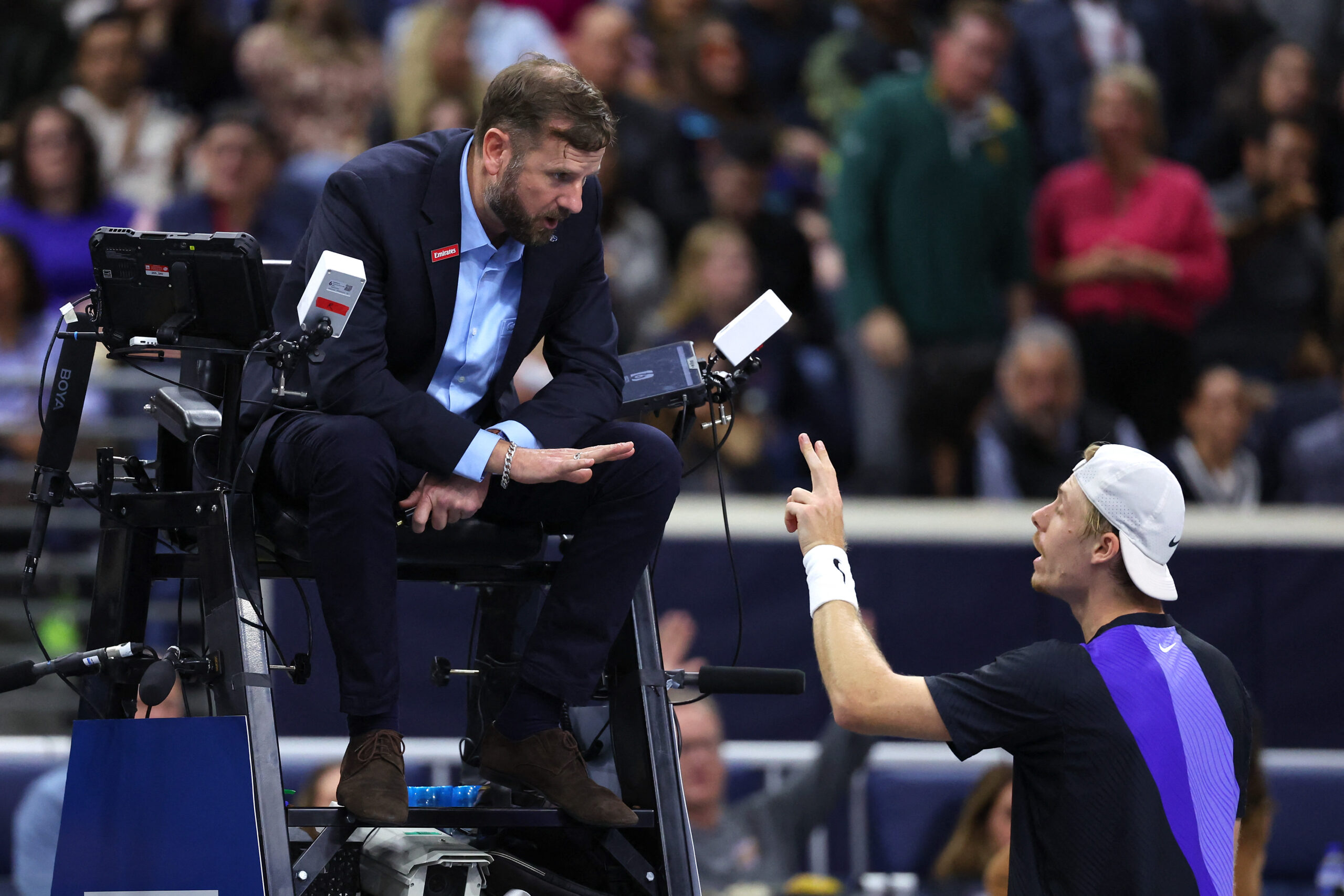
Tennis officials are easy to miscount as most viewers can name the person in the high chair and stop there, which means that when a match is suspended, a player is defaulted, or a ruling is overturned, it is not obvious who actually made the call. The sport divides its authority along a line that is precise, old, and almost never explained on air.
The chair umpire runs the match, not the tournament
The chair umpire is in charge of one match: the court, its immediate surrounds, and everything that happens on it from the warm-up to the handshake. That covers the coin toss, the score announcements, ball changes, the timing of the shot clock and the changeover and set-break windows, code violations, and the scorecard, which is the official record of the match.
What the chair umpire does not control is the schedule, the draw, the assignment of officials, or the fines that follow a match. Those belong elsewhere, and the confusion between the two is the source of most arguments about who is responsible for what.
Questions of fact end on court
The ITF Rules of Tennis split every dispute into two categories, and the category decides who has the last word.
A question of fact is an issue about what actually happened during a specific incident. Did the ball land in or out. Was that a foot fault. Did the ball touch the net cord on the serve. On these, the decision of the on-court official is final. A player cannot appeal a line call to a higher authority, because there is no higher authority on a question of fact.
The one internal exception is the overrule. Where line umpires are assigned, the chair umpire may overrule a call if a clear mistake has been made — but that is the chair correcting the officiating team from inside it, not an appeal being granted from outside. Where electronic line calling is in use, the question of fact moves to the system, and the chair umpire’s overrule power over line calls goes with it.
Questions of tennis law can be appealed
A question of tennis law is different: it is an issue about how the rules apply to a set of facts that are not themselves in dispute. Everyone agrees what happened; the argument is about what the rulebook says should follow.
Here the chair umpire rules first. But if the chair is uncertain, or if a player appeals the determination, the referee is called and gives a decision — and that decision is final. This is why players who want a ruling reconsidered ask for the referee rather than arguing the point in the chair, and why a chair umpire who is out of their depth on an obscure rule is expected to send for one rather than guess.
The practical test is simple. If the argument is about what the eye saw, the chair or the machine has already settled it. If the argument is about what the rule means, there is somewhere else to go.
The referee owns the tournament
The referee is in overall charge of the event of which any single match forms a part. The remit is the whole tournament: the draw, the order of play, the condition of the courts, the appointment and replacement of on-court officials, defaults, and code of conduct penalties that extend beyond the match itself.
A terminology note that trips people up: the ATP and WTA tours generally use the title supervisor for the equivalent off-court authority, while the Grand Slams and ITF events use referee. Some rulebooks write it as “Supervisor/Referee” precisely because the function is the same and the label is not.
Crucially, the referee is also the person who stops play. Suspensions for rain, lightning, failing light or extreme heat are the referee’s decision, not the chair umpire’s, and so is the decision about when play resumes. When a tournament falls a round behind schedule and starts moving matches between courts, that is the referee’s office at work.
The rest of the officiating team
Two other roles complete the structure. The chief umpire is an administrative position rather than a judicial one: recruiting and training officials, building the daily assignment sheets, running rotations, and evaluating performance. Chief umpires decide which chair umpire gets which match, which is quietly one of the more consequential jobs at a major.
Line umpires call only the lines assigned to them, and call “out” or “fault” accordingly. If a line umpire cannot see the bounce, the correct response is an unsighted signal to the chair rather than a guess. At the top level a full officiating crew can put close to a dozen people on court at once; electronic systems have reduced that number considerably at events that have adopted them.
A worked example
The 2018 US Open women’s final is the clearest public demonstration of the split, because both halves of the structure acted in sequence. During the match, the chair umpire issued three code violations to Serena Williams — a warning, then a point penalty, then a game penalty. Those were on-court decisions, made under the escalating penalty structure the chair umpire administers, and they took effect immediately on the scoreboard.
The day after the match, the tournament referee fined Williams for the same three offences. Same conduct, two separate authorities, two separate consequences: one that changed the score in real time, one that arrived from the tournament afterwards. The ITF subsequently stated that the chair umpire’s decisions were in accordance with the relevant rules. Whether the rules themselves were the right ones is a separate argument, and one the sport is still having.
Quick reference
- Was the ball in? Chair umpire or electronic system. Final.
- Should that point be replayed under the rules? Chair umpire first, appealable to the referee, whose decision is final.
- Is it too wet, too dark or too hot to play? Referee.
- Which court and what time? Referee.
- Who is umpiring this match? Chief umpire.
- Is that a code violation? Chair umpire during the match; the referee handles fines afterwards.
- Is the player defaulted? Referee, on the chair umpire’s report.
For what happens when a match ends without being completed, see our explainer on walkovers, retirements and defaults. For the treatment rules the chair umpire administers mid-match, see medical timeouts.