

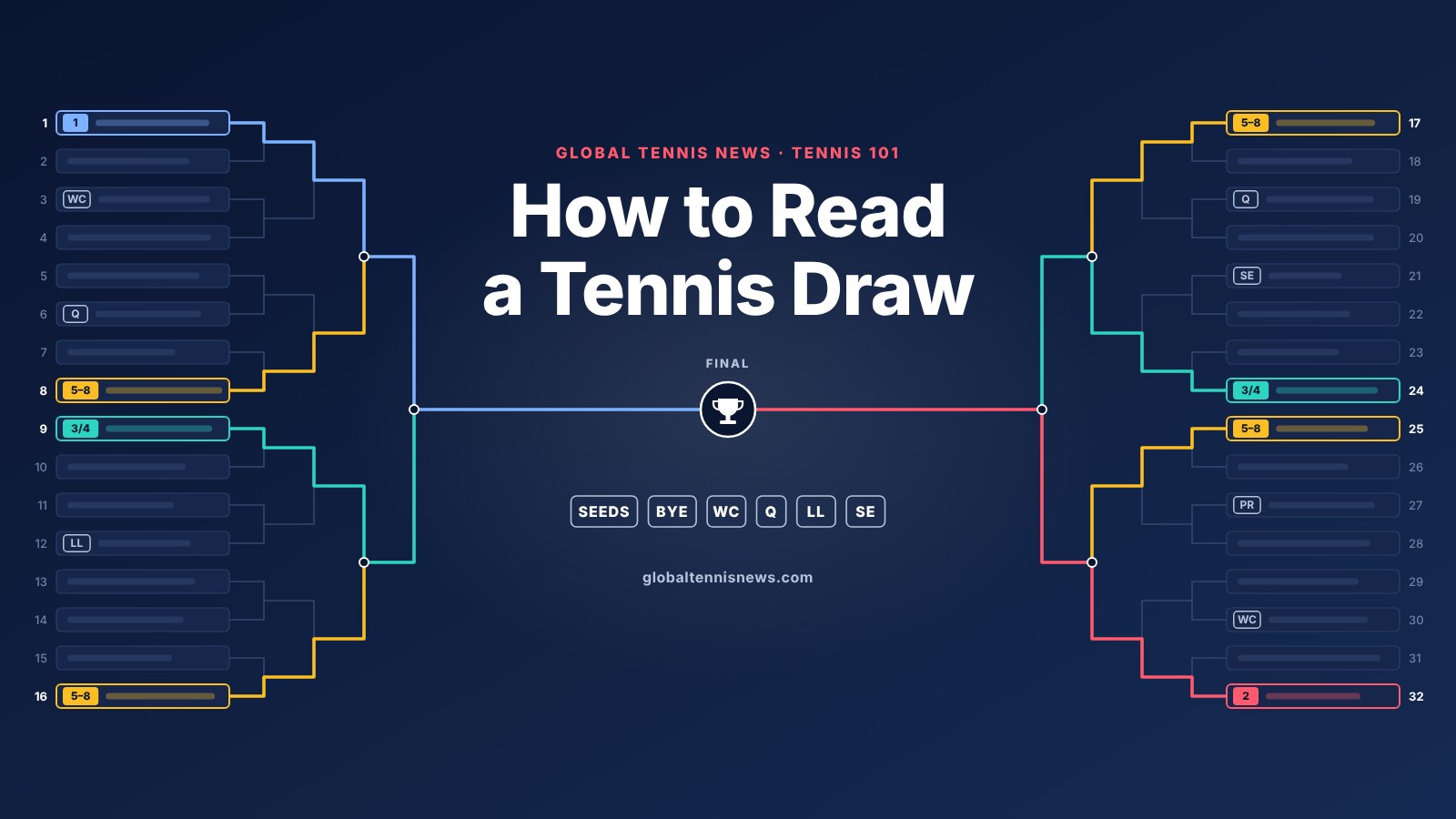
The draws released on Saturday for this week’s ATP 500 events in Basel and Vienna show most of what a tennis draw can contain: two seeded wild cards, a seed who withdrew after the draw was made, special exempts who were still playing finals elsewhere, and empty lines waiting for qualifiers. This explainer uses those two 32-player draws to show how to read one.
Lines, halves and quarters
A draw is a numbered list of lines, read from top to bottom. In the first round, line 1 plays line 2, line 3 plays line 4, and so on down the sheet, and each winner meets the winner of the neighbouring match in the next round. A 32-player draw has 16 first-round matches. Lines 1 to 16 form the top half and lines 17 to 32 the bottom half, and each half splits into two quarters of eight lines.
The top seed goes on line 1 and the second seed on the last line, so they can meet only in the final. In Basel, Ben Shelton is on line 1 and Arthur Fils on line 32. In Vienna, Alexander Zverev is on line 1 and Carlos Alcaraz on line 32.
The other seeds go into fixed positions, and a draw decides which seed takes which. Both draws this week have eight seeds. In each, the third and fourth seeds are on lines 9 and 24, at the head of the two quarters not held by the top two seeds, so neither can meet the first or second seed before the semifinals. Seeds 5 to 8 are on lines 8, 16, 17 and 25, one in each quarter, but in a different order in each city: in Vienna, sixth seed Frances Tiafoe sits on line 8 in Zverev’s quarter, while in Basel that line belongs to eighth seed Jiri Lehecka. Unseeded players fill the remaining lines.
The Grand Slams run a larger version of the same system, with 32 seeds in a 128-player draw. Our explainer on how Grand Slam seedings are determined covers it.
Who can be seeded
Seeds follow the ATP Rankings. The ATP rulebook states that “wild cards may be seeded,” and both draws this week show it. Alcaraz, ranked third, is the second seed in Vienna on a wild card, and Novak Djokovic, ranked 12th, is the fourth seed in Basel on one.
A qualifier can be seeded only if qualifying ends before the main draw is made. If the draw comes first, as it did in both cities this week, the original seedings stand. A protected ranking can get a player into the draw, but the rulebook bars its use for seeding.
Byes
Basel and Vienna have 32 players and no byes, so the seeds play in the first round. Smaller draws give the top seeds a free pass instead: in Brussels last week, a 28-player event, top seed Fils began in the second round. How byes are allotted is in our explainer on byes.
The labels next to the names
- WC (wild card): a place given by the tournament. Basel’s are Djokovic, Stan Wawrinka, Jerome Kym and Dominic Stricker; Vienna’s are Alcaraz, Martin Landaluce, Grigor Dimitrov and Jurij Rodionov. See how wild cards work.
- Q (qualifier): a player who came through the qualifying rounds. See how tour-level qualifying works.
- LL (lucky loser): a player who lost in the final round of qualifying but gets in when a main-draw player withdraws. See what a lucky loser is.
- SE (special exempt): a place held for a player whose run at the previous week’s event kept him out of qualifying. This week Jan-Lennard Struff, a Brussels finalist, is an SE in Basel, and Nikoloz Basilashvili, an Almaty finalist, is one in Vienna. See special exempts explained.
- PR (protected ranking): a player entering on a ranking protected during a long injury absence. It counts for entry but not for seeding.
- Alt (alternate): a player who gets in from the alternate list when a place opens.
Draws are usually made before qualifying finishes, so some lines carry a placeholder. On Saturday night, Basel’s draw sheet had six lines marked “Qualifier / Lucky Loser” and Vienna’s had four marked “Qualifier”. They are filled as the qualifying matches end.
When a seed withdraws after the draw
Basel showed this within hours. Alexander Bublik, the seventh seed on line 16, withdrew with a knee injury after the draw was made. Under the rulebook, when a seed in the 5-to-8 group pulls out after the draw but before the order of play is released, the next highest-ranked player in the draw who is eligible to be seeded moves into the empty seeded line. That was Casper Ruud, ranked 24th. He moved from line 2, where he had been drawn against Shelton, to line 16, where he now plays Stricker. His old line went to a qualifier or lucky loser, so Shelton’s first opponent changed without Shelton doing anything.
Once qualifying has begun, any opening in the main draw is filled from the lucky loser and alternate list. A lucky loser can be put in for a player who withdraws at any point before the first ball of that player’s first match. After that, no one is replaced: a player who cannot play gives his opponent a walkover. The differences between a walkover, a retirement and a default have their own explainer.
Both draws are covered match by match in our Basel and Vienna draw stories, and the venue and format details are in the Swiss Indoors Basel guide and the Erste Bank Open guide. When matches are scheduled is explained in how the order of play works.