

The ATP Tour season ends at the Nitto ATP Finals in Turin on 22 November, but the ATP Challenger Tour keeps running into December. It is the level directly below the tour, run by the ATP under the same rulebook, and it is where most players earn the ranking that gets them into ATP Tour draws. This is how it works under the 2026 ATP Rulebook.
Five Levels
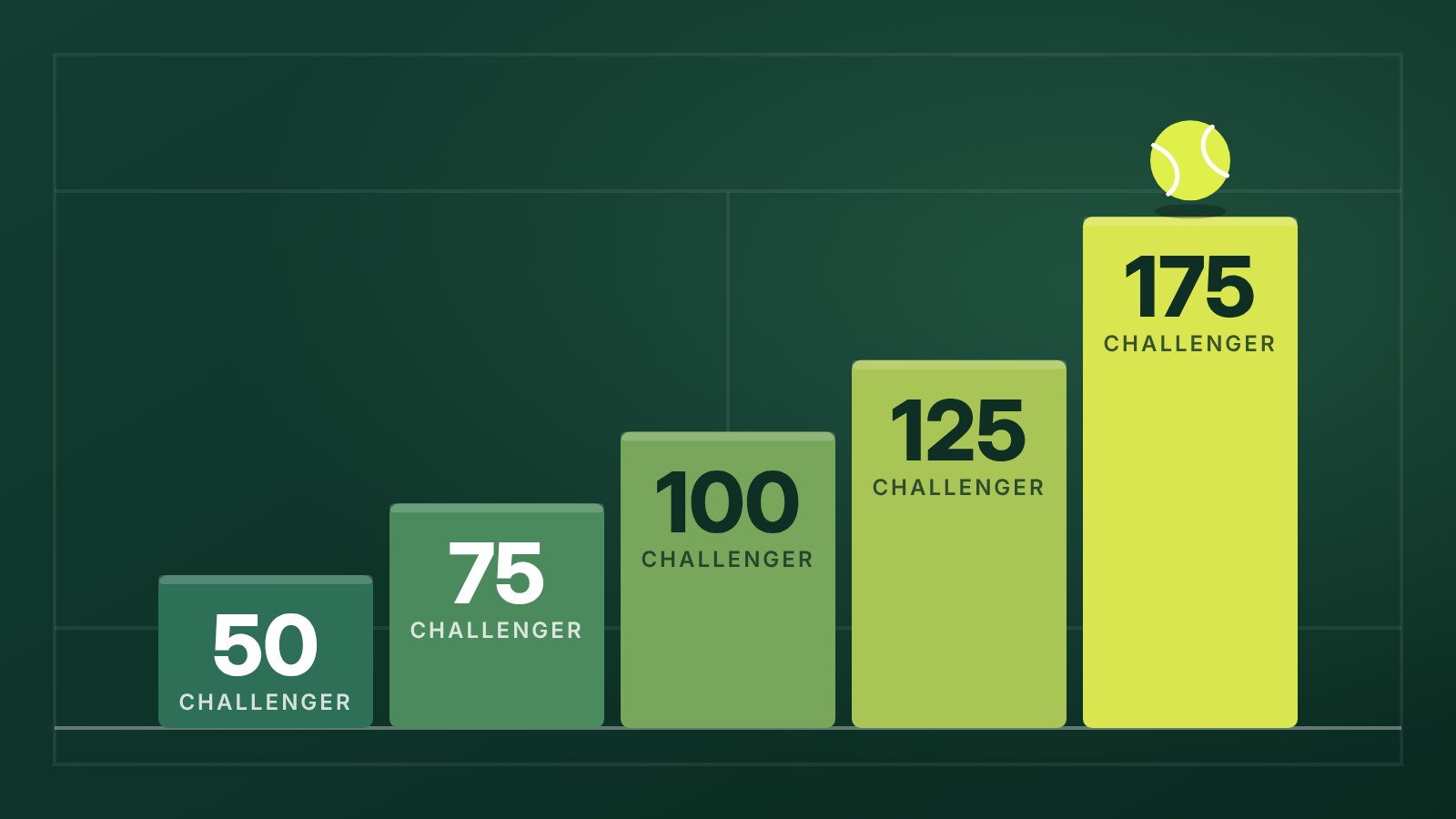
Challengers come in five categories, each named for the points its singles champion receives: the Challenger 50, 75, 100, 125 and 175. The 2026 singles points are:
- Challenger 175: winner 175, finalist 90, semifinalist 50, quarterfinalist 25, round of 16 13
- Challenger 125: 125, 64, 35, 16, 8
- Challenger 100: 100, 50, 25, 14, 7
- Challenger 75: 75, 44, 22, 12, 6
- Challenger 50: 50, 25, 14, 8, 4
Qualifying rounds also carry small amounts. For comparison, an ATP 250 champion receives 250 points and a 250 finalist 165, so a Challenger 175 title is worth more than reaching an ATP 250 final.
How Challenger Points Count
The ATP ranking is built from a player’s best 18 results. For a top player who plays every automatic-entry event, that means the four Grand Slams, eight Masters 1000s and six “best other” results, and Challenger results compete for those six places with the United Cup, the Monte-Carlo Masters, ATP 500s, ATP 250s and ITF events.
The Draw
Unless the ATP approves otherwise, a Challenger singles main draw has 32 players:
- 19 to 21 direct acceptances by ranking
- 3 wild cards
- 6 qualifiers
- 0 to 2 special exempts
- 0 to 2 places for young players through the Next Gen, junior and college accelerator programmes (up to three at Challenger 50 and 75 events)
Qualifying is a 24-player event for the six main-draw places, with 18 direct acceptances, four wild cards and up to two accelerator places. The doubles draw has 16 teams: 10 by advance entry, four by on-site entry and two wild cards. Every Challenger must provide main-draw singles players with a complimentary hotel room from the first Saturday for at least five nights.
Who Can Enter
Main-draw entries close at 12 noon Eastern Time 21 days before the tournament week begins; qualifying entries close on the Wednesday 19 days before. Only players ranked 500 or better can enter the main draw of a Challenger 125 or 175 through advance entry. Players ranked 501 or lower can enter the main draw of a Challenger 50, 75 or 100 and the qualifying of any Challenger, and can accept wild cards at any level. A player with no ranking at all can get into a draw only as a wild card.
Who Is Kept Out
The rulebook’s play-up regulation stops leading players from taking Challenger places and points from the players who need them. Rankings 21 days before the tournament decide who is affected.
- Top 10: barred from entering, accepting a wild card into or playing a Challenger 75, 100 or 125. A player who would have been a direct acceptance at a Grand Slam also cannot play a Challenger in the first week of that Slam.
- Nos. 11 to 50: barred from entering any Challenger except a Challenger 175, and barred from the Challenger 75 completely. They can play a Challenger 100 or 125 only on an ATP-approved wild card. In a week with an ATP Tour event, a Challenger 125 may give two such wild cards and a Challenger 100 one; in other weeks, including the second week of a Grand Slam or a 96-draw Masters 1000, each may give three.
- Challenger 50: players ranked 1 to 150 cannot enter. The tournament may give one wild card to a player ranked 51 to 100 who shares the event’s nationality and one to a player ranked 101 to 150 from anywhere.
These restrictions apply to singles only.
Places for Young Players
The PIF ATP Next Gen Accelerator reserves Challenger places for players born in 2006 or later. Those ranked 351 to 500 can take up to eight main-draw places a year at Challenger 50 and 75 events; those inside the top 350 can take up to eight at Challenger 100 and 125 events. Separate junior places at Challenger 50 and 75 events go to the top 20 in the year-end ITF junior rankings and to junior Grand Slam singles champions and finalists, and college places go to the top 20 in the season-end ITA college rankings and to NCAA Division I singles quarterfinalists.
Scheduling
Challengers start their main draws on a Monday and finish on the Sunday unless the ATP approves otherwise. Challenger 75 to 125 events in the weeks before the qualifying or first week of a Grand Slam must finish no later than the Saturday. Each Challenger also has two special exempt places for players who are still competing elsewhere in the same region when its qualifying begins.
Other tiers are covered in GTN’s explainers on the ATP 500 and the Masters 1000.
Sources: 2026 ATP Rulebook, Chapter 7; 2026 ATP Rulebook, Chapter 1; ATP Rankings FAQ.