

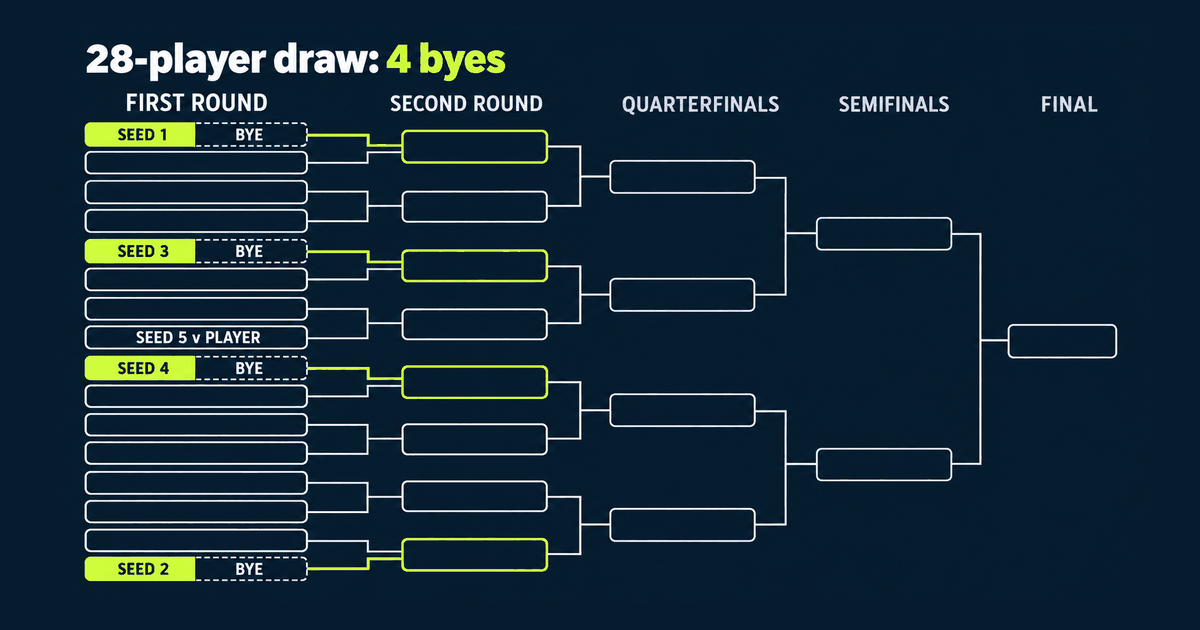
Mirra Andreeva‘s first match at the Singapore Tennis Open this week was a second-round match. The No. 1 seed beat Aliaksandra Sasnovich 6-2, 6-2 without having played a first-round match at all. Maja Chwalinska, the No. 5 seed, had to start in the first round. The difference between them is a bye.
What a bye is
A knockout bracket only works cleanly with a power of two: 32, 64 or 128 players. Many tour events use draws that fall between those numbers, such as 28, 48, 56 or 96 players. The empty lines in the bracket are byes. A player drawn next to one goes into the second round without playing and waits there for the winner of a first-round match.
The ATP rulebook builds the draw that way. For a field of 48 or 56, it specifies a draw sheet with 64 places: the seeds and byes are placed first, and the remaining players, qualifiers included, are drawn into the spaces left over.
How many byes each draw size creates
- 28-player draw: four byes, on a 32-line bracket. Singapore, Ningbo and Tokyo all use 28-player singles draws on this year’s WTA Asian swing.
- 32-player draw: no byes. Seoul, Osaka and Guangzhou use 32.
- 48-player draw: 16 byes, on a 64-line bracket.
- 56-player draw: eight byes, on a 64-line bracket. The Wuhan Open uses 56.
- 96-player draw: 32 byes, on a 128-line bracket. The women’s event at the China Open in Beijing uses 96.
- 128-player draw: no byes. The four Grand Slams use 128.
Draw sizes for each tournament category are covered in the guides to ATP 250, ATP 500, ATP Masters 1000, WTA 500 and WTA 1000 events.
Who gets them
Byes go to the top seeds, in order. In Singapore’s 28-player draw the four byes went to the top four seeds, which is why Andreeva, as No. 1, started in the second round and Chwalinska, at No. 5, did not. In a 96-player draw there are 32 byes to hand out, so a much deeper group of seeded players skips the first round.
Seeds come from the rankings, so a bye is usually earned over months rather than in the week itself. How rankings translate into seedings is explained in How Grand Slam Seedings Are Determined by Rankings.
The WTA has also used byes to protect players coming off a deep run the week before. In 2019 the Wuhan semifinals and final were played on the Friday and Saturday, with the Beijing main draw starting on the Saturday, and the WTA gave the Wuhan semifinalists what it called performance byes into the second round in Beijing. Whether an event uses them depends on the tour’s rules for that season.
What a bye is worth in ranking points
A bye is not a win. The ATP’s 2026 rulebook states that a player who reaches the second round by drawing a bye and then loses is treated as having lost in the first round and receives first-round loser’s points.
That matters because of how the ATP points table is built. At ATP 500 and ATP 250 events, a first-round loss earns no points, so a seed who receives a bye at one of those events and loses the opening match leaves with nothing. At a 96-player ATP Masters 1000, a first-round loss is worth 10 points, so a seed who loses straight after a bye leaves with 10. From the second match on, the table applies as normal: a seed who wins after a bye and then loses in the third round of a 96-player Masters takes the round-of-32 figure, 50 points.
The WTA publishes its own points table for each event. On the current Asian swing, a first-round loss is worth 1 point in Singapore’s 28-player WTA 500 and 10 points in Beijing’s 96-player WTA 1000. For the wider picture, see How Tennis Rankings Work.
Why it matters on court
The arithmetic is simple. In a 28-player draw, a player with a bye needs four wins to take the title and everyone else needs five. In a 96-player draw it is six against seven. On a stretch of the calendar with back-to-back weeks across Asia, one fewer match is a real saving.
The other side of it is that a seed’s first match always comes against a player who has already won a match at the event that week, while the seed has not yet played one there.
More: the Singapore and Seoul draws, the China Open Guide, the Wuhan Open Guide, What Is a Lucky Loser in Tennis and How Tennis Qualifying Works.