

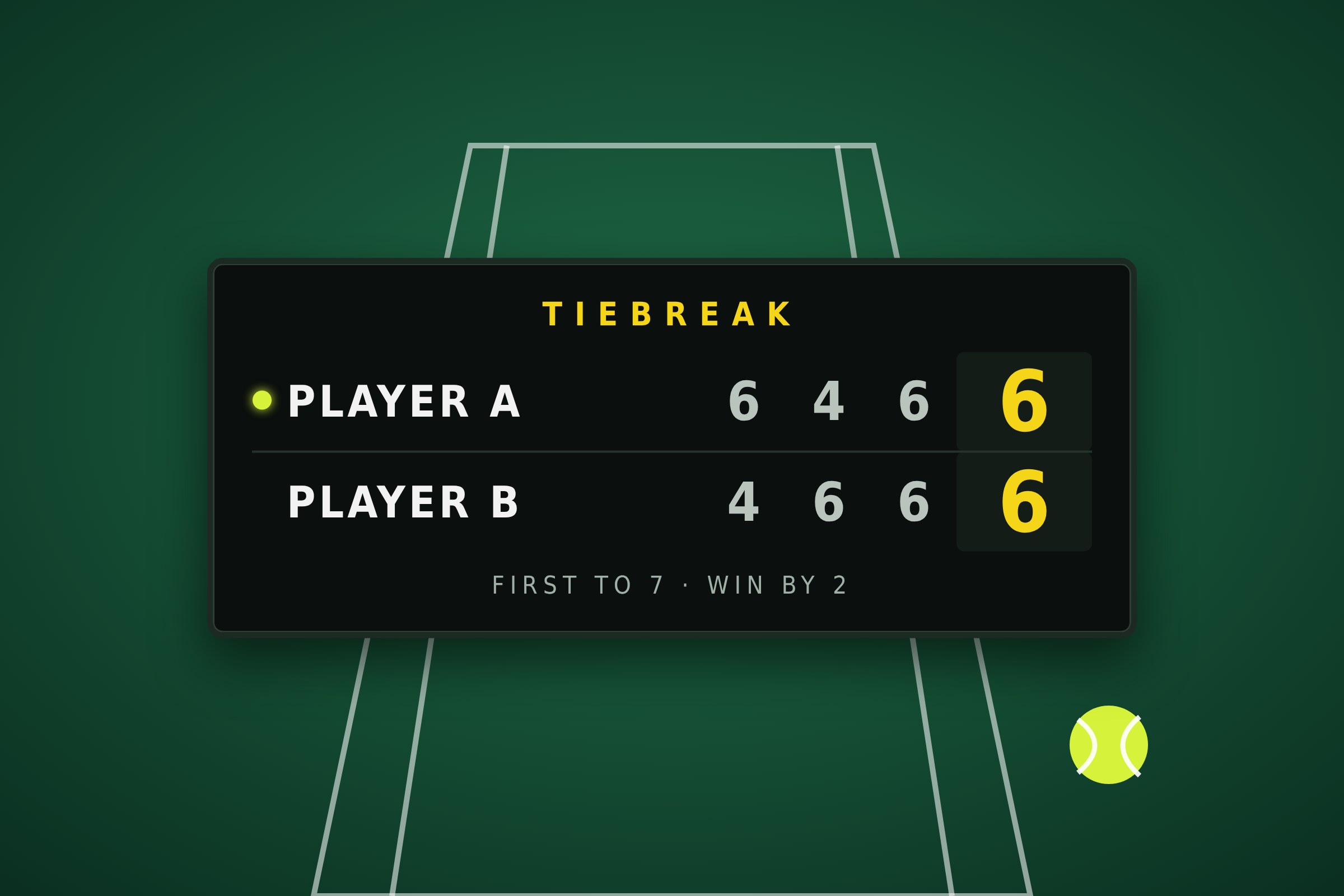
At six games all, most sets in professional tennis are decided by a tiebreak. Every set at this week’s ATP events in Basel and Vienna is played that way, the third included. At the four majors the deciding set ends in a longer version, played to 10 points. This explainer covers how each one works: who serves, when the players change ends, and where each format is used.
When a tiebreak is played
The Rules of Tennis allow two kinds of set. In an advantage set there is no tiebreak, and play continues until one player leads by two games. In a tiebreak set, a tiebreak game is played when the score reaches six games all.
On the ATP Tour, every singles match, finals included, is the best of three tiebreak sets. The advantage set has all but disappeared from professional tennis. Roland Garros was the last major to use it, in the deciding set, and dropped it in 2022.
How the seven-point tiebreak works
Scoring. Points are counted zero, 1, 2, 3 and so on. The first player to seven points wins the tiebreak and the set, but they must lead by two, so play continues past 6-6 until one player is two points clear. The set goes into the record as 7-6.
Serving. The player whose turn it is to serve takes the first point. The opponent serves the next two, and from then on the players alternate, two points each. In doubles, each team keeps the serving rotation it was using in that set.
Changing ends. The players change ends after every six points: at 6-0, 5-1, 4-2 or 3-3, then again at 12 points, and so on.
The next set. The player who served first in the tiebreak receives in the first game of the next set. In practice, the server order picks up as though the tiebreak had been a single game.
In a sequence: player A serves point 1, player B serves points 2 and 3, A serves 4 and 5, B serves 6 and 7. The players change ends after point 6, and the pattern continues until someone reaches seven with a two-point lead.
The 10-point match tiebreak
The match tiebreak replaces a deciding set entirely. It is played at one set all (or two sets all in a best-of-five match), and the first player or team to 10 points, with a two-point margin, wins the match. The serving order runs on from the set before. In doubles, a team may change which partner serves first, as it can at the start of any set. There is a 120-second set break before it, and the balls are not changed at that point, even if a change is due.
On the ATP Tour, every doubles match, finals included, is two tiebreak sets with a 10-point match tiebreak at one set all, and games are played with no-ad scoring: at deuce, one deciding point settles the game. More on that format is in our explainer on how tennis doubles works.
The deciding-set tiebreak at the majors
The Rules of Tennis provide a third format: when the deciding set reaches six games all, a 10-point tiebreak decides the match. It is played to the same 10-points-and-two-clear rule as the match tiebreak, but only after a full deciding set has reached 6-6.
All four majors have used it since Roland Garros in 2022. The Grand Slam Board announced it in March that year as a trial, saying the decision was “based on a strong desire to create greater consistency in the rules of the game at the Grand Slams.” Before then, each major had its own deciding-set rule:
- Australian Open: a 10-point tiebreak at six games all
- US Open: a standard seven-point tiebreak at six games all
- Wimbledon: a seven-point tiebreak at 12 games all
- Roland Garros: no tiebreak, play until one player led by two games
Wimbledon in 2026 was the fifth edition of the Championships to use the 10-point tiebreak at 6-6 in the final set, and the seventh with a final-set tiebreak of any kind. The 12-all version was used in 2019 and 2021, and there was no tournament in 2020. In men’s singles at the majors, the deciding set is the fifth; see our best-of-five explainer for that format. Every other set at the majors still ends in a seven-point tiebreak at 6-6.
Quick reference
- ATP Tour singles: a seven-point tiebreak at 6-6 in every set, including the third.
- Grand Slams: a seven-point tiebreak at 6-6 in every set except the deciding set, which ends in a 10-point tiebreak at 6-6.
- ATP Tour doubles: two tiebreak sets, a 10-point match tiebreak at one set all, and no-ad games.
- Advantage set: no tiebreak; play until one player leads by two games.
For the scoring that comes before a tiebreak, see how sets and games work and scoring from deuce. The season-ending event in Turin is covered in the ATP Finals guide.