

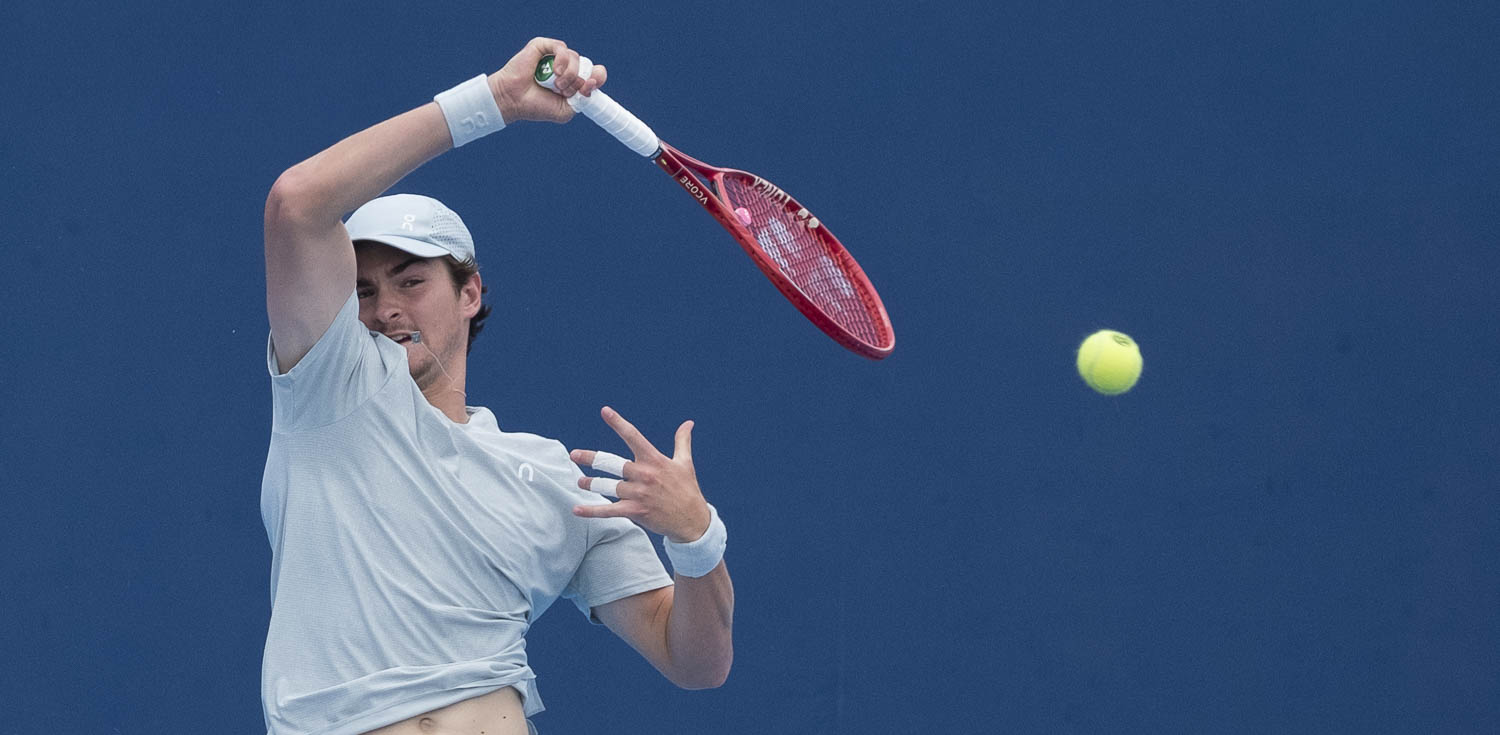
Joao Fonseca will not defend his Swiss Indoors title in Basel next week, and he will not play the Rolex Paris Masters either. The Brazilian ended his 2026 season in a video he posted on Instagram, and the line that explained the decision was a short one: “And there is no need to rush things.”
“As you saw, I skipped the Asian swing to focus on my recovery,” Fonseca said. “My plan was to return during the European swing. But after talking with my team, I realised I’m still not 100% ready to compete at the level I’d like. And there is no need to rush things. So, we decided to prioritise my health and put all focus on the 2027 season.”
The wording is in the ATP’s English rendering of the statement. What makes it worth more than a withdrawal notice is the record behind it. Fonseca has now pulled out of tournaments with problems in four different parts of his body in a single season, and he has said several times this year that he is still learning where his limits are.
The back. The season started with a lower back problem that kept him out of Brisbane and then Adelaide. “I was born with something in my back and sometimes it’s more tight,” he said in Adelaide on 10 January. “I already had a stress fracture five years ago, but it’s something that it’s going to be in my body, so I need to deal with it.” He played the Australian Open and lost in the first round to Eliot Spizzirri, 4-6, 6-2, 1-6, 2-6. “My back is 100 per cent. I’m healthy again. I just needed time,” he said afterwards, and then: “I think [it’s] bad that I wasn’t 100 per cent playing, but at the same time, it gives me maturity to keep going, to understand my body, to understand my limits.”
The wrist, the shoulder and the abdomen. In May he withdrew from Hamburg with discomfort in his right wrist. At Roland Garros he reached the quarterfinals, his best result of the year, and said after losing to Jakub Mensik that the run had meant “understanding a little bit more body and my limits.” In June he left Eastbourne with a right shoulder problem. In August he withdrew from Cincinnati before a third-round match against Christopher O’Connell after feeling “slight discomfort on the left side of my abdomen” in practice, and six days later he was out of the US Open. “After undergoing tests and starting treatment for my abdomen, it became clear to me and my team that I need more time to fully recover so I can compete at a high level,” he said then.
He came back for Brazil’s Davis Cup tie in September, won, and then called off Tokyo and Shanghai. “2026 has been a very challenging year for me,” he said on 22 September. “I made a huge effort to return and represent Brazil in the Davis Cup, but I still need more time.” The October statement closes the plan he set out then. The European swing was the target in September; now it is the 2027 season.
What it costs. Fonseca finishes the year 20-13, according to the Infosys ATP Win/Loss Index, and No. 29 in the PIF ATP Rankings. The ranking runs over 52 weeks, so what he won at this stage of 2025 comes off without a chance to defend it. In Basel last October he beat Alejandro Davidovich Fokina 6-3, 6-4 in the final for his first ATP 500 title, worth 500 points. In Paris he beat Denis Shapovalov in the first round before losing to Karen Khachanov. Both results drop as this year’s events are played.
What the rules allow. Under Chapter 9 of the 2026 ATP Rulebook, withdrawing from an ATP 500 event normally brings a zero-point ranking penalty. The exception covers players with multiple consecutive withdrawals who are out of competition for 30 days or longer through injury, provided verified and approved medical forms are supplied. Basel follows his withdrawals from Tokyo and Shanghai.
Paris is different. For a player with direct entry, as Fonseca has, the ranking total includes all eight mandatory Masters 1000 events, so a missed one counts as a zero. The rulebook gives a long-term absentee a route out: a player who misses two or more consecutive mandatory Masters 1000 events can replace up to three Masters 1000 zero-pointers, but only after applying to the ATP’s Medical Committee. Shanghai and Paris are consecutive mandatory events. The ATP has not said whether either provision has been applied in his case.
One provision does not fit his plan. Entry protection, the ATP’s version of a protected ranking, requires a player to be out of competition for at least six months. Fonseca’s stated focus is the 2027 season, which starts in January, less than four months after his last match, so he will come back on whatever ranking he holds then.
The question for 2027. Fonseca won the Next Gen ATP Finals in 2024 and Basel a year later. What 2026 changed is the order of priorities in his own statements: in January he wanted to be “a hundred per cent to play” the Australian Open; in October the phrase was “no need to rush things.” Whether the body holds up over a full season is the question he has left for next year. The Basel guide and the Paris Masters guide cover the two events he will miss, and the general rules on pulling out are in our withdrawal rules explainer.