

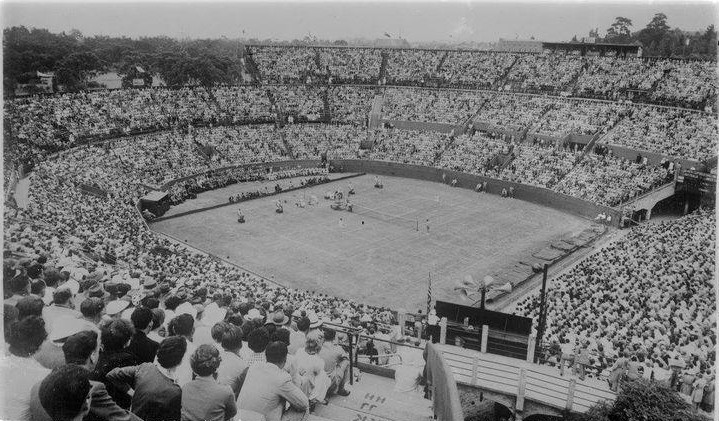
Every Grand Slam tournament has an origin story. Wimbledon’s is the oldest — a private club in a London suburb organizing the first lawn tennis championship in 1877. The US Open’s traces back to a Newport, Rhode Island resort in 1881. Roland Garros began in 1891 as a national championship at the Racing Club de France in Paris.
The history of the Australian Open began in 1905 as the Australasian Championships — and spent the next sixty-seven years wandering between cities, hosted in Melbourne, Sydney, Adelaide, Brisbane, Perth, and even twice across the Tasman Sea in New Zealand. No other Grand Slam tournament travelled so far for so long before settling on a permanent home.
That long journey from regional curiosity to global Grand Slam is the most distinctive founding narrative in major-tournament tennis. The Australian Open’s transformation from the smallest and most isolated of the four majors into one of the most commercially powerful and most-attended events in world sport required nearly a century of structural decisions — the 1972 move to a permanent home at the Kooyong Lawn Tennis Club, the 1986 calendar reset that briefly meant no Australian Open at all, the 1988 transition to a purpose-built venue with the world’s first retractable roof, and the modern transformation that has made the Australian Open the season-opening Grand Slam that defines the start of the tennis calendar.
Understanding how the Australian Open became what it is requires understanding both the tournament’s competitive history and the specific structural decisions that turned a wandering regional championship into a modern Grand Slam capable of holding its own with Wimbledon, Roland Garros, and the US Open.
The Founding: 1905
The first Australasian Championships were held in November 1905 at the Warehouseman’s Cricket Ground in Melbourne — a venue now known as Albert Reserve, occupying what is today part of Melbourne’s St Kilda Road precinct. The tournament was organised by the Lawn Tennis Association of Australasia, which had been formed the previous year to represent tennis in both Australia and New Zealand.
The inaugural tournament was a modest affair by international standards — seventeen players in the men’s competition, no women’s singles competition (which would not be added until 1922), and a competitive field drawn entirely from Australia and New Zealand. The inaugural men’s champion was Rodney Heath, a Melbourne-born player who would go on to win the tournament twice across the decade.
The Lawn Tennis Association of Australasia formally established the Australasian Championships as the regional tennis championship for both Australia and New Zealand — explicitly designed as a binational competition rather than a purely Australian event. This binational structure would last until the early 1920s, when Australia and New Zealand formally separated their tennis administrations and Australia took sole control of what would soon be renamed the Australian Championships.
The competitive level of the early Australasian Championships was high within the regional context but limited in international comparison. The combination of geographic isolation, the 45-day sea journey from Europe that discouraged international travel, and the modest prize structures of amateur tennis meant that the world’s top players rarely competed in Australia.
The tournament built its reputation as the premier event in Australasian tennis but lacked the international competitive credibility that Wimbledon and the US Championships were already accumulating.
The Wandering Years: 1905–1971
For the next sixty-seven years, the Australasian — and later Australian — Championships had no fixed home. The tournament rotated between cities based on which state association was best positioned to host in a given year, the available facilities, the local commercial conditions, and political considerations within the national tennis administration.
The cities that hosted the tournament across this wandering era included Melbourne, Sydney, Adelaide, Brisbane, and Perth — covering the major population centres of Australia and reflecting the tournament’s identity as a national event that belonged to no single city. The Australasian Championships also travelled across the Tasman Sea on two occasions — to Christchurch in 1906 and to Hastings in 1912 — reflecting the binational identity of the early years.
The practical consequences of this rotating venue structure were significant. Each city’s tennis association had to organise the tournament when its turn came, with venue selection, ticket sales, and competitive arrangements managed separately for each edition. The lack of institutional continuity made it difficult to build commercial relationships, develop consistent broadcast partnerships, or invest in long-term facility improvements.
Within Australia itself, the distances between host cities meant many domestic players couldn’t easily travel to compete when the tournament was held interstate. The Australian Championships, paradoxically, was harder for many Australian players to enter than Wimbledon was for British players or the US Championships for American players — the geographic spread of the country meant a national championship in Perth was nearly as inaccessible to Sydney-based players as an international event would have been.
For international players, the journey was even more discouraging. The 45-day sea voyage from Europe to Australia — the only practical means of travel before mid-century commercial aviation — required an extraordinary commitment of time and money for an event whose prize structure could not justify the trip. Many of the world’s best players never competed at the Australasian Championships during this era, leaving the competitive field heavily dominated by Australian and New Zealand players.
The Renaming Era
The Australasian Championships underwent two early identity changes that reflected the evolution of Australian tennis administration. In the early 1920s, Australia and New Zealand formally separated their tennis governance bodies — with Australia retaining the championship and New Zealand establishing its own national tournament. The event continued to be called the Australasian Championships for several more years before being formally renamed the Australian Championships in 1927, reflecting the new national identity.
The naming sequence — Australasian Championships (1905–1926), Australian Championships (1927–1969), Australian Open (1969–present) — tracks the tournament’s institutional evolution from regional binational competition through national amateur championship to the Open Era event that admitted professional players for the first time.
The Australian Dominance Era: 1950s–1970s
The decades from the late 1940s through the mid-1970s produced the most sustained concentration of Australian tennis excellence in the sport’s history — a generation of champions that transformed Australia into the dominant force in international tennis and that made the Australian Championships one of the most competitive events in the world during these years, regardless of the limited international field.
The list of Australian men’s champions during this era reads like a roll call of tennis’s all-time greats: Frank Sedgman, Ken McGregor, Lew Hoad, Ashley Cooper, Mal Anderson, Roy Emerson, Rod Laver, John Newcombe, and Ken Rosewall all won the Australian Championships during this period — many of them multiple times. The combined talent on display at the Australian Championships in any given year during these decades exceeded what most international tournaments could field.
Roy Emerson holds the all-time men’s record at the Australian Championships with six titles between 1961 and 1967 — five consecutive championships from 1963 to 1967 reflecting a level of dominance at a single Grand Slam venue that has never been matched in the amateur era. Emerson’s record stood until Novak Djokovic finally surpassed it nearly six decades later.
Rod Laver — the only player in tennis history to complete the calendar-year Grand Slam twice (in 1962 and 1969) — won the Australian Championships three times: in 1960, 1962, and 1969. His 1969 title at the AO was the first Grand Slam of his second calendar-year Slam — the only such achievement in the Open Era.
Ken Rosewall holds the unique distinction of being the oldest men’s singles champion in Grand Slam history — winning the 1972 Australian Open at the age of thirty-seven years and two months. His record stood for over five decades and remains one of the most remarkable late-career achievements in the sport.
The women’s competition during this era was dominated by Margaret Court — the Australian who holds the all-time women’s Grand Slam singles title record with twenty-four major championships. Court won the Australian Championships eleven times across her career — the most by any player at any single Grand Slam tournament in tennis history.
Evonne Goolagong Cawley, the Wiradjuri Australian whose competitive elegance made her one of the most celebrated players of her era, won the Australian Open four consecutive times between 1974 and 1977 — her record reflecting both her individual brilliance and the strength of women’s Australian tennis during this period.
The combination of generational Australian talent and the tournament’s role as a national showcase created an environment in which the Australian Championships, despite its limited international competitive field, was a genuinely world-class event. The Australian school of tennis — exemplified by the coaching of Harry Hopman, whose Davis Cup teams dominated international competition from the 1950s through the 1970s — established Australia as the world’s leading tennis nation during a generation when most of the sport’s competitive infrastructure was concentrated in just a handful of countries.
The Open Era and the Identity Crisis
The Australian Championships entered the Open Era in 1969 — joining the other three Grand Slams in admitting professional players to compete alongside amateurs. The renaming from Australian Championships to Australian Open formalised the identity that would carry the tournament into the modern era.
But the Open Era transition revealed a structural problem that had been masked during the amateur years. As professional tennis became truly international and as the world’s top players began competing across the global calendar, the Australian Open’s geographic isolation became more visible. The 45-day sea journey was no longer the obstacle — commercial aviation had made the trip practical — but the tournament’s modest prize money, its often-changing venue, and its January timing (which conflicted with the European and American off-season rest periods) meant that many of the world’s top players continued to skip the Australian Open.
The competitive field at the Australian Open during the 1970s frequently lacked many of the world’s top ten players. The tournament’s status as one of the four Grand Slams was nominally equal to Wimbledon, Roland Garros, and the US Open — but in practice, the Australian Open was treated as a smaller event by the international tours, with reduced ranking points awarded to its winners and less commercial weight given to its champions.
This identity crisis — formally one of the four Grand Slams, but practically treated as a lesser event — would not be fully resolved until the 1990s. The structural decisions made between the early 1970s and the mid-1990s were what eventually closed the gap and established the Australian Open as a genuinely equal major.
Settling at Kooyong: 1972
The first structural decision that would transform the Australian Open was the 1972 settlement at the Kooyong Lawn Tennis Club — ending the sixty-seven-year wandering era and establishing Melbourne as the tournament’s permanent home.
Kooyong was a historic suburban club in the eastern Melbourne suburb of the same name, with grass courts and a horseshoe-shaped main stadium that had opened in 1927. The decision to settle the Australian Open at Kooyong reflected Melbourne’s consistently strong attendance and the city’s established position as Australia’s tennis capital.
The Kooyong era — 1972 to 1987 — produced some of the most memorable moments in the tournament’s history. Rod Laver, Ken Rosewall, John McEnroe, Mats Wilander, Martina Navratilova, Evonne Goolagong Cawley, Chris Evert, and Steffi Graf all competed there on the club’s grass courts. The 1972 tournament itself was won by Ken Rosewall, whose age-37 victory at Kooyong remains the oldest men’s Grand Slam singles championship in tennis history.
But Kooyong had structural limitations that became increasingly visible as the Australian Open’s ambition grew. The stadium held approximately 8,500 spectators — a fraction of what other Grand Slams could offer. The grass courts required intensive maintenance and were vulnerable to Melbourne’s unpredictable summer weather. The suburban club setting lacked the infrastructure needed to host a truly world-class event.
After the 1983 Australian Open, the International Tennis Federation formally urged the Lawn Tennis Association of Australia to find a new venue, citing Kooyong’s inadequacy for an event of this scale. Upgrade proposals for the club were explored but ultimately fell through.
The 1977 Calendar Shift
One of the most peculiar episodes in the Australian Open’s history occurred in 1977, when the tournament was played twice in a single calendar year as part of an attempt to shift the AO from its traditional January slot to December.
The January 1977 Australian Open at Kooyong was won by Roscoe Tanner and Kerry Reid. The December 1977 Australian Open — also at Kooyong, just eleven months later — was won by Vitas Gerulaitis and Evonne Goolagong Cawley. Both tournaments counted as official Australian Opens, producing two champions in the same year and one of the few examples in tennis history of a Grand Slam tournament being held twice in twelve months.
The tournament remained in December for the next eight years, with the 1985 Australian Open being the last of the December editions. The calendar shift had been intended to align the Australian Open with the end of the calendar tennis year, but the December timing created its own problems — conflicting with the Christmas and New Year holiday period, putting the tournament at the end of a tiring competitive season, and reducing its commercial appeal to broadcasters and sponsors.
The 1986 Skipped Year
The decision to move the Australian Open back to January meant a calendar reset that produced one of the tournament’s most unusual records — the 1986 Australian Open was never played at all.
There was no January 1986 tournament because the December 1985 edition had already been played, and there was no December 1986 tournament because the calendar shift had been formalised to move the tournament permanently back to January. The next Australian Open was held in January 1987, eleven months after the December 1985 edition — effectively skipping a full year.
The 1986 skipped year remains the only example in the modern era of a Grand Slam tournament being formally omitted from the calendar — and the resulting list of Australian Open champions has a curious blank entry for 1986 that reflects this structural anomaly.
The 1988 Transformation: Flinders Park
The single most consequential decision in the Australian Open’s history was made in 1985, when the Victorian Government identified a site on the edge of Melbourne’s central business district — Flinders Park, a former railyards precinct near the Yarra River — as the location for a new purpose-built National Tennis Centre.
The project cost A$94 million and was completed in two stages, with the first stage finished in 1987 in preparation for the 1988 tournament. The new facility was unlike anything tennis had ever seen.
Its centrepiece was a stadium court — initially called Centre Court, later renamed Rod Laver Arena — with a retractable roof. The roof was the first of its kind at any tennis venue in the world, predating Wimbledon’s Centre Court roof by twenty-one years, the US Open’s Arthur Ashe Stadium roof by twenty-eight years, and Roland Garros’s Court Philippe-Chatrier roof by thirty-two years.
The move from Kooyong also brought with it a new playing surface: Rebound Ace, a hard court material that replaced the grass courts and aligned the Australian Open with the US Open as a hard court Grand Slam. The surface switch was as consequential as the venue change — the Australian Open had been played on grass since the inception of the tournament in 1905, and the move to hard court fundamentally changed the competitive demands and the style of player who would dominate the event.
The reaction when the doors opened in January 1988 was immediate. The new facility drew 266,436 fans — a 90 percent increase over the 1987 tournament’s attendance at Kooyong. The inaugural champions at Flinders Park were Stefan Edberg and Steffi Graf, and the new venue’s commercial success vindicated the Victorian Government’s investment within a single tournament.
The 1988 Australian Open marked the beginning of the tournament’s modern era — and the start of the structural transformation that would eventually close the prestige gap with the other three Grand Slams.
1996: Renaming and Ranking Equality
Ahead of the 1996 tournament, the second stage of the National Tennis Centre was completed, effectively doubling the size of the precinct. The expansion added a 3,000-seat Show Court 3 and Garden Square — a grassed public plaza with a giant screen where fans could watch the action outside the main stadiums.
It was also in 1996 that Flinders Park was officially renamed Melbourne Park by the Victorian Government — a change that reflected both the precinct’s expanded scope and the desire to give the venue a name more clearly tied to the city of Melbourne.
The same year marked another milestone of greater competitive significance: the Australian Open was finally granted ranking points equal to the other three Grand Slams. Until 1996, the AO had been awarded fewer ranking points than Wimbledon, Roland Garros, and the US Open — a formal acknowledgment of its lower competitive standing within the international tennis structure. The 1996 ranking equality decision ended the formal hierarchy among the Slams and gave the Australian Open the same commercial weight as the other three.
The combination of the venue rename and the ranking equality decision marked the moment the Australian Open formally closed its long-running prestige gap with the other Grand Slams. From 1996 onward, the AO was treated as a fully equal major by the international tours, by the players, and by the global tennis media.
Equal Prize Money: 2001
The Australian Open’s commitment to equal prize money for men and women was adopted in 2001 — making the AO one of the early Grand Slams to formalise prize money equality. The US Open had pioneered equal prize money in 1973, and the Australian Open’s 2001 commitment placed it well ahead of Wimbledon and Roland Garros, which fully equalised in 2007.
The 2001 decision reflected Tennis Australia’s broader institutional culture of positioning the tournament as a leader in equality and inclusion across professional tennis. It also reflected the commercial reality that women’s tennis had become as commercially significant as men’s tennis — a reality the Australian Open formally acknowledged before the other European Slams did.
For a deeper read on how Australian Open prize money has evolved across the modern era, see The Australian Open Prize Money Guide.
Djokovic and the Defining of an Era
No discussion of the Australian Open’s modern history is complete without acknowledging the achievement that has permanently transformed how the tournament is understood — Novak Djokovic’s ten Australian Open titles between 2008 and 2023.
Djokovic’s relationship with the Australian Open is the most extreme concentration of excellence at any single Grand Slam by any player in the Open Era. His ten titles — beginning with his first Grand Slam championship at the 2008 AO — established a benchmark of hard court dominance at Melbourne Park that no player has produced before or since at this tournament.
The specific quality of Djokovic’s Australian Open performance — the return-of-serve excellence, the baseline patience, the physical durability across the Melbourne heat, the mental resilience that produced multiple comeback victories from seemingly impossible positions — represented hard court tennis taken to its logical extreme. His 33-match winning streak between 2018 and 2024 matched the previous AO record set by Monica Seles in the early 1990s.
For a fuller treatment of the records Djokovic established at Melbourne Park, see Australian Open Records — Titles, Matches, and Statistics.
The 21st Century Commercial Transformation
The Australian Open of the twenty-first century has undergone the most significant commercial transformation of any Grand Slam during the modern era. Tennis Australia has invested heavily in expanding the Melbourne Park precinct, modernizing the existing stadiums, and positioning the tournament as a global entertainment event rather than purely a sporting competition.
Major facility upgrades through the 2010s added retractable roofs to Margaret Court Arena (2015) and John Cain Arena (2018) — making Melbourne Park the only Grand Slam venue with retractable roofs on three courts. The Tanderrum Bridge, opened in 2017, connected Melbourne Park to the city’s central business district for the first time, integrating the venue into Melbourne’s broader urban fabric.
The tournament’s commercial growth has been extraordinary. The 2020 Australian Open injected A$387.7 million into the Victorian economy, and over the preceding decade, the tournament contributed more than A$2.71 billion in economic benefits to the state. The 2026 prize pool of A$111.5 million was the first time the tournament crossed the nine-figure threshold in Australian dollars.
The 2024 expansion to a 15-day tournament — beginning on a Sunday rather than the traditional Monday — created additional broadcast and ticket revenue while addressing the persistent problem of late-night finishes that had become one of the tournament’s most criticized features.
The 2026 edition attracted more than 1.2 million visitors across the tournament fortnight — the highest attendance figure of any Grand Slam — and the tournament’s broadcast reach now extends to more than 200 countries through territory-specific rights agreements that generate substantial revenue for Tennis Australia.
Why the Australian Open Remains Unique
Among the four Grand Slams, the Australian Open occupies a specific and irreplaceable position — not simply as one of four major championships but as the season-opening event whose identity has been shaped by both its physical setting and its institutional choices in ways no other major can replicate.
The medium-fast GreenSet hard court surface creates competitive conditions that differ meaningfully from the US Open’s hard court — faster, more rewarding to aggressive play, more demanding on the bodies of players coming off the off-season. The Melbourne heat amplifies physical demands in ways the other Grand Slams cannot replicate. The three retractable roofs allow the tournament to manage weather and heat disruption with a flexibility no other venue can match.
The Australian Open’s commercial transformation across the modern era — from the smallest of the four Grand Slams to one of the highest-attended and most lucrative events in world sport — represents one of the most successful institutional turnarounds in professional sport. The combination of structural decisions made in 1972 (settling at Kooyong), 1985 (commissioning Flinders Park), 1988 (the venue opening and hard court switch), 1996 (renaming and ranking equality), and 2001 (equal prize money) cumulatively transformed the tournament’s identity.
The “Happy Slam” reputation — the relaxed, fan-friendly atmosphere that distinguishes Melbourne from the formality of Wimbledon, the cultural intensity of Paris, or the frenetic energy of New York — reflects both the city’s character and the deliberate institutional choices Tennis Australia has made about what kind of tournament the Australian Open should be.
The history of the Australian Open is the history of a regional curiosity that became a global Grand Slam. It is the history of seven decades of structural decisions — the 1972 settlement, the 1977 calendar shift, the 1986 skipped year, the 1988 venue transformation, the 1996 ranking equality, the 2001 prize money parity — that cumulatively closed the gap between the smallest of the four majors and the most modern and ambitious of them. It is the history of a tournament that, more than any other Grand Slam, has reinvented itself across its modern era to become what it is today.
In doing so, the Australian Open has produced one of the most distinctive identities in professional tennis — and one whose competitive history, accumulated across more than a century of competition, makes the tournament an irreplaceable element of the global Grand Slam calendar.
Part of the Australian Open series. Related: The Australian Open Guide · How the Australian Open Found Its Home at Melbourne Park · Australian Open Records — Titles, Matches, and Statistics