

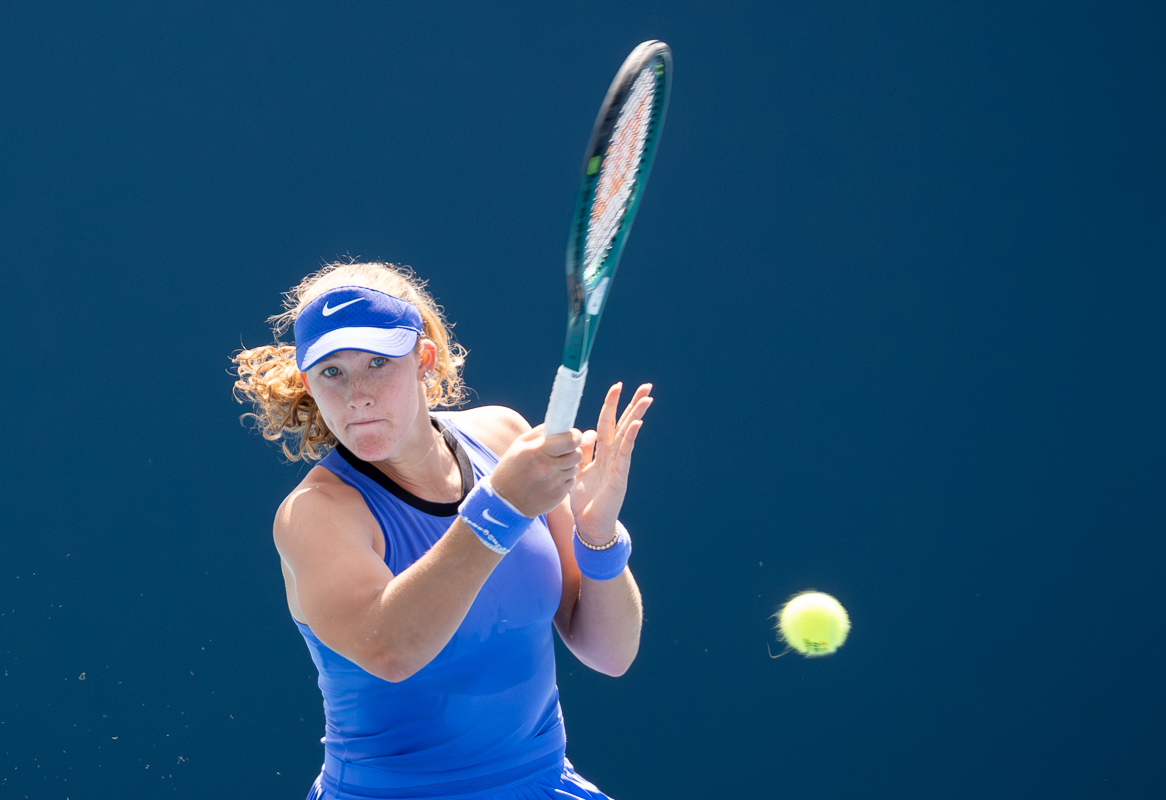
Mirra Andreeva has spoken at length about the emotional collapse that nearly cost her a Madrid Open quarter-final, describing the moment cameras caught her telling her box “I’m not a champion, I will lose” as the lowest point of a season she has otherwise approached with growing maturity.
The 18-year-old Russian survived a 6-7(5), 6-3, 7-6(5) round-of-16 thriller against Hungary’s Anna Bondár on Monday night, having squandered a 5-1 lead in the deciding set before recovering in a final tiebreak.
By Tuesday afternoon she had backed up the win with a 7-6, 6-3 quarter-final victory over Leylah Fernandez to reach the semi-finals on the third year of asking. The deeper conversation, however, was about what happened the night before.
The Collapse
Andreeva entered the Bondár match as a heavy favourite despite a 0-1 head-to-head. She lost the opening set in a tiebreak, recovered to take the second 6-3, and broke twice in the decider to lead 5-1, holding two points to serve out the match.
Bondár, ranked outside the top 100, broke back, then broke again, and the Russian’s body language deteriorated visibly. Television cameras captured Andreeva turning to her coaching box, eyes filling, and repeating the line that has now circulated globally.
“I’m not a champion. I’m not a champion, no. I will lose. I will lose.” She lost five games in a row from 5-1 to 5-6, eventually held serve to force a tiebreak, and edged it 7-5 after nearly three hours on court. She left the court in tears.
Her Own Account
Speaking to Tennis Channel and to Spanish reporters at Caja Mágica, Andreeva was unusually direct about what had happened. “I caught myself being in a pretty bad spot when it was 5-6 in the third set, when I lost those five games in a row,” she said. “Maybe it’s weird to say, but I feel like that moment helped me because I was so mad at myself.
I was just like, ‘No, I’m not leaving it like this.'” She acknowledged that the first set had been costly because she had played reactively rather than proactively. “I felt like I was aggressive, but at the same time I was waiting for her mistakes and not really going for my shots.
I guess that’s why it didn’t go my way.” The phrase she returned to repeatedly was closing things out. “I feel like I cannot make this happen again. I really have to be able to close things out.”
Why Madrid Matters
The emotional weight of the week is partly explained by the calendar. Andreeva’s birthday and her father’s birthday both fell during the tournament, and her mother’s birthday falls in three days.
“Madrid is a very special place for me,” she said. “Basically every year since I turned 16, we’ve spent our birthdays here. So it gives me extra motivation to keep fighting and pushing at hard times.”
The Caja Mágica is also where she reached her first Tier 1 quarter-final in 2024 and her second in 2025, the previous two stages at which her run had ended. Reaching the semi-finals on Tuesday with the Fernandez win broke that pattern.
It also made her the youngest player to reach three consecutive quarter-finals at a single WTA 1000 event since Martina Hingis at Miami between 1997 and 1999.
The Pattern of the Season
The Bondár collapse was the fourth three-set defeat-from-winning-position scare of Andreeva’s 2026, a season in which she has nonetheless captured WTA 500 titles in Adelaide and Linz, reached the Stuttgart semi-finals, and now leads the entire WTA Tour with 10 clay-court wins in 2026.
She is the world No. 10 and a two-time WTA 1000 champion, with titles in Dubai and Indian Wells in 2025, and she defended neither this season. The Indian Wells defence ended with a third-round loss to Kateřina Siniaková during which she threw her racket on court.
The pattern of late-match volatility, in matches she has otherwise dominated, is the central technical and psychological problem of her season. Her 12th main-draw victory in Madrid is now her highest tally at any WTA-level event.
The Self-Criticism
What was striking on Tuesday was Andreeva’s refusal to use the comeback as a way to reframe the meltdown. “I held a lot of emotions inside of myself,” she told reporters. “I was trying to be very pumped in the third set, and I felt I was playing pretty good. Then after, being 5-1 up, I just felt a little bit nervous for some reason, even though I feel I should just have more confidence that I’m up on the score.”
She identified specific corrections for the Fernandez match. “I would really like to see a little bit less double faults, because today at some moments I was nervous and tight. And also not to wait for mistakes.
No matter what happens, I’d rather miss but go for my shots. I don’t want to wait for my opponent. I want to do everything myself.” She delivered against Fernandez 24 hours later, breaking serve four times and limiting herself to two double faults.
What Comes Next
Andreeva will face the winner of Aryna Sabalenka and Hailey Baptiste in the semi-finals on Wednesday or Thursday. A meeting with Sabalenka, the three-time Madrid champion and world No. 1, would mark the third career encounter between them, with the head-to-head currently tied at 1-1.
A first WTA 1000 final on clay would also keep alive what is increasingly the central question hovering over Andreeva’s season ahead of Roland Garros, which begins on 24 May. The talent has never been disputed. Whether the closer arrives in time for Paris is the question she has now publicly asked herself.