

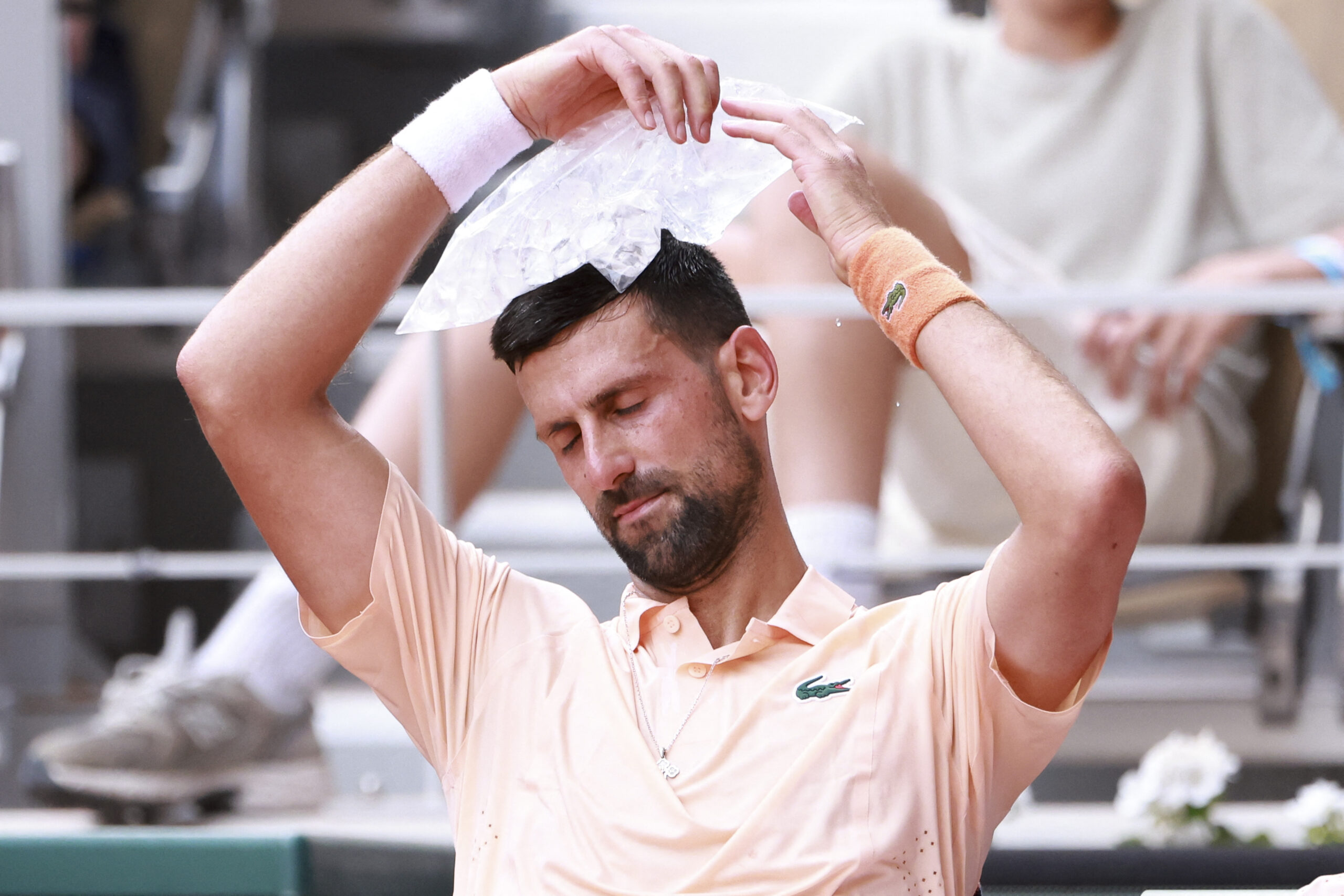
Tennis is one of the few professional sports played for hours at a time, in direct sun, with no substitutions and no clock to run down. A match can last five hours. A player who overheats cannot be rotated off. That combination is why the sport has built a formal set of rules governing when heat becomes dangerous enough to change how a match is played — and when it becomes dangerous enough to stop play altogether.
Those rules are not uniform. The two tours use one standard, and each of the four Grand Slam tournaments sets its own. Understanding the difference explains why play can be suspended at a tour event in conditions that a major would allow to continue.
What WBGT Actually Measures
Nearly every heat rule in tennis is built on a single measurement: the Wet Bulb Globe Temperature, or WBGT. WBGT is not the air temperature, and it is not the heat index. It is a composite measure of heat stress on a body in direct sunlight, and it combines four environmental inputs:
- Air temperature
- Relative humidity
- Wind speed
- Radiant heat — the strength of the sun, accounting for sun angle and cloud cover
This matters because air temperature alone is a poor guide to physiological danger. A dry 38C day in the desert can be less dangerous than a 31C day at 85 percent humidity, because sweat evaporates in the first case and does not in the second. Evaporation is how the human body sheds heat. When humidity blocks it, core temperature climbs regardless of what the thermometer reads.
WBGT captures that. It is why the same index is used well beyond tennis, in military training standards and occupational safety codes.
The Tour Standard — Cooling Breaks and Suspension
The WTA has operated a heat policy since 1992, making it the longest-standing player-welfare rule of its kind in professional tennis. The ATP had no equivalent written standard for decades, and adopted one effective from the 2026 season after its board approved a policy built on the same index. The two tours now work to aligned thresholds in best-of-three singles.
The 30.1C cooling break
When WBGT reaches 30.1C — roughly 86F — during the first two sets, either player may request a 10-minute cooling break after the second set. If one player requests it, it applies to both.
During the break, players may hydrate, change clothing, shower, take cooling measures and receive coaching, under the supervision of tour medical staff. It is a structured recovery window, not a tactical timeout.
The 32.2C suspension
Above 32.2C — approximately 90F — play is suspended. This is the harder line, and it is not discretionary in the way a referee’s weather call is. It is the same trigger the women’s tour has used for three decades. The distinction between the two thresholds is the core of the whole system. The lower one modifies how a match is played. The higher one stops it.
Why the Grand Slams Are Different
The four majors are not governed by the ATP or WTA rulebooks on this question. Each sets its own heat policy, and a tour-level threshold does not automatically bind them.
Roland Garros, Wimbledon and the US Open
These three operate WBGT-based policies, which makes them broadly comparable to the tour standard in method — but the thresholds, the monitoring schedules and the degree of referee discretion are set individually by each tournament. Wimbledon, for example, takes readings before play begins and again at fixed points during the day, and does not apply the heat rule to matches being played under a closed roof, where conditions are controlled.
The Australian Open and the Heat Stress Scale
Melbourne is the outlier. The Australian Open introduced an Extreme Heat Policy in 1998 and rebuilt it in 2019 around the Australian Open Heat Stress Scale, a graded 1-to-5 system rather than a single trigger point. The scale draws on the same four climate factors as WBGT, but adds something the tour rules do not: it accounts for physiological differences between adult, junior and wheelchair athletes, who do not disperse heat at the same rate.
At the top of the scale, play is suspended and the roofs close on the main stadiums. Matches already underway continue to the end of an even number of games or the completion of a tiebreak, and no new matches are called to court.
The best-of-five complication
Men’s singles at the majors is played over five sets, which the tour thresholds — written for best-of-three — do not directly address. This is one of the practical reasons the Slams maintain separate policies rather than adopting the tour standard wholesale, and it is a recurring source of confusion in coverage of heat stoppages at the majors.
Why the Rules Were Tightened
Formal heat rules in tennis have generally followed incidents rather than preceded them. The men’s tour’s move to a written standard came after a run of heat-related retirements and visible distress at events in high humidity, where the absence of any binding threshold left decisions to case-by-case judgment. Players said publicly that the discretion-based approach was not adequate.
The underlying pressure is not only about individual matches. Ball kids, line officials, courtside staff and spectators in unroofed seating are exposed to the same conditions as the players, and tournament heat protocols increasingly account for all of them.
Season Snapshot — August 2026
- The ATP heat rule took effect from the 2026 season, having been approved by the ATP board in December 2025.
- At the US Open, the USTA introduced WBGT monitoring in 2024, with tournament medical staff taking readings at regular intervals through each day. The tournament has stopped short of adopting a mandatory suspension threshold of the kind now written into both tour rulebooks, leaving stoppage decisions to officials.
- At Roland Garros in May 2026, a significant heat wave passed without the tournament’s policy being activated.
Volatile detail, accurate as of publication.
Frequently Asked Questions
Does the ATP heat rule apply at the Grand Slams?
No. The four majors set their own heat policies, and the tour rule does not extend to them. This was widely misreported when the ATP policy was announced.
Can a player refuse a cooling break their opponent requested?
No. In singles, when the break is triggered it applies to both players.
Is a heat suspension the same as a rain delay?
Procedurally it is similar — play halts and resumes when conditions allow — but the trigger is a measured index rather than an observable condition, and at some events matches under a closed roof continue while outdoor courts stop.
What happens to a match that is stopped for heat?
It resumes from the same score. A heat suspension is a pause, not a result. That is different from a retirement, where a player is unable to continue and the match ends.