

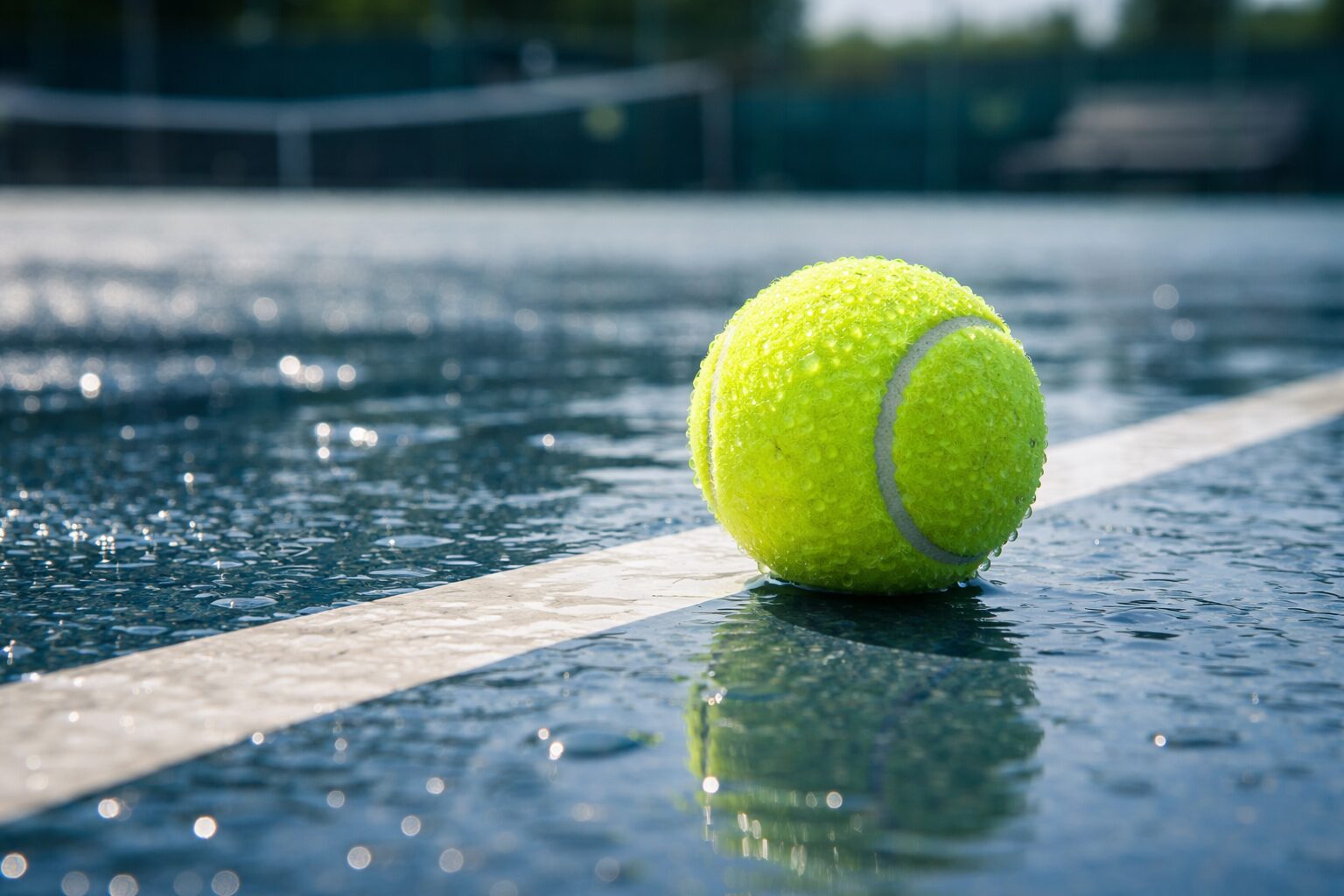
Tennis rain delay rules live in one short section of the Grand Slam Rule Book, and they are narrower than most people expect. Section X, Suspension and Postponement, runs to roughly 200 words. It sets out who may stop a match, who may move it to another day, what gets written down at the moment play halts, and how long players get to hit before they start again. It says nothing about roofs.
Here is what actually happens when the covers go on, and why a delay can change a tournament long after the sun comes back.
Who can stop play, and who can postpone it
Two different officials, with two different powers. The chair umpire may suspend a match temporarily for darkness, weather or the condition of the grounds. So may the referee, in consultation with the Grand Slam Supervisors. Any suspension a chair umpire orders must be reported to the referee immediately.
Only the referee can postpone a match to a later day. The referee holds most of the discretionary powers at a major, from making the draw to deciding when a court is playable. That distinction is the one that matters on a wet afternoon. Until the referee makes that call, nobody is released: the rulebook requires the players, the chair umpire and every on-court official to remain ready to resume. A suspension is a pause. A postponement ends the day.
The referee also decides whether a court is fit for play in the first place, and whether play should be postponed for weather, inadequate light or other conditions. The chair umpire’s remit is narrower — judging whether the court in front of them remains fit while the match is running.
What the chair umpire writes down
The moment play is suspended, the chair umpire records six things: the time, the point, the game and set score, the name of the server, and the side of the court each player was standing on. Then they collect every ball in use.
That list is why a resumed match picks up at the exact point it stopped rather than at the start of a game. It also explains something viewers notice and rarely hear explained: the balls that come out for the re-warm-up are not the balls that come back into play. The regulations state it plainly — balls used in a warm-up after a suspension or postponement are not the balls used when play resumes.
The re-warm-up clock
How much hitting a player gets before the restart is fixed by the length of the delay, not negotiated between the players.
| Length of delay | Re-warm-up |
|---|---|
| Under 15 minutes | None |
| 15 to 30 minutes | 3 minutes |
| 30 minutes or more | 4 minutes |
Four minutes is the same warm-up a match gets at the start. A two-hour rain delay and a 35-minute one therefore buy identical amounts of hitting, which is one reason players talk about long delays as a physical problem rather than an inconvenience.
When a match can be moved to another court
Once a match has officially started — the rulebook defines that as the first serve of the first point being struck — it normally cannot be moved. Two exceptions are written for exactly this situation. The referee may move a match in progress if bad weather or other unavoidable circumstances have caused disruption, and only where the move is needed either to prevent a player having to play two singles matches in one day, or to complete the event at all.
Outside those two cases the move requires the agreement of both players, and the rulebook adds that such agreement is not to be unreasonably withheld. Wherever possible the switch happens at the end of a set or after an even number of games. That is how a match begun on an outside court can finish under a roof. It is also why it happens less often than spectators expect.
The roofs, and what the rulebook does not say about them
The Grand Slam Rule Book’s facilities requirements cover the net band, the position of the scoreboard, the intensity of the lighting, and a rule that back walls and banners must not carry light colours that interfere with a player’s vision. There is no roof provision anywhere in them. Roof operation belongs to each tournament, not to the shared rulebook.
Nine courts across the four majors are covered.
| Tournament | Roofed courts | First roof |
|---|---|---|
| Australian Open | 3 | Rod Laver Arena, 1988 |
| Wimbledon | 2 | Centre Court, 2009 |
| US Open | 2 | Arthur Ashe Stadium, 2016 |
| Roland Garros | 2 | Philippe-Chatrier, 2020 |
Rod Laver Arena, which opened in 1988, was the first covered court at any major; Margaret Court Arena is among the other two at Melbourne Park. Wimbledon added No. 1 Court in 2019, the US Open added Louis Armstrong Stadium in 2018, and Roland Garros covered Suzanne-Lenglen in 2024. The Ashe roof closes in about five minutes.
Every other court at every major is open to the sky, which is the practical limit on what roofs can do. They protect the marquee matches and the broadcast window. They do not protect the draw.
Tournaments also apply their own conditions to roof use. Closing a roof is a weather decision made under each tournament’s own conditions, and it sits separately from the heat rules, which run on their own thresholds.Wimbledon changed its policy in 2019 so that a match suspended under the roof by the 11 p.m. curfew resumes the following day with the roof open, unless the weather says otherwise.
Darkness is treated differently from weather
When play stops for rain it stops at once, mid-game if that is what conditions demand.
Darkness is handled with more care. If a suspension or postponement is due to darkness, the rulebook says it should come at the end of a set, or after an even number of games in the set in progress. The reason is service fairness: stopping after an odd number of games hands one player an extra service game on the resumption, which is an advantage nobody earned.
What a delay does to the rest of the schedule
This is where a rain delay stops being a weather story. In normal conditions a player is scheduled for no more than one singles and one doubles match a day, and no match starts less than 12 hours after their previous one finished. Both protections carry the same written exception: weather or other unavoidable circumstances that disrupt the schedule.
When two matches in a day become unavoidable, a shorter guarantee replaces them — a minimum rest period scaled to the length of the first match.
- Under one hour played: 30 minutes rest
- Between one hour and 90 minutes: one hour rest
- More than 90 minutes: 90 minutes rest
A player who has just come through a three-hour match is entitled to 90 minutes before starting the next one. That is a floor, not a norm, and it applies however long the second match is likely to run. What those compressed minimums do to a player across a week is covered separately in how rain delays reshape a tournament.
The same exception reaches into qualifying. A qualifier normally gets 12 hours between their final qualifying match and their first-round main draw match, and a player who has played two qualifying matches in a day should not be scheduled the next day — unless they entered the main draw as a lucky loser, in which case the protection does not apply.
What happens if a tournament runs out of days
The Grand Slam Tournament Regulations answer this in a single sentence, under the heading Rain and Force Majeure: “Grand Slam Tournaments may be extended as necessary for completion.” That is the entire provision.
In practice the majors work hard to avoid using it. Running past the scheduled final day collides with the next event on the calendar and with broadcast commitments made months earlier. The instruments referees reach for first are the ones above: covered courts, later finishes, and rest periods compressed to the minimums the rulebook allows. The weather becomes invisible long before its effects do.
Frequently asked questions
Does a suspended match restart at the beginning of the game?
No. It restarts at the exact point recorded by the chair umpire, with the same server and the same players on the same ends.
Can a player refuse to move to a different court?
Only outside the two exceptions. If the referee has determined the move is needed to stop a player having two singles matches in a day, or to complete the event, it can be made without agreement. In every other case the players must agree, and the rulebook says that agreement is not to be unreasonably withheld.
Do players get a longer warm-up after a longer delay?
No. Four minutes is the maximum, reached once a delay hits 30 minutes, and it does not grow after that however long the wait.
Why do the roofs not solve the problem?
Nine courts are covered across the four majors. Every other court at every major is open to the sky, and a first-round day runs matches on far more courts than the roofs can hold.
Season snapshot
Current as of 2 September 2026. Figures in this block change; the rules above do not.
The opening rounds of the 2026 US Open put most of this into practice at once. Rain across the first three days left first-round matches unplayed into a fourth, with Arthur Ashe Stadium and Louis Armstrong Stadium running under closed roofs while the outside courts waited. The last first-round match on Ashe, Alexander Zverev against Lorenzo Sonego, finished shortly before 2 a.m. on 2 September. Cincinnati had already lost a full day of qualifying to rain three weeks earlier.