

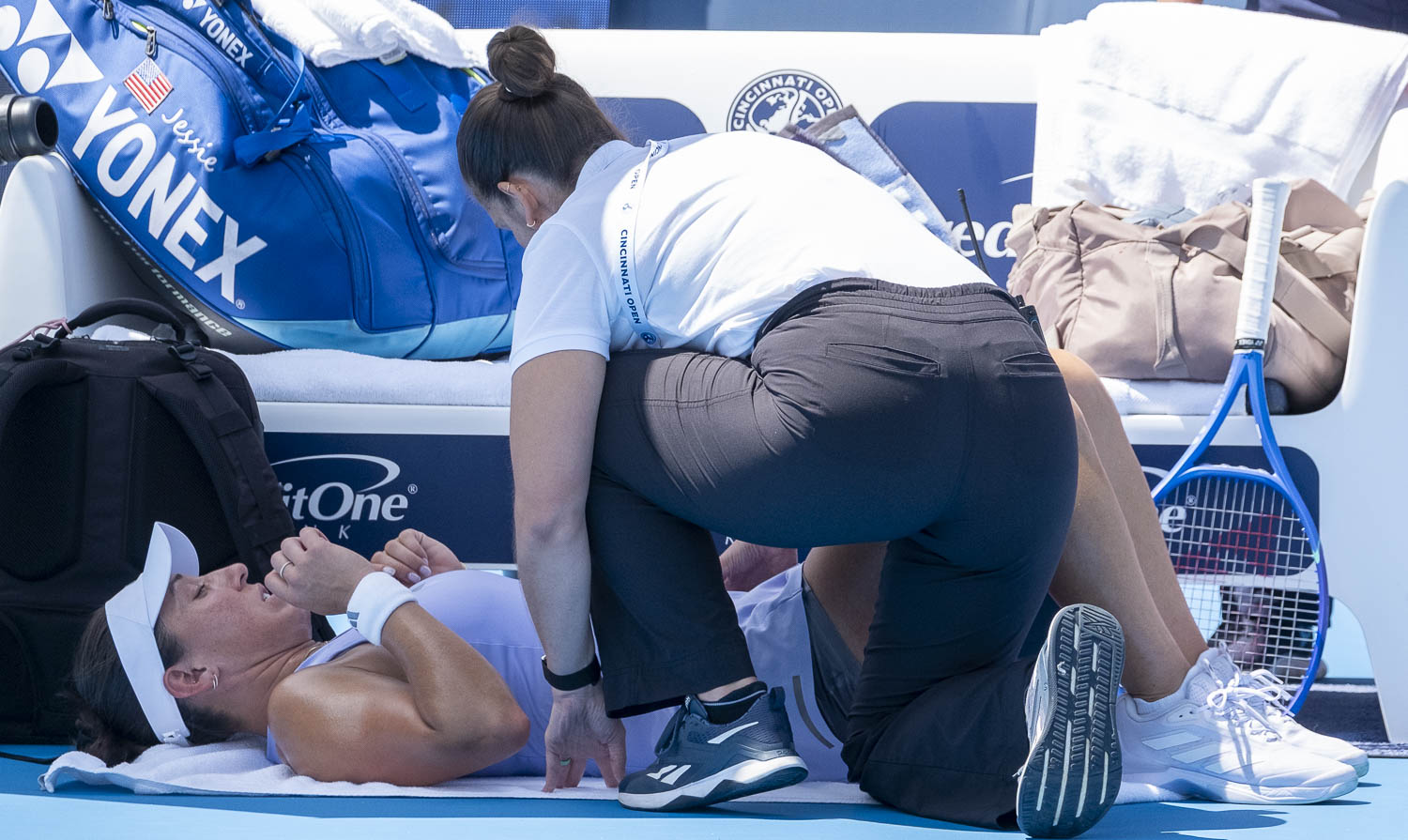
A medical timeout is a formal stoppage of play granted so that an injured or ill player can receive treatment on court. It is one of the most misread moments in tennis. Viewers see a physiotherapist walk on and assume the player has bought themselves a rest, when in practice the rules are narrow, the clock is short, and the decision belongs to medical staff rather than to the player asking.
Most of the confusion comes from a single distinction the broadcast rarely explains: whether a condition is treatable at all, and if so, whether it is treatable now or only at the next changeover.
Treatable and non-treatable conditions
Under the rules governing the four majors, a medical condition means an illness or a musculoskeletal injury that warrants evaluation or treatment during the warm-up or the match. Treatable conditions split into two categories.
An acute condition is one that develops suddenly during play and needs immediate attention. A non-acute condition is one that develops or worsens during the match but can wait for a changeover or a set break.
Non-treatable conditions get nothing. That category covers anything that cannot be meaningfully improved by the treatment available in the time allowed, anything that did not develop or worsen during the warm-up or match, and general player fatigue. It also covers any condition requiring injections or intravenous infusion, with a narrow exception for diabetic players who have obtained prior medical certification and may receive subcutaneous insulin. Supplemental oxygen is not permitted at any point.
The practical effect is that a player who arrives on court already carrying an injury cannot stop the match to have it treated. The condition has to arise or deteriorate during play.
How a player asks for treatment
A player requests evaluation through the chair umpire, and the physiotherapist attends at the next changeover or set break. Immediate evaluation is available only when the player has developed an acute condition that genuinely requires play to stop.
The evaluation itself is a diagnostic step, not a treatment. Its purpose is to establish whether a treatable condition exists and when treatment is warranted. If the physiotherapist concludes the condition is non-treatable, the player is told no treatment will be allowed and play resumes.
Who authorizes the timeout
The medical timeout is granted by the referee, in consultation with the supervisor or the chair umpire, once the physiotherapist has determined that additional treatment time is required. The player does not decide, and neither does the umpire alone. Treatment may take place off court at the physiotherapist’s discretion and may involve the tournament doctor.
Three minutes, and how many are allowed
The timeout is limited to three minutes of treatment, and the clock starts when the physiotherapist is ready to begin, not when the player first raises a hand. It is taken at a changeover or set break unless the condition is acute enough to require an immediate stop.
A player gets one medical timeout per distinct treatable condition. Two rules prevent that from being gamed. All clinical manifestations of heat illness count as a single condition, so a player cannot claim separate timeouts for dizziness, nausea and cramping arising from the same underlying problem. Similarly, all musculoskeletal injuries that form part of one kinetic chain count as a single condition, so a hip, a hamstring and a calf connected by the same mechanism are treated as one.
Two consecutive timeouts are permitted in one narrow circumstance: when the physiotherapist determines during a single evaluation that the player has developed at least two distinct acute treatable conditions, such as an illness alongside a musculoskeletal injury.
Separately from any timeout, a player may receive treatment and supplies at any changeover or set break. As a guideline this is limited to two changeovers or set breaks per treatable condition, before or after a medical timeout, and they need not be consecutive.
Why cramping is handled differently
This is the rule that generates the most argument, and it is unambiguous. A player may receive treatment for muscle cramping only during the time allotted for a change of ends or a set break. No medical timeout is available for cramping. The reasoning is that cramping is treated as a conditioning and hydration matter rather than an injury and allowing a stoppage for it would hand a struggling player rest at the exact moment the opponent has earned an advantage.
The rules go further to close the obvious loophole. A player who stops play claiming an acute condition, but who is then found by the physiotherapist to be cramping, is ordered by the chair umpire to resume play immediately. If the cramping is severe enough that the player cannot continue, the only route to treatment is to forfeit whatever points or games are needed to reach a change of ends.
A maximum of two full change-of-ends cramping treatments are allowed in a match, and they need not be consecutive. Where officials determine gamesmanship was involved, a code violation for unsportsmanlike conduct can follow.
The heat illness exception
There is one route by which cramping does get treated inside a timeout. If the physiotherapist believes the player is suffering heat illness, and cramping is one of the manifestations of it, the cramping may be treated as part of the recommended treatment for the heat illness. In any case of doubt about which category applies, the physiotherapist’s decision, with the tournament doctor where appropriate, is final. Heat illness is also governed by separate tour and tournament heat policies covering cooling breaks and suspension thresholds.
Bleeding and vomiting
Both are handled outside the standard timeout structure. If a player is bleeding, the chair umpire must stop play as soon as possible and call the physiotherapist for evaluation and treatment. Up to five minutes total may be allowed to bring the bleeding under control, and play cannot resume until any blood spilled on court has been cleaned.
Vomiting triggers a stoppage in two situations: when it has spilled onto the court, or when the player requests medical evaluation. If evaluation is requested, the physiotherapist determines whether a treatable condition exists and whether it is acute or non-acute. As with blood, play does not resume until the court is cleaned.
When a player can be ruled unable to continue
If an emergency arises and the player is physically unable to request help, the chair umpire calls the physiotherapist and tournament doctor without waiting to be asked. Medical staff can also recommend that a player be ruled unable to compete, either before a match or in the middle of one. That recommendation goes to the referee, who is expected to use considerable discretion before acting on it.
A player ruled out of one match may still compete in another event at the same tournament if the tournament doctor determines the condition has improved enough for safe play. A match that ends this way is recorded differently from one a player simply does not start, a distinction covered in our guide to walkovers, retirements and defaults.
Penalties
Once a timeout or treatment is complete, any further delay in resuming play is penalised with code violations for delay of game under the point penalty schedule. Abuse of the medical rule itself is penalised as unsportsmanlike conduct.
Rulebook edition
The provisions described above are drawn from the 2026 Official Grand Slam Rule Book, which governs the four Grand Slam tournaments. The physical demands those rules respond to are heaviest in men’s singles at the majors, the only competition still played over best of five sets.
The ATP and WTA maintain their own rulebooks for tour-level events, and while the structure is broadly comparable, the specific limits and exceptions at a Masters 1000 or a WTA 1000 are set by that tour rather than by the Grand Slam rulebook. Rulebooks are revised annually.
Frequently asked questions
How long is a medical timeout in tennis?
Three minutes of treatment. The clock begins when the physiotherapist is ready to start, not when the player requests help.
Can a player take a medical timeout for cramp?
No. Cramping may only be treated during a change of ends or a set break, with a maximum of two such treatments in a match. The exception is when cramping is a manifestation of diagnosed heat illness.
How many medical timeouts can a player take in one match?
One per distinct treatable condition. Two consecutive timeouts are permitted only when a single evaluation identifies at least two distinct acute treatable conditions.
Can a player be treated for an injury they arrived with?
Not through a medical timeout. A condition that did not develop or worsen during the warm-up or match is classed as non-treatable.
Who decides whether a medical timeout is granted?
The physiotherapist evaluates and determines whether treatment time is needed. The referee then authorises the timeout in consultation with the supervisor or chair umpire. The player has no say in the determination.
What happens if a player refuses to resume play?
Delay after treatment is complete draws code violations for delay of game, escalating under the point penalty schedule.