

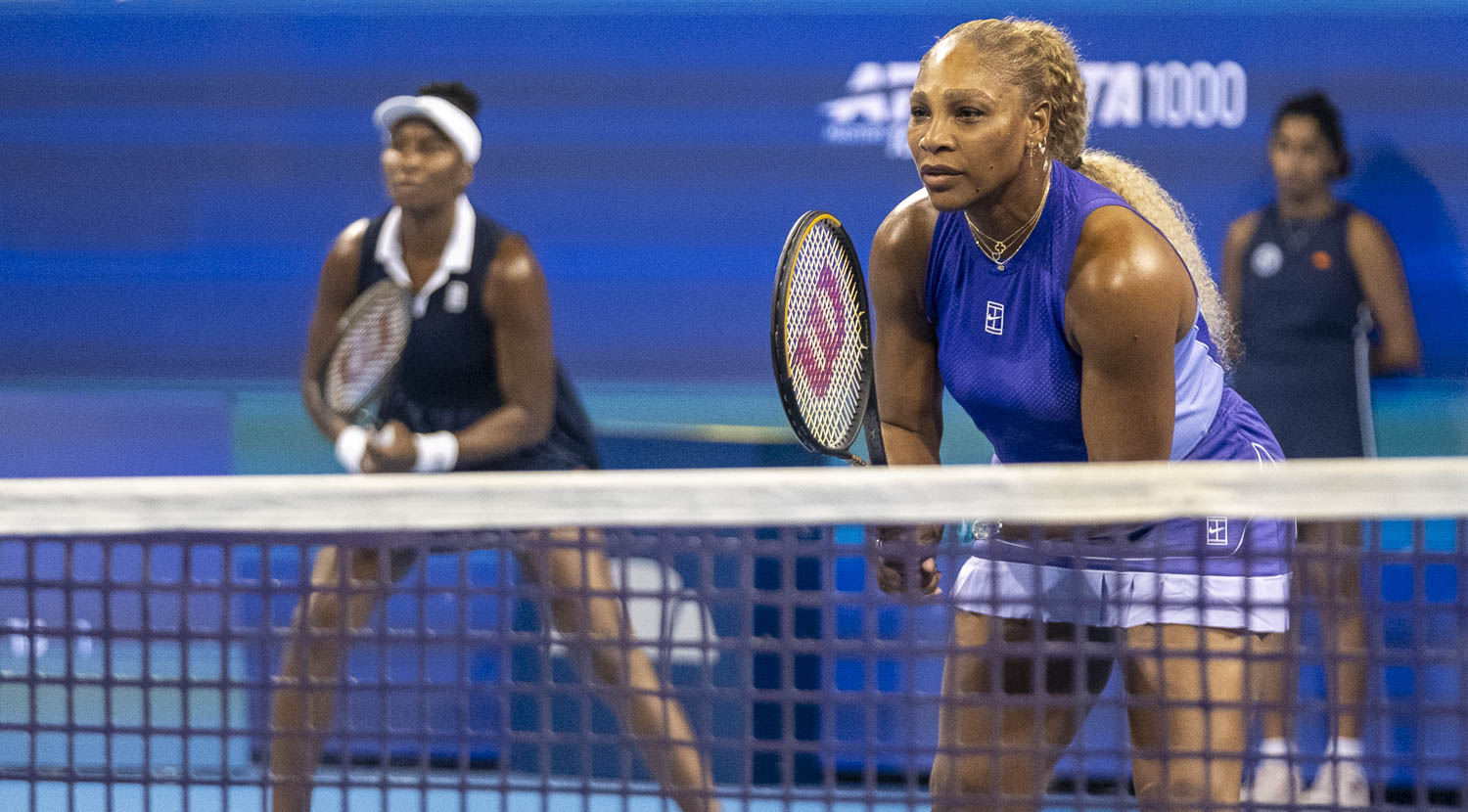
Doubles keeps the scoreboard of singles and changes almost everything else. Same points, same games, same sets — but a court that is nine feet wider, a serve that has to get past a player standing eight feet from the net, and, at most events, a scoring system that hands whole games to a single point.
The court gets wider, the service boxes do not
A doubles court is 36 feet wide against 27 feet for singles. The extra strips down each side are the doubles alleys, and they are live for every shot in the rally.
They are not live on the serve. The service boxes are identical in singles and doubles, which is why the serve is a narrower proposition in doubles than the wider court suggests, and why so much of the tactical work happens on the second and third shot rather than the first.
Who serves, who receives, and when it can change
Teams alternate service games as in singles, and within each team the two players alternate their own service games. So the order across four games is: Team A player one, Team B player one, Team A player two, Team B player two. A team may reorder its servers at the start of each new set, but not inside one.
Receiving is more rigid. For the whole of a set, one player takes every point in the deuce court and the partner takes every point in the ad court. That order can only be changed at the start of the next set. It is why a team with one clearly stronger returner cannot simply move them to whichever side the pressure is falling on.
No-ad scoring and the deciding point
ATP and WTA tour-level doubles uses no-ad scoring throughout. At 40–40 there is no advantage: one point settles the game.
The receiving team chooses which service box that point is played into, which is the one moment in a set when they can put their preferred returner in front of the ball. Mixed doubles removes the choice. Under Appendix V of the ITF Rules of Tennis, the deciding point in mixed is played between players of the same sex, so the server’s opposite number receives it whether the team wants that or not.
The practical effect of no-ad is that a doubles service game can be lost from 40–40 without a single conventional break point being played. Deuce games that would run six or eight points in singles end immediately.
The match tiebreak
At ATP and WTA events, doubles matches are best-of-three with the third set replaced by a 10-point match tiebreak. First team to 10, win by two, service rotation continuing in the same order as the set that preceded it.
This is a different animal from the standard seven-point tiebreak played at 6–6 in a normal set. The match tiebreak replaces an entire set of tennis, so a team can be broken once in a first set, hold everything in the second, and still lose the match inside ten minutes.
The Grand Slams play by different rules
Doubles at the majors is the traditional version. Games are played to advantage rather than a deciding point, and a match tied at one set all is settled by a full third set, with a 10-point tiebreak only if that set reaches 6–6.
The formats are otherwise now aligned. Wimbledon was the last major to stage men’s doubles over five sets and moved to best-of-three from 2023, bringing it into line with the Australian Open, Roland Garros and the US Open. All four majors run 64-team men’s and women’s doubles draws, one round more than the 32-team fields at Masters 1000 and WTA 1000 level, on top of the longer third set and the advantage scoring.
Where the four players stand
The default is one player at the baseline and one at the net. The server’s partner starts inside the service box on the opposite half, hunting the return. The receiver’s partner usually stands closer to the service line, ready to move forward if the return lands well.
- Both back. Used against a team that is poaching effectively, or on a slow surface where the net is harder to hold.
- Australian formation. The net player stands on the same side of the centre line as the server, forcing the return crosscourt into the middle rather than into the alley.
- I-formation. The net player crouches on the centre service line before the serve, then breaks left or right. The returner does not know which side will be covered until the ball is struck.
All three exist for the same reason: to take away the crosscourt return, which is the safest shot in doubles and the one that keeps the receiving team in the point.
Ranking points and specialists
Doubles carries its own ATP and WTA rankings, separate from singles and earned on the same 52-week rolling basis. That separate ladder is what sustains a specialist tier — players such as Katerina Siniakova and Taylor Townsend — whose majors come almost entirely from the doubles draw.
Mixed doubles is the exception. It carries no ATP or WTA ranking points at the majors, which is part of why its entry criteria have been the easiest for tournaments to rewrite.
Season snapshot
Updated 6 September 2026. Formats change; the rules above are the stable part.
- Grand Slam men’s and women’s doubles: best-of-three, advantage scoring, 64-team draws, 10-point tiebreak only at 6–6 in the deciding set
- ATP and WTA tour doubles: best-of-three, no-ad throughout, 10-point match tiebreak in place of a third set
- Wimbledon men’s doubles moved from best-of-five to best-of-three in 2023
- The US Open mixed doubles championship now runs during Fan Week as a 16-team event: sets to four games, no-ad, a tiebreak at 4–4 and a match tiebreak instead of a third set, with the final played to six-game sets. Six teams enter on combined singles ranking, eight take wild cards and two come through qualifying. The 2026 winners took $1 million
More on the mixed doubles overhaul and who it locks out in our report from the 2026 event, and the underlying scoring in how tennis scoring works.