

Understanding how tennis scoring works is the first hurdle for anyone new to the sport. Tennis is one of the most-watched games on the planet — four Grand Slam events, an Olympic discipline, and a global professional circuit that runs nearly year-round. Yet to a first-time viewer, the scoreboard can look like a foreign language. Why does a score jump from 30 to 40? What does “deuce” mean? How many sets does it take to win? This guide answers all of it.
The trick is to see a match as built in layers. Players compete for points, points accumulate into games, games into sets, and winning enough sets wins the match. Each layer has its own rules — and together they create one of the most psychologically layered competitions in sport.
How Tennis Scoring Works — The Match Structure
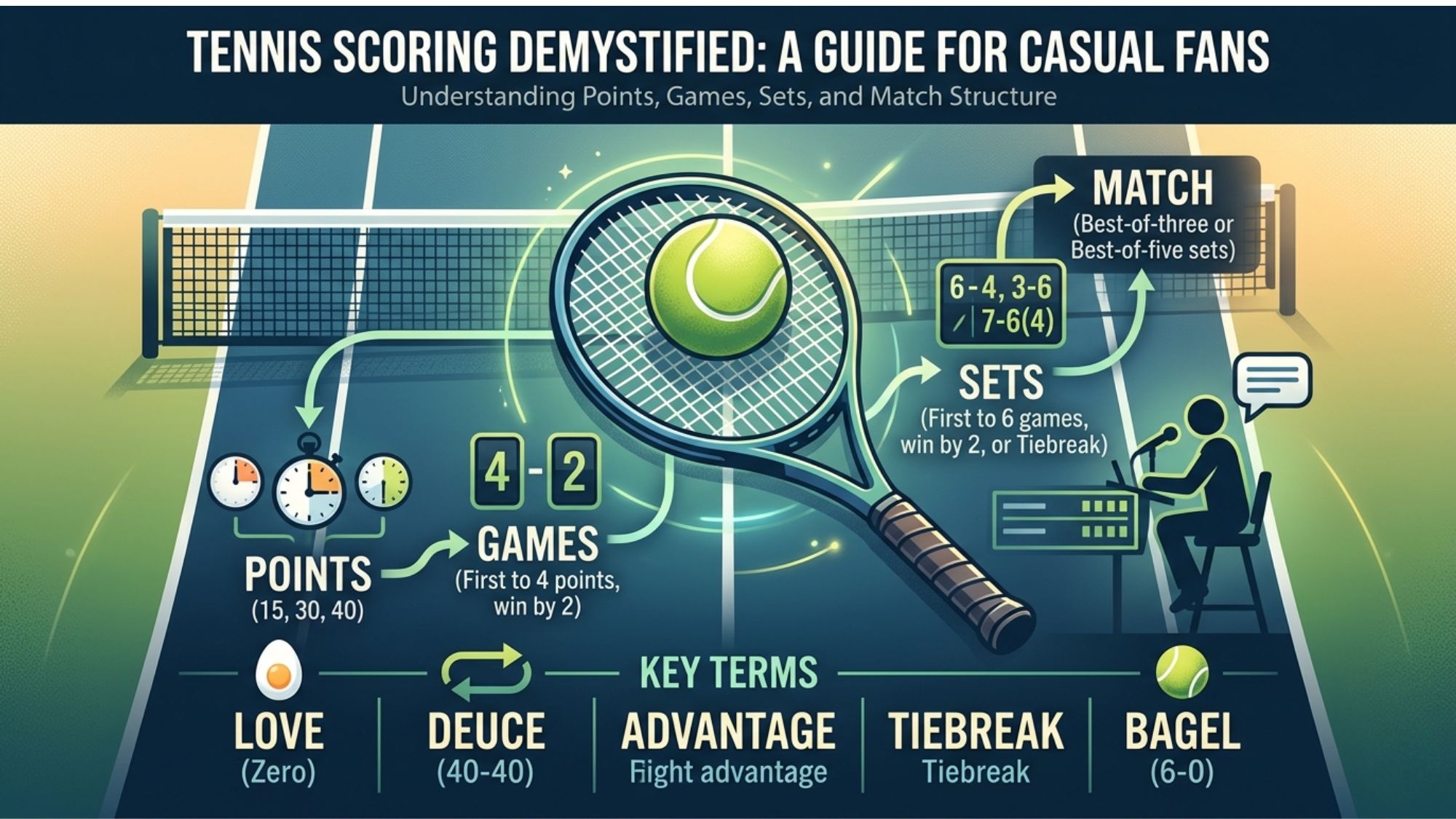
Before diving into the details, picture the structure from the ground up: points build games, games build sets, sets decide the match. Think of it like nesting containers — the smallest unit (a point) fills into a game, games fill a set, and sets determine who wins the day.
To win a match, a player must win a majority of sets — typically best-of-three (first to win 2 sets) in most professional and recreational formats, or best-of-five (first to win 3 sets) in men’s Grand Slam events. Each layer has its own win condition, and that’s where things get interesting.
Points: The Strangest Numbering in Sports
Points are the smallest unit of tennis scoring, and they use a counting system unlike anything else in major sports. Rather than incrementing by one, points within a single game are called 15, 30, 40, and then “Game.” The origin is debated — one popular theory traces it to medieval France, where clock faces tracked score, with each point advancing the hand a quarter turn (15, 30, 45 — later simplified to 40). Whatever the history, the rule is simple: win four points and you win the game, provided you lead by at least two.
Zero points is called “love” — most likely derived from the French word l’œuf (the egg), because a zero resembles one.
The full point sequence within a game:
- 0 points = Love
- 1 point won = 15
- 2 points won = 30
- 3 points won = 40
- 4 points won = Game (if leading by 2+)
Deuce: When It Gets Tight
If both players reach 40-40 — three points each — the score is called “deuce.” From deuce, a player must win two consecutive points to claim the game. The first point after deuce gives that player “advantage” (often called “ad”). Win the very next point and you win the game. Lose it and the score reverts to deuce — and the process repeats indefinitely until someone wins two in a row.
This is why a single game can stretch several minutes during tense moments. Deuce can cycle back and forth, creating dramatic momentum swings — and it’s one of the elements that makes tennis so psychologically gripping.
Games: The Building Blocks of a Set
A game is the unit won by reaching “Game” in the point sequence above. Each time a player wins a game, their game count increases by one within the current set. The chair umpire announces the updated game score after every game — for example: “Game, Williams — leads four games to two, second set.”
The game count resets to 0–0 at the start of each new set. Games are the currency you spend to win sets.
Sets: Where Matches Are Decided
A set is a collection of games, and winning sets is what wins matches. To win a set, a player must win at least 6 games — with a margin of at least 2 games over their opponent. Here’s how it plays out:
| Set Score | Result | What Happens |
|---|---|---|
| 6–0, 6–1, 6–2, 6–3, 6–4 | Clear win | Set is over |
| 6–5 | Play continues | One more game; 7–5 wins the set |
| 6–6 | Tiebreak triggered | A special tiebreak game decides the set |
A dominant performance might produce a 6–0 scoreline — called a “bagel” in tennis slang. A tightly contested set may go all the way to a tiebreak at 6–6. Both outcomes follow the same structure; the score just depends on how evenly the players are matched.
The Tiebreak
When a set reaches 6–6, a tiebreak is played to decide it. Unlike standard games, the tiebreak uses regular counting (1, 2, 3…) rather than the 15/30/40 system. The first player to reach 7 points with a 2-point lead wins the tiebreak and the set (recorded as 7–6).
Players alternate serving every two points throughout the tiebreak, except for the very first point — served by the player whose turn it is to serve. The number in parentheses you sometimes see beside a set score — for example, 7–6 (4) — indicates the losing player’s tiebreak score.
In some tournament formats, particularly Grand Slam final sets, no tiebreak is played. The set continues until one player leads by two games, however long that takes — which is how legendary matches like the 2010 Wimbledon first-round between John Isner and Nicolas Mahut reached a final set score of 70–68.
A variation called the match tiebreak (or “super tiebreak”) is used as a final-set decider in doubles formats — first to 10 points, win by 2.
Serving and the Break of Serve
One more piece of the puzzle: service alternates between players after every game. The player serving holds a significant built-in advantage — the serve initiates play, and a powerful serve can win points outright (called an ace). Because serve alternates, both players receive equal opportunities throughout a set.
When you win the game while serving, you’ve “held” your serve — the expected outcome. When you win a game while your opponent is serving, you’ve “broken” their serve. Breaking serve is often the decisive moment that shifts a set, and the point when a break is most likely — a break point — generates some of the most intense rallies in professional tennis.
Reading a Live Scoreboard
With all of this in mind, a live scoreboard becomes easy to decode. Take this example:
Djokovic leads 6–4, 3–2
That means Djokovic has won the first set 6 games to 4 and currently leads the second set 3 games to 2. The match continues — he needs to win the second set and possibly a third to claim victory.
If the final score reads 6–4, 7–6 (3), Djokovic won two sets straight: the first 6–4, the second via tiebreak 7–3.
Key Terms at a Glance
- Love — Zero. A score of 6–0 in a set is called a “bagel.”
- Deuce — 40–40. Both players must then win two consecutive points to take the game.
- Advantage (Ad) — The first point won after deuce. “Ad-in” favors the server; “Ad-out” favors the returner.
- Hold — Winning a game while you are the server.
- Break — Winning a game while your opponent is the server.
- Tiebreak — A mini-game played at 6–6; first to 7 points with a 2-point lead wins the set.
- Bagel — Slang for a 6–0 set score.
- Ace — A serve the returner cannot reach, winning the point outright.
Why This Scoring System Makes Tennis Unique
The layered structure of tennis scoring creates a sport where momentum is real but fragile. You can win more total points than your opponent and still lose the match. You can win more games and still fall short. The system rewards consistency, mental toughness, and the ability to perform under pressure at precisely the right moments.
That fragility is also what makes tennis comebacks so dramatic. Saving match points at deuce, clawing back from 0–5 in a set, winning a tiebreak 7–0 — these swings happen because the scoring system creates dozens of mini-crises and mini-triumphs inside a single match.
Now that you understand how sets and games work, you’re equipped to follow any professional match in the world. You’ll know when a game score matters, when a tiebreak is approaching, and when one player is pulling decisively away. Welcome to tennis — it’s a sport best enjoyed when you know exactly what you’re watching.
Part of the Tennis 101 series. Next: How Serving Works — the most important shot in the game, explained.