

For most of tennis history, a tied set had only one resolution: keep playing. Win by two games, however long that takes. In 1969, that produced a first-round Wimbledon match that lasted 112 games in the final set alone. In 2010, John Isner and Nicolas Mahut played a fifth set that reached 70–68 — a single set that took more than eight hours across two days. These were extraordinary spectacles. They were also unsustainable.
The tiebreak exists to solve that problem. It is tennis’s most elegant compromise: a compressed, high-stakes points race that decides a deadlocked set quickly, fairly, and under maximum pressure. Once you understand how it works — and why it’s designed the way it is — you’ll never look at a 6–6 scoreline the same way again.
What a Tiebreak Is and Why It Exists
A tiebreak is triggered when a set reaches 6–6. Rather than continuing to play full games until one player leads by two — which could theoretically never happen — players switch to a direct points race with its own serving rotation, its own target score, and its own win condition.
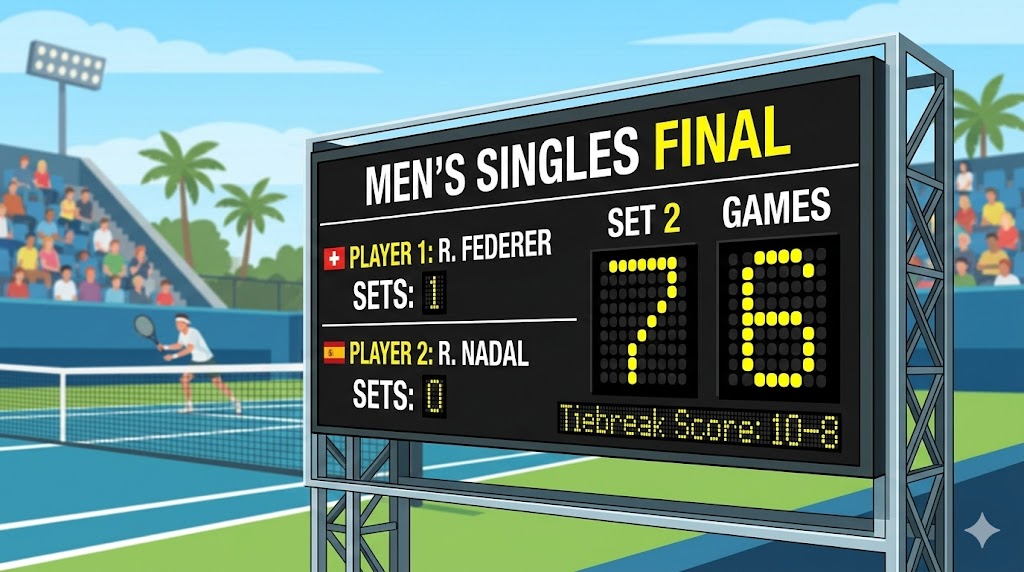
The tiebreak doesn’t replace the set. It decides it. The player who wins the tiebreak wins the set, and the set score is recorded as 7–6. The number in parentheses you often see beside that score — for example, 7–6 (4) — indicates the losing player’s point total in the tiebreak. A score of 7–6 (4) means the tiebreak ended 7–4.
Tiebreaks come in more than one format depending on the level of play and the specific event. The two you’ll encounter most often are the 7-point set tiebreak and the 10-point match tiebreak. They share the same underlying logic but differ in target score and where they appear in a match.
The Standard 7-Point Tiebreak
This is the classic tiebreak — the one used when a set reaches 6–6 in the vast majority of professional and recreational matches.
The rules are straightforward: first to 7 points wins, but must win by at least 2. That two-point margin requirement means the tiebreak doesn’t necessarily end at 7. If the score reaches 6–6 within the tiebreak itself, play continues until one player opens a two-point lead. Scores like 7–5, 8–6, 10–8, and even higher are entirely normal in tight tiebreaks. The winner of the tiebreak wins the set 7–6.
The two-point margin rule is not accidental — it’s the same principle that governs deuce in regular games. A single point shouldn’t decide a closely contested set any more than it should decide a closely contested game. At 6–6 in a tiebreak, both players have earned their way to that position, and the margin requirement ensures the winner demonstrates at least a small, sustained edge to close it out.
Serving in the Tiebreak: The Part That Confuses Everyone
The serving rotation inside a tiebreak is the single most confusing element of tennis scoring for new fans — and understandably so. It doesn’t follow the simple alternating pattern of regular games. Here’s exactly how it works.
The player whose turn it is to serve — based on the normal alternating game rotation — serves the first point only. After that first point, service passes to their opponent, who serves two consecutive points. From there, players alternate serving two points each for the remainder of the tiebreak.
Written out, the serving sequence looks like this:
Player A serves point 1. Player B serves points 2 and 3. Player A serves points 4 and 5. Player B serves points 6 and 7. And so on, in blocks of two, until the tiebreak ends.
The reason for this structure is balance. If one player served the entire tiebreak, or served significantly more points than their opponent, the serving advantage — which is substantial in tennis — would distort the outcome. The alternating two-point blocks ensure both players serve roughly the same number of points, with the one-point opening serve the only asymmetry. Over the length of a full tiebreak, that single extra point evens out statistically.
Changing Ends During the Tiebreak
Players also change ends — switching sides of the court — after every six points played in the tiebreak. So after points 1 through 6, they cross. After points 7 through 12, they cross again. And so on. This rotation accounts for any environmental factors — sun position, wind direction, crowd noise from a particular end — that might give one player an unfair advantage if they stayed on the same side throughout.
If you’ve ever watched a tiebreak and been puzzled by players constantly crossing to the other side between points, this is why. It’s a fairness mechanism, not a procedural formality.
The 10-Point Match Tiebreak
The match tiebreak — also called a super tiebreak — operates on the same principles as the 7-point tiebreak but with a higher target score and a different role in the match structure.
Instead of deciding a set at 6–6, the match tiebreak replaces an entire final set. Rather than playing a full third set (or fifth set in Grand Slam men’s events), teams or players compete in a single extended tiebreak: first to 10 points, with a two-point margin required to win. The serving rotation follows the same pattern as the standard tiebreak — one point, then alternating blocks of two.
A match tiebreak appears in a scoreline as the third number — for example: 6–4, 3–6, 10–7. That 10–7 is the match tiebreak result. It counts as the deciding set for all purposes, including the official match record.
Match tiebreaks are most commonly used in doubles formats on the professional tour, in mixed doubles at major events, and in some lower-tier singles events where compressed scheduling makes full three-set matches impractical. The format rewards the same qualities as a standard tiebreak — clean serving, disciplined returning, and mental composure — but over a longer points race that allows for slightly more variance and momentum shifts.
Final-Set Tiebreak Rules: A Sport in Transition
The final set has historically been the most contentious battleground for tiebreak policy, and the rules have changed significantly in recent decades.
For most of tennis history, the final set — the deciding third or fifth set — was played with no tiebreak at all. Players had to win by two games, full stop. This produced some of the most dramatic matches in the sport’s history, including the Isner-Mahut match mentioned earlier. It also produced matches that were physically brutal, logistically difficult for tournament scheduling, and occasionally unfair — a player could sustain an injury late in a long final set and have no realistic path to recovery before the match ended.
The sport has moved decisively away from that model. Most top-level events now use a tiebreak to decide the final set if it reaches 6–6, though the format of that tiebreak varies.
At the four Grand Slams — the Australian Open, Roland Garros, Wimbledon, and the US Open — the current standard is a 10-point match tiebreak played at 6–6 in the final set. This format was adopted progressively across the Slams through the early 2020s and represents the modern consensus at the sport’s highest level.
If you’re explaining tiebreak rules in an evergreen context, this is the safe and accurate baseline: most major events now decide the final set with a tiebreak at 6–6, with the 10-point format the current Grand Slam standard.
Tiebreak Strategy: What Separates Winners at 6–6
A tiebreak is not just a random points scramble. It rewards specific skills, and players who understand those skills — and have practiced specifically for tiebreak situations — win a disproportionate share of them.
First-serve reliability is critical. In a standard game, a double fault costs you a point but rarely ends the game outright. In a tiebreak where every point is precious, a double fault at 5–6 can be match-defining. The best tiebreak servers combine aggression on first serves with absolute reliability on second serves — they never hand points away.
Return quality on second serves becomes decisive. Because both players are serving under heightened pressure in a tiebreak, second-serve percentages often dip slightly. A returner who can consistently punish a tentative second serve — stepping in, taking the ball early, attacking the open court — can seize control quickly. In regular games, one break of serve is significant. In a tiebreak, a mini-break — winning a point while your opponent serves — is the equivalent, and the best returners hunt for them relentlessly.
Mental discipline under pressure separates tiebreak players. The compressed, high-stakes nature of a tiebreak means there is almost no margin for the kind of mental drift that a long set can occasionally absorb. Unforced errors — shots you miss without your opponent forcing you into a difficult position — are extraordinarily costly.
One unforced error at 5–6 in a tiebreak is the difference between serving for the set and facing set point. The players who win tiebreaks consistently are almost always the ones who keep unforced errors to zero in the critical stretches.
Momentum shifts quickly and must be managed. Because points alternate in two-point serving blocks, momentum can swing from one player to the other very rapidly. Losing both points on your serve puts you immediately in a difficult position.
The best tiebreak players treat each two-point serving block as a complete, self-contained unit — win both, stay neutral, move on. Allowing a bad point to infect the next one is the most common tiebreak mistake at every level of play.
Common Tiebreak Questions
Does a tiebreak always happen at 6–6? In most sets at most levels, yes. The exception is certain final-set formats at specific tournaments, though these have become increasingly rare as the sport has standardized around the 6–6 tiebreak model.
Can a tiebreak end 7–0? Yes. If one player wins seven consecutive points from the start, the tiebreak ends 7–0. It’s rare but not unheard of, particularly when one player is serving at a very high level and the other is struggling with their return.
Why do players change ends so often during a tiebreak? To neutralize environmental advantages — sun angle, wind, crowd positioning — that could unfairly favor one player if they stayed on the same side throughout. Ends change every six points.
Is a tiebreak a separate set? No. It is the final game of the set, played under different rules. The set score becomes 7–6 regardless of the tiebreak’s internal score.
What does the number in parentheses mean? The parenthetical number after a 7–6 set score shows the losing player’s point total in the tiebreak. A score of 7–6 (3) means the tiebreak ended 7–3.
Do both players serve the same number of points? Very nearly. The serving rotation — one point, then alternating blocks of two — means the player who serves first serves one more point than their opponent if the tiebreak ends on an odd total. Over a full tiebreak, this slight asymmetry is considered statistically negligible.
Key Terms at a Glance
- Tiebreak — A points race played at 6–6 to decide a set, avoiding indefinite game play.
- Set tiebreak — The standard 7-point tiebreak; first to 7 points with a 2-point margin wins the set 7–6.
- Match tiebreak (super tiebreak) — A 10-point tiebreak used to replace a final set; first to 10 points with a 2-point margin.
- Mini-break — Winning a point in a tiebreak while your opponent is serving; the tiebreak equivalent of a break of serve.
- Parenthetical score — The number in brackets beside a 7–6 set score indicating the loser’s tiebreak point total.
- End change — Switching sides of the court, which happens every six points during a tiebreak.
- Two-point margin — The requirement that a tiebreak winner leads by at least two points; same principle as deuce in regular games.
The Tiebreak as Tennis at Its Most Concentrated
Everything that makes tennis compelling — the serving duel, the mental pressure, the momentum swings, the win-by-two requirement — is compressed into the tiebreak. A full set might last forty-five minutes. A tiebreak can last seven minutes or forty, depending on how it unfolds. But in that span, you often see more pure competitive intensity than in any equivalent stretch of regular-game play.
The tiebreak is not a concession to convenience, even though it was born partly from necessity. It is a genuinely superior format for deciding a deadlocked set — more dramatic than an extended game-by-game grind, more fair than a single deciding point, and more revealing of competitive character than almost any other format in sport.
When a set reaches 6–6 and the tiebreak begins, you’re watching tennis stripped to its essentials. No more room to ride out a bad game and regroup in the next one. Every point is a small crisis or a small triumph. That’s the tiebreak. And now you know exactly what you’re watching.
Part of the Tennis 101 series. Previous: Scoring from Deuce — Why “Win by Two” Changes Everything. Next: Reading the Court — Understanding Tennis Court Surfaces and Why They Matter.