

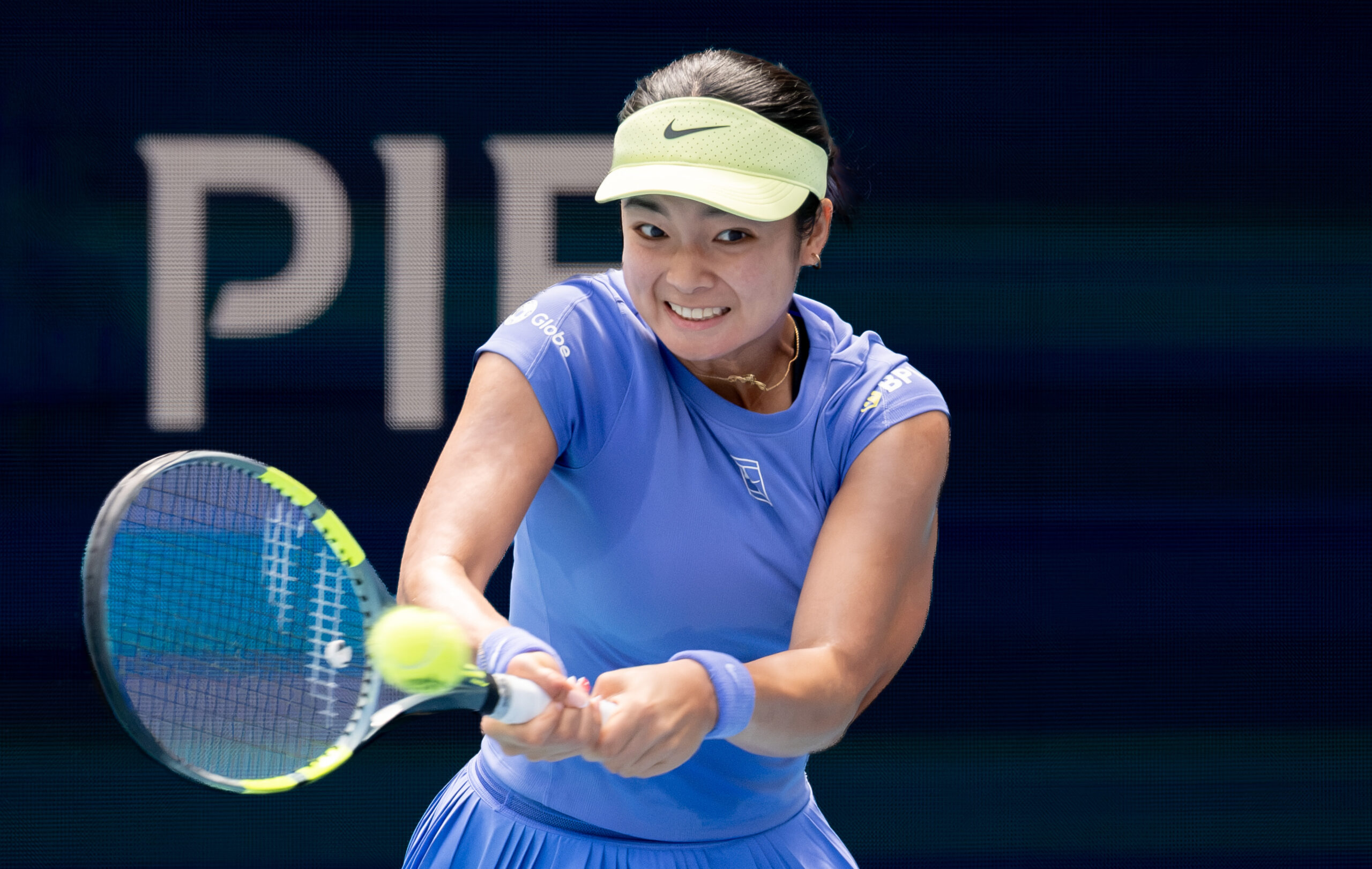
Alexandra Eala will spend next week at the Asian Games in Nagoya rather than at the China Open in Beijing. Under the WTA’s rules, a player of her ranking who misses a WTA 1000 without an exemption takes a zero-point result that must count on her ranking, and she can be fined on top of it. The rule applies to every eligible adult player on the tour, not just her, and it will come up again the next time a national multi-sport Games lands on the tennis calendar.
What makes an event mandatory. The WTA rulebook calls them Commitment Tournaments. All WTA 1000 events are designated WTA 1000 Mandatory, and any player who is accepted into the main draw, or would have been accepted had she entered, must play. She does not have to opt in: a player whose ranking qualifies her for a WTA 1000 main draw is entered automatically. WTA 500 events carry a separate commitment of up to six a year, depending on how many a player is accepted into, and a WTA 500 is not a commitment for anyone ranked 51 or lower at its entry deadline.
Who is exempt. The commitment is subject to four sets of rules: age eligibility, years of service, long-term injury and the integrity rules. Players under 17 are not required to play WTA 1000 events, and 17-year-olds must play a maximum of four. Players aged 34 or older at the start of a year escape zero-pointers for missed WTA 500 events, but not for WTA 1000s: the rulebook says a Years of Service player must still play every WTA 1000 she is accepted into. Players serving integrity suspensions remain subject to the commitments and the zero-point results. Once a player is 18, a missed WTA 1000 commitment produces a zero.
How the zero-pointer works. A WTA singles ranking is built from a maximum of 18 results: the four Grand Slams, the best six of the seven combined WTA 1000s (Indian Wells, Miami, Madrid, Rome, Toronto/Montreal, Cincinnati and Beijing), the best one of the three non-combined WTA 1000s (Doha, Dubai and Wuhan), and the next best seven results from everything else. A zero from a missed mandatory event counts inside its own group.
A zero from Beijing therefore takes one of the six combined WTA 1000 places, and the WTA’s Race rules say the same penalty is applied to Race to the WTA Finals points by removing the player’s lowest-scoring result in that group. In practice, the player loses the cushion that lets her drop her worst combined WTA 1000 week. Our WTA rankings explainer and Race to the WTA Finals explainer cover the full structure.
The fines. A player automatically entered into a WTA 1000 who withdraws receives the zero and is subject to the Late Withdrawal fines, the rulebook says. A singles withdrawal counts as late once the player has been accepted into the main draw. For a WTA 1000, the fine is set by her ranking at the entry deadline: $20,000 for the top 10, $10,000 for players ranked 11 to 25, $5,000 for 26 to 50 and $2,500 below that. Fines double with each further offence in the same category.
A player can use up to three Excused Withdrawals a year to avoid the fine if she withdraws before her first match, but an Excused Withdrawal does not remove the zero. In an extreme personal emergency, a player can appeal a fine to the Code of Conduct Committee.
Playing somewhere else that week. The rulebook also covers a player who withdraws from a WTA event and plays an Exhibition/Non-WTA Event in the same week. A player ranked in the top 50 who does so faces the Late Withdrawal fine plus a separate fine under the Exhibition/Non-WTA Event Rule.
Elsewhere in its withdrawal rules, the rulebook lists Olympic and Olympic Qualification events as a category of their own, alongside Grand Slams, ITF events and exhibitions. The Asian Games singles events are part of the ITF’s qualification pathway for Los Angeles 2028. How the WTA applies its rules to a Games of that kind is the WTA’s decision, and the rule text GTN reviewed does not name the Asian Games.
The Eala case. The Philippine Tennis Association has formally asked the WTA to exempt Eala from the China Open, Reuters reported on 16 September. “We have formally requested an exemption and we respect the WTA’s process,” PHILTA secretary general John Rey Tiangco said. “At the same time, Alex has made her decision to represent the Philippines at the Asian Games, and we fully support her.” The WTA’s own China Open preview lists Eala among the players not competing in Beijing, citing a schedule change. GTN has not found a published WTA decision on the exemption request.
Eala has been clear about why she is going. “I love playing and competing with the Philippines team; I think it’s a really fun environment,” she told Olympics.com at the US Open. “I love being with the team.” How much a zero would cost her in practice depends on details that have not been made public, including when her withdrawal was lodged relative to the entry deadline and where she was ranked on that date. Those facts decide whether a Late Withdrawal fine applies and at what level.
Why this will happen again. The ITF gives the singles champions of the Asian, Pan-American, African and Pacific Games places at the Los Angeles 2028 Olympics, provided they are ranked inside the top 500 and their nation’s quota is not already full. The first of those places are decided at Nagoya, and the rest in 2027, when the Pacific Games run from 24 July to 8 August.
For a player whose ranking would not carry her into the Olympics directly, a regional Games title is a route in. Each time one of those events overlaps a WTA 1000, the player faces the same choice Eala did. The mechanics of the 1000 tier itself are in our WTA 1000 guide, and general withdrawal rules across both tours are in our withdrawal rules explainer.