

An ATP player who pulls out of a tournament pays in one of three ways: a fine, a ranking penalty, or both. Which one depends on the level of the event, when he withdraws and whether a tournament doctor has examined him. The rules sit in two chapters of the 2026 ATP Official Rulebook, the Code (chapter VIII) and the PIF ATP Rankings (chapter IX).
They matter this week. Arthur Fils retired from his Basel quarterfinal on Friday and Flavio Cobolli from his Vienna second-round match on Thursday, and both are seeded in the Rolex Paris Masters draw, the last Masters 1000 of the season.
The Friday Deadline
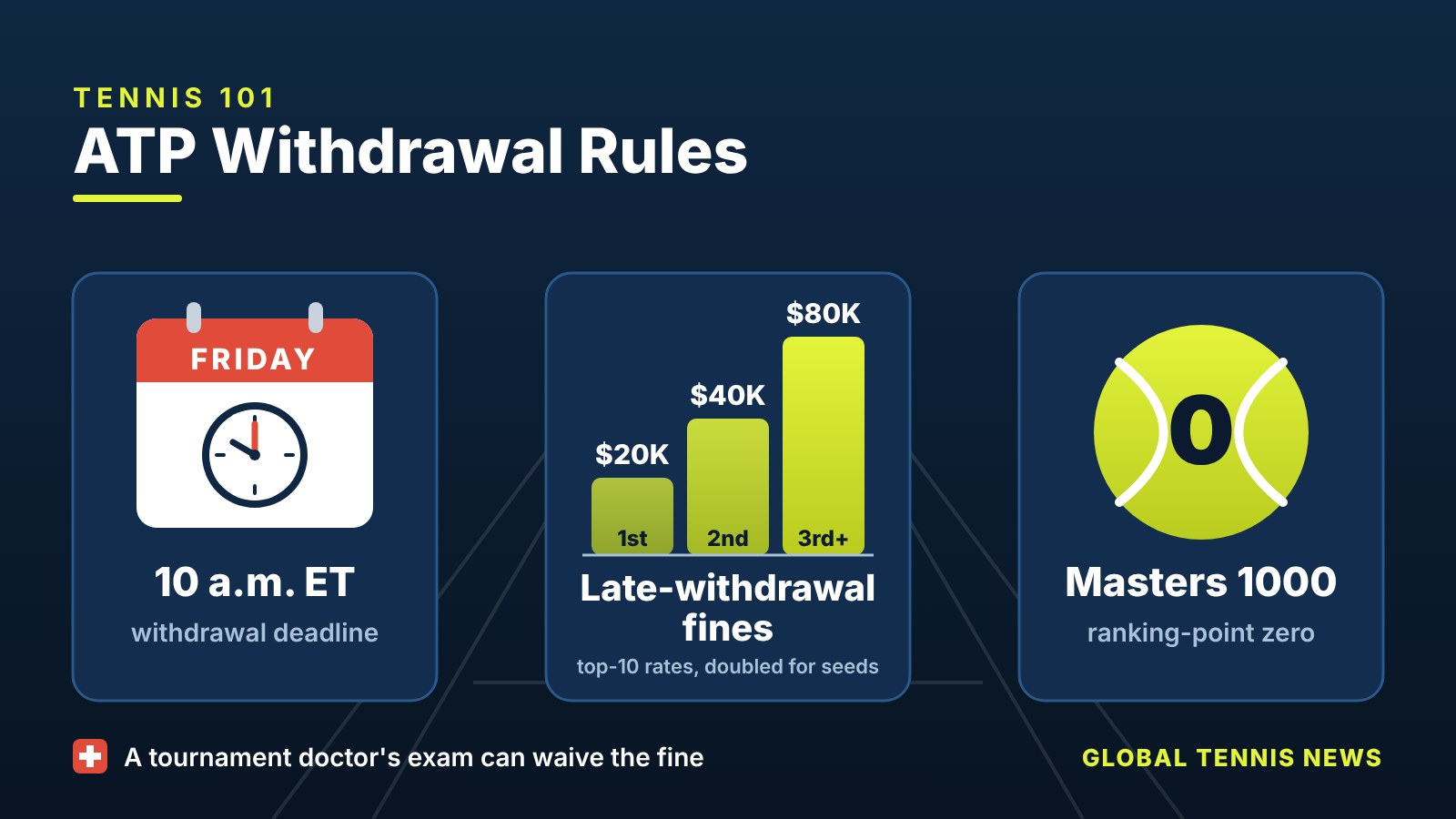
Every ATP Tour event has a withdrawal deadline of 10 a.m. Eastern Time on the Friday before the tournament. A player entered in the main draw, or moved into it as a direct acceptance, may not withdraw after that deadline, or fail to appear for his first-round match, without a penalty. A withdrawal after the deadline is a late withdrawal.
What a Late Withdrawal Costs
At Masters 1000, ATP 500 and ATP 250 events, the late-withdrawal fine is set by the player’s position in the most recent PIF ATP Rankings and rises with each offence. Only late withdrawals count towards the second and third offence.
- Ranked 1 to 10: $20,000 for a first offence, $40,000 for a second, $80,000 for a third and any after that
- 11 to 25: $10,000, $20,000, $40,000
- 26 to 50: $4,000, $8,000, $16,000
- 51 to 100: $2,000, $4,000, $8,000
- 101 and below: $1,000, $2,000, $4,000
The fine is doubled for a player who would have been seeded. The money collected from late withdrawals at Masters 1000 and ATP 500 events goes back to the tournament where the withdrawal happened.
The Masters 1000 Zero
A player who withdraws from the main draw of a Masters 1000 receives a ranking penalty: a zero for that event. Once a player is accepted into the main draw of a Grand Slam or a mandatory Masters 1000, as a direct acceptance, qualifier, special exempt, lucky loser or wild card, his result there counts for his ranking whether or not he plays. The rulebook calls the Masters penalty automatic and unappealable.
There are two ways round it. A withdrawal within a two-week window centred on the birth or adoption of the player’s child carries neither the fine nor the ranking penalty. And a player who is out of competition for two or more consecutive mandatory events (Masters 1000s, Grand Slams or the Nitto ATP Finals) can replace up to three Masters 1000 zeros, after applying to the ATP Medical Committee. Withdrawing from a Masters also affects a top player’s share of the season-end bonus pool, which is covered in ATP bonus pool explained.
ATP 500 Withdrawals
Pulling out of an ATP 500, whether before or after the Friday deadline, also brings a zero-point ranking penalty, and each further non-consecutive withdrawal brings another. Unlike the Masters penalty, it has exits. It is not applied to a player with consecutive withdrawals who is out injured for 30 days or more and files approved medical forms, to a player who completes the promotional activities requirement, or where the on-site withdrawal procedure applies. A player can appeal to a three-member Tribunal. A commitment player can also wipe out the zero by playing a fourth ATP 500 later in the same calendar year, once a year.
ATP 250 Withdrawals
ATP 250 events carry no ranking penalty. The fine table for withdrawals before the Friday deadline starts at the third offence, so the first two are not fined. The third, fourth and fifth and later are fined on a sliding scale, from $500 up to $40,000 for a player in the top 10. A late withdrawal from a 250 is fined on the same table as a late withdrawal from a Masters 1000 or ATP 500, and at 250s all withdrawal fines are returned to the event.
When the Fine Does Not Apply
Most exemptions turn on a medical examination by a tournament doctor. A late withdrawal is not fined if the player is still competing at another tournament after the Friday deadline, is forced to withdraw or retire there, and that event’s doctor finds him unfit for the following week. Nor is it fined if he was on site at the event he withdrew from and its doctor declares him unfit to play that week. A player examined on site is given a tournament hotel room through the night of the examination.
A player who was not on site can avoid the fine by travelling to the tournament within the first three days of the main draw and doing a reasonable amount of promotional work over two days, as set by the ATP. At a Masters 1000 that also lets him recover potential bonus pool money. The parental window applies to fines at every level. At ATP 250s, a player with consecutive withdrawals who is out injured for 30 days or more, with approved medical forms, is not fined, provided he plays no other tennis in that period.
Retiring During a Match
A player who retires during a match, or withdraws during the tournament week because of injury or illness, must be examined on site by the tournament doctor, and a player who retires must be seen before the end of play that day. Skipping the examination costs $10,000 at ATP Tour events, or $2,500 in qualifying, or the prize money he won at the tournament if that is greater. The supervisor at the next event he enters can then require another examination and his own authorisation before he plays again.
A match that ends in a retirement is recorded differently from one that never starts. The difference is covered in walkover vs retirement vs default, and what can be treated during a match is in medical timeouts explained.
Byes and Points
Ranking points are assigned to the losers of each round. A player who reaches the second round through a bye and then loses is treated as a first-round loser and receives first-round points. At a 56-draw Masters 1000 such as Paris, that is 10 points, against 50 for a player who wins one match and loses in the round of 32. How seeds, byes and lucky losers are placed in a bracket is in how to read a tennis draw, and the wider points system in ATP rankings explained.
Appeals
Masters 1000 and ATP 500 penalties are appealed to the Appeals Tribunal, made up of a designee of the player board members, a designee of the tournament board members and a designee of the ATP CEO. At a Masters 1000 the appeal is due by 6 p.m. Eastern on the Tuesday of the event week and decided by 10 a.m. Eastern on the Friday, and the Tribunal can rule only on the fine. At an ATP 500 the deadline is 10 days from the Monday of the event week, and the Tribunal can rule on both the fine and the ranking penalty. ATP 250, qualifying and Challenger appeals go to the ATP’s Senior Vice President for Rules and Competition.
The WTA’s version works differently, with excused withdrawals and an on-site withdrawal that still pays prize money. It is covered in WTA mandatory events explained and WTA prize money withdrawals explained.
Season Snapshot — 31 October 2026
- Rolex Paris Masters: 2 to 8 November; draw released 30 October, top eight seeds with first-round byes
- Not in the draw: Jannik Sinner (season over), Felix Auger-Aliassime, Jakub Mensik, Alexander Bublik and Joao Fonseca
- Retired this week and seeded in Paris: Flavio Cobolli (5), retired in Vienna on 29 October; Arthur Fils (6), retired in Basel on 30 October
- Next: Nitto ATP Finals, Turin, 15 to 22 November
This snapshot is dated and will change. The career record above does not.