

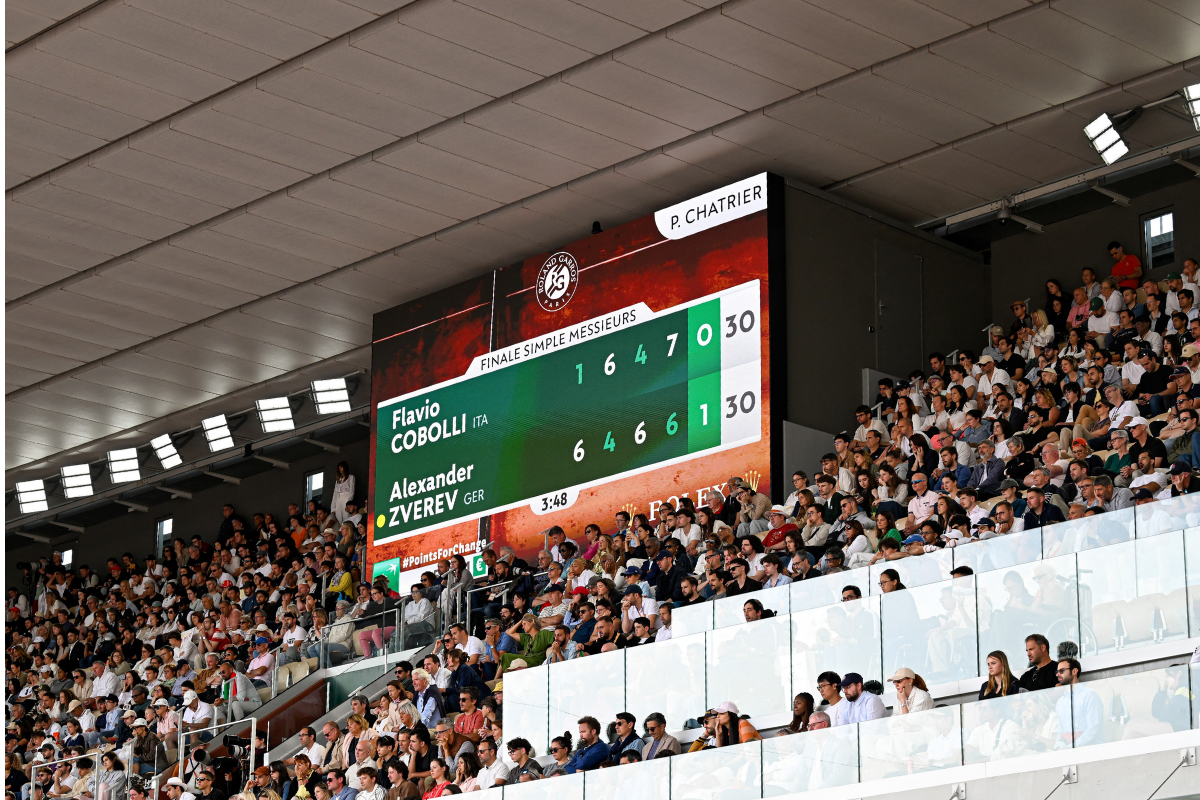
Best-of-five sets is the oldest surviving format in professional tennis and, by now, almost the rarest. It applies to one competition only: men’s singles at the four Grand Slam tournaments, from the first round through the final. Everything else on the professional calendar is best-of-three. That makes the majors structurally different events rather than simply bigger ones, and it explains a good deal about who wins them.
How the format works
A best-of-five match is won by the first player to take three sets. A player can lose two sets and still win. In best-of-three, losing two sets ends the match. Individual sets are scored the same way in both formats: first to six games, by a margin of two, with a tiebreak at six games all. What changes is the number of sets required and, with it, the shape of the contest. A best-of-three match usually runs between an hour and a half and two and a half hours. A best-of-five averages closer to three, and a tight one can pass four or five.
The deciding-set tiebreak
The fifth set once ran on indefinitely until a player led by two games, which is how the sport produced matches that stretched across days. The four majors now settle it with a tiebreak to 10 points, won by two clear points, played when the deciding set reaches six games all. Reaching that point took decades and four separate approaches. The Australian Open adopted a 10-point deciding tiebreak first. Wimbledon used a seven-point tiebreak, but only once the final set reached 12-12.
The US Open played a standard seven-point tiebreak at 6-6. Roland Garros used no deciding tiebreak at all. The Grand Slam Board unified the four on the current rule, approved by the International Tennis Federation’s Rules of Tennis Committee, and it now applies across singles, doubles, qualifying, wheelchair and junior events. Every other set at a major still uses the ordinary seven-point tiebreak.
Where the format came from
Best-of-five dates to the earliest championship tennis of the 1870s and 1880s, when the format was chosen as the fullest available test of a player. It was never adopted because it was thought better television or a better sporting contest in any modern sense. It survived because the majors are the sport’s oldest institutions, and the format came with them.
Elsewhere it has steadily disappeared. Davis Cup ties, long played over five sets, moved to best-of-three. The men’s Olympic singles final was best-of-five as recently as Rio 2016 before the Games shortened it. No ATP tournament outside the majors uses it, including the season-ending finals.
Why women do not play best-of-five
The usual assumption is that women have never played the format. They have. The challenge round of the United States national championships, the tournament that became the US Open, was scored best-of-five for women from 1891 to 1901. The format was then withdrawn by the governing council of the day. Women played it again much later at the season-ending championships, where the final was best-of-five from 1984 to 1998 — a change the players themselves supported.
Since 1998, women’s professional tennis has been best-of-three throughout. The debate about restoring the longer format at the majors resurfaces regularly, and the arguments are less about physiology than about scheduling. Slam draws run 128 players across two weeks. Doubling the length of the women’s matches would require either more courts, more days, or fewer other events.
What five sets actually changes
The most important effect is that the format suppresses upsets. A lower-ranked player who serves exceptionally for 90 minutes can beat almost anyone in best-of-three. Sustaining that level for three or four hours against an opponent who has done it repeatedly is a different demand, and the additional sets give the better player time to solve the problem in front of them.
Three consequences follow. Physical durability becomes a selection criterion rather than a bonus, which is why players with long injury histories often struggle at the majors even when their tour-level form is strong. Slow starts become survivable, so a two-set deficit is a genuine deficit rather than a defeat. And the effect compounds across a fortnight, because a player who spends four hours winning a second-round match carries that into the next one.
This is the practical reason the four majors are weighted so heavily in the ranking system. They are not just worth more points. They ask a different question.
Frequently asked questions
Which matches are best-of-five sets?
Men’s singles at the Australian Open, Roland Garros, Wimbledon and the US Open, in every round. No other professional competition uses the format.
How long does a best-of-five match last?
Around three hours on average. A straight-sets win can be done inside two; a close five-setter regularly runs past four.
Can a player win after losing the first two sets?
Yes. Winning the next three sets takes the match. It is uncommon but far from rare, and it is the single feature that most distinguishes the format.
What happens at six games all in the fifth set?
All four majors play a tiebreak to 10 points, won by two clear points. Earlier sets use the standard seven-point tiebreak.
Have women ever played best-of-five?
Yes, twice in the sport’s history: at the US national championships from 1891 to 1901, and in the final of the season-ending championships from 1984 to 1998.