

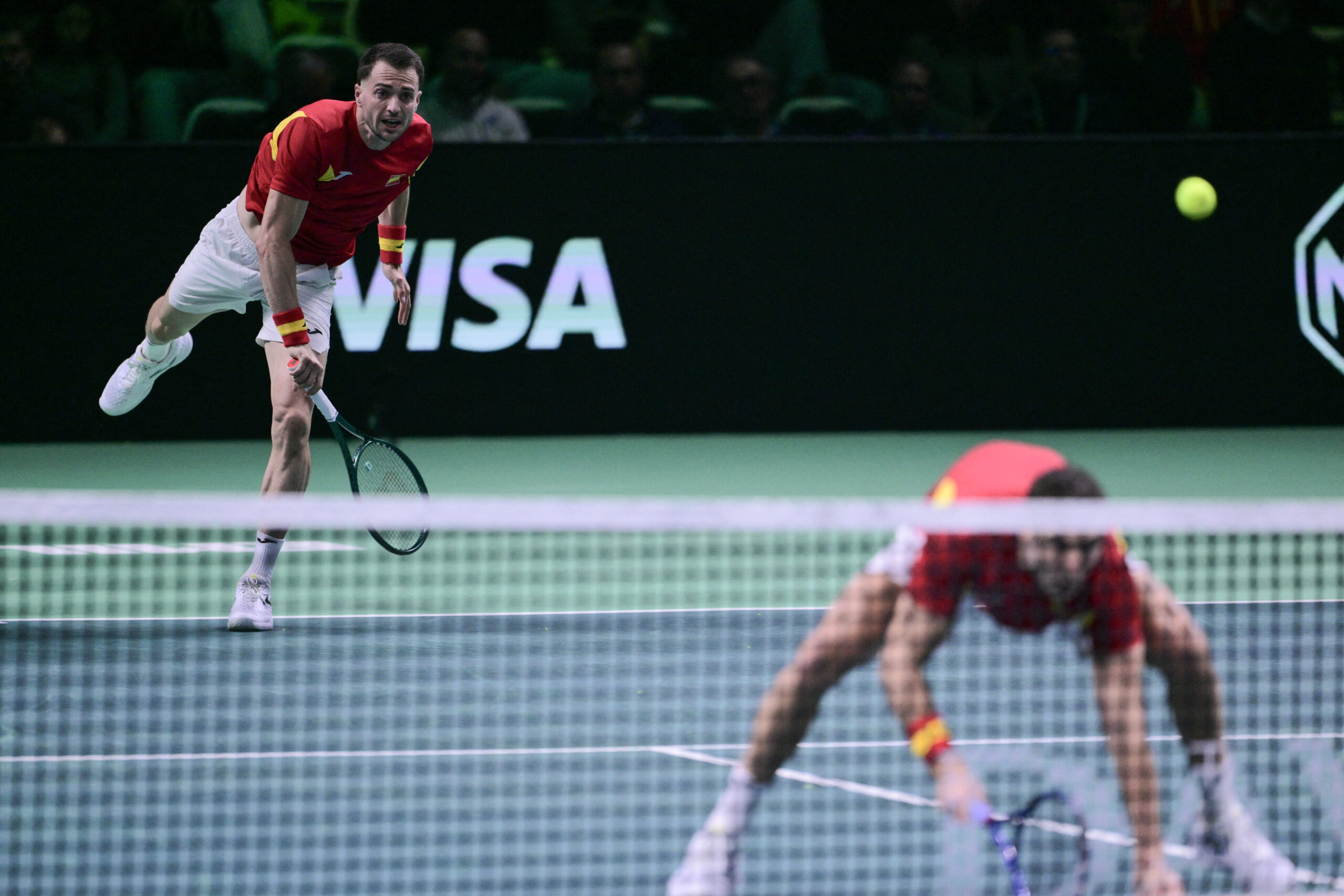
Mirra Andreeva and Karolina Muchova still have to play each other in Group 2 at the WTA Finals in Indian Wells, and the result cannot move either of them. Andreeva has already won the group, and Muchova is already out. In team tennis a match like that has a name: a dead rubber.
What a dead rubber is
A rubber is one match within a team tie. It is dead when it is played after the tie has already been decided. The Davis Cup still recognizes the old name, but its current regulations call these “dead matches”. In individual events the phrase is borrowed for round-robin matches that cannot change who goes through.
The Davis Cup today
A tie at the Finals is two singles and one doubles, all on one day, every match best of three tie-break sets. In the quarterfinals and semifinals, if the second singles decides the tie, the doubles must still be played unless both nations and the referee agree otherwise. A dead doubles is best of three sets with a 10-point match tie-break in place of a third set and regular ad scoring. In the final, the doubles is not played once the second singles has decided it, and the trophy ceremony follows. A nation that fails to field a doubles team for a dead match it is required to play can be penalised.
Qualifiers and World Group ties are longer: four singles and one doubles over two days. If the doubles, the third match, decides the tie, only the fourth match must be played. If the fourth match decides it, the fifth is not played unless both nations and the referee agree. Dead matches use the same 10-point match tie-break in place of a third set. How a tie is built is in how the Davis Cup works, the squad rules are in Davis Cup team nomination rules explained, and the match tie-break is in tennis tiebreak rules explained.
The Final 8 in Bologna, from 24 to 29 November, runs under these rules. The teams and dates are in the Davis Cup Final 8 guide.
Before the reform
Until 2018 a Davis Cup tie was five rubbers over three days, with live matches played over five sets. The dead ones were shortened or dropped. In the World Group, if the third singles decided the tie and had gone at least four sets, the last singles was not played unless both teams agreed. If the deciding match had been shorter, the last singles went ahead over best of three tie-break sets. The longer format is in best of five sets explained.
The Billie Jean King Cup
The women’s competition follows the same pattern. At the Finals the doubles is still played in a decided quarterfinal or semifinal unless both nations and the referee agree otherwise, and it is not played in a decided final. The one difference is the scoring: a dead doubles in the Billie Jean King Cup uses no-ad scoring, with a 10-point match tie-break as the third set. In qualifiers and play-offs the fifth match is not played unless both nations and the referee agree. The format is in how the Billie Jean King Cup works, and the play-off ties are in Billie Jean King Cup play-offs explained.
The United Cup and the Laver Cup
At the United Cup the mixed doubles is played whatever happened in the two singles, because group places can come down to matches, sets and games won. Only in the final is a decided mixed doubles dropped, unless both countries agree to play it. No ranking points are given for the mixed doubles. The event is in United Cup explained.
The Laver Cup goes to the first team to 13 of the 24 points available, and its last matches are played only if they are needed. The 2023 edition ended 13-2, and the final day closed with a doubles exhibition. The scoring is in Laver Cup explained.
The ATP Finals and the WTA Finals
The season-ending events never cancel a round-robin match. The ATP Rulebook says qualified players “must be available for play through the completion of the round robin competition”, and the WTA Rulebook says its qualified players “are required to attend and compete”. Both codes also require effort: “A Player shall use her best efforts during a match when competing in a Tournament,” in the WTA’s wording.
A match that settles nothing is still paid. On both tours a round-robin win is worth 200 ranking points. At the 2026 ATP Finals each round-robin win pays $405,000, and the participation fee is paid per match: $169,000 for one, $253,500 for two and $338,000 for three, so simply playing a third match is worth $84,500. At the WTA Finals a round-robin win pays $230,000.
Pulling out has a cost. On the WTA side a player who withdraws from any round-robin match is eliminated, and an alternate takes over her place, her standing, and the points and prize money she wins; with no alternate available, the opponent gets a walkover. On the ATP side a player who withdraws from a round-robin match after his first cannot play in the knockout rounds, and an alternate keeps any points and prize money he wins. How the reserves are called up is in ATP Finals alternates explained and WTA Finals alternates explained.
Retirements are treated so that no one can game the standings. The ATP counts a retirement or a conduct default as a straight-set result, so a player who needs only one set cannot win it and then stop. The WTA counts a retirement after the opponent has won a set as two sets to one for the player who goes through. The full order of tiebreaks is in ATP Finals round-robin tiebreakers explained and WTA Finals round-robin tiebreakers explained, and defaults are covered in what happens when a player is defaulted.
When a dead match decides someone else’s week
A match can be dead for one player and live for the rest of the group. At the 2024 WTA Finals in Riyadh, Coco Gauff was already through when she played Barbora Krejcikova. Krejcikova won 7-5, 6-4, took the last semifinal place and eliminated Iga Swiatek, who had beaten Daria Kasatkina 6-1, 6-0 and went out on percentage of sets won.
A year later Elena Rybakina had already qualified for the semifinals before her last group match. Madison Keys withdrew ill, the first alternate, Mirra Andreeva, declined to play, citing fitness concerns, and the second alternate, Ekaterina Alexandrova, took the place. Rybakina won 6-4, 6-4. “Every match I play, I want to win,” Rybakina said. She went on to win the title and a record $5.235 million.
Season Snapshot — 12 November 2026
- WTA Finals, Indian Wells: Group 2 finishes on Friday, 13 November. Andreeva has won the group and Muchova is eliminated; Sabalenka and Svitolina play for second place.
- ATP Finals, Turin: 15–22 November. Prize money figures above are for 2026.
- Davis Cup Final 8, Bologna: 24–29 November, quarterfinals 24–26 November.
This snapshot is dated and will change. The career record above does not.