

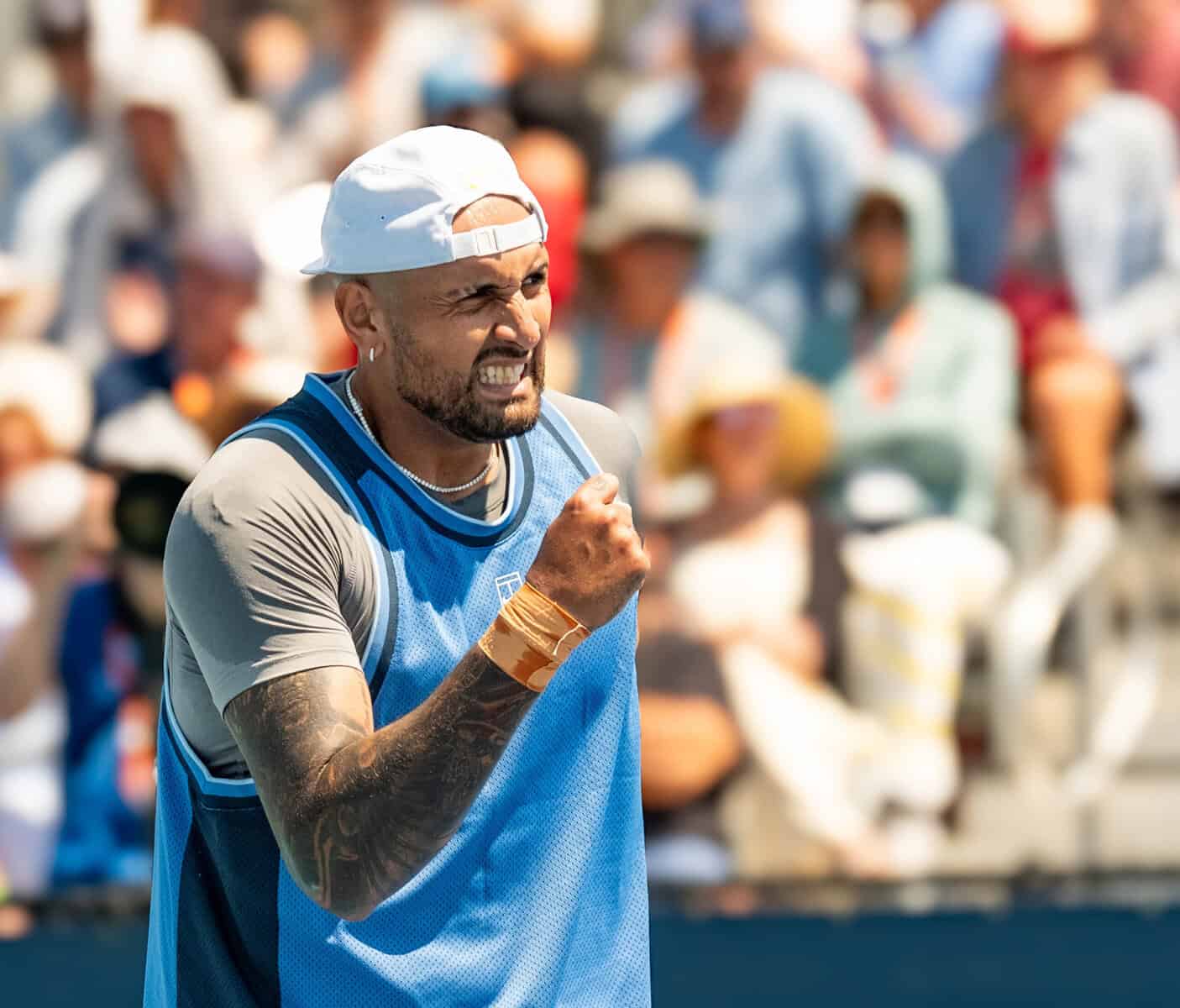
Nick Kyrgios has been provisionally suspended under the Tennis Anti-Doping Programme after a sample he provided in June returned a metabolite of cocaine, the International Tennis Integrity Agency said Wednesday, and the Australian responded within hours by accepting responsibility and announcing he would step away from public life for a month.
The sample was collected at an ATP 250 event in Mallorca, Spain, on June 22. A World Anti-Doping Agency-accredited laboratory confirmed the presence of benzoylecgonine, a metabolite of cocaine, on July 17. Because of the nature of the substance, a provisional suspension is mandatory under the program, and it has been in force since Aug. 4 — two weeks before any of it became public.
The classification is the case. Cocaine sits on the WADA Prohibited List as both a stimulant and a substance of abuse, and it is banned in competition rather than at all times. Where a player can establish that use occurred out of competition and was unconnected to sporting performance, the substance-of-abuse provisions allow for substantially reduced sanctions. The distinction between an in-competition finding and an out-of-competition one is not a technicality here. It is the difference between a case measured in months and one measured in years.
While the suspension stands, Kyrgios cannot play in, coach at, or attend any event organized or sanctioned by World Tennis, the WTA, the ATP, the Grand Slams or any national association. He has the right to appeal the provisional suspension and, as of Wednesday, had not done so.
He addressed it himself the same day, on his own channels, in a statement that made no attempt to contest the finding. “I made a huge mistake and I take full responsibility for it,” he wrote, apologizing to his family, his sponsors and his fans, and saying he would leave social media and public life for 28 days.
The dates are worth laying out in order, because the sequence explains why this landed the way it did. The sample came on June 22. Nine days later, on July 1, Kyrgios walked onto Court 17 at Wimbledon for a first-round doubles match alongside Alexander Bublik, a wild-card pairing that lost 6-3, 6-4 to sixth seeds Marcelo Arevalo and Mate Pavic. The laboratory result did not arrive until July 17. The provisional suspension did not begin until Aug. 4. The public announcement came Wednesday. By the time anyone outside the process knew, the suspension was already 15 days old.
That Wimbledon appearance now reads differently than it did at the time. Kyrgios said afterward that he was fairly certain it had been his last match at the All England Club, the venue where he reached the 2022 final and lost to Novak Djokovic. He had not been granted a singles wild card and entered only the doubles. He spoke about looking around the court and taking it in. He hinted, as he has repeatedly over the past two years, that retirement was close.
The wider context is a sport that has spent two years arguing with itself about proportionality in anti-doping enforcement. Global Tennis News has covered that argument closely, from Marketa Vondrousova’s four-year ban for refusing a test and the dispute it triggered, to Max Purcell’s return after a ban for a prohibited method rather than a prohibited substance. The framework that produced those very different outcomes is the same one that will now decide this case, and the mechanics of it are set out in our explainer on how tennis anti-doping rules work.
Kyrgios himself had been among the sharpest critics of that framework, arguing publicly that its outcomes were inconsistent depending on who was in front of it.
What happens next is a tribunal. The provisional suspension is not a finding, and it is not a ban. It is a holding position while the case is prosecuted, and the outcome will turn almost entirely on when the substance entered his system rather than whether it did. Kyrgios has not contested that it did.
For a player who had already told the sport he was close to done — a comeback that stalled through Stuttgart, the grass swing and an exhibition-heavy summer — the question is no longer what he can still play. It is whether the last competitive match of his career has already been played, and whether it was that doubles loss on Court 17.