

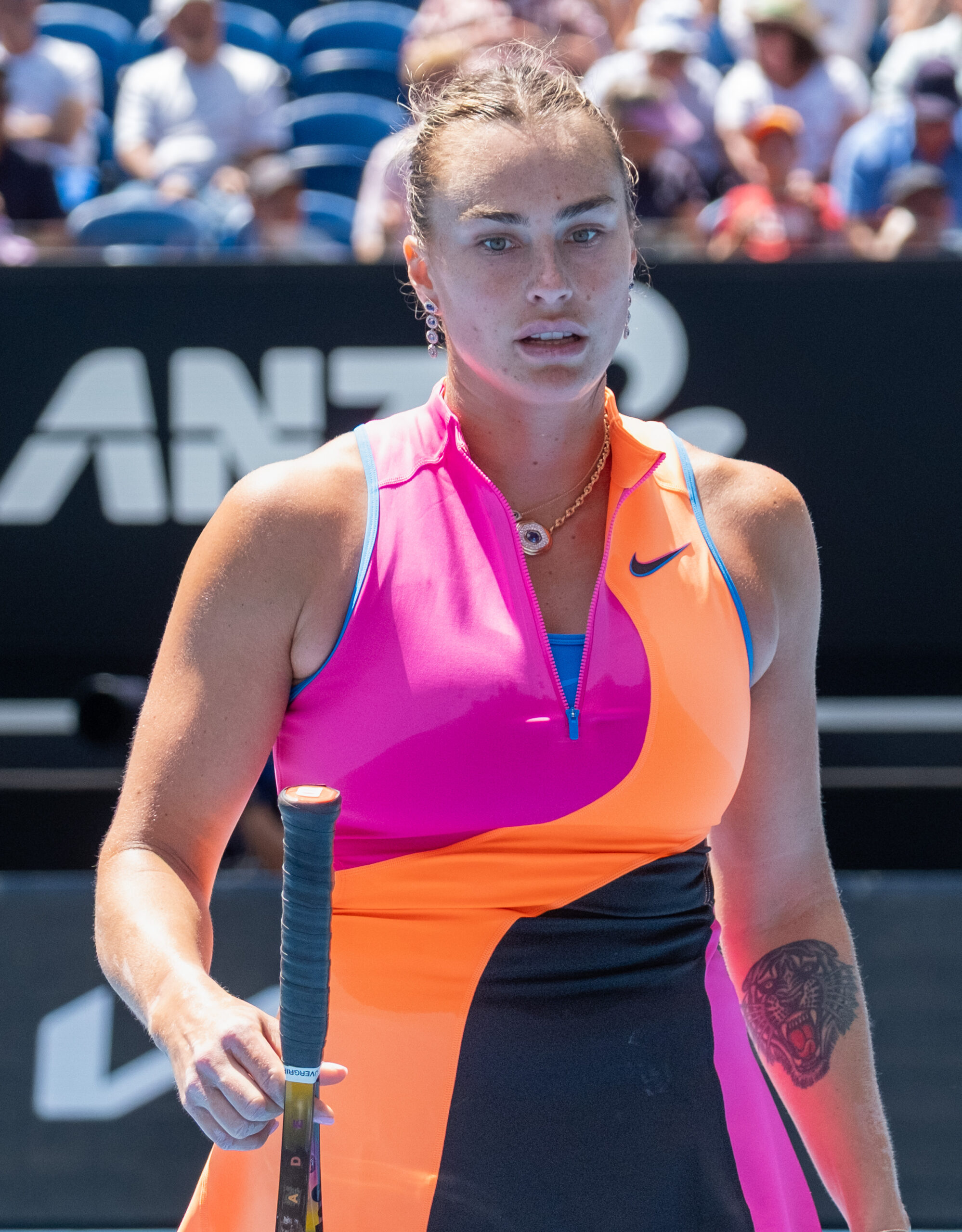
Aryna Sabalenka lost in the round of 16 in Toronto on Saturday, and the defeat matters less for what it cost her than for when it arrived. She is three weeks from the start of a US Open title defense that carries more weight than any other on the women’s tour, and she goes into it having played the least convincing tennis of her season.
The loss itself, 7-6(3), 4-6, 6-4 to the No. 16 seed Ekaterina Alexandrova, is thin evidence on its own. Before the National Bank Open she had lost once in 24 matches on a hard court this year, and that defeat came in the Australian Open final against Elena Rybakina. Two losses on the surface in a season remains a record almost nobody else on tour can approach, and any argument built on Saturday alone is an argument built on very little.
The case for paying attention is about timing rather than volume. Sabalenka has not won a tournament since Miami in late March, when she took the Sunshine Double and looked as far ahead of the field as she has ever been. Since then she has gone out in the quarterfinals at Roland Garros, lost in the fourth round at Wimbledon to Naomi Osaka, and now exited a WTA 1000 as top seed before the quarterfinals. Four months without a trophy is not a crisis for most players. For a world No. 1 who won three titles in the first three months of the year, it is a change in pattern.
What sharpens it is the size of what waits in New York. Sabalenka is defending 2,000 points at Flushing Meadows, the largest single block anyone in the women’s game is carrying into the last month of the season, and unless the US Open delivers she will finish a year without a major for the first time since 2023. She reached the Australian Open final in January and lost it. The season has been built on hard-court consistency rather than on the two-week runs that decide titles, and the tournament that has most reliably given her those runs is the one now approaching.
The history is the part that will get repeated through the fortnight. Sabalenka won the US Open in 2024 and again in 2025, becoming the first woman to take consecutive titles at the tournament since Serena Williams a decade earlier. A third in a row would put her alongside Williams again, and would be the first three-peat in the women’s draw since Williams completed hers. That is the kind of stake that turns an ordinary early-round loss in New York into a story with a long tail.
The ranking is the smaller worry. Sabalenka has held the No. 1 position without interruption since October 2024, a run that reached 95 weeks on Aug. 10, and by reaching the round of 16 in Toronto she cleared the threshold that kept it safe for the tournament regardless of how the rest of the draw finished. Rybakina, who was the only player positioned to take it this week, is still in the draw and can close the gap considerably with a title, but the arithmetic that governs the top of the rankings now points past Canada. The reckoning is in New York, where the points Sabalenka is defending dwarf anything either player can win before then.
Cincinnati comes first, and it is the last opportunity to gather evidence either way. The main draw begins Aug. 13 in a field already thinned by withdrawals on both sides, which improves the odds of a deep run for everyone still entered. Sabalenka won the title there in 2024 and lost in the quarterfinals to Rybakina in 2025, so the week is not a large points liability. It is simply the last set of matches before the US Open that will tell anyone anything.
None of this suggests the field has caught her. It suggests something narrower and more interesting: that the player who has spent nearly two years as the most reliable performer in women’s tennis is arriving at the one tournament she most needs to win with less recent proof than at any point in 2026. The hard-court swing exists to settle exactly that kind of question, and it has two weeks left to do it.