

Canada’s Billie Jean King Cup team will play Brazil on outdoor clay in Vitória on 20 and 21 November. Brazil picked the court. In a home-and-away tie that is the host’s right: the nation with choice of ground chooses the venue, the court surface and the ball, and the visitors have to adapt.
Seven Billie Jean King Cup Play-off ties are played under that rule this week. The Davis Cup Final 8 in Bologna, from 24 to 29 November, is not, because the Finals sit outside it. This is how choice of ground works in both competitions.
The rule
The Davis Cup Regulations and the Billie Jean King Cup Regulations use the same sentence: “The Home Nation has the right to choose the ball and court surface for the Tie.” The venue goes with it. The regulations say the venue for Davis Cup Qualifiers, World Group I and II ties and their play-offs, and for Billie Jean King Cup Qualifiers and Play-offs, is determined by the nation that has choice of ground.
The choice is wide but not unlimited. It covers home-and-away ties only. It must be used within the regulations’ limits on surfaces, court speed and balls. And the competition committees can take it away.
How choice of ground is decided
History decides first. If two nations have met before, “the Nation that did not have the choice in their most recent meeting will have choice”. Not every meeting counts. In the Davis Cup, ties played before 1970, at the Finals and in the Regional Groups are ignored. In the Billie Jean King Cup, the cut-off is 1995, and ties in Finals Week and in Regional Group I and below are ignored.
If the nations’ most recent tie was not played for any reason, the competition committee decides. If neither of those applies, choice of ground is decided by lot. In the Billie Jean King Cup it is settled at the same time as the draw for the Qualifiers or Play-offs, and the previous year’s champion is automatically the home nation for its Qualifier tie.
The lot mattered this year. In the 2026 Play-off draw, choice of ground went to the United States, Brazil and Thailand by lot. Poland, Japan, France and Slovenia had it without one.
Where the home nation can play
A nation with choice of ground does not have to stay at home. It can play in its own country, at a neutral venue on the same continent, or in its opponent’s country if the opponent and the committee agree. A home nation playing at a neutral venue is still treated as the home nation for the running and finances of the tie.
The venue has to meet standards. Qualifier ties in both competitions must be held in a major city or heavily populated area of the home nation. A Davis Cup Qualifiers second-round stadium needs at least 4,000 seats and a first-round stadium at least 2,000. A Billie Jean King Cup Qualifier stadium needs 4,000. The Davis Cup rules also require the stadium to be no more than 45 minutes by car from the team hotels.
The home nation sets all of this out in a questionnaire to the ITF. In the Davis Cup it is due 14 days after the Qualifiers draw for a first-round tie and 90 days before the start of the tie for later rounds and play-offs. In the Billie Jean King Cup it is due 60 days after the Qualifiers or Play-off draw. Once approved, the arrangements can be changed only with the committee’s agreement.
The committees can step in at any time. A nation “may lose its choice at any time” if the Davis Cup Committee considers that hosting is not possible or practicable, and the tie can then be moved to a neutral venue or to the opponent’s country. The Billie Jean King Cup rules add that the opposing nation’s agreement is not needed for that move.
What surfaces are allowed
Both sets of regulations list the permitted surface types: acrylic, asphalt, carpet, clay, hybrid clay, artificial clay, concrete, grass and artificial grass. Hard courts must be an ITF classified surface product. Carpet may not be laid on a temporary basis for an outdoor tie, and the Billie Jean King Cup rules bar carpet at its Finals and Qualifiers.
Speed is regulated too. The court must have a measured Court Pace Rating between 24 and 50, measured with the tie ball, which stops a host from laying an extremely fast or extremely slow hard court. The Billie Jean King Cup rules exempt clay and grass from that test. Ratings are approved in advance where practicable and otherwise tested on site. A court that fails can cost the host nation ranking points and its choice of ground the next time it would have had it.
Once the referee arrives, the court is fixed. From then until the tie ends, the surface and its surrounds cannot be changed without the referee’s consent. The match court must be available for practice at least three days before the tie. A practice court of exactly the same surface must be available to both teams, although an indoor host can offer the match court alone, with the visitors given priority in the practice schedule. A temporary clay court must be under construction at least four days before the first day of practice, and outdoor ties need covers on site eight days before the first day of play.
Choosing the ball
The home nation also picks the ball, which needs ITF approval by the questionnaire deadline. The ball type has to match the court’s pace: Type 1 or 2 for a slow court rated 29 or under, Type 2 for a medium court rated 30 to 44, and Type 2 or 3 for a fast court rated 45 or over. A venue 1,219 metres or more above sea level uses high-altitude balls.
If a team turns up to find an unapproved ball, the referee can order approved balls and delay play, or let the match go ahead, with penalties for the host afterwards.
The Finals exception
Choice of ground ends where the Finals begin. The Davis Cup and Billie Jean King Cup Finals are held at fixed locations decided by the ITF with the Finals organiser. The ITF determines the surface type, and the ball is chosen by the Davis Cup Event Committee or, in the Billie Jean King Cup, by the ITF. No nation in Bologna next week chose the court, whichever team is playing at home in the stands.
The rule also has nothing to say about line-ups, which are a captain’s call made after the team nominations are in.
How nations have used it
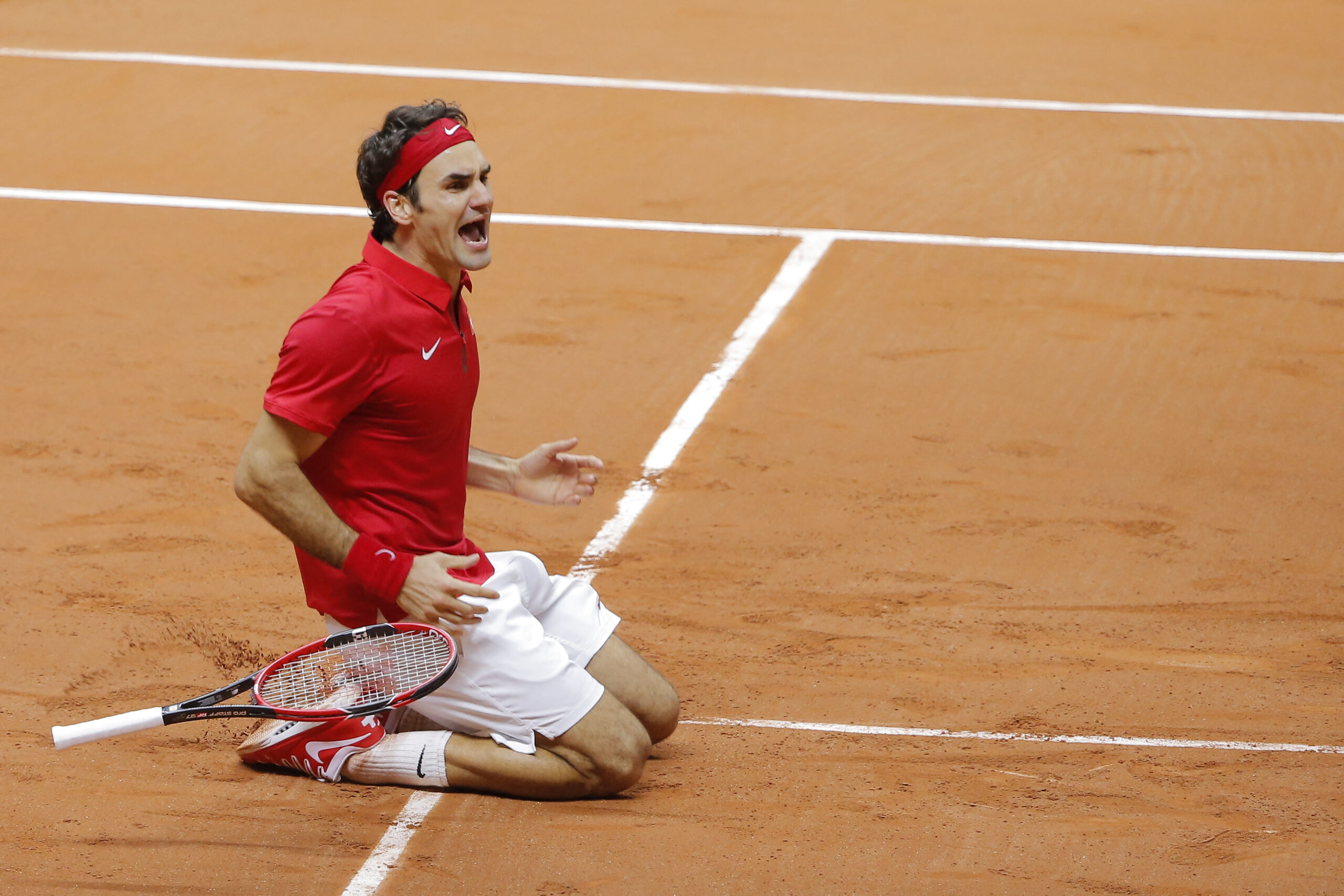
Clay against a visiting star is the classic choice. When France hosted Switzerland in the 2014 Davis Cup final, it chose indoor clay at the 27,000-capacity Pierre Mauroy Stadium in Lille in a bid to stop Roger Federer winning his first title. “It won’t have a big impact on the result,” Jo-Wilfried Tsonga said. Federer clinched the decisive point against Richard Gasquet, and Switzerland won 3-1.
A year later, Belgium chose clay for the final against Britain in Ghent, on an indoor court at the Flanders Expo, to slow down Andy Murray, whose best results had come on faster surfaces. “Think clay is a good surface for us looking forward to it,” Murray wrote. Britain won 3-1. France chose clay again in Lille for the 2018 final against Croatia, and Croatia won. The full list is in GTN’s Davis Cup winners page.
Hosts still bring the clay indoors. For the 2026 Billie Jean King Cup Qualifiers in April, Poland chose indoor clay in Gliwice against Ukraine, Belgium indoor clay in Ostend against the United States, and Kazakhstan indoor clay in Astana against Canada. Switzerland went the other way with an indoor hard court in Biel, and Australia played on outdoor hard at John Cain Arena. In the second round of the 2026 Davis Cup Qualifiers, Chile, which won choice of ground by lot, hosted Spain on outdoor clay in Santiago, while Germany, Britain, Czechia and Canada all chose indoor hard courts.
Season Snapshot — 17 November 2026
Billie Jean King Cup Play-offs, 20–22 November (host named first):
- United States v Hungary, Delray Beach Tennis Center, Delray Beach, 21–22 November
- Brazil v Canada, Vitória, 20–21 November (outdoor clay)
- Poland v Sweden, Hala Mistrzów, Włocławek, 20–21 November
- Japan v Argentina, Ariake Coliseum, Tokyo, 21–22 November
- France v Australia, Le Chaudron, Le Portel, 21–22 November
- Thailand v Switzerland, National Tennis Development Center, Nonthaburi, 21–22 November
- Slovenia v Indonesia, Bela Dvorana, Velenje, 20–21 November
Only the Brazil v Canada surface had been confirmed at the time of writing. The Davis Cup Final 8 is at BolognaFiere from 24 to 29 November; squad changes are tracked on GTN’s Final 8 withdrawals page, and how ties can finish early is covered in the dead rubber explainer.
This snapshot is dated and will change. The career record above does not.