

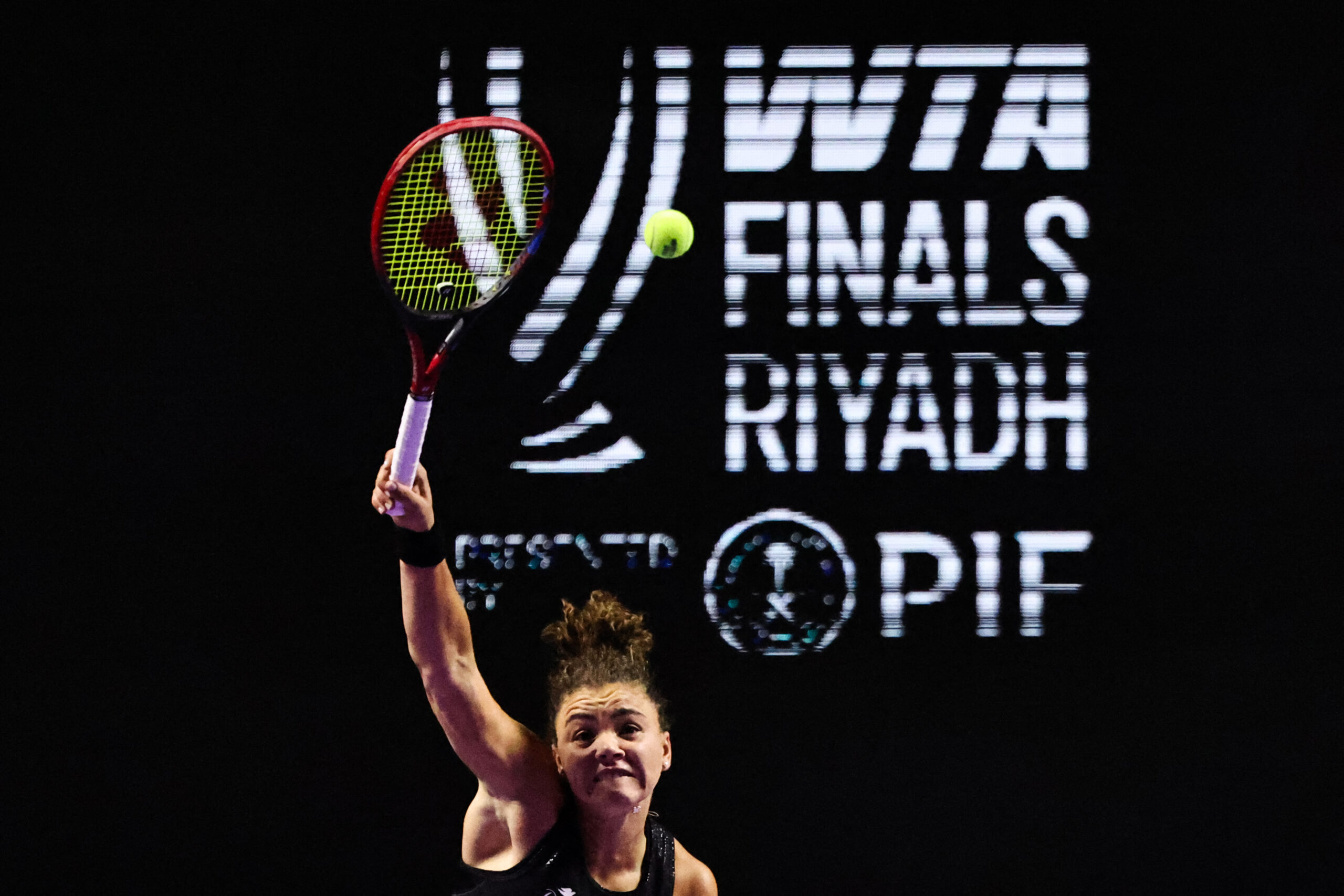
Elena Rybakina was the eighth and last player to qualify for the 2025 WTA Finals, and then won the title. A year later she was the first singles qualifier for 2026, confirmed by the WTA on Sept. 14, two days after she won the US Open. Aryna Sabalenka followed on Sept. 29. That leaves six singles places at the Indian Wells Tennis Garden, where the WTA Finals are played from Nov. 8 to 15.
The eight are chosen by the PIF Race to the WTA Finals, a points table with rules of its own. This explainer follows the WTA’s published Race qualification rules.
The Race Year
Race points count from tournaments beginning the week before the previous year’s WTA Finals through tournaments beginning two weeks before the upcoming Finals. The WTA calls this period the Race Year. Results from the 2025 tournaments in Chennai, Hong Kong and Jiujiang, played the week before last year’s Finals, count toward the 2026 Race. The 2026 tournaments in Tokyo and Guangzhou are the last that count this year.
Two kinds of results never count. WTA 125 and ITF tournaments are excluded, and so are the WTA Finals themselves: winning the Finals adds nothing to the following season’s Race.
The 18 results that count
A singles player’s Race total is built from 18 results, and the rules specify where each comes from:
- The four Grand Slams: the Australian Open, Roland Garros, Wimbledon and the US Open.
- The best six results from the seven combined WTA 1000 events: Indian Wells, Miami, Madrid, Rome, Toronto/Montreal, Cincinnati and Beijing.
- The best one result from the three non-combined WTA 1000 events: Doha, Dubai and Wuhan.
- The best seven results from other WTA 1000, WTA 500 and WTA 250 tournaments.
Zero-point results for missed mandatory WTA 1000 events and unmet WTA 500 commitments are included among the 18. How they are placed is covered below.
The eight-tournament minimum
To be eligible in singles, a player must have played at least eight WTA 1000 mandatory or WTA 500 tournaments during the Race Year. The exception is a player exempted because of a long-term injury. The rule means points alone are not enough: a player who finishes high on the leaderboard from a short schedule still has to meet the minimum.
Who gets the eight places
Qualification is decided in this order:
- The top seven players on the Race leaderboard.
- The highest-ranked current-year Grand Slam champion who is ranked eighth to 20th and has not already qualified.
- If there is no such champion, the next highest-ranked player, eighth or lower.
The second step is the one that changes outcomes. A player who wins a major but has a thin season elsewhere can take the last place ahead of the player who finished eighth on points. A champion ranked 21st or lower gets no such protection, and a champion who is already in the top seven qualifies on points, which leaves the eighth place to the leaderboard.
The zero-point rule
A penalty on a player’s WTA ranking for not playing a Grand Slam, a mandatory WTA 1000 or a WTA 500 commitment is applied to her Race points as well. The points come off her lowest-scoring result in the matching group:
- A zero at a Grand Slam counts in the four-Slam group.
- A zero at Indian Wells, Miami, Madrid, Rome, Canada, Cincinnati or Beijing counts in the best-six-of-seven group.
- A zero at Doha, Dubai or Wuhan counts in the best-one-of-three group.
- A zero for a missed WTA 500 commitment counts in the best-seven group.
The WTA gives this example: a player who plays five WTA 500 events, one short of the six required, and incurs a penalty loses the ranking and Race points from her lowest-scoring 500 of the season. Which absences bring a penalty and which are excused is set out in our explainer on WTA mandatory events.
Ties
If two singles players finish level on points, the tie is broken by, in order: the most points from WTA 1000 mandatory tournaments, the best single WTA 1000 mandatory result, the best single WTA 500 result and the best single WTA 250 result.
Doubles
Doubles teams qualify on their best 12 results together during the Race Year, from the Grand Slams and WTA 1000, 500 and 250 tournaments. Each player must have played doubles at a minimum of six WTA tournaments during the Race Year, unless exempt for long-term injury, and the pair must have competed together at least twice. A player who qualifies with more than one team chooses which to play with; the partner she does not choose is in only if she qualifies with another team. The selection order mirrors singles: the top seven teams, then the highest-ranked current-year Grand Slam winning team ranked eighth to 20th, then the next highest-ranked team.
The Race and the rankings
The Race and the WTA rankings are different tables. The rankings roll over 52 weeks, so a result stays on a player’s ranking for a year whenever it was won. The Race counts only the current Race Year and starts again after the Finals, which is why a player can sit higher in one table than in the other. The Finals field is set by the Race alone.
The format
The eight singles players and eight doubles teams are split into two round-robin groups of four. The top two in each group advance to the knockout stage, according to the WTA. For the men’s equivalent, see our guide to the Race to Turin.
2026 Race Snapshot — 30 September 2026
Qualified in singles: Elena Rybakina (confirmed Sept. 14) and Aryna Sabalenka (Sept. 29), according to the WTA. Qualified in doubles as of Sept. 14: Katerina Siniakova and Taylor Townsend, Gabriela Dabrowski and Luisa Stefani, and Anna Danilina and Aleksandra Krunic.
This year’s Grand Slam singles champions are Rybakina (Australian Open and US Open), Mirra Andreeva (Roland Garros) and Linda Noskova (Wimbledon). Rybakina is already in. For Andreeva and Noskova, the champion rule comes into play only if either finishes the Race between eighth and 20th.
Jessica Pegula was third on the WTA’s Race leaderboard when she withdrew from the China Open. The China Open in Beijing, which runs to Oct. 11, and the Wuhan Open, Oct. 12-18, are the last WTA 1000 events that count.
This snapshot is dated and will change. The rules above do not.