

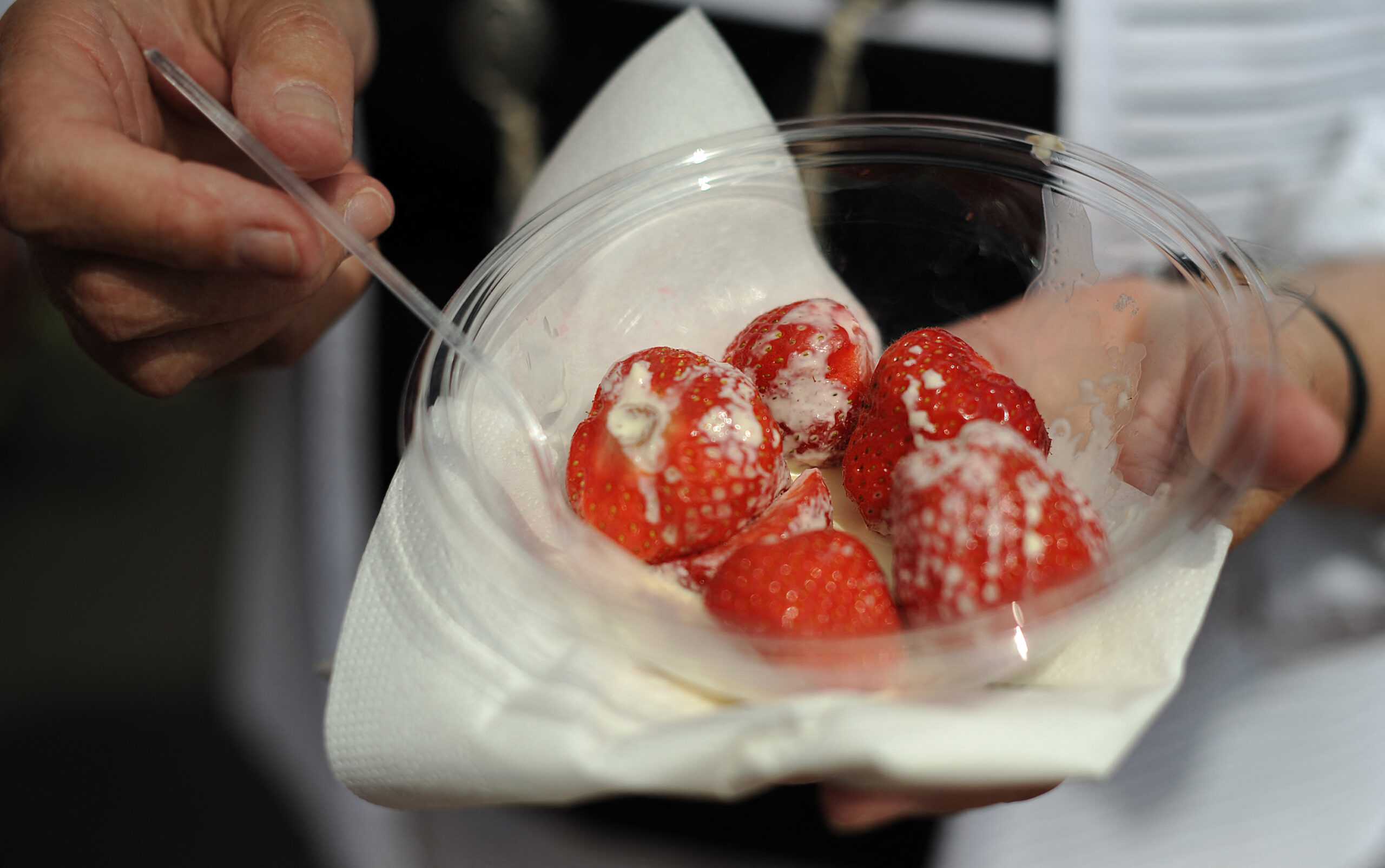
At every major sporting event, there is food. At Wimbledon, the food is the event — or at least, no part of the spectator experience is more associated with The Championships than the bowl of strawberries and cream served on the lawns of the All England Club. The combination has been served at Wimbledon since the very first Championships in 1877.
The recipe is two ingredients. The history stretches back to the court of Henry VIII. And the modern operation — sourcing close to 2 million strawberries from a single Kent farm and serving them across a fortnight to hundreds of thousands of spectators — is a feat of agricultural logistics performed every summer with a level of consistency that is itself characteristically Wimbledon.
Alongside the strawberries sits the Pimm’s Cup — the gin-based summer drink that has become as inseparable from the tournament as the white clothing and the grass. Here is the complete story of the food and drink that defines Wimbledon, where they came from, and why they remain so central to the experience of attending The Championships.
The Origin: Cardinal Wolsey and the Court of Henry VIII
The story of strawberries and cream at Wimbledon does not begin in 1877. It begins in 1509, at a banquet hosted by Cardinal Thomas Wolsey, almoner and later Lord Chancellor to King Henry VIII, at Hampton Court Palace — roughly seven miles from where the All England Club would eventually be built.
The wild strawberries served that day were, by the standards of Tudor England, a luxury food. Strawberries grew naturally in English meadows but had a brief and unreliable harvest window, making them a seasonal delicacy available only for a few weeks each summer. Cream, by contrast, was considered something close to a peasant food — a by-product of the dairy farming that sustained much of rural England’s agricultural economy.
Wolsey’s chef paired them anyway. The combination was unusual enough to be remarkable, and because it was served to the King, it acquired the kind of cultural prestige that turned a regional summer dish into a national one. Henry VIII was a passionate tennis player who maintained royal tennis courts at Hampton Court, and the dish became associated with both the King’s table and the royal tennis tradition he embodied. By the time lawn tennis was invented in the 19th century, strawberries and cream were already a fixture of British summer entertaining — the seasonal food of garden parties, regatta picnics, and the kind of outdoor social events at which lawn tennis itself was first played.
When the first Championship was held at Wimbledon in July 1877, strawberries and cream were on the menu. The timing was perfect: early July is the peak of the English strawberry harvest. The combination was already culturally embedded in the kind of social occasion the Championship aspired to be. The fruit was, by Victorian standards, both delicious and respectable. And it has been served at Wimbledon every year since.
Hugh Lowe Farms: The Single Source
For decades, all of Wimbledon’s strawberries have come from one place: Hugh Lowe Farms in Mereworth, near Maidstone in Kent, roughly 31 miles southeast of the All England Club.
The relationship is exclusive. Every strawberry served at the All England Club during The Championships comes from this single family-run operation, which has been supplying the tournament for more than 40 years. The farm grows multiple strawberry varieties across more than 100 acres, but only specific cultivars meet the All England Club’s specification — known internally as the “Wimbledon” or “Championships” grade.
The logistics of the daily supply are as carefully managed as any aspect of the tournament. Pickers begin work in the pre-dawn hours, harvesting Grade 1 strawberries by hand throughout the early morning. The fruit is sorted, packed, and dispatched by truck before breakfast. Delivery to the All England Club is completed by 8:30 am each day, ensuring that every strawberry served at Wimbledon has been picked within hours of being eaten.
The freshness is the point. Strawberries do not improve in transit, and the difference between a strawberry picked at dawn and one picked yesterday is, to a discerning palate, substantial. The All England Club’s insistence on daily delivery from a single nearby source is what distinguishes the Wimbledon strawberry experience from anything that could be produced by a longer or less integrated supply chain.
The Numbers
The scale of the strawberry operation at Wimbledon, across a typical fortnight, is genuinely impressive:
- Approximately 38.4 tonnes of strawberries consumed each year
- Approximately 1.92 million individual strawberries served
- Approximately 140,000 portions sold across the two weeks
- Approximately 7,000 litres of cream poured over them
- Exactly 10 strawberries per portion, by official specification
The cream is supplied by other British dairy producers, and the cream-to-strawberry ratio is part of the All England Club’s quality specification. A Wimbledon portion is not a generic bowl of fruit and cream; it is a specific dish, prepared the same way every time, served at every food outlet on the grounds.
The strawberries served at Wimbledon are also genuinely seasonal. The variety, the freshness, and the timing of the English strawberry harvest combine to produce, for two weeks each year, what is arguably the best strawberry experience available anywhere in the country.
The Price — and the Famous Price Freeze
For 15 years, between 2010 and 2024, a portion of strawberries and cream at Wimbledon cost £2.50 — a price that the All England Club deliberately held steady despite inflation, supply chain pressures, and the general rise in concession prices across British sporting venues during the same period.
In 2025, the price was raised for the first time since 2010 — to £2.70, a 20-pence (8 percent) increase. The All England Club issued a statement explaining that the modest increase would still ensure the strawberries remained available at a reasonable price.
At £2.70, strawberries and cream remain the cheapest food item on the All England Club’s menu. Most other concessions at Wimbledon — sandwiches, salads, hot food — cost £8 to £15. A glass of Pimm’s costs £11.95. A bottle of Champagne costs many multiples of that. The strawberries are, by some distance, the most accessible food the tournament sells — a deliberate choice that reflects the same instinct that produces The Queue: a commitment to making at least some elements of the Wimbledon experience available to ordinary spectators at ordinary prices.
The 15-year price freeze itself, which became something of a celebrated tradition during its duration, was widely covered in the British press whenever it was renewed. The decision to break it in 2025 was treated as front-page news by several outlets — an unintended demonstration of how culturally significant the price had become.
Pimm’s: The Drink of the Fortnight
If strawberries and cream are the food of Wimbledon, Pimm’s is the drink. The gin-based “fruit cup,” developed in 1823 by James Pimm as a digestive at his oyster bar in the City of London, has been served at the All England Club for decades and has become as inseparable from the tournament as the white clothing and the silence on Centre Court.
A traditional Pimm’s Cup is a long drink. The base is Pimm’s No. 1 — a herbal gin-based liqueur whose recipe has been a closely guarded secret since the early 19th century. The Pimm’s is mixed with lemonade (Sprite or 7UP for those unable to source proper British lemonade), poured over ice, and garnished with mint leaves, cucumber slices, orange slices, and — fittingly — a strawberry or two.
The drink is gently alcoholic, visually elaborate, and quintessentially summer. It is the kind of drink that exists almost entirely for the season in which it is consumed: pre-dinner garden parties, sporting events, riverside lunches, garden weddings. In the British social calendar, Pimm’s is to summer what mulled wine is to Christmas.
The numbers at Wimbledon are correspondingly substantial. In 2023, more than 330,000 glasses of Pimm’s were sold across the fortnight — averaging more than 23,000 glasses per day. The drink is served in plastic reusable cups (glass is prohibited on the grounds for safety), with a 2024 price of £11.95 per glass. The combination of the volume sold, the price point, and the brand exclusivity of Pimm’s as a Wimbledon partner makes the drink one of the most commercially significant concessions at the tournament.
The presence of Pimm’s at Wimbledon is not merely a refreshment offering. It is part of the deliberately cultivated cultural identity of the tournament — the visual signal, the lifestyle association, and the seasonal embedded-ness that turns drinking a glass at the All England Club into a small ceremonial act in its own right.
Other Wimbledon Foods and Drinks
Beyond the strawberries and the Pimm’s, Wimbledon’s food and drink operation is considerable. Some of the headline statistics from a typical Championships fortnight:
- Approximately 27,000 bottles of Champagne sold
- Approximately 234,000 glasses of beer poured
- Approximately 305,000 cups of tea and coffee served
- Approximately 200,000 sandwiches sold
- Tens of thousands of fish and chips, pies, salads, and afternoon teas served
The All England Club operates more than 30 food and drink outlets across the grounds, ranging from quick-service concessions to fine dining facilities serving members and Royal Box guests. The breadth of the operation reflects the size of the daily spectator population — approximately 42,000 people on the busier days — and the All England Club’s commitment to maintaining quality across price points.
Catering at Wimbledon has been provided since 1981 by Compass Group, the British contract caterer, through its subsidiary Facilities Management Catering (FMC). The operation employs more than 1,800 catering staff during the Championships and processes food and drink sales totaling several million pounds across the fortnight.
Bring Your Own Food and Wine
Unlike most major sporting events, Wimbledon allows spectators to bring their own food and drink onto the grounds — including alcohol, within reason. The official guidance permits a bottle of wine or two cans of beer per person, alongside any food a spectator wishes to bring in a small bag.
This is, again, characteristic of the All England Club’s approach to spectator access. While the concessions on the grounds are priced at premium levels, the option to bring a picnic from outside means that even budget-conscious fans can have a full day at Wimbledon without spending heavily on food. Picnics on Henman Hill, on the lawns of the grounds, or in the queueing areas are part of the visual character of The Championships.
The strawberries, in this context, are the gateway food. They are cheap enough that almost anyone can buy one portion regardless of their broader spending plans, and good enough that the experience of eating them at Wimbledon — fresh from Hugh Lowe Farms, served in a paper cup, eaten standing on a lawn with a tennis match audible in the distance — is genuinely worth the price. The All England Club has, in this regard, made the strawberries do a substantial amount of cultural work.
The Bottom Line
Strawberries and cream and Pimm’s are not merely refreshments at Wimbledon. They are deliberately cultivated cultural objects — connected to the tournament’s history, embedded in its visual identity, defended in their pricing, and supplied through logistics chains that the All England Club has refined across decades.
The strawberries trace their origin to a Tudor banquet and arrive each morning from a Kent farm that has supplied them exclusively for more than 40 years. The Pimm’s is a Victorian invention that has become inseparable from the British summer and the tennis tournament that defines it. Together they represent one of the most distinctive food-and-drink traditions in international sport — and one of the most enduring expressions of what Wimbledon believes itself to be: serious about quality, committed to tradition, and offering at least one thing on the grounds at a price that anyone can afford.
To attend Wimbledon without eating strawberries and cream, or without drinking at least one Pimm’s, is to have missed something essential about the experience. The tennis is the reason people come. The strawberries are part of why they remember it.