

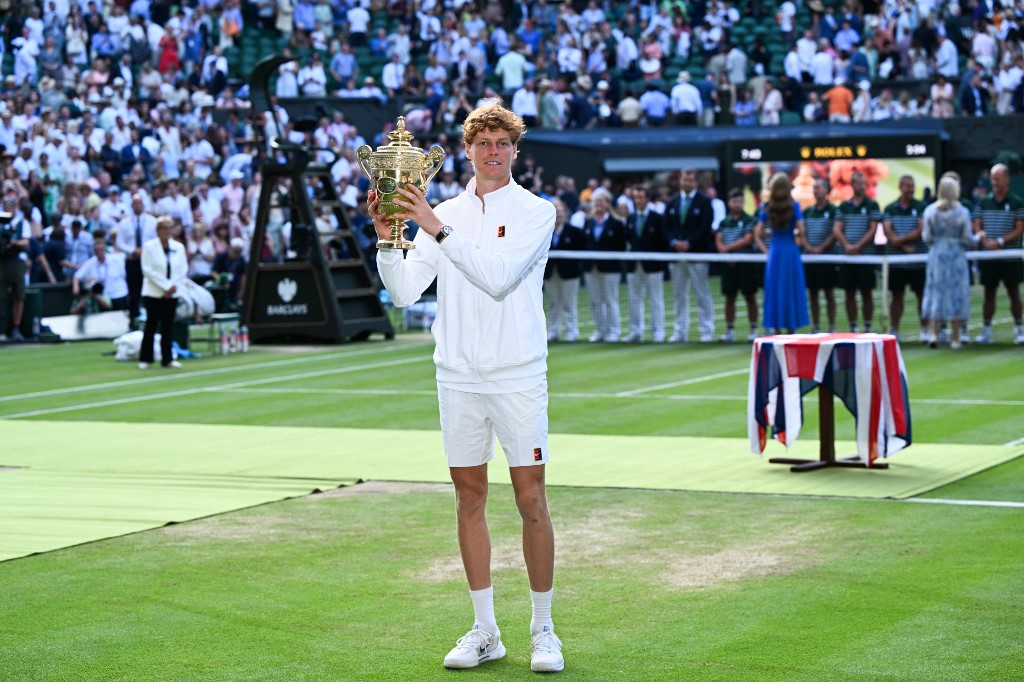
Every player who competes at Wimbledon — from the qualifier who falls in the first round to the champion who lifts the trophy on Centre Court — leaves the All England Club with a cheque.
The Wimbledon prize purse has grown into one of the largest in tennis, and the way the All England Club distributes that money reveals as much about the tournament’s priorities as any tradition it maintains.
Here is a complete guide to what players earn at The Championships, how the figures are structured, and how Wimbledon’s prize money has evolved into what it is today.
The Total Purse
The total prize money at the 2025 Championships was £53.5 million, an increase of 7 percent over 2024 and roughly double what the tournament paid out a decade earlier. The figure is announced annually by the All England Club ahead of each year’s event and has risen almost every year since the start of the Open Era in 1968, the first Wimbledon to pay players at all.
Wimbledon’s purse is one of the largest in tennis, comparable to the other Grand Slams and substantially above any non-Slam tournament on the calendar.
What the Singles Champions Earn
The headline figure is what most players, journalists, and fans focus on: the cheque written to the men’s and women’s singles winners. In 2025, that figure was £3 million each — an 11.1 percent increase on the previous year.
The full singles prize money breakdown for the 2025 Championships:
| Round | Prize Money (GBP) |
|---|---|
| Champion | £3,000,000 |
| Finalist | £1,520,000 |
| Semi-finalist | £775,000 |
| Quarter-finalist | £400,000 |
| Round of 16 | £240,000 |
| Round of 32 (third round) | £152,000 |
| Round of 64 (second round) | £99,000 |
| Round of 128 (first round) | £66,000 |
Every player who reaches the main singles draw — including those who lose in the first round — takes home a five-figure sum. The £66,000 first-round prize is a 10 percent increase on the previous year, reflecting Wimbledon’s stated commitment to supporting lower-ranked players who travel to compete.
Equal Pay for Men and Women
Wimbledon adopted equal prize money in 2007, becoming the last of the four Grand Slams to do so — one year after Roland Garros, decades after the US Open (which had paid equally since 1973), and a year before the Australian Open formalized the same policy.
The decision was announced by then-chairman Tim Phillips in February 2007. That year, both the men’s and women’s singles champions received £700,000. Equal pay applies across every round of the singles, doubles, and mixed doubles draws and has been maintained without controversy ever since.
The road to equal pay was longer at Wimbledon than at any other Grand Slam, but the policy has been settled for nearly two decades and is now a structural feature of the tournament rather than a debate.
Doubles Prize Money
Wimbledon’s doubles prize money, while substantially lower than singles, has grown alongside the overall purse. The 2025 doubles totals (paid per pair):
| Round | Prize Money (GBP, per pair) |
|---|---|
| Champions | £680,000 |
| Finalists | £345,000 |
| Semi-finalists | £174,000 |
| Quarter-finalists | £87,500 |
| Round of 16 | £43,750 |
| Round of 32 | £26,000 |
| Round of 64 | £16,500 |
The figures apply to both gentlemen’s and ladies’ doubles. Mixed doubles, contested over a smaller 32-team draw, carries a smaller purse with the champions receiving a six-figure sum.
Qualifying Prize Money
Wimbledon’s qualifying tournament, held at Roehampton in the week before the main draw, distributes a substantial purse of its own. In 2025, £4.97 million was allocated to qualifying across the men’s and women’s events.
Players who lose in the first round of qualifying still receive £15,500 in 2025. Those who reach the final round of qualifying — losing one match short of the main draw — earn £41,500. The combination of qualifying prize money and the £66,000 first-round main-draw payment means a player who comes through qualifying and loses in the first round of the main draw walks away with around £100,000.
The size of the qualifying purse reflects a structural decision by the All England Club to put more money into the early rounds of the tournament, helping lower-ranked players cover the considerable costs of competing on tour.
Wheelchair and Invitational Events
Beyond the main singles and doubles events, Wimbledon’s prize money also covers gentlemen’s and ladies’ wheelchair singles and doubles, the quad wheelchair events, and junior competitions. Wheelchair purses have grown substantially in recent years as the All England Club has expanded both draw sizes and total prize money for these events.
The invitational doubles competitions, contested by former players, carry honorary prizes rather than competitive purses.
How Wimbledon’s Prize Money Compares
Among the four Grand Slams, Wimbledon’s purse sits at the top end of the range. The US Open consistently offers the largest total prize money in absolute terms, with Wimbledon, the Australian Open, and Roland Garros clustered close behind. The order shifts slightly year to year depending on exchange rates and individual tournament budgets.
What distinguishes Wimbledon is not the headline figure but the distribution. The All England Club has, in recent years, weighted increases toward both the very top (the champions) and the early rounds (qualifiers and first-round losers) — meaning the players who benefit most from each annual increase are either the champions or the journeymen, with the middle rounds rising more modestly.
The History of Prize Money at Wimbledon
Wimbledon paid no prize money at all for the first 91 years of its existence. The Championships were strictly amateur, and players competed for the trophy, the title, and — by the 1960s — the considerable indirect rewards of being a Wimbledon champion. The Open Era arrived in 1968, and that year’s tournament was the first to distribute prize money.
The figures from that first year now read almost as a different sport: the men’s singles champion earned £2,000, the women’s singles champion £750. Total prize money was £26,150. The next five decades saw nearly continuous increases, broken only by the COVID-19 pandemic.
The 2020 Championships were cancelled — for the first time since the Second World War — but the All England Club still distributed roughly £10 million in prize money to players who would have competed, funded in part by the foresight of a pandemic insurance policy the club had held for nearly two decades.
Prize money rebounded sharply after the pandemic. By 2022, the total purse had surpassed the pre-pandemic peak, and the figure has continued to rise.
What Players Actually Take Home
The prize money headlines do not, of course, reflect what players ultimately keep. Wimbledon prize money is paid in pounds sterling, and players from outside the UK face tax obligations in both their home countries and Britain — though double tax treaties typically prevent the same income from being taxed twice.
After tax, agent fees, coaching costs, travel, and the considerable expenses of competing on tour, the practical take-home for a Wimbledon competitor is meaningfully less than the headline figure.
For champions, this is largely academic — £3 million remains a transformational sum after every deduction. For first-round losers, the £66,000 cheque, while substantial, can be largely absorbed by the costs of a season on the road.
The Bottom Line
Wimbledon’s prize money has grown from £26,150 in 1968 to over £53 million in 2025 — a near-2,000-fold increase that reflects both the commercial expansion of professional tennis and the All England Club’s deliberate strategy of pushing more money toward lower-ranked players in recent years.
The Champions earn £3 million each. The first-round losers earn £66,000. The qualifying competitors earn enough to make the trip worthwhile.
Equal pay, settled in 2007, is no longer controversial. The total purse is one of the largest in sport. And the structure of the distribution — top-heavy and bottom-heavy in roughly equal measure — continues to shape who can afford to be a professional tennis player at all.