

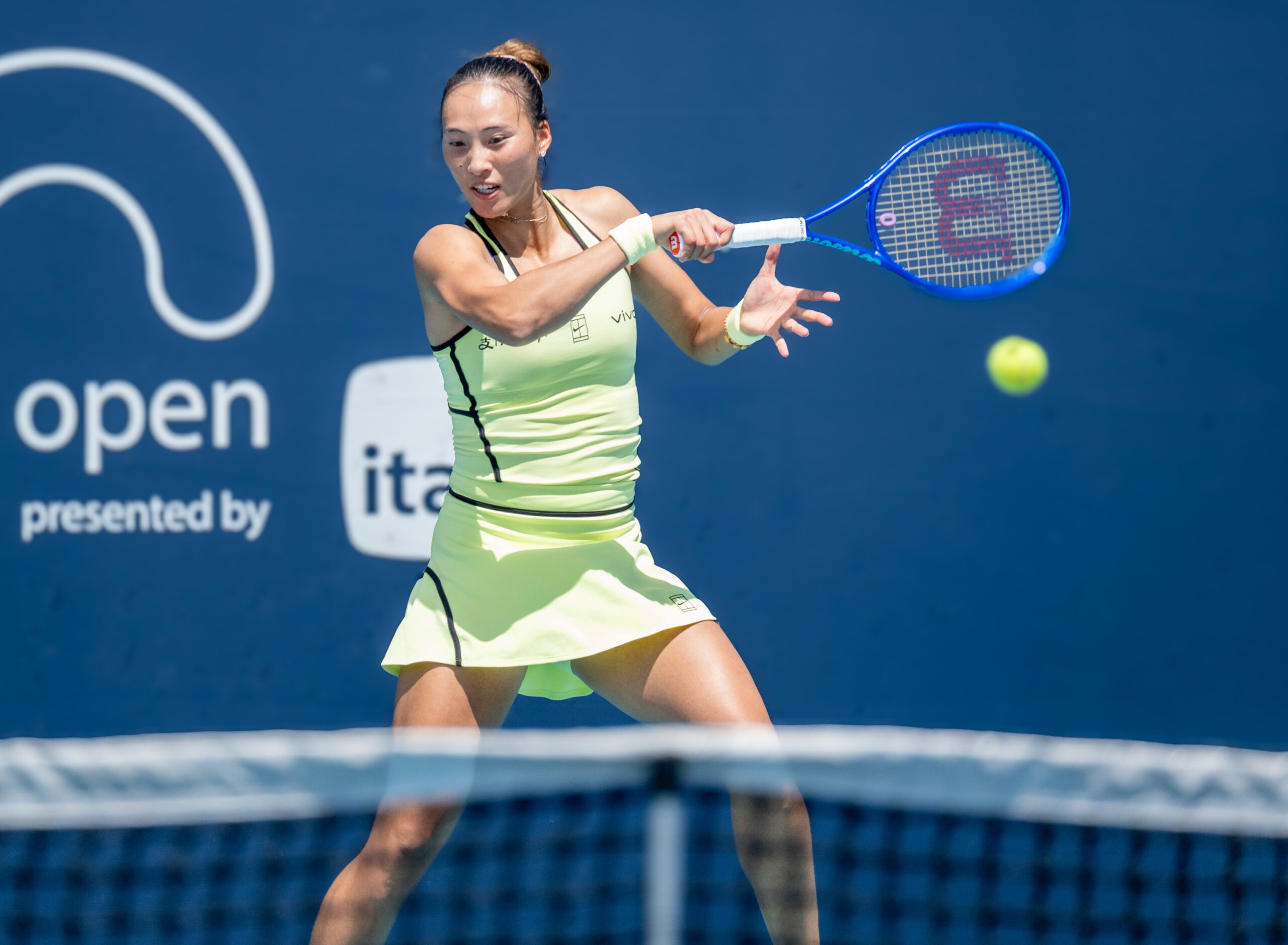
The best women’s field at Flushing Meadows this week was not in the main draw. It was on the outside courts, in a qualifying competition that has held a US Open champion, an Olympic gold medalist and a former Australian Open winner, and that will not finish until Friday.
Rain suspended the final round on Thursday and pushed the remainder into Friday, with an 11 a.m. Eastern restart. Zheng Qinwen was a set from the main draw when play stopped. Bianca Andreescu had played two games. Both resume needing one win, four days before the tournament they used to headline.
Who is in the draw. Andreescu won the 2019 US Open on her main-draw debut and has not played the qualifying rounds here since 2018. She is ranked No. 183 and reached the Wimbledon main draw through qualifying in June. She plays Tamara Zidansek, herself a Roland Garros semifinalist in 2021. Zheng, the Olympic champion and a two-time US Open quarterfinalist, reached a career high of No. 4 and is now No. 121 after elbow surgery last July cost her most of a year. Sofia Kenin, the 2020 Australian Open champion, is ranked No. 118. Nadia Podoroska, a Roland Garros semifinalist in 2020, is in the field as well.
Why the rankings put them there. Both tours run a rolling 52-week table that counts a fixed number of a player’s best results and nothing else. It has no memory. A major title, an Olympic gold and a career-high ranking earn points when they happen and stop earning anything twelve months later, which means a player who misses half a season falls out of the top 100 regardless of what she has previously won. Zheng returned in February and has won roughly as often as she has lost since. Kenin has a 5-19 record for the season. Neither figure is unusual for a player rebuilding, and neither is enough to reach a Grand Slam cutoff of 104 direct acceptances.
What the relief valve does and does not do. Tennis has a mechanism for this. The ATP calls it entry protection and the WTA calls it a special ranking, and it lets a player who has been out for roughly six months enter events at a number reflecting where she stood before the absence. The WTA said ten players used special rankings to enter this qualifying competition. The provision has limits that matter here. It cannot be used for seeding on the ATP, it cannot be used for lucky loser consideration on either tour, the WTA version is capped at two Grand Slams, and it expires. A protected number also only helps if it clears the cutoff of the draw a player is aiming at. For a returning player whose pre-injury ranking sat outside the top 100, or who has already spent the allowance, the protected route ends where the qualifying draw begins.
What is at stake on Friday. Sixteen of the 128 players who entered qualifying reach the main draw. The WTA noted that Andreescu would become the eighth former champion in the women’s field if she comes through, joining Aryna Sabalenka, Coco Gauff, Iga Swiatek, Naomi Osaka, Emma Raducanu, Sloane Stephens and Venus Williams. The men’s competition has produced comparable names, with Grigor Dimitrov qualifying at 35 for a 15th main-draw appearance and Kei Nishikori, the 2014 finalist, also playing on Friday.
The delay carries a cost the winners will absorb rather than the tournament. Qualifiers who come through on Friday have less recovery before first-round matches begin on Sunday than the schedule originally allowed them.