

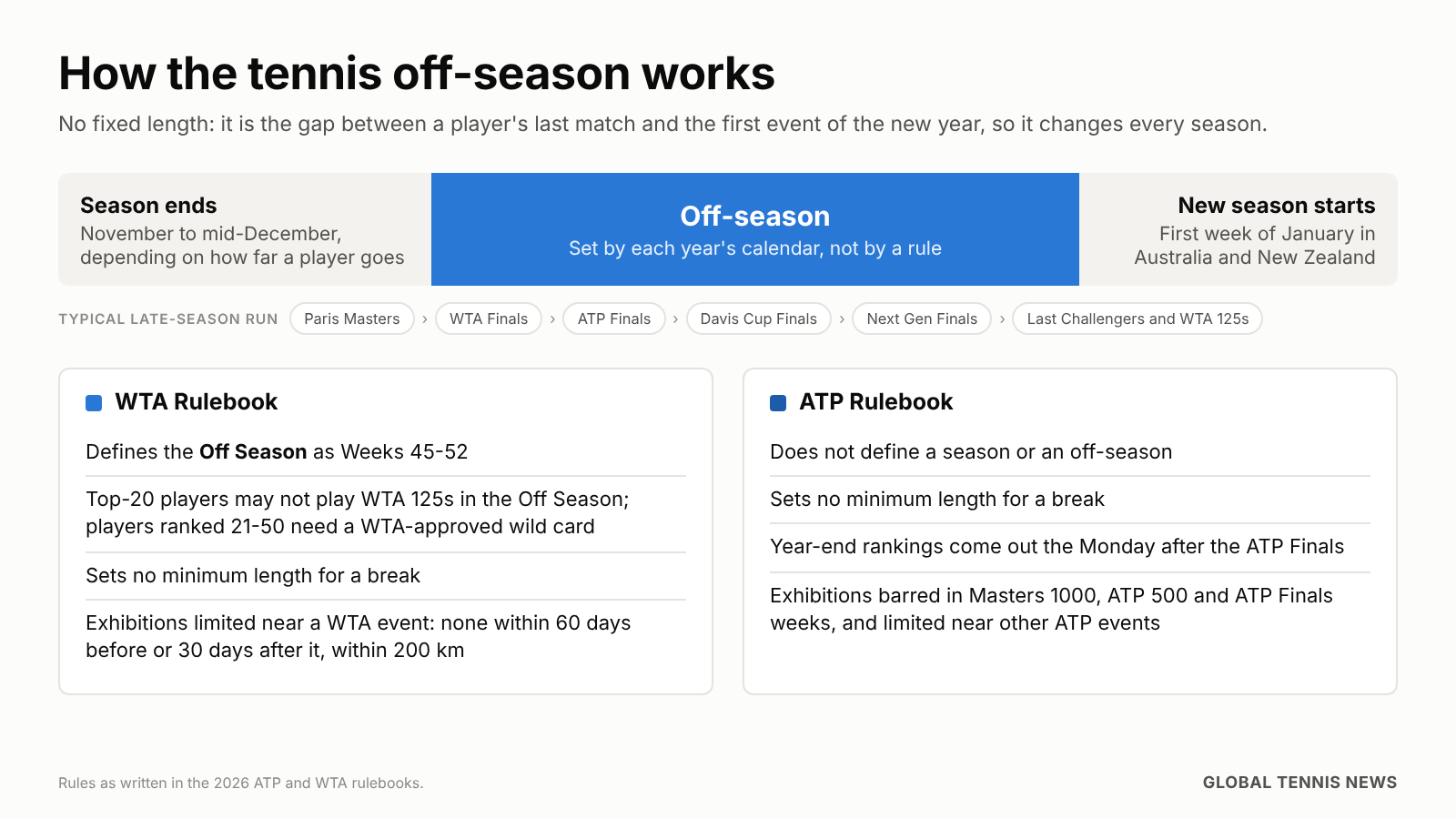
Tennis has no fixed off-season. Neither tour sets a minimum length for one, the ATP Rulebook never defines it, and the WTA Rulebook uses the term mainly to decide who may play its smaller events in November and December. What players get in practice is the gap between their last match of one season and their first of the next.
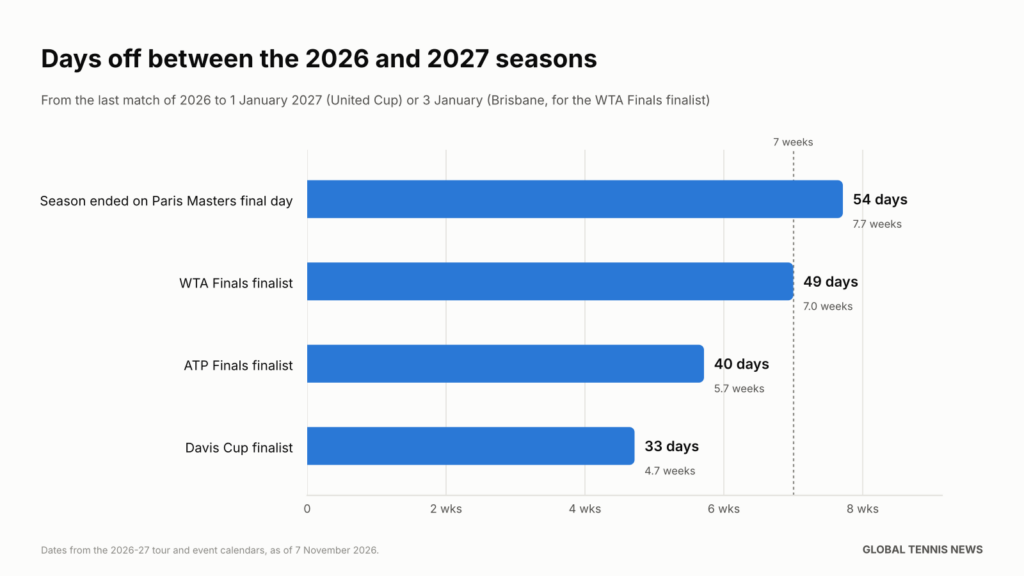
For the leading players that gap is short. On the 2026-27 calendar, a man who plays the Davis Cup final on 29 November and the United Cup on 1 January gets 33 days. A woman whose season ends at the WTA Finals on 15 November gets about seven weeks before Brisbane. The dated calendar is in the snapshot at the end of this explainer; the rules that shape it are below.
What the WTA Rulebook Means by Off Season
The WTA Rulebook defines the Off Season as “Weeks 45-52”, the last eight weeks of the calendar. On the 2026 calendar that is the week of the WTA Finals, from 9 November, to the week of 28 December. The definition matters most for the WTA 125 events that keep running after the Finals:
- Players ranked 1-20 may not play an Off Season WTA 125.
- Players ranked 21-50 may play only on WTA-approved wild cards, with a maximum of four such players per event across singles and doubles. Each Off Season WTA 125 receives two “WTA 125 Exemption Wild Card” spots.
- Every player has one extra excused withdrawal in singles and one in doubles for a WTA 125 held in November or December.
The rulebook sets no minimum number of weeks off. The WTA’s year-end rankings are processed immediately after the WTA Finals, so the WTA 125 results that follow go into the rolling rankings but cannot change the year-end order.
What the ATP Rulebook Says
The ATP Rulebook has no definition of a season or an off-season, no minimum length for a break, and no index entry for either. It refers to the “calendar year” and the “ATP Tour circuit year” without defining them. What it does fix are the dates around the end of the year:
- The year-end PIF ATP Rankings are published on the Monday after the Nitto ATP Finals. In 2026 that is 23 November. Our year-end No. 1 explainer covers how the top spot is decided, and the women’s equivalent is in our WTA year-end No. 1 explainer.
- Qualification for the ATP Finals closes after the Paris Masters, and results from ATP Tour events in the week after Paris count towards the next year’s Finals, as set out in our ATP Finals cutoff explainer.
- The rankings run on a rolling 52 weeks, so a Challenger played in December counts like any other result. Points from the ATP Finals are the exception: they drop on the Monday after the last ATP Tour event of the following year. The timing is covered in our explainer on when ATP ranking points drop.
The men’s calendar also runs well past Turin. The ATP Challenger Tour schedules events up to week 50 and no later, and the Next Gen ATP Finals are played in December.
Exhibitions
Neither tour has an exhibition rule written for the off-season. Both regulate exhibitions by distance and dates from their own events, and the windows reach back into December.
ATP. The rule on special events applies to players in the top 30 at a fixed date the previous November. A player may not play an exhibition in the week of a Masters 1000, an ATP 500 or the Nitto ATP Finals, or in the week of any ATP Tour or Challenger event he has entered. Exhibitions near an ATP event, within 100 miles or 160 kilometres or in the same market area, are also restricted around those weeks, including the period of an ATP 250. A player can ask the ATP chief executive for an exemption. A breach is treated as a Major Offense.
WTA. A player may not play an exhibition in the same week as a WTA 1000, WTA 500 or WTA 250 event, including the WTA Finals. She also may not play one within 60 days before or 30 days after such an event if it is within 125 miles or 200 kilometres of the site or in the same market area. That 60-day window covers December exhibitions held near the January events in Australia and New Zealand. A Grand Slam can promote an exhibition on the weekend before its main draw. Breaches carry automatic fines of $100,000 for a top-10 player, $75,000 for players ranked 11-20, $50,000 for 21-35 and $25,000 for 36-50, and the WTA chief executive can grant a waiver.
Events such as the Six Kings Slam sit outside both tours; how one works is in our Six Kings Slam explainer.
Will the Off-Season Get Longer?
The ATP has said it should. “At the moment the off-season is a bit too short,” Andrea Gaudenzi, the ATP chairman, said during the 2025 Finals. “I do believe players need at least seven weeks off.” He added: “The year has 52 weeks and we’re not going to change that,” and “You don’t have to play week one and two.”
The ATP’s plan for 2028 does not set a longer break. It is built around dedicated weeks for each tournament category and changes to how results count, and the final package is due to be considered at the ATP’s year-end meetings in Turin. What it changes is in our ATP 2028 plan explainer.
Frequently Asked Questions
How long is the tennis off-season? It depends on when a player’s season ends. On the 2026-27 calendar it is about five weeks for a man who plays the Davis Cup final, about six for one whose season ends at the ATP Finals, and about seven for a woman whose season ends at the WTA Finals.
Is there a minimum off-season in tennis? No. Neither the ATP nor the WTA Rulebook sets one.
Do tournaments in December count for the rankings? Yes. ATP Challengers and WTA 125s in November and December count in the 52-week rankings. WTA 125 and ITF results never count in the Race to the WTA Finals, as our Race to the WTA Finals explainer sets out.
Can players play exhibitions in the off-season? Yes, within each tour’s distance and date limits around its own events.
2026-27 Calendar Snapshot (as of 7 November 2026)
| Event | 2026-27 dates |
|---|---|
| Rolex Paris Masters, last event counting for Turin | 2-8 November |
| WTA Finals, Indian Wells | 8-15 November |
| Nitto ATP Finals, Turin | 15-22 November |
| ATP year-end rankings published | 23 November |
| Davis Cup Final 8, Bologna | 24-29 November |
| Next Gen ATP Finals, Reggio Calabria | 9-13 December |
| Last WTA 125 (Limoges) and last ATP Challenger week | Week of 14 December |
| United Cup, Perth and Sydney | 1-10 January 2027 |
| Brisbane (WTA 500) | 3-10 January |
| Auckland (WTA 250 / ATP 250) | 4-10 January / 11-16 January |
| Australian Open main draw | from 17 January |
- Davis Cup final (29 November) to the United Cup (1 January): 33 days.
- ATP Finals final (22 November) to 1 January: 40 days.
- WTA Finals final (15 November) to Brisbane (3 January): 49 days.
- Paris Masters final (8 November) to 1 January: 54 days, for a player who does not go to Turin, Bologna or the late-season events.
The Davis Cup format is in our Davis Cup Final 8 guide, and the first Grand Slam of 2027 is in our Australian Open guide.
This snapshot is dated and will change. The career record above does not.