

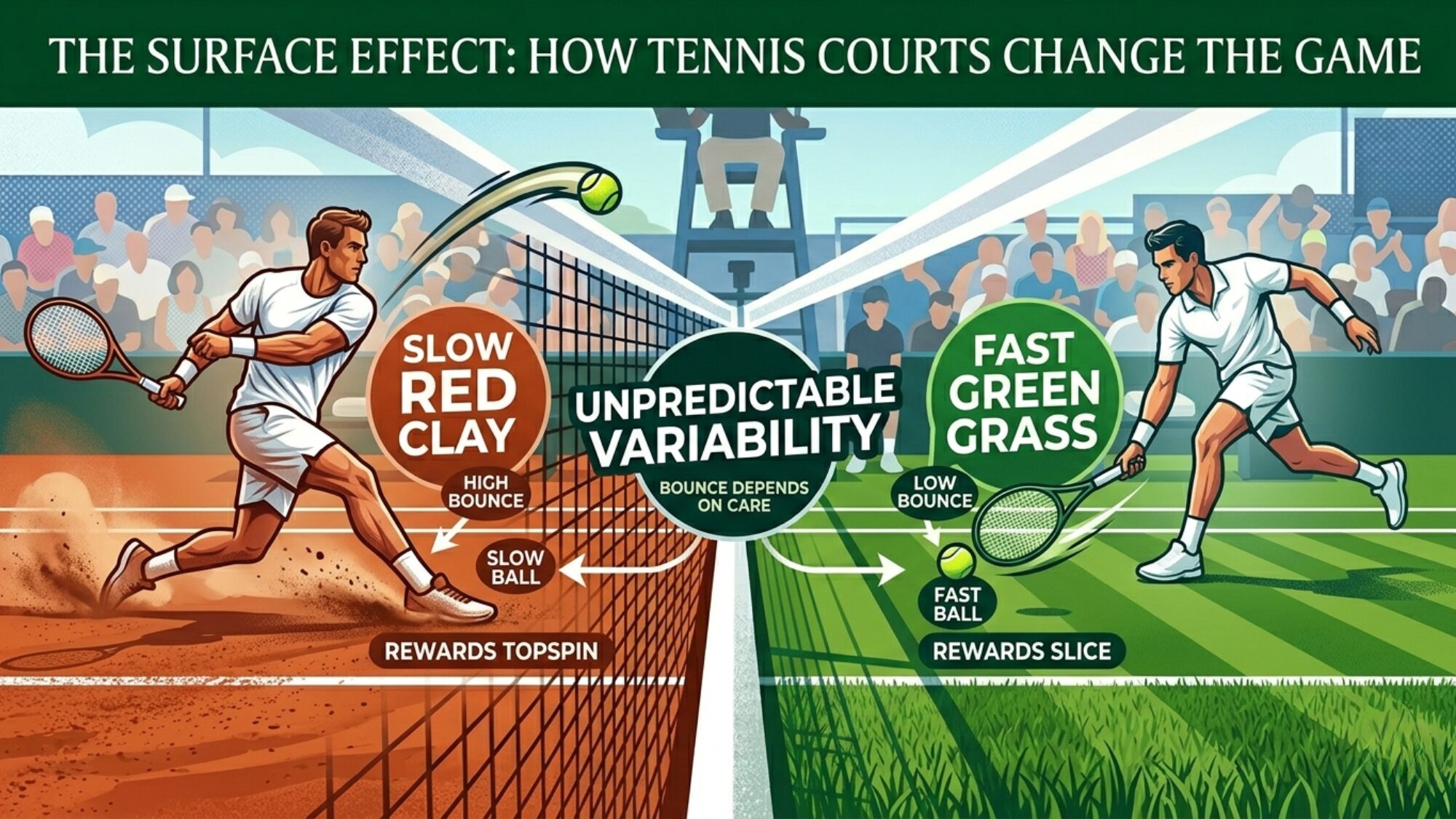
Walk into any tennis facility in the world and you might notice something that doesn’t exist in most other sports: the playing surface itself is a variable. A basketball court is a basketball court. A football field is a football field. But a tennis court can be made of grass, clay, hard acrylic, carpet, or any number of synthetic materials — and each one produces a fundamentally different game.
This isn’t a cosmetic difference. The surface a match is played on affects the speed of the ball, the height and predictability of the bounce, the physical demands on the players, and the tactical approaches that succeed.
A player who dominates on clay may struggle on grass. A serve that is nearly unreturnable on a fast hard court becomes manageable on a slow red surface. Understanding court surfaces is understanding why the same sport can look so different from one tournament to the next.
Why Surfaces Matter: The Physics of the Bounce
Before breaking down each surface type, it helps to understand what’s actually changing when a ball lands on different materials.
Two variables govern how a tennis ball behaves after it bounces: speed and height. A fast, low bounce gives the returner less time to react and a more awkward contact point. A slow, high bounce gives the returner more time but produces a heavier ball that is harder to generate pace from. These two variables — pace and bounce height — interact differently on every surface, and they determine which playing styles thrive and which struggle.
A third variable is consistency. On some surfaces, particularly well-maintained hard courts, the bounce is highly predictable — the ball does roughly what physics says it should. On others, particularly grass and worn clay, the bounce can be irregular, rewarding players who can improvise and punishing those who rely on precise positioning.
The Three Major Surface Types
Professional tennis is contested on three primary surface categories: clay, hard court, and grass. Each has its own physical properties, its own Grand Slam, and its own strategic demands.
Clay Courts
Clay is the slowest major surface in tennis, and it produces the most physical, baseline-dominated style of play found anywhere in the professional game. The surface itself is typically made of crushed brick, shale, or stone — the distinctive red you see at Roland Garros in Paris, the most famous clay court event in the world. Some clay courts use a green surface, common in parts of South America and in the US, but the playing characteristics are broadly similar.
When a ball bounces on clay, it slows down significantly and kicks up higher than on any other surface. That high, looping bounce is the defining feature of clay court tennis. It neutralizes pace — a flat, hard-struck ball loses much of its speed through the clay and sits up at a comfortable height for the returner.
It rewards topspin — heavy topspin shots kick up even higher off clay, pushing opponents further behind the baseline and making the court feel larger. And it punishes flat, serve-dominant styles — a big serve that wins free points on faster surfaces becomes manageable on clay because the bounce slows the ball enough for even good returners to get it back.
Clay also produces the most physically demanding tennis of any surface. Rallies are longer, points take more time to develop, and the grinding, repetitive nature of baseline exchanges puts enormous strain on legs and lungs.
The clay court season — which peaks in the spring buildup to Roland Garros — is widely regarded as the most grueling stretch of the professional calendar.
What succeeds on clay: Heavy topspin forehand, strong movement and court coverage, physical endurance, consistent baseline play, high first-serve percentage over raw pace.
Who historically dominated clay: Rafael Nadal’s 14 Roland Garros titles make him the most dominant clay court player in history. Bjorn Borg, Gustavo Kuerten, and Arantxa Sánchez Vicario are among the all-time clay specialists.
The clay Grand Slam: Roland Garros (French Open), Paris, France. Played late May through early June.
Hard Courts
Hard courts are the most widely played surface in the world, used in recreational facilities, public parks, schools, and professional venues across every continent. The surface is typically made of asphalt or concrete with an acrylic coating — the blue you see at the Australian Open and US Open, or the variety of colors used at other hard court events.
Hard courts sit in the middle of the speed spectrum, though within that category there is meaningful variation. The Australian Open’s surface plays slightly faster than the US Open’s, for example.
Tournament organizers can influence pace by adjusting the granule size in the surface coating — a finer texture produces a faster court, a coarser one slows the ball down. Both Australian Open courts and US Open courts are classified as hard, but they don’t play identically.
The bounce on a hard court is the most predictable and consistent of any major surface. The ball does roughly what you expect — a flat shot stays low, a topspin shot kicks up moderately, a slice shot stays low and skids through. That consistency rewards technically clean ball-striking and precise court positioning.
There are fewer free points from a bad bounce, fewer lucky errors from an unpredictable surface. Players who thrive on hard courts tend to be complete, all-around competitors — strong from the baseline, capable at the net, and reliable on serve.
Hard courts also take a significant physical toll, particularly on joints. The unforgiving rigidity of asphalt or concrete transmits impact force directly through the feet, knees, and hips. Many players cite hard courts as the surface most associated with chronic injury accumulation over a long career.
What succeeds on hard courts: All-around game, reliable serve, clean ball-striking, flat and topspin groundstrokes, net approaches on shorter balls.
Who historically dominated hard courts: Novak Djokovic has won more hard court Grand Slams than any active player. Serena Williams, Andre Agassi, and Pete Sampras were defining hard court champions of their respective eras.
The hard court Grand Slams: Australian Open (Melbourne, January) and US Open (New York, August–September).
Grass Courts
Grass is the oldest surface in tennis — the sport was invented on it — and it remains the most distinctive, the most prestigious in the sport’s historical imagination, and the most difficult to maintain. Natural grass courts require constant care, are vulnerable to weather, and deteriorate visibly over the course of a tournament as the surface wears down from repeated play.
Grass produces the fastest conditions in professional tennis. The ball skids through low and quickly after the bounce, staying close to the surface rather than kicking up. That low, fast bounce fundamentally changes the game in two ways: it rewards serve-and-volley tactics, and it makes the return of serve significantly more difficult.
A well-struck serve on grass has very little time in the air and bounces before the returner can set their feet properly, leading to the highest ace counts and the highest percentage of serve-dominated points of any surface.
The nature of grass also introduces an element of surface irregularity that doesn’t exist on hard courts. Early in a tournament the court is well-maintained and plays relatively true. By the later rounds, particularly in high-traffic areas near the baseline, the grass wears down and the surface becomes patchier — producing occasional unpredictable bounces that reward improvisation. This is one of the reasons grass is considered the most skill-testing surface for returners.
The grass court season is the shortest on the professional calendar, concentrated in a few weeks in June and July leading up to Wimbledon. Many players never fully adapt to it. A select few — most notably Roger Federer with eight Wimbledon titles — made it their definitive domain.
What succeeds on grass: Big serve, serve-and-volley tactics, slice backhand (which stays low on grass), flat groundstrokes, quick net approaches, strong volleying.
Who historically dominated grass: Roger Federer’s eight Wimbledon titles are the most in the Open Era for men. Martina Navratilova won nine Wimbledon singles titles. Pete Sampras, Boris Becker, and Steffi Graf were dominant grass court champions across different generations.
The grass Grand Slam: Wimbledon, London, England. Played late June through early July.
Indoor and Carpet Courts
Beyond the three major outdoor surfaces, professional tennis is also played indoors on a variety of surfaces — most commonly a hard court variant, but historically also on carpet. Carpet courts — low-pile synthetic surfaces stretched over a hard base — were once common on the indoor European circuit in the autumn and produced extremely fast conditions similar to or faster than grass.
Carpet has largely disappeared from the professional tour over the past two decades, replaced by indoor hard courts, but you may encounter references to it in historical match records.
Indoor hard courts, by removing the wind variable and producing consistent lighting, tend to reward flat, aggressive ball-striking even more than outdoor equivalents. Serve-and-volley tactics see a modest resurgence indoors for the same reason — the conditions are controlled, the bounce predictable, and the serve holds even more authority without wind disruption.
How Surfaces Shape the Professional Calendar
The professional tennis calendar is structured around surface transitions, and those transitions shape the competitive narrative of each season. The year broadly divides into four phases:
Hard court season (January–February): The year opens in Australia and the surrounding Asian-Pacific hard court events. The Australian Open is the first Grand Slam, and the hard courts reward the players who have maintained their fitness through the offseason.
Clay court season (April–June): After a brief grass warm-up that rarely features major events, the circuit shifts almost entirely to clay through April and May, building toward Roland Garros. This is the longest sustained surface block of the year and the one that most dramatically reshuffles the competitive order — clay specialists rise, hard court specialists sometimes struggle.
Grass court season (June–July): The shortest block of the year, beginning almost immediately after Roland Garros concludes. Players have as little as two weeks to transition from the slowest major surface to the fastest. Wimbledon is the only Grand Slam on grass, making it the most surface-specific of the four majors.
Hard court season (August–November): The North American hard court swing — including the US Open — and the indoor European autumn circuit close out the year. Players are often managing accumulated fatigue, and the hard court conditions once again favor complete, all-around competitors.
Surface Specialists vs. All-Court Players
One of the most compelling narratives in professional tennis is the tension between surface specialists and all-court players. A surface specialist builds their game almost entirely around the demands of one surface — heavy topspin and grinding baseline endurance for clay, a massive serve and flat groundstrokes for grass. They may win the Grand Slam on their preferred surface repeatedly but struggle to go deep on the others.
An all-court player — the rarer and generally more celebrated type — can compete at the highest level regardless of surface. Novak Djokovic, who has won all four Grand Slams multiple times, is the definitive modern all-court player.
Roger Federer was dominant on grass and hard courts and won Roland Garros once. Rafael Nadal, primarily a clay specialist, also won the Australian Open twice and the US Open four times — evidence that the greatest players transcend their preferred surfaces even if they don’t dominate equally across all of them.
The all-court debate is one of the richest ongoing conversations in tennis: is it more impressive to win 14 titles on one surface, or to be consistently excellent across all three? There is no consensus answer, which is exactly what makes it worth arguing about.
What to Watch For: Reading the Surface in Real Time
Once you understand how surfaces work, you can read a match differently in real time. Here’s what to look for:
Pace of rallies. On clay, even powerful players engage in extended exchanges. On grass and fast hard courts, rallies are shorter and serve dominance is higher. If you’re watching a match and points are ending quickly — mostly on serve or within one or two shots of the return — you’re watching a fast surface.
Serve statistics. Ace counts and first-serve points won tell you how much the surface is rewarding the server. Grass and indoor hard courts produce the highest ace counts. Clay produces the lowest. If a player is hitting 20 aces in a match, the surface is doing significant work.
Bounce height. Watch where the ball sits when a player strikes their groundstrokes. On clay, baseline players often hit the ball above shoulder height — the high-kicking bounce forcing them back and up. On grass, players are often hitting the ball below knee height, crouching to deal with the skidding low bounce.
Net approaches. On fast surfaces, particularly grass, watch for players stepping in behind short balls and closing to the net. On clay, net approaches are riskier because the slower surface gives the opponent more time to pass. A player who approaches the net frequently on clay is either very confident in their volleying or making a tactical mistake.
Player rankings versus surface results. World rankings are based on points accumulated across all surfaces. Pay attention to where individual players rank among surface-specific specialists — a player ranked 30th in the world but known as an elite clay court performer may be a legitimate threat at Roland Garros regardless of their overall number.
Key Terms at a Glance
- Clay — The slowest major surface; high, heavy bounce; rewards topspin and endurance. Signature event: Roland Garros.
- Hard court — The most common surface; medium pace; predictable bounce; rewards all-around play. Signature events: Australian Open, US Open.
- Grass — The fastest major surface; low, skidding bounce; rewards serve and net play. Signature event: Wimbledon.
- Surface speed — How quickly the ball travels through the court environment, factoring in bounce height, pace absorption, and friction.
- Topspin — Forward rotation on the ball that causes it to bounce higher and kick more sharply — most effective on clay.
- Slice — Backspin on the ball that causes it to stay low after the bounce — most effective on grass.
- Serve-and-volley — A tactic where the server follows their serve to the net immediately, used most on fast surfaces.
- Surface specialist — A player whose game is optimized for one surface type.
- All-court player — A player capable of competing at a high level on all three major surfaces.
- Grand Slam — One of the four most prestigious tournaments: Australian Open, Roland Garros, Wimbledon, US Open — each played on a different surface (two on hard courts).
The Surface Is Part of the Story
Tennis is unusual among major sports in asking its players to be adaptable in a way that goes beyond tactics or fitness. The surface literally changes the physics of the game. A player who has spent months perfecting their clay court baseline patterns must essentially relearn how to trust their instincts when they step onto grass two weeks later. The best players in the world make this transition look seamless. It never actually is.
That adaptability — the ability to read a surface, adjust your game, and compete at the highest level regardless of what’s beneath your feet — is one of the least appreciated skills in professional tennis.
When you watch a clay court specialist win a tiebreak on grass, or a grass court serve-and-volleyer grind out a five-set clay court win, you’re watching something genuinely difficult being made to look straightforward.
The court is never just the court. It’s an active participant in every match played on it. Now you know how to read it.
Part of the Tennis 101 series. Previous: Understanding the Tiebreak — When Sets Go to 6–6. Next: How Tennis Tournaments Work — Draws, Seeds, and the Road to a Championship.