

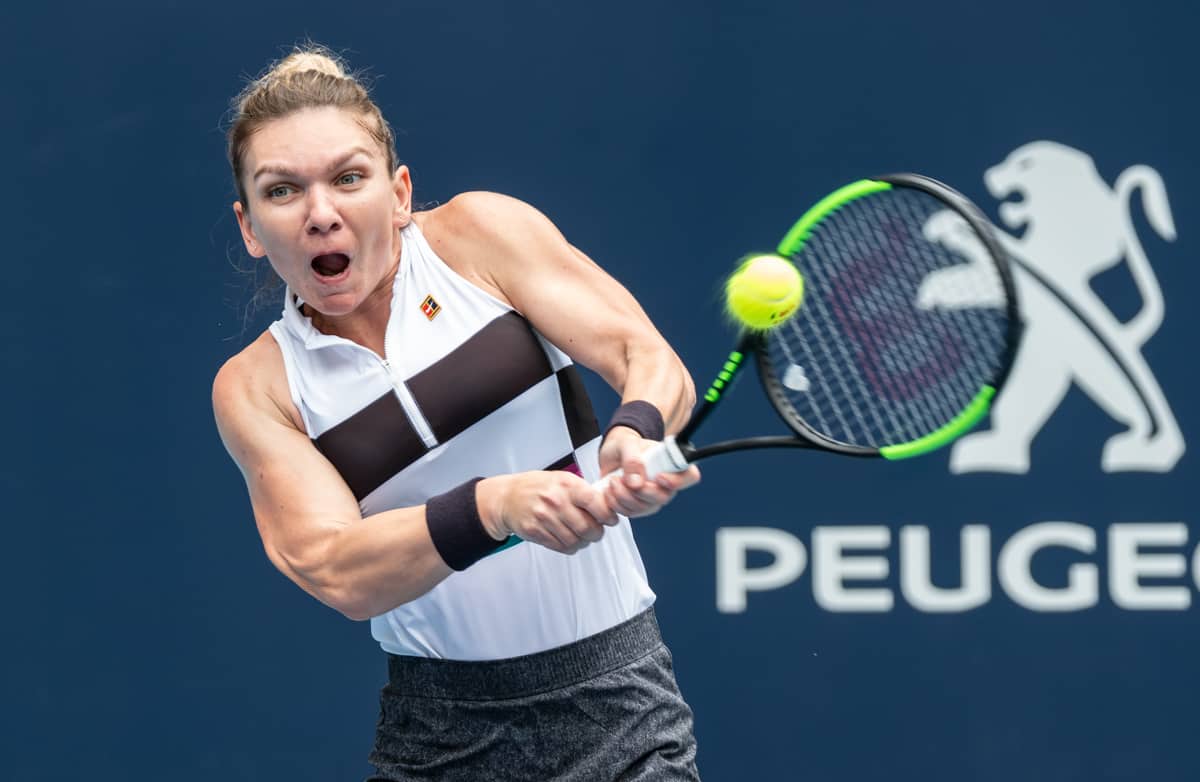
Simona Halep’s professional tennis career has officially reached its end, closing the chapter on one of the most successful and complicated careers in modern women’s tennis.
The former world No. 1 and two-time Grand Slam champion announced her retirement after losing in the first round of the Transylvania Open in Cluj-Napoca, Romania, where she fell 6-1, 6-1 to Italy’s Lucia Bronzetti. The result itself quickly became secondary. Playing in front of a home crowd, Halep used the moment to say goodbye to the sport that had defined most of her life.
For Romanian tennis, it was a deeply symbolic ending. Halep did not retire quietly through a social media post or a distant statement. She chose to do it on court, in Romania, in front of fans who had followed her from a promising junior to one of the most respected players in the world.
Halep, 33 at the time of her announcement, said her body could no longer handle the physical demands required to return to the level she once reached. Knee and shoulder problems had already delayed the start of her 2025 season, and her comeback had been limited since her return from suspension in 2024.
The decision ended a career built on movement, discipline and relentless consistency. Halep was never the biggest hitter on tour, but at her peak she was one of its hardest players to break down. She turned defense into pressure, chased down balls few players could reach and built points with a mix of patience and controlled aggression.
Her greatest breakthroughs came after years of near misses. Halep lost her first three Grand Slam finals, including two at Roland Garros, before finally winning the French Open in 2018 by defeating Sloane Stephens. One year later, she produced perhaps the finest performance of her career at Wimbledon, beating Serena Williams in the final to claim her second major title.
That Wimbledon victory became the image many fans will remember most: Halep playing fast, clean and fearless tennis on Centre Court against one of the greatest players in history. It was the perfect expression of her game at its sharpest.
Across her career, Halep won 24 WTA singles titles and spent 64 weeks as the world No. 1. She also finished as the year-end No. 1 in 2017 and 2018, becoming a national sporting icon in Romania and one of the defining players of her generation.
Her final years, however, were marked by turmoil. Halep was provisionally suspended in 2022 after testing positive for roxadustat, a banned substance. She denied knowingly taking the substance and argued that the positive test came from a contaminated supplement. A four-year ban was later reduced by the Court of Arbitration for Sport to nine months, clearing her to return to competition in 2024.
But the time away from the tour, combined with injuries, made a full comeback difficult. Halep played only a limited schedule after her return and was unable to rebuild the rhythm, fitness and confidence that had once made her one of the most consistent players in the sport.
Her retirement is therefore not only the end of a great career but also a reminder of how thin the margins are at the top of tennis. Halep’s game depended on elite movement, physical resilience and emotional intensity. Once those pieces were no longer there, she decided not to continue chasing a version of herself she knew may no longer be possible.
Still, Halep leaves tennis with a legacy that goes far beyond the difficult final chapter. She was the first Romanian woman to reach world No. 1, a French Open champion, a Wimbledon champion and a player who inspired a generation of Romanian athletes.
Her goodbye in Cluj-Napoca was emotional because it carried the weight of everything that came before it: the titles, the pressure, the controversy, the injuries and the bond with a country that treated her as more than a tennis player.
For Halep, the ending came sooner than many expected. But the career itself remains one of the most significant of the WTA era.