

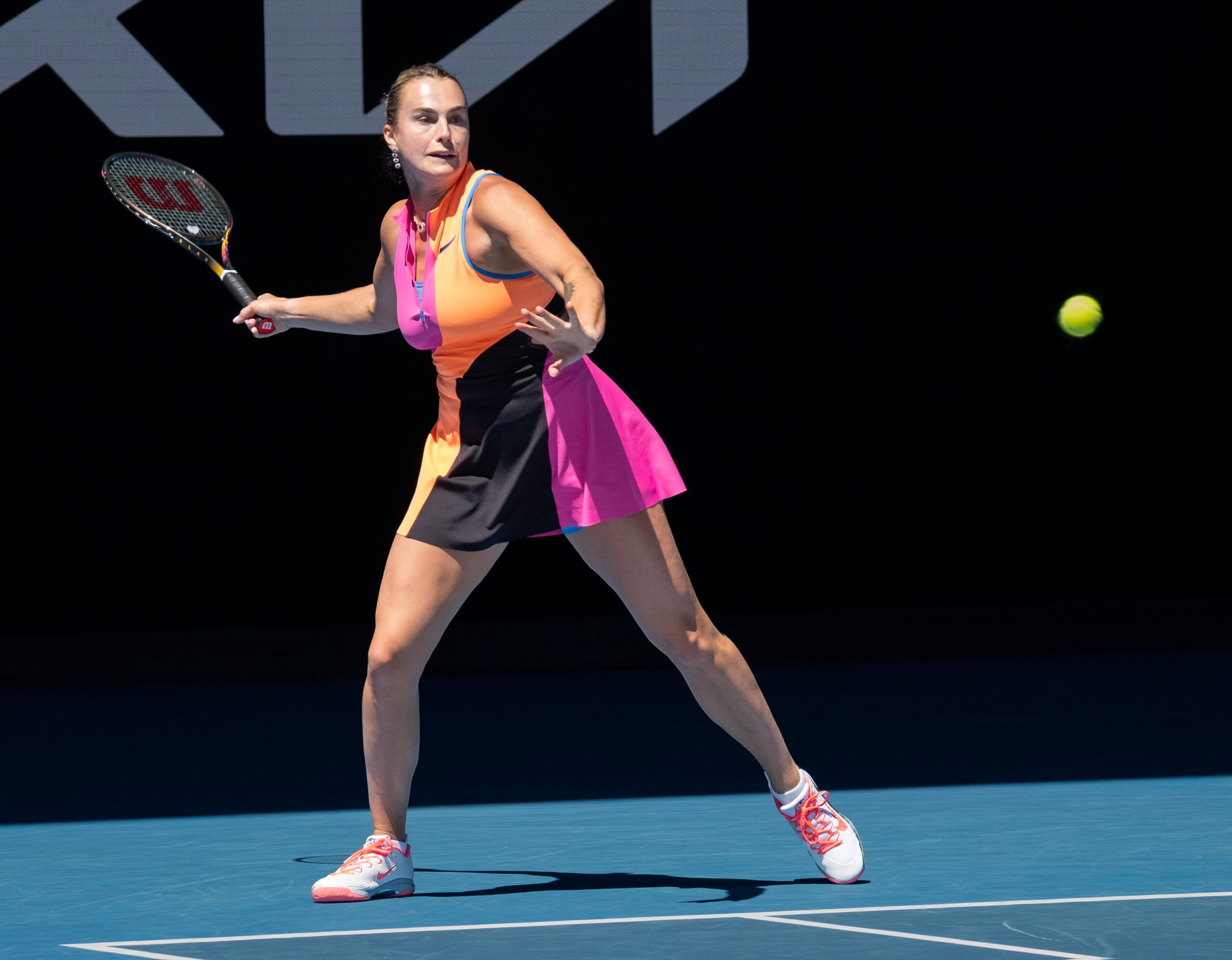
Aryna Sabalenka began her 95th consecutive week as the world’s top-ranked woman on Monday, moving past Steffi Graf on the all-time list of longest uninterrupted reigns. The timing is hard to improve on. The same ranking release that lifted her past one of the sport’s foundational marks also left her nearer to losing the position than at any point in the run itself.
The streak now clears the 94 weeks Graf assembled in the second of her stints at the top, the longest of the German’s runs outside the 186-week span that remains the women’s record. Four individual streaks still sit above it: the 186 weeks Graf and Serena Williams share, Martina Navratilova’s 156, Ashleigh Barty’s 114 and Chris Evert’s 113. Sabalenka has held the ranking without interruption since Oct. 21, 2024, when she displaced Iga Swiatek, and her career total passed 100 weeks last month.
What makes the milestone worth examining rather than simply recording is Elena Rybakina, who has spent the summer closing a gap that looked settled in March. Sabalenka went out in the round of 16 in Toronto to Ekaterina Alexandrova, 7-6(3), 4-6, 6-4, a result that stopped her extending a lead she had spent the spring building and handed the week to a player who has never held the top ranking.
The arithmetic is unusually tight. Sabalenka sits on 8,670 points in the live rankings, having banked 120 for reaching the last 16. Rybakina moved to 7,881 by reaching the quarterfinals, though that figure already absorbs the 390 she surrendered from last year’s semifinal run in Canada. Strip out what she has earned this week and her base is 7,666. A title in Toronto adds 1,000 and carries her to 8,666 — four points behind, and the narrowest margin at the top of the women’s game in years.
Anything short of the trophy leaves the distance materially wider, which is why Tuesday’s quarterfinal against Naomi Osaka carries more than its place in the draw. The two have never met on tour. Rybakina reached it by recovering from 0-3 down in the deciding set against Liudmila Samsonova, a match that took her 2 hours, 49 minutes and turned on a run of four straight games.
Rybakina has been careful not to treat the ranking as a target. “I try not to think about it,” she said, framing the week around whether the work of recent months is showing up in her tennis rather than around a number she has never reached.
The Cincinnati Open follows immediately, and it is the smaller of the two remaining checkpoints. Rybakina reached the quarterfinals there last year and beat Sabalenka at that stage, so neither player carries a heavy defense into Ohio and neither can gain decisively. That leaves New York, where the imbalance becomes severe. Sabalenka is defending 2,000 points and a title she has won in each of the last two years, the largest single block anyone in the women’s game is carrying into the closing months. Rybakina has comparatively little exposed.
The form question sits underneath all of it. Sabalenka has not won a tournament since completing the Sunshine Double in Miami in late March, and has reached one semifinal in her last six events. That is a thin recent record for a player whose ranking has been built on relentlessness rather than on peaks, and it arrives three weeks before the fortnight that will decide whether the streak survives the season.
The list Sabalenka joined on Monday is populated by players whose reigns ended when a single rival finally sustained a full season against them. Graf’s first run ended that way. So did Evert’s. The record she passed this week measures how long she has held on, and it has never been in question. What the next month establishes is whether the number keeps moving, and the answer to that is now, for the first time since October 2024, genuinely open.